Skip to content
Your child is at school, your phone rings, and a CPS investigator says there is an allegation against you. Before the call ends, you are already making decisions that can shape the entire case. That is why parents need to understand one point early. A motion to dismiss cps case texas is not just a form to file after months of litigation. It is a strategic tool, and its value depends heavily on timing.
In the right case, a motion to dismiss forces CPS to prove more than suspicion. It can target a thin affidavit, challenge a removal that did not meet legal standards, or test whether the agency has enough admissible evidence to keep pressing forward. I tell parents this often. The same motion can be weak on day ten, strong after the adversary hearing, and even stronger once CPS commits itself to facts that do not hold up under scrutiny.
Many parents assume dismissal is something that happens only at the end of a long case. Texas law does allow earlier attacks, but filing too soon can waste a good argument. Waiting too long can let a weak case gain momentum. The better approach is to match the legal ground to the stage of the case, then decide whether immediate pressure or a more developed record gives you the best chance in court.
That decision is rarely simple. Some cases call for an early challenge to the removal or pleadings. Others require careful restraint while you gather records, identify witnesses, and pin CPS to a version of events the evidence does not support. The goal is not just to file a motion. The goal is to file it when the judge has a clear legal reason to end the case.
Your Family's Future is Worth Fighting For
A CPS case can make a decent parent feel like a defendant before anyone has heard the full story. One parent gets a call at work and learns a teacher made a report after a bruise showed up on a child who plays hard and falls often. Another opens the door to an investigator who says there are allegations of neglect because the home looked cluttered during a stressful week. By that evening, both parents are asking the same question. How do I get this case dismissed before it takes over my life?

The law doesn't guarantee a dismissal just because a parent feels wronged. It does provide real points of attack. A dismissal may be possible when CPS lacks enough evidence, when the agency relied on faulty procedures, or when the facts don't support continued intervention. That matters because fear often pushes parents into passivity. They comply with everything, say too much, sign papers they don't understand, and wait for someone else to fix it.
A motion to dismiss changes the posture of the case. Instead of reacting to CPS, you ask the judge to examine whether CPS has met the legal standard to keep the case alive.
That shift is important emotionally and legally. Once a parent understands there are deadlines, burdens of proof, and defects that can be challenged, the case becomes less mysterious. It becomes work. Serious work, but work that can be done carefully.
A result that offers real hope
Texas parents should know that courts can and do reject improper CPS action. In December 2019, the Supreme Court of Texas intervened in the Pardo family's case after CPS illegally removed their four-year-old child. CPS later dismissed the case entirely, even though the family still faced separate registry consequences afterward. That example matters because it shows courts will scrutinize removals and that strong legal action can reunite families.
What worried parents need most right now
If you're reading this in the middle of a CPS case, focus on three things first:
- Protect the record: Save every text, email, notice, school message, medical paper, and service-plan document.
- Slow down before speaking: Parents often hurt their own cases by guessing, speculating, or trying to be overly agreeable.
- Think strategically about timing: Filing a motion too early can waste a strong argument. Filing too late can let CPS reach trial before the issue is tested.
A dismissal doesn't come from outrage alone. It comes from matching the right legal ground to the right moment in the case.
Understanding the Grounds for Dismissal in Texas
Texas CPS dismissals are built on law, not sympathy. Judges want a clear legal basis rooted in the record. If you want the court to dismiss a case, you need to know what the judge is permitted to act on.
The court's deadline is real
The most important statutory protection in many CPS cases is the dismissal deadline tied to the court's jurisdiction over the case.
Under Texas Family Code §263.403, a court must dismiss a CPS case by the first Monday following the one-year anniversary of DFPS being appointed Temporary Managing Conservator, unless DFPS proves extraordinary circumstances that justify one 180-day extension. The DFPS handbook explains that framework in its discussion of dismissal dates, extensions, and monitored return rules.
That rule matters because it keeps cases from staying open indefinitely. It also provides parents with an advantage. If CPS can't finish the case properly within the allowed time, dismissal becomes mandatory unless the agency meets the legal standard for the limited extension.
Common legal grounds parents raise
Dismissal arguments usually fall into a few categories. Some attack the case from the beginning. Others develop as the case moves forward.
- Insufficient evidence: CPS still bears the burden to prove the legal basis for removal, conservatorship, or termination. If the proof doesn't hold up, dismissal becomes a live issue.
- Procedural defects: If the removal paperwork, notice, or hearing process doesn't satisfy the law, the case can be vulnerable.
- Contradictory evidence: School records, medical records, witness statements, and other documents may directly undercut the allegations.
- No current safety basis for continued involvement: Even if an investigation started with concern, a case can weaken when the record no longer supports ongoing state intrusion.
Parents looking for a fuller discussion of the patterns behind dismissal can review this explanation of why CPS cases get dismissed and what outcomes follow.
Chapters 262 and 263 matter in plain English
Chapter 262 generally governs removal and emergency intervention. Chapter 263 governs the court process after removal, including hearings, status reviews, permanency settings, and dismissal deadlines. For a parent, the practical takeaway is simple. CPS doesn't get to remove a child and then coast. The agency has to justify what it did and keep justifying continued court involvement as the case unfolds.
Practical rule: A weak case at removal doesn't always stay weak. A weak case can harden if a parent gives CPS new problems to document.
That is why dismissals often turn on both law and behavior. A parent may have a strong legal argument, then undermine it by missing services without explanation, failing drug tests, or sending hostile messages that CPS later offers to the court. On the other hand, a parent with a rough start may improve the record enough to support dismissal later.
What doesn't usually work
Some arguments feel powerful to parents but don't move judges much on their own:
- Saying the allegation is unfair without proof
- Arguing CPS is lying without documents or testimony to back it up
- Relying on family members who are supportive but vague
- Waiting for the final hearing to raise problems that should have been challenged earlier
A dismissal motion succeeds when it gives the court a legal reason to act. That reason must be grounded in the statute, the procedure, or the evidence.
When to File Your Motion for Maximum Impact
Timing is where strategy matters most. The law may allow a motion before trial, but that doesn't mean every filing window is equally strong. In practice, parents and lawyers are making a strategic choice about what kind of dismissal argument they want to present.
The earliest window after removal
The case begins fast. Removal happens, and then the adversary hearing follows by Day 14. That early hearing is often the first serious chance to test whether CPS had enough to separate the family.
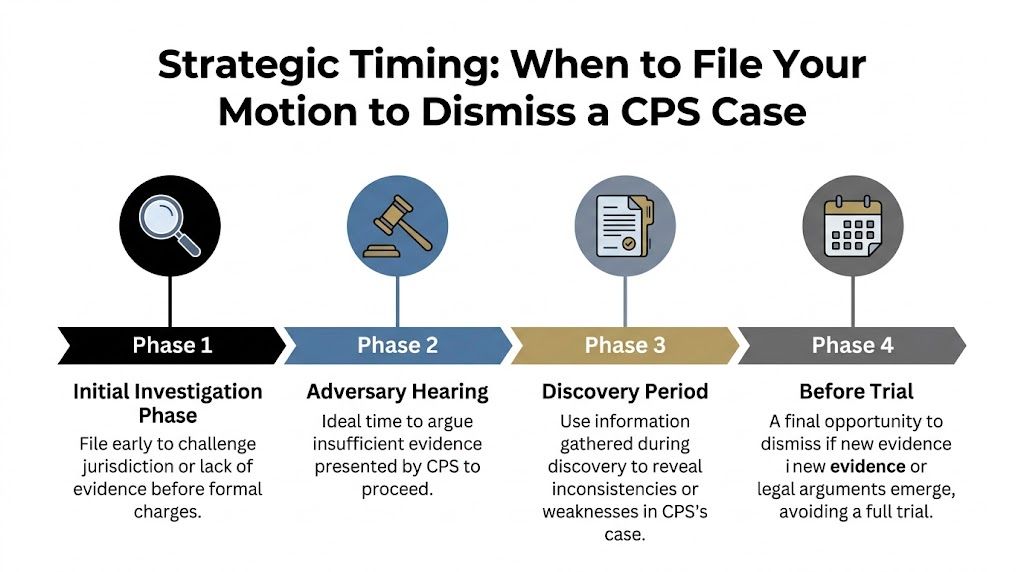
If your strongest argument is that CPS never had a legally sufficient basis to remove the child in the first place, early filing makes sense. The agency may still be relying on a thin affidavit, incomplete witness statements, or allegations that sound urgent but don't hold up under scrutiny.
Texas guidance on dismissal strategy recognizes a real timing issue. Motions can be filed before trial, but their effectiveness can differ depending on when the record is strongest. This discussion of CPS court hearings and timelines for Texas parents and guardians helps show why.
When early filing works best
- The affidavit is weak on personal knowledge
- The reported danger was speculative, not immediate
- There were less restrictive options than removal
- Key allegations can be disproved quickly with records
Early filing is often strongest when the case is front-loaded with error.
The middle of the case can create better facts
Some motions are stronger later, not sooner. That's especially true when the parent's best argument isn't "CPS never had a case" but instead "CPS no longer has a case worth continuing."
A parent who has completed evaluations, cooperated with reasonable requests, maintained clean and appropriate housing, stayed in contact with the child, and gathered favorable records may have a much better dismissal posture several months in. At that point, the court sees not just denials, but a documented pattern of stability.
Filing right after the adversary hearing can capitalize on a weak initial CPS presentation. Waiting can allow a parent to build a record of compliance that supports dismissal on a different ground.
This is the trade-off many families miss. Filing too soon can tip off CPS to defects it may be able to patch. Waiting too long can let the case drift toward trial. The right timing depends on whether your best evidence already exists or still needs to be built.
The period before the statutory deadline
There is also a late-stage strategy. Some cases survive longer than they should because everyone is busy complying, reviewing, and resetting settings. As the dismissal deadline approaches, the court and all parties become far more focused on whether CPS can finish the case. That pressure can sharpen dismissal arguments.
According to TexasLawHelp's overview of CPS timing, the case schedule leads to a final hearing or trial by about Day 360, with limited extension and monitored return complications in some cases. Their article on final hearing, dismissal, extension, or monitored return in CPS cases explains that framework.
Pros and cons by filing window
| Filing window | What may make it strong | What can go wrong |
|---|---|---|
| Right after the adversary hearing | CPS may still have a weak factual record | CPS may use the warning to shore up proof |
| Mid-case after compliance | You may have better documentation and favorable witnesses | The court may feel the case should continue a bit longer |
| Closer to final hearing | CPS must show it can carry the case to conclusion | Trial may begin before the motion gains traction |
A realistic example
Take a parent accused of medical neglect after a child misses follow-up care. If the missed appointment happened because the clinic rescheduled and the parent has records proving continued treatment, an early motion may work if the affidavit overstated the facts. But if the concern also involves missed school, unstable housing, and weak communication, a later motion may be better after the parent can show attendance records, lease documents, and steady compliance.
Both approaches can be correct. The mistake is thinking timing is just clerical. It isn't. Timing defines what argument the court is being asked to decide.
How to Draft and File Your Motion to Dismiss
A strong motion doesn't just say CPS is wrong. It shows exactly where CPS's proof fails and backs that challenge with organized documents. The most effective filings are built like trial binders in miniature. Facts, law, exhibits, and a clean theory of why the judge can dismiss now.
Start with a parallel investigation
CPS builds its case by collecting records and statements from institutions and people around your child. A dismissal motion should be built through a parallel investigation that looks at those same sources with a defense perspective. The point isn't to argue louder. The point is to produce better-supported facts.
The practical guidance on Texas CPS removal makes this clear. CPS often gathers school records, medical records, witness statements, criminal background material, and prior case history. A parent's legal team should gather the same records to identify contradictions and favorable interpretations. You can see that framework in this guide to the CPS removal process in Texas and the value of counter-evidence.
What to collect and why it matters
Some evidence refutes the allegation directly. Other evidence softens a harmful inference. Both can matter.
| Evidence to Support Your Motion to Dismiss | |
|---|---|
| CPS Allegation | Potential Counter-Evidence to Collect |
| Unsafe home conditions | Current photographs, repair receipts, lease documents, testimony from neutral visitors |
| Physical abuse | Pediatric records, doctor's note explaining accidental injury, coach or teacher observations |
| Neglect through school issues | Attendance explanations, school communications, counselor letters |
| Medical neglect | Appointment records, prescription history, discharge papers, provider statements |
| Failure to protect | Messages showing protective action, police reports, family safety plan documents |
| Substance use affecting parenting | Negative test results, treatment attendance, witness observations of caregiving |
A motion becomes much stronger when each allegation is paired with a document or witness who answers it.
Judges rarely dismiss a CPS case because a parent says, "That isn't true." Judges pay closer attention when the parent can say, "Here is the record that shows why it isn't true."
The motion itself needs a clear structure
Most dismissal motions should include these core parts:
- Caption and case information: The court, cause number, names of the parties, and title of the motion.
- Brief procedural history: When removal occurred, what hearings have happened, and where the case stands now.
- Specific factual challenge: What allegation or procedural defect makes dismissal appropriate.
- Legal basis: The statute, burden issue, or procedural rule supporting dismissal.
- Request for relief: Exactly what you want the court to do.
Sample language for the factual section
Respondent denies the allegations forming the basis of continued court intervention and shows that the Department's asserted safety concerns are not supported by the attached records, including school records, medical documentation, and witness statements.
Sample language for the legal request
Respondent requests that the Court dismiss the Department's suit because the record does not establish legally sufficient grounds for continued conservatorship and because the Department has failed to meet its burden under the applicable provisions of the Texas Family Code.
Those examples are general. A real motion should be specific to the exact hearing posture, the pleadings on file, and the evidence you can authenticate.
Filing mistakes that hurt good arguments
Parents often focus on the argument and forget the mechanics. Courts don't. A motion can lose force if it is incomplete, unsupported, or improperly served.
Watch for these practical issues:
- Missing exhibits: If you mention records but don't attach them, the judge may treat the motion as unsupported.
- Loose wording: Broad complaints about unfairness don't substitute for legal grounds.
- Poor chronology: If dates don't line up, even a strong point can lose credibility.
- Signature problems: If you are filing signed statements or declarations, make sure they are complete and correctly executed. If you're unsure how to properly sign a legal document, reviewing the basics can help you avoid preventable technical issues.
- Service failures: All parties entitled to notice must be served according to the rules and local practice.
Practical preparation before filing
Before the motion goes to the clerk, review it like opposing counsel would. Ask:
- What exact ruling am I asking for
- What record supports each factual statement
- Can the judge act on this now, or is more development needed
- Does this motion challenge the affidavit, the evidence, the timeline, or all three
- Is there any weakness CPS will immediately point out
A parent with counsel can also decide whether the motion should be paired with affidavits, records custodian documents, witness testimony, or a request for a hearing date. In some cases, that coordination matters as much as the legal writing.
Get the filing posture right
The same core facts can be framed in different ways depending on posture. At an early stage, the motion may attack the sufficiency of the removal basis. Mid-case, it may emphasize contradictory evidence and successful compliance. Near final hearing, it may focus on whether CPS has enough admissible proof left to proceed.
That is one reason many families choose representation rather than trying to draft alone. The legal issue is not just "Can I file a motion?" It's "What motion fits this record right now?"
Presenting Your Motion to the Judge
The hearing is where paperwork turns into persuasion. Judges read motions, but they also watch how parties present themselves, how clearly the issues are framed, and whether the parent's evidence directly answers the concerns that brought the case into court.
A motion to dismiss is often heard early, sometimes at the adversary hearing, when the court is testing whether removal was justified. TexasLawHelp notes that the CPS case runs on a strict schedule toward a final hearing by Day 360, and that the adversary hearing commonly becomes the first key setting where the judge evaluates whether the initial affidavit contains sufficient facts to support the removal. That means your presentation needs to challenge the affidavit directly, not wander into side issues.
What the judge usually wants to hear
A judge is often listening for a short chain of logic:
- What was the allegation
- What did CPS rely on
- What is missing or inaccurate
- What evidence now contradicts that claim
- What legal ruling should follow
That sounds simple, but parents under stress often do the opposite. They talk about everything at once. They start with how upset they are, then move to old family conflict, then describe CPS as unfair in general. The judge still needs a focused legal reason to dismiss.
Calm, specific testimony usually carries more weight than angry testimony, even when the parent has every reason to be upset.
A common courtroom scenario
A parent is accused of failing to cooperate because she missed a scheduled service appointment. CPS presents that missed appointment as proof she is disengaged. At the hearing, her side presents the clinic email showing the appointment was changed, screenshots of her response asking to reschedule, and a later attendance confirmation. Instead of arguing in broad terms that CPS is "twisting everything," the parent's case narrows the issue and corrects the record.
That kind of presentation can matter. It doesn't guarantee dismissal, but it builds credibility. Credibility matters in every CPS courtroom.
A short video can help you get more comfortable with what CPS litigation feels like in practice:
Courtroom habits that help
- Arrive organized: Bring your motion, exhibits, notes, and copies in a neat folder or binder.
- Answer only the question asked: Long answers often create new issues.
- Stay respectful to everyone in the room: Judges notice tone.
- Don't guess: If you don't know or don't remember, say so.
- Let documents do part of the work: Records often persuade better than emotion.
The best hearing presentation usually feels controlled. Not dramatic. Just prepared.
Why You Shouldn't Face CPS Alone
Parents can learn a lot about their rights, deadlines, and hearing structure. That knowledge helps. It usually isn't enough by itself. CPS cases move fast, involve overlapping statutes, and can shift from an emergency hearing to a long conservatorship fight before a parent fully understands what happened.
The hardest part isn't finding general information. It's applying law to a messy record with real consequences. A parent may have a valid dismissal argument but present it at the wrong time. Another may have excellent facts but fail to authenticate records or frame the motion in a way the court can act on. These are not small mistakes.
Why professional help changes the case
An experienced CPS attorney does more than write a motion. Counsel can evaluate whether to challenge the initial affidavit, whether the better strategy is to build compliance first, how to present contradictory records, and how to preserve issues if the court refuses relief.
Parents looking for legal representation in this area can review what a Texas CPS lawyer handles in child protective services cases. Some families also use support resources for document preparation and legal workflow coordination, including services connected to Hire Paralegals, when they are trying to stay organized around complex legal paperwork. Those tools can help with process, but they don't replace courtroom judgment.
A firm like Law Office of Bryan Fagan PLLC may fit for some families. The work typically includes reviewing removal documents, identifying procedural defects, building the evidentiary record, filing motions, and appearing at hearings where parental rights are at risk.
What self-representation often misses
- The record is always evolving: What helps today may hurt later if not handled carefully.
- CPS cases intersect with family law and sometimes criminal issues: A statement made in one setting can affect another.
- Procedure matters as much as emotion: Parents know their children. Lawyers know how to convert facts into rulings.
When your family is under CPS scrutiny, trying to handle everything alone can feel cheaper at first and far more costly later.
Frequently Asked Questions About Dismissing a CPS Case
What happens if the motion is denied
Denial doesn't mean the case is over for you. It usually means the court believes CPS has shown enough for the case to continue at that point. The next step is to reassess strategy. That may mean strengthening the evidentiary record, correcting compliance problems, challenging later developments, or preparing for the next major hearing.
Can CPS still pursue the case after a failed dismissal attempt
Yes. If the court denies the motion, the case generally continues under the normal schedule unless another order changes the posture. That's one reason timing matters. A weak early motion can educate CPS about where its proof is vulnerable.
Does a court dismissal automatically clear the abuse registry
Not always. The Pardo case is the clearest warning on this point. Even after CPS dismissed the court case, the family still faced placement on the state Child Abuse Registry. Court dismissal and registry consequences can be separate issues, so parents should ask specifically about both.
Can a case be dismissed even if CPS was involved for a while
Yes. Some dismissals happen because CPS never had enough evidence. Others happen after the facts develop and the case no longer supports continued intervention. The key is whether the legal and evidentiary basis still exists.
Should I file the motion myself
Some parents do, but many underestimate how technical these filings are. If the motion isn't matched to the hearing stage, supported by the right records, and presented clearly, a good argument can be lost.
If CPS has entered your family's life, you don't have to sort through the deadlines, hearings, and dismissal strategy on your own. The attorneys at Law Office of Bryan Fagan PLLC help Texas parents evaluate whether a dismissal motion makes sense, when to file it, and how to present the strongest record possible. If you're worried about removal, an upcoming adversary hearing, or a case that seems to be dragging on without proof, contact the firm for a free consultation.