Skip to content
When you get notice of a permanency hearing, most parents don't read it and think, “Good, another chance to explain myself.” They think about everything they could lose. They worry the judge has already made up their mind. They replay every missed call, every test, every visit, every hard week since CPS entered their home.
That reaction is normal.
A Texas CPS case can make even steady, loving parents feel like they're always one step behind. You may be working your service plan, trying to keep your job, finding rides to classes, submitting to testing, and showing up for visits, yet still feel like no one sees the effort. A permanency hearing matters because the court then looks closely at whether the case is moving toward a safe, lasting outcome for your child.
Take a common situation. A mother has completed some services, missed others because of work conflicts, and recently found better housing. Her visits with her child are going well, but the CPS report still says progress is “partial.” She walks into court wondering whether the judge will give her more time, order a return home, or move the case in a more serious direction. That uncertainty is often the hardest part.
The good news is that a permanency hearing is not a mystery once you understand what the judge is looking for. It's a serious hearing, but it's also one you can prepare for in concrete ways. Parents do better when they stop treating it like a routine court date and start treating it like a decision point.
The Letter Arrived and Your Heart Sank
The envelope, email, or phone call often lands in the middle of ordinary life. You're on a lunch break, in the school pickup line, or trying to make it through another workday. Then you see the hearing date and feel your stomach drop.
Many parents hear the word permanency and assume the court is about to end the case or terminate rights immediately. Sometimes that fear comes from rumors, sometimes from past hearings that felt rushed, and sometimes from the simple fact that no one has explained the process in plain language. A permanency hearing is important, but it isn't automatically the end of the road.
What it usually means is this. The court wants updated, real information about where the case stands and where it's headed. If you've made progress, that progress needs to be shown clearly. If you've fallen behind, the problem has to be addressed directly instead of brushed aside.
Why parents often feel blindsided
Parents are often told to “work your services” without anyone translating that into courtroom reality. Finishing a class matters, but proof matters more. Saying you've changed helps, but showing stable conduct helps more. The judge is not grading good intentions. The judge is deciding whether your child's situation is becoming safer and more stable.
Practical rule: At a permanency hearing, the court focuses less on promises and more on demonstrated follow-through.
That can feel harsh. It can also be useful, because it tells you where to put your energy.
What helps right away
If you're reading your hearing notice with panic, start with these immediate steps:
- Call your attorney quickly. Don't wait until the day before court.
- Gather your paperwork. Keep certificates, test results, pay stubs, lease documents, counseling records, and visitation logs in one place.
- Write down dates. If you missed something, note why and what you did next.
- Stay calm with CPS communications. Angry texts and emotional outbursts rarely help your position.
Parents who walk into court with a timeline, documents, and a plan usually feel more grounded than parents who rely on memory alone.
The Purpose and Legal Standard of a Permanency Hearing
A Texas permanency hearing is a structured court review focused on whether the child is moving toward a safe and legally secure long-term outcome. Under Texas practice, this is not just another status date. It's one of the hearings where the court measures progress, examines obstacles, and decides whether the current permanency goal still makes sense.
In Texas, the initial permanency hearing must be held within 180 days after the court appoints DFPS as temporary managing conservator, and later permanency hearings must occur no later than every 120 days until the case ends under DFPS guidance on permanency hearings. That timeline matters because the law does not want children drifting in temporary care without recurring judicial review.

What the court is really deciding
At this hearing, the judge is looking at the child's safety, current placement, the family service plan, your compliance, and whether reunification remains realistic. If it does, the court may keep pushing that direction. If it doesn't, the court may begin leaning toward another permanency path.
Texas lawyers often talk about Chapter 263 because that chapter drives much of the court's review process in CPS cases. But as a parent, the simpler way to understand it is this: the court wants movement, not drift.
A permanency hearing also differs from an early hearing under Chapter 262 or a status hearing. Earlier hearings often focus on emergency issues, temporary placement, and immediate services. A permanency hearing looks further ahead. It asks what the child's stable future is likely to be if the case keeps going the way it's going.
If you need a clearer picture of how the long-term goal fits into your case, this explanation of a permanency plan in a Texas CPS case helps connect the hearing to the larger process.
The legal standard in plain English
The hearing is tied to permanency and the child's best interest. In practice, that means the court weighs questions like these:
- Is the child safe where they are now
- Has the parent made meaningful progress
- Is reunification still a workable goal
- If not, is there another stable legal option
A permanency hearing is a decision point. Judges use it to see whether the case is moving toward a real solution or stalling out.
The parent who understands this usually presents better. Instead of arguing only that they love their child, they show why the child can be safe and stable with them, or what additional steps are still needed.
Who Will Be in the Courtroom
A Texas CPS courtroom can feel crowded and confusing if no one tells you who each person is. Once you know the roles, the hearing becomes easier to follow.
The people making reports and recommendations
The judge runs the hearing, listens to the evidence, asks questions when needed, and signs the orders. The judge does not work for CPS. The judge decides what happens next based on the law, the record, and the child's best interest.
The CPS caseworker usually gives the court the practical update. This person explains where your child is placed, what services have been offered, how visits have gone, and what progress CPS believes has or hasn't happened.
The CPS attorney represents the agency in court. That lawyer presents CPS's position and may question witnesses, including you.
CASA may also be present. A CASA volunteer usually gives the court an independent perspective about the child's situation, needs, and placement.
The people advocating for legal rights
Your attorney protects your rights, challenges weak or incomplete claims, prepares your response to the CPS report, and helps you present evidence in a way the judge can use.
If the other parent is involved, that parent's attorney may also appear and advocate for their client's position, which may or may not align with yours.
The attorney ad litem for the child represents the child in the case. That role is different from your lawyer's role. The child's attorney may support reunification, a relative placement, continued services, or another outcome depending on the facts.
Why this matters in real time
Parents often make the mistake of hearing one person speak and assuming that person controls the result. They don't. The caseworker may recommend one thing, CASA another, and the attorneys may disagree with both.
A useful way to think about the room is this:
| Person | Main role |
|---|---|
| Judge | Decides and signs orders |
| CPS caseworker | Reports facts and progress from CPS's view |
| CPS attorney | Presents the agency's legal position |
| Parent's attorney | Defends the parent's rights and evidence |
| Child's attorney ad litem | Advocates regarding the child's interests |
| CASA | Gives observations and recommendations |
Knowing the cast of characters helps you listen strategically. You won't hear the hearing as random criticism. You'll hear it as competing accounts the judge must sort through.
A Step-by-Step Walkthrough of the Hearing
Most permanency hearings follow a recognizable rhythm. Once you know that rhythm, the courtroom feels less chaotic.
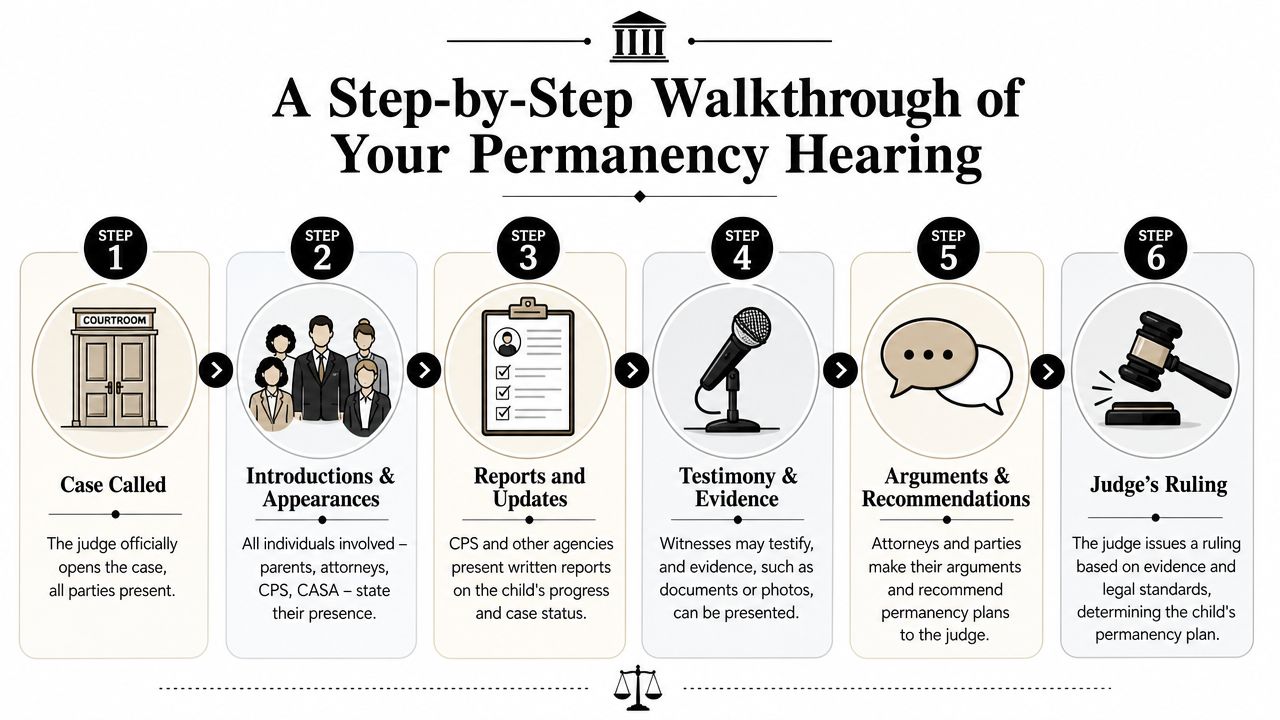
The hearing often starts with the court calling the case. The attorneys announce who they represent, and the judge confirms which parties are present. If a parent is missing, that immediately creates problems. If everyone is there, the court moves into reports, testimony, and recommendations.
What usually happens first
In many cases, CPS presents the first update through the caseworker and written reports. During this update, the agency tells the judge what services were ordered, what it says you completed, how visits have gone, whether housing and employment are stable, and what permanency plan CPS is recommending.
A permanency hearing is a structured judicial decision point where the court evaluates whether CPS has made reasonable efforts to finalize a permanent plan, and the result can be a new order that changes obligations, orders services, or locks in a path that becomes harder to reverse later, as described in the NCJFCJ permanency hearing guidance.
Here is a visual overview before you picture yourself in the room:
How testimony and argument unfold
Then the court may hear from other people. Your attorney may question the caseworker about missing information, outdated assumptions, or progress that wasn't fully credited. If appropriate, your attorney may present your documents or call you to testify.
Consider a simple example. A father is accused of lacking stable housing. CPS's report says he has moved several times. But his lawyer presents a signed lease, utility records, and testimony that he has been in the same apartment long enough to establish stability. That doesn't automatically win the hearing, but it changes the record from “he says he has housing” to “there is documentary proof of current housing.”
If your hearing turns on whether things have improved, your lawyer should be ready to show the judge exactly how they've improved.
The child's attorney, CASA, and CPS may each state what outcome they believe serves the child best. Sometimes everyone agrees. Often they don't.
What the hearing ends with
At the end, the judge makes findings and issues orders. The court may keep the current plan, add services, adjust visitation, direct further review, authorize a monitored return, or move the case toward a different permanency goal.
What happens at a CPS permanency hearing is not usually dramatic in the television sense. It is often more consequential than dramatic. A few pages of reports, a few key answers under oath, and a few minutes of legal argument can shape the next phase of your case in a major way.
Evidence and Testimony That Shape the Outcome
Parents sometimes think the hearing will turn on whether the judge personally likes them. That's not the right frame. These hearings are heavily driven by the record.
The court relies heavily on documentary proof. Bench guidance for judges emphasizes review of the updated case plan, CASA or GAL reports, medical and education records, and caregiver information, and courts may consider oral and written testimony from parents, caseworkers, and foster parents as noted in state bench guidance discussing permanency evidence.
The documents that matter most
Your service-plan record is central. If CPS says you were ordered to complete parenting classes, therapy, substance-use treatment, domestic-violence counseling, or other services, the court will want to know what was done.
Useful proof often includes:
- Completion certificates for classes, counseling, treatment, or evaluations
- Attendance records showing regular participation, not just enrollment
- Drug test results when substance use is part of the case
- Housing proof such as a lease, letters from a landlord, or utility records
- Employment proof such as pay stubs or employer letters
- Visitation records showing consistency and quality of contact with your child
A common problem is that parents complete services but don't keep copies. If the provider never sends CPS the paperwork, your progress may not appear in the report the way it should.
Testimony can fill gaps, but it rarely replaces proof
Testimony matters, especially when context is missing. A parent may explain why there was a missed visit, a delayed class start, or a temporary setback. A therapist or other provider may help the court understand whether progress is genuine and ongoing.
But testimony works best when it supports documents instead of trying to substitute for them.
Courtroom reality: “I've changed” is a beginning. “Here are my counseling records, my clean tests, my lease, and my work schedule” is stronger.
What tends to help and what usually hurts
This quick comparison shows the difference:
| More persuasive | Less persuasive |
|---|---|
| Verified attendance | Verbal claims without records |
| Stable contact with the child | Sporadic visits with excuses |
| Acknowledging setbacks and correcting them | Denying obvious problems |
| Updated documents | Old paperwork from months ago |
Judges understand that CPS cases involve stress, poverty, transportation issues, relapse risk, and family conflict. What hurts parents most is usually not imperfection. It's inconsistency without a credible plan to correct it.
Understanding the Possible Rulings and Outcomes
Parents often walk into court fearing only two possibilities. Return home or termination. Real cases are often more nuanced than that.
Legal sources show permanency outcomes are not just binary. Options can include permanent guardianship, kinship or legal custody with a fit and willing relative, and other planned permanent living arrangements, as described in guidance on permanency hearings and termination of parental rights. In Texas practice, that means the judge may have several paths available depending on safety, progress, and placement options.
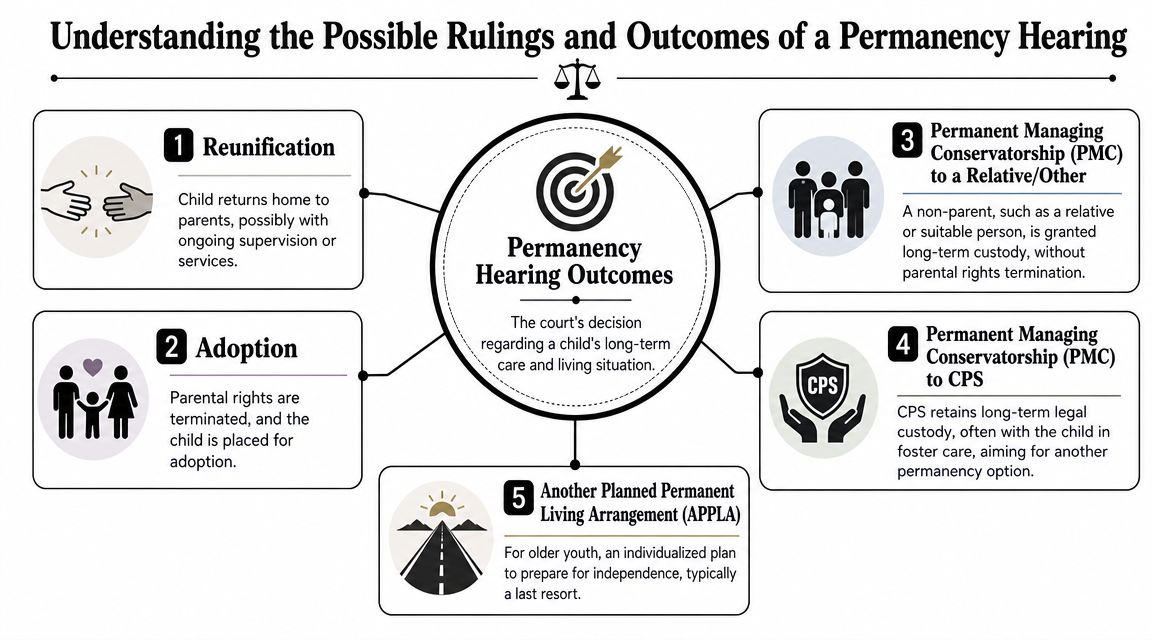
The most common directions a case can take
Reunification remains the goal. If the court believes progress is happening and safety concerns can still be addressed, the judge may keep the existing plan in place and give the parent more time to complete what remains.
Monitored return becomes possible. In some cases, the child may return home while the court and CPS continue to monitor the family. If that issue is on the table in your case, this guide to monitored return in Texas CPS cases can help you understand how that arrangement works.
Relative or kinship placement becomes the long-term answer. Sometimes the court concludes the child should not return home soon, but termination is not the only solution. A relative or other suitable adult may become the long-term conservator or guardian.
When the court shifts in a more serious direction
If the evidence shows limited progress, repeated instability, or unresolved safety risks, the court may shift the permanency goal toward termination and adoption. That does not always mean termination happens that day. It means the case may be moving into a stage where the agency is no longer primarily working toward reunification.
There are also situations in which CPS remains in a long-term managing role while another permanency option is pursued. For older youth, another planned permanent living arrangement may be discussed in some systems, though that is typically treated as a later, more limited option.
Middle-ground outcomes matter. A case can move away from reunification without immediately cutting off parental rights.
What these outcomes mean for strategy
If reunification is still realistic, the strategy is to tighten the record and eliminate weak spots fast. If the court is skeptical, parents and relatives sometimes need to think carefully about whether a relative conservatorship or guardianship option would better protect the child and preserve family relationships than a direct march toward termination litigation.
This is why parents need honest advice, not false reassurance. The best strategy depends on what the evidence can support right now.
Your Actionable Preparation Checklist
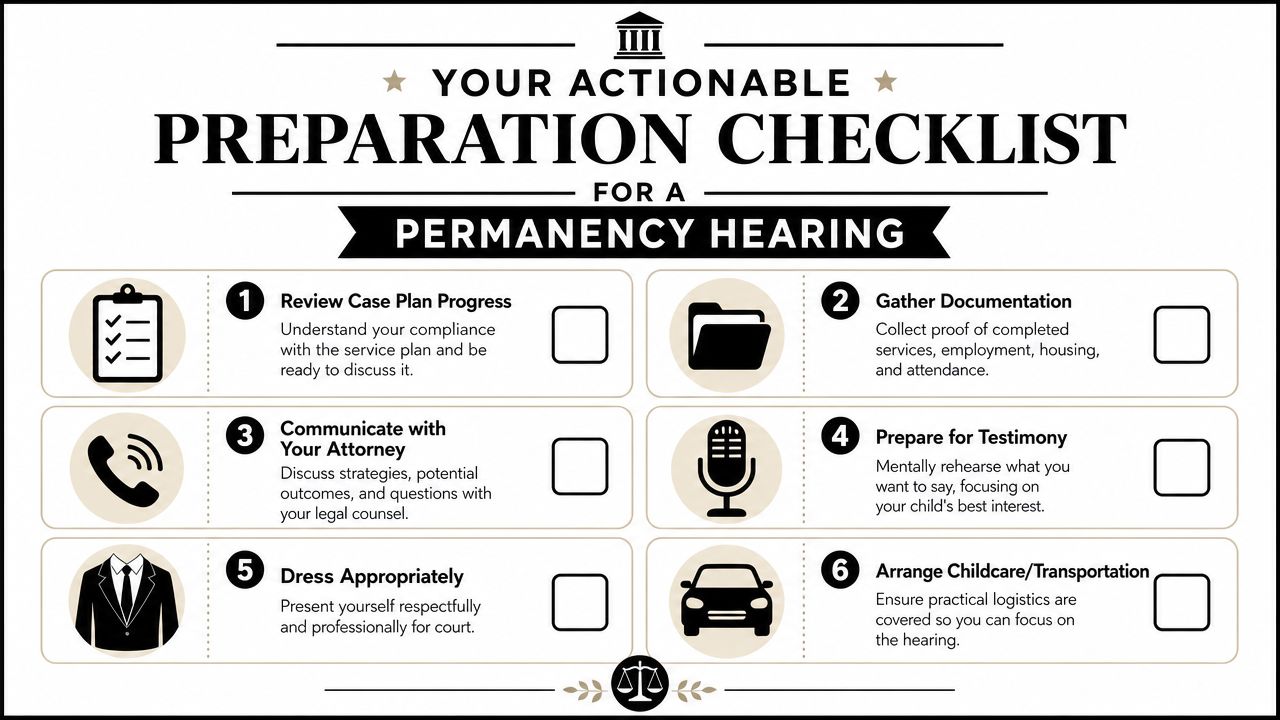
The strongest preparation starts before you step into court. Caseworkers must file the current family service plan and a permanency progress report no later than 10 days before each hearing, which creates an important window to review CPS's position and prepare a response according to child welfare guidance discussing permanency hearing preparation.
Use the days before court wisely
Meet with your attorney before the hearing. Review the CPS report line by line. If something is wrong, incomplete, or outdated, your lawyer needs time to address it. For parents wanting a broader court-preparation guide, this article on how to prepare for a Texas CPS status hearing covers practical habits that also help at permanency hearings.
Build one organized document packet. Put certificates, test results, counseling records, housing proof, pay stubs, and any positive provider letters in one folder. Don't assume CPS already has everything.
Make a clean timeline. List what you completed, when you completed it, what remains, and what obstacles came up. Keep it factual.
Prepare your presentation, not just your paperwork
Talk through weak points honestly. If you relapsed, missed services, changed jobs, or lost housing for a period, discuss that with your lawyer before court. Surprises hurt.
Be ready to explain change in terms of safety. Judges care about more than effort. They care whether the conditions that led to CPS involvement are improving.
Plan your logistics. Get transportation arranged, arrive early, dress neatly, silence your phone, and don't bring avoidable chaos into the day.
Parents regain a sense of control when they prepare for court like a serious job interview backed by records.
Know your support options
Some parents work with private counsel from the start. Others have court-appointed counsel. If you're looking for legal help, the Law Office of Bryan Fagan PLLC handles Texas CPS-related family matters, including preparation for hearings where service-plan compliance and permanency recommendations are at issue.
One final point. Don't confuse emotional preparation with legal preparation. You need both. It helps to be calm, but calm without documents won't carry the day.
Frequently Asked Questions About Texas Permanency Hearings
Will my child have to be at the hearing
Not always. The court may receive information about whether the child should attend, and that decision depends on the child's age, circumstances, and what the judge believes is appropriate. Ask your attorney what is expected in your specific case.
Can I speak directly to the judge
Sometimes, but not whenever you want. In most hearings, your attorney guides when and how you speak so your testimony helps rather than hurts. Don't interrupt the judge or try to argue from counsel table.
What happens if I miss my permanency hearing
Missing the hearing is serious. The court can still proceed, and your absence may make you look disengaged or unreliable. If a true emergency prevents attendance, contact your attorney immediately and document the reason.
What if I disagree with the judge's ruling
Talk to your attorney right away. Depending on the order, there may be options to seek reconsideration, preserve issues for appeal, or focus on building a stronger record before the next hearing. The right response depends on the kind of ruling the judge made.
Should I bring anything with me to court
Yes. Bring a copy of your paperwork, notes for your attorney, and any documents your lawyer asked you to have available. Keep them organized and easy to hand over quickly if needed.
If you're facing a permanency hearing and feel like the ground is shifting under your feet, get legal guidance before the next court date arrives. A CPS case can change direction fast, and the record built at this hearing can shape everything that follows. The attorneys at Law Office of Bryan Fagan PLLC can help you understand the court's concerns, prepare your evidence, and make a practical plan for protecting your relationship with your child. Reach out for a free consultation.