Skip to content
If you're reading this after CPS showed up at your home, talked to your child, or removed your child with little warning, you're probably running on fear and adrenaline. Most parents in this moment don't need abstract legal theory. They need to know what happens next, what matters right now, and how not to make the situation worse.
Temporary orders in a Texas CPS case can shape everything that follows. They aren't the final outcome, but they often decide where your child lives, when you can see your child, what services you must complete, and what the court expects from you while the case is pending. The first hours matter. The first hearing matters. The way you respond matters.
A common situation looks like this: a parent thinks the first court date is just a formality, shows up with no documents, no placement options, and no clear plan. CPS arrives with an affidavit, safety concerns, and a request for restrictions. The judge has to decide quickly. Compare that with a parent who walks in with names of safe relatives, school records, text messages, proof of housing, proof of sobriety efforts, and a lawyer ready to challenge weak points in the removal. Those are very different hearings.
The Knock on the Door That Changes Everything
A CPS case often starts in the most disorienting way possible. Someone knocks. An investigator says there's been a report. Questions start immediately. If the situation escalates to an emergency removal, the shock is hard to describe unless you've lived it.
Parents usually tell me the same thing. They felt like events were moving too fast to understand, and they were terrified that one wrong answer would cost them their child.
That fear is real. But panic leads parents into mistakes that can follow them for months. Talking too much, arguing with the investigator, refusing to provide basic information, attacking the other parent, or assuming the truth will "come out later" are all common errors. In CPS court, later can be too late.
What the first 48 hours are really about
The first two days are about stabilizing the case. You are trying to do three things at once:
- Protect your child relationship: Make sure the court sees you as a parent who is engaged, reachable, and focused on safety.
- Protect the record: Gather documents, names, messages, medical information, and anything else that helps the judge see more than the allegation.
- Protect your legal position: Avoid statements or decisions that can hurt you in family court, and sometimes in a related criminal case.
Practical rule: Treat the first hearing as an evidence event, not a conversation where the judge will simply "hear your side" in a broad, open-ended way.
A parent example that happens all the time
A mother is accused of leaving her child with an unsafe boyfriend. She insists the accusation is exaggerated. That may be true. But if she walks into court saying only, "That didn't happen," she hasn't solved the judge's immediate problem.
If instead she brings proof that the boyfriend no longer lives in the home, offers a maternal aunt for placement, provides school attendance records, and shows she has already enrolled in recommended services, she gives the court options. Judges are looking for a workable safety plan, not just denial.
That's the heart of temporary orders in CPS cases. What parents need to know is that the court moves fast because the court believes the child's immediate safety can't wait. Your job is to move just as fast, but with discipline.
What Exactly Are Temporary Orders in a Texas CPS Case
Temporary orders are the court's short-term rules for your family while the case is being investigated and litigated. They don't decide the final outcome, but they can decide the day-to-day reality of your life for weeks or months.
In plain terms, temporary orders tell everyone what must happen now. Who has legal control of the child. Whether visitation is supervised. What services a parent must begin. Who can and cannot be around the child. What information must be shared.
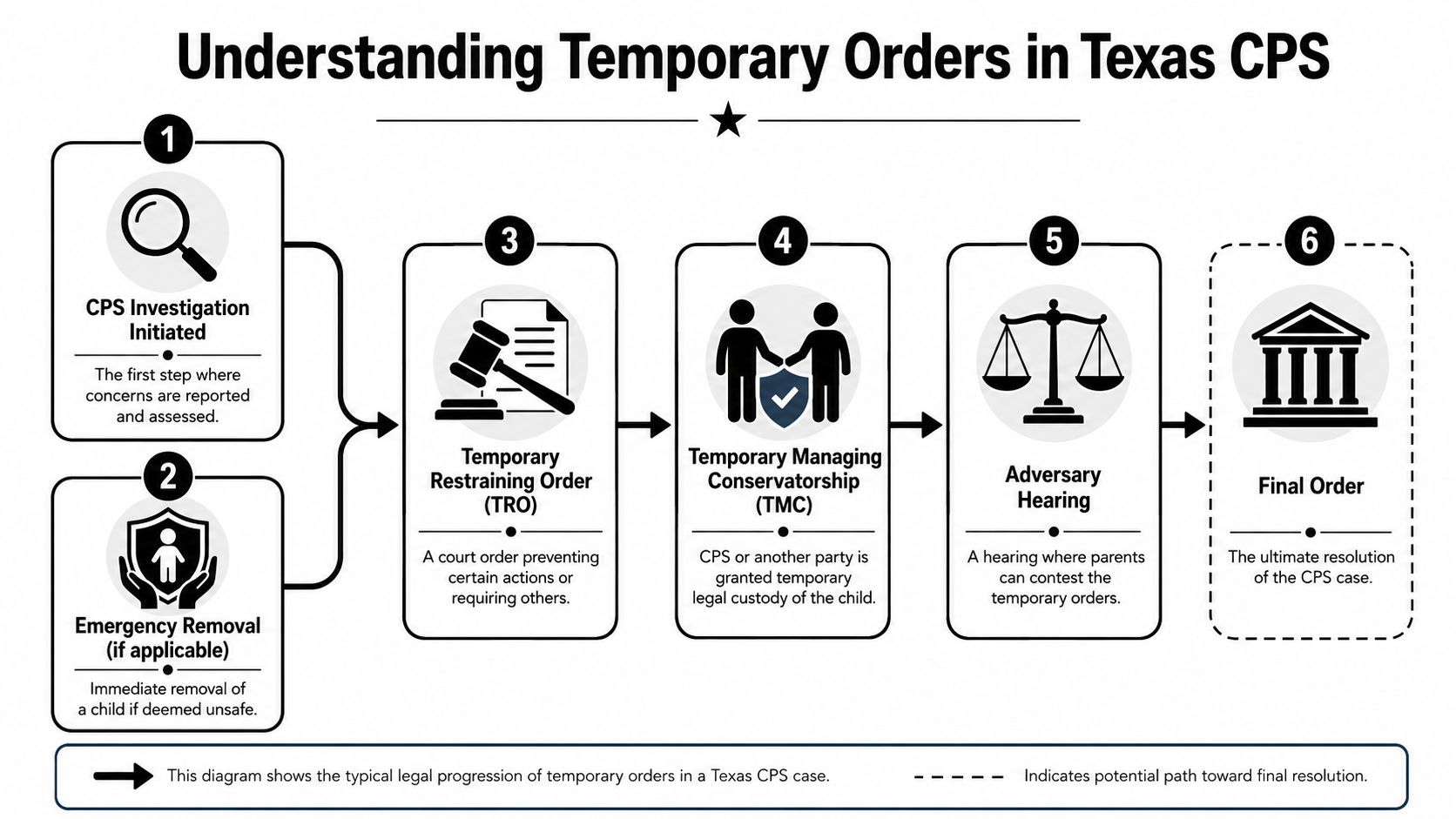
What temporary orders can do
Under DFPS practice, the agency can ask the court for a temporary order requiring a parent to cooperate with an investigation, participate in services, keep an alleged perpetrator away from the home, or require services for a child or siblings. DFPS also states that if parents don't cooperate and safety remains a concern, the agency lacks authority to impose those services or restrictions without a court order. A temporary order can last up to 20 days and may be extended once for another 20 days, according to the DFPS handbook on temporary orders.
That short duration is important. These orders are meant to stabilize an emergency, not permanently decide your rights. But short-term doesn't mean low stakes.
Why parents underestimate them
Many parents hear the word "temporary" and assume they can fix things later. That's a mistake. The terms entered early often become the baseline the court expects you to follow.
A judge may use temporary orders to address:
- Placement: Whether your child stays in CPS custody, with kin, or under another temporary arrangement
- Visitation: Whether you have contact, how often, and whether that contact is supervised
- Services: Drug testing, counseling, parenting classes, evaluations, therapy, or other tasks
- Household rules: Who can be in the home, where the child can stay, and what safety conditions must be met
If you need a clearer understanding of custody authority during a CPS case, this overview of temporary managing conservatorship in Texas CPS cases is a helpful starting point.
Temporary orders are often where a CPS case quietly takes shape. If the early structure is bad for your family, everything after that gets harder.
What they usually cannot do
Parents often confuse different kinds of court orders. A temporary restraining order in a family-law setting generally doesn't decide final custody or support. In a CPS case, the court still needs proper hearings and evidence before making broader or longer-lasting rulings. That matters because you may feel like the system has already made up its mind when, legally, the case is still in an early posture.
The practical takeaway is simple. Don't treat temporary orders as paperwork. Treat them as the opening framework of the case.
The Initial Hearing After a CPS Removal
Your child was taken. You may have spent the night calling relatives, replaying every conversation with the investigator, and trying to figure out what happens next. Then the court date arrives almost immediately.
In Texas, a child removed without prior notice must be brought before the court quickly. The parent is entitled to a prompt hearing on whether the removal should continue, as outlined by the Texas Department of Family and Protective Services explanation of the adversary hearing process. For many families, that means the first 48 hours matter more than they ever expected.
This hearing sets the tone of the case. If you walk in without documents, without names for family placement, and without a workable safety plan, the judge has very little to rely on besides CPS's account. If you walk in prepared, you give the court another option besides defaulting to continued separation.
What the judge is deciding right now
The judge is deciding whether CPS should keep temporary custody while the case moves forward. The court is also looking at whether there is a safer, less restrictive option, such as placement with a relative or a return home under specific conditions.
That is a narrower question than many parents realize. The judge is not deciding whether you are a good parent in the abstract. The judge is deciding whether your child can be protected today, this week, and until the next stage of the case.
Judges usually focus on a few hard questions:
- Is there an immediate safety risk if the child returns home?
- Did CPS have sufficient grounds to remove the child without waiting?
- Is there a relative or close family friend who can safely take the child?
- Can the parent present a specific plan that addresses the problem that led to removal?
If you need a clearer picture of the courtroom process, this guide to what happens at your first CPS court hearing in Texas explains what parents can expect.
What to do before the hearing if you only have hours
Start with proof, not speeches.
Parents often want to explain everything from the beginning. I understand that impulse. At this stage, the court usually responds better to organized facts that answer the immediate safety concern.
Bring what you can gather fast:
Names for possible placement
List relatives or close family friends with full names, phone numbers, addresses, and a short explanation of why they are safe and available. If the person has a clean home, stable job, and prior relationship with the child, say so plainly.Records tied to the reason for removal
If CPS raised concerns about housing, bring your lease, utility bills, and photos if appropriate. If the issue involves medical care, bring prescriptions, appointment records, or discharge paperwork. If the concern is a dangerous person in the home, bring proof that person no longer lives there or no longer has access.A short written timeline
Keep it factual. Dates, events, who was present, what happened next. A clean timeline helps your lawyer, helps the judge, and reduces the risk that panic will scramble your memory.A practical safety plan
If the allegation involves drug use, supervision, domestic conflict, or unsafe living conditions, show the court what changes can be put in place now. That may include another adult in the home, a move to a relative's house, counseling already scheduled, or immediate separation from a harmful partner.
The mistakes that hurt parents early
The first hearing is not the place to fight every battle at once. It is the place to protect your position and keep the court focused on realistic options.
Several mistakes show up over and over:
Arguing without evidence
Strong feelings do not replace records, witnesses, or a placement option the court can evaluate.Minimizing a real problem
If there was drug use, violence, untreated mental health issues, or unsafe supervision, denial damages credibility fast. Judges do not expect perfection. They do expect honesty.Talking too freely when there is a parallel criminal issue
This is one of the most overlooked dangers in the first 48 hours. If the same facts could lead to assault charges, drug charges, or a protective order, what you say in family court can affect another case. Parents need a plan that protects the child without creating avoidable criminal exposure.Failing to give CPS a safe relative option
If the judge hears only two choices, foster care or immediate return to a home CPS says is unsafe, foster care often becomes the temporary answer.
A hard truth about this hearing
Parents sometimes believe the judge will see through everything if they just tell their side passionately enough. Court does not work that way. Early hearings are compressed, crowded, and driven by immediate risk.
The better approach is controlled and specific. Show where the child can stay. Show what has changed. Show who can help. Show that you understand the concern and have already started addressing it.
In the first 48 hours, preparation can affect placement, visitation, services, and the judge's sense of whether you are reacting to the case or taking responsibility for it.
If criminal charges or a protective order may be coming, tell your lawyer immediately. That overlap can change what should be said in court, what documents should be produced, and how your reunification strategy needs to be built from day one.
Your Rights and Responsibilities Under Temporary Orders
Once temporary orders are in place, many parents feel trapped between fear and confusion. The better approach is to think in two lanes at the same time. One lane is what you can demand from the process. The other is what the court will expect from you.
Emergency removals are now reported to account for 70% to 95% of foster care entries in many jurisdictions, according to The Imprint's reporting on emergency removals and due process. That helps explain why so many parents feel as if the case started before they had any real chance to respond.

Rights you should actively use
Your rights don't mean much if you don't exercise them.
- The right to counsel: Ask for a lawyer if you qualify for appointed counsel, or hire one as early as possible.
- The right to know what the court ordered: Get a copy of the temporary orders and read every line. Don't rely on memory.
- The right to visitation if the court allows it: If visits are supervised, show up early, act appropriately, and treat every visit as part of your case.
- The right to challenge weak evidence: Temporary doesn't mean unquestionable.
- The right to participate in planning: You can propose relatives, services, schedules, and safer alternatives.
Responsibilities the court will track closely
Many reunification efforts falter. Parents do some things right, but they don't do them consistently enough to build trust with the court.
| Court expectation | What good compliance looks like |
|---|---|
| Attend hearings | You appear on time, prepared, and respectful |
| Follow services | You enroll quickly, attend regularly, and keep proof |
| Stay in contact | CPS and your lawyer can reach you without chasing you |
| Protect the child | You follow restrictions about unsafe people or unsafe conditions |
| Document progress | You save certificates, receipts, testing results, and attendance logs |
The day-to-day strategy that helps most
Don't just "work services." Build a file.
Create one folder for every requirement. Keep screenshots of class enrollment, attendance confirmations, counseling schedules, negative test results, medication records, and transportation receipts. If a service provider cancels, document that too.
Parents lose ground when they assume CPS is keeping perfect records. Sometimes the file is incomplete. Sometimes a provider hasn't sent updates. Your own paperwork can fill those gaps.
A useful habit: After every class, test, visit, or meeting, save proof that it happened. If the judge asks about progress, you shouldn't be relying on memory.
Mapping the CPS Timeline After the Initial Order
The first 48 hours after removal shape what happens at the next several hearings. Parents often focus on the shock of the emergency order, but the court starts measuring follow-through almost immediately. If you wait for the next court date to get organized, you lose time that is hard to recover.
Texas CPS cases usually move through a set series of review hearings after the court names CPS temporary managing conservator. The exact dates can shift, but the pattern does not. A status hearing comes early. Permanency hearings follow on a regular schedule. If you want a plain-English overview of those deadlines, this guide to the Texas CPS timeline and what parents should expect lays out the sequence clearly.
A visual timeline can make that easier to follow.

The major court milestones
Each hearing has a different job, and parents get better results when they prepare for the specific question the judge will be asking.
Status hearing
This is usually the court's first close review of whether services have been identified, whether visitation is working, whether relatives have been considered, and whether the family understands the service plan. If something was missing in the first days after removal, this hearing is where that problem starts to show.First permanency hearing
The judge looks at progress in a more serious way. Has the parent started services. Are visits consistent. Is the child's placement stable. Are safety concerns being addressed with proof, not promises.Later permanency hearings
These hearings often decide the direction of the case. A parent who started late, missed tests, or treated referrals casually can look stagnant on paper. A parent who acted fast, kept records, and solved obstacles early usually has a stronger argument for more time, more visitation, or a return plan.
Here's a short video that helps explain the process from a parent perspective.
Why early delay hurts so much
Researchers writing in a peer-reviewed study on CPS decision-making and hearing delay found that delay at the front end of a case was strongly associated with children remaining in foster care in substantiated cases.
That matches what happens in court. Once placement, visitation routines, school arrangements, and service schedules settle in, the temporary setup begins to look stable to the system. Judges do not like unnecessary disruption unless a parent can show real progress and a workable safety plan.
That is why the first 48 hours matter so much. Call your lawyer. Give your lawyer names and contact information for safe relatives. Ask for every referral in writing. Start gathering documents the same day. If transportation, work schedules, medication, or housing problems will interfere with services, raise those problems before the status hearing, not after.
What to do between hearings
Use the weeks between court dates to build a record the judge can trust.
- Right after the initial order: Confirm every requirement in writing. Get copies of the service plan, testing instructions, visitation schedule, and next court date.
- Before the status hearing: Start services that are available, document every attempt to start those that are not, and tell your lawyer about any blocked visitation, bad case notes, or missed referrals.
- Before each permanency hearing: Organize proof by topic. Drug tests, counseling attendance, parenting classes, housing records, employment records, and visit summaries should be easy to hand to your lawyer.
- If there is a parallel criminal or family violence issue: Be careful. Statements that seem helpful in family court can create problems elsewhere. Parents dealing with an arrest or bond conditions often need to understand how release terms affect contact with the other parent or child. This guide to understanding domestic violence bail gives useful background on that side of the problem.
Parents who reunify fastest usually do one thing well. They treat the time between hearings as evidence-building time, not waiting time.
When CPS Cases Overlap with Criminal Charges
Some CPS cases don't stay in family court. They overlap with domestic violence allegations, drug charges, assault investigations, protective orders, or pending criminal cases. When that happens, parents face a hard problem. What helps in one case may hurt in the other.
A statement to a CPS investigator may look cooperative in family court, but it can create risk if law enforcement is also investigating. On the other hand, complete silence may be interpreted by CPS as a failure to address safety concerns unless your legal strategy is handled carefully.

Why these cases need a coordinated plan
Temporary custody terms can significantly influence the final permanent custody arrangement, and when a CPS case involves domestic violence or criminal allegations, temporary orders about supervised visitation and information sharing can interact with protective orders and Fifth Amendment concerns, as discussed in Justia's explanation of temporary custody orders.
That means you shouldn't treat the CPS case as separate from the criminal case if they arise from the same allegations. The facts may overlap even when the legal goals don't.
Common collision points
- Interviews and written statements: What you say to explain yourself can later be used in ways you didn't expect.
- Service plans: Anger management, substance treatment, or battering intervention may be helpful in family court, but admissions made in those settings can raise strategy issues.
- Protective orders: Visitation terms in one court may conflict with no-contact or stay-away restrictions in another.
- Supervised access: A judge may allow some child contact, but the structure matters if there's also a criminal no-contact issue.
If you're trying to understand the release side of a family-violence arrest while sorting out the CPS consequences, this resource on understanding domestic violence bail can help you make sense of the process.
Don't let one lawyer handle the criminal side in isolation while another handles CPS without sharing strategy. In overlapping cases, inconsistency creates risk.
What usually works better
A coordinated defense doesn't mean refusing every service or refusing all communication. It means making decisions intentionally.
That can include limiting unnecessary statements, using documented third-party records instead of broad personal explanations, clarifying the boundaries of protective orders before visits occur, and making sure any lawyer involved understands the whole picture. The point is to protect your child relationship without handing the prosecution evidence it didn't already have.
The Law Office of Bryan Fagan PLLC handles criminal defense matters that intersect with CPS and protective-order issues, which can matter when the same allegation is driving multiple proceedings.
Taking Control and Building Your Case for Reunification
Temporary orders can feel like the court took over your life in a single day. But temporary orders are not the final chapter. They are the period when your choices start creating the record the judge will later rely on.
The parents who put themselves in the best position usually do the same basic things well. They respond fast. They keep proof. They stop arguing about labels and start solving safety concerns. They don't miss visits. They don't ignore services because they feel insulted by them. They work with a plan.
A realistic path forward
If your family also faces special-needs issues or crisis-response concerns, outside support can matter. For example, families dealing with communication or behavioral escalation may find useful practical guidance in Guiding Growth's overview of social-service help during autism crises. Resources like that don't replace legal advice, but they can help parents show the court they are building safer supports around the child.
Keep your focus narrow and disciplined:
- Follow the written order, not assumptions
- Document every step of compliance
- Tell your lawyer about barriers immediately
- Offer safe, realistic solutions instead of emotional arguments
- Stay child-focused in every hearing, every visit, and every message
Reunification cases are rarely won by one dramatic moment. They're won by credible, steady effort that the court can verify.
If you're dealing with a CPS removal, temporary orders, or a case that also involves criminal allegations or a protective order, contact Law Office of Bryan Fagan PLLC for a free consultation. A fast, informed response can affect placement, visitation, and the direction of the entire case. You don't have to sort this out alone.