Skip to content
A permanency plan is a legal roadmap in a Texas CPS case that decides where a child will live safely and permanently, whether that's back home with a parent or in another stable placement. In Texas, CPS must begin permanency planning when a child enters substitute care, develop a primary goal and at least one backup goal within 45 days, and the court is working toward a final order within 12 months of removal.
If CPS has shown up at your door, called your child's school, or removed your child, you're probably dealing with fear first and legal terms second. That's normal. Most parents don't start out knowing what a permanency plan is, what a permanency hearing does, or whether they still have any say in the process.
You do.
The permanency plan matters because it becomes the working map for your case. It tells the court what CPS says should happen next, what steps people are expected to take, and what long-term outcome the agency is pursuing for your child. That can feel cold and procedural when your family is in crisis, but understanding the plan gives you something important back. A way to respond, document progress, and challenge unfair assumptions.
Your Family's Path Forward After CPS Arrives
When CPS first gets involved, parents often focus on the immediate shock. Will my child be taken? What should I say? What happens in court? Those are urgent questions, but there is another one underlying everything else. What future is CPS building into the case?
That future usually starts taking shape through the permanency plan.
A parent in this situation might be told, “Work your services, stay in touch, and show progress.” That sounds simple until you realize CPS and the court are measuring progress against a written plan that affects placement, hearings, and long-term outcomes. If you haven't seen that plan clearly, you're trying to defend your family while someone else defines the finish line.
Why this feels so personal
A CPS case isn't just paperwork. It touches trust, communication, and whether people believe change is real. Parents often need to rebuild trust with the court, with caseworkers, and sometimes with family members who may become temporary caregivers. If your family is trying to repair communication under pressure, The Love Language Test's guide to trust offers a practical, non-legal look at how trust gets rebuilt through consistent action. That doesn't replace legal advice, but it does reflect something courts notice too. Follow-through matters.
The parent who engages early, asks questions, keeps records, and shows up prepared is usually in a stronger position than the parent who waits for the next hearing and hopes things improve on their own.
What parents often misunderstand
Many parents hear “plan” and assume it's fixed from the start. It isn't. The case has structure, but your actions can influence where it goes.
Common early mistakes include:
- Treating the plan like a suggestion instead of the document the judge may rely on to measure your progress.
- Missing the difference between goals and services because “take classes” is not the same thing as the final permanency outcome.
- Staying silent when the plan is unrealistic even though concerns about transportation, scheduling, housing, or placement details may need to be raised quickly.
If you understand the permanency plan early, you're in a better position to protect your relationship with your child.
What Is a Permanency Plan in Legal Terms
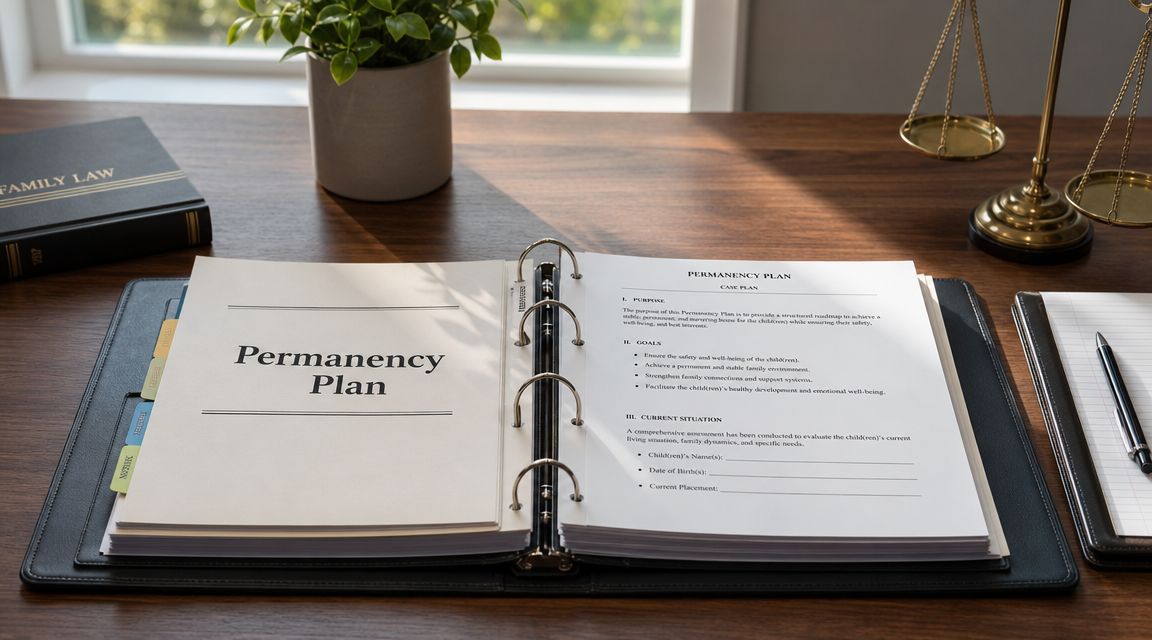
A permanency plan is not just CPS describing what it hopes will happen. It is a required legal case-management document used in conservatorship cases to guide where a child will live permanently and how that result is supposed to be reached.
Texas DFPS states that permanency planning must begin whenever a child enters substitute care, and the plan must include one primary permanency goal plus at least one concurrent backup goal, with those goals developed within 45 days of the child coming into care, as explained by Texas DFPS on permanency options.
What goes into the plan
Under Texas practice, this document is supposed to be specific. It isn't enough for CPS to say “reunification” and leave it there. The plan should connect the goal to concrete steps, responsibilities, and timing.
That means the plan often addresses issues like:
- Primary goal such as reunification
- Backup goal such as placement with a relative or adoption
- Required actions expected from parents, caregivers, and the agency
- Practical deadlines tied to the case's progress
- Changing circumstances that may require revision
Legal jargon can be confusing for families. The permanency plan is about the child's long-term outcome. A service plan focuses more narrowly on what a parent is being asked to do. The two are related, but they are not identical.
Why the court cares so much about it
Texas CPS cases run under a legal structure that emphasizes child safety and a timely permanent home. Chapters 262 and 263 of the Texas Family Code are especially important because they govern removal and review of conservatorship cases, while Chapter 161 matters when termination of parental rights becomes part of the case.
Practical rule: If a judge is trying to decide whether your child can safely return home, the permanency plan becomes one of the main yardsticks the court uses.
That's why parents should read it carefully, compare it to what is happening in the case, and flag anything that is incomplete, inaccurate, or impossible to satisfy as written.
The Four Main Permanency Goals in Texas
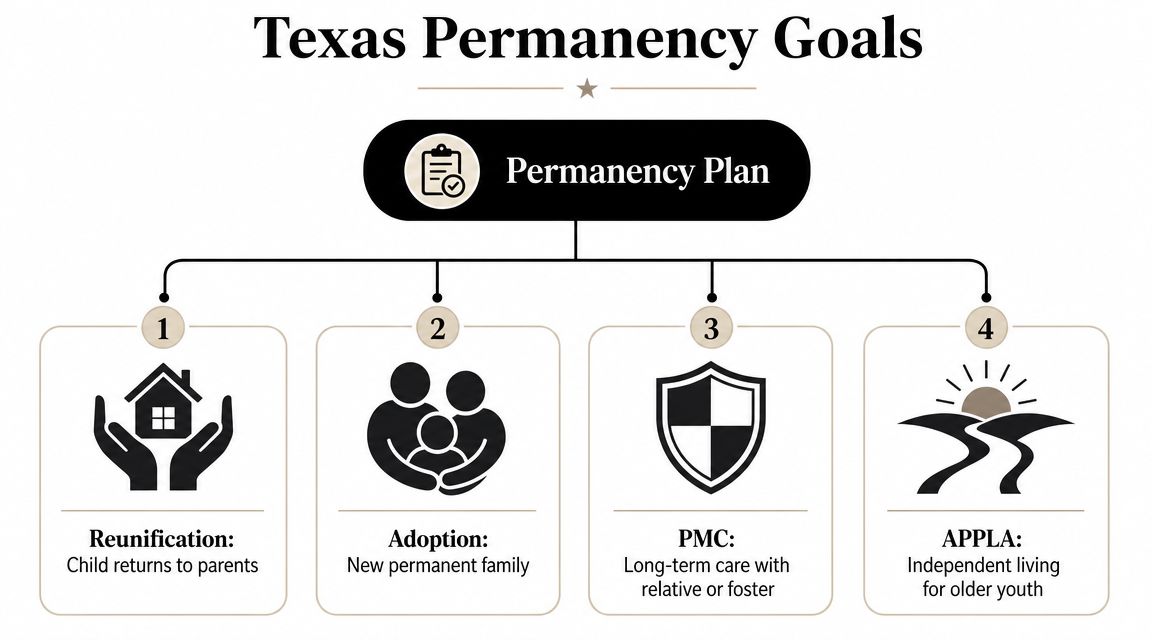
Texas recognizes four permanency outcomes for children in CPS cases. The goal chosen for your child affects everything from hearing strategy to what evidence matters most.
Reunification
This means the child returns to a parent. In many cases, this is the outcome parents want and work toward from day one. If reunification remains the primary goal, the case usually centers on whether the parent can provide a safe, stable home and whether the concerns that led to removal have been addressed.
That can involve showing sobriety, attending counseling, maintaining stable housing, visiting consistently, and demonstrating sound judgment over time. If you want to understand how this path usually unfolds, this guide to the Texas CPS reunification process is a useful companion.
Adoption
Adoption creates a new permanent legal family for the child. In practice, this usually means parental rights have been terminated or voluntarily relinquished first. Chapter 161 of the Texas Family Code becomes especially important here because termination is one of the most serious actions a court can take.
Parents need to understand the difference between “CPS is discussing adoption as a backup goal” and “the case has shifted toward terminating parental rights.” Those are related, but they are not the same moment in the process.
Permanent managing conservatorship
This is often called PMC. A relative or another suitable adult becomes the child's long-term legal caregiver. In some cases, this allows the child to stay connected to family without reunification happening right away.
PMC can be confusing because it doesn't always mean parental rights are terminated. A parent may still have some legal connection, but the child's day-to-day care and major authority rest elsewhere. The details matter a lot.
Another planned permanent living arrangement
This is known as APPLA. It is a recognized permanency option under Texas law, but parents often hear about it without understanding what it means. It is generally discussed in more limited situations, often involving older youth when other permanent placements are not feasible.
Comparing Texas CPS Permanency Goals
| Permanency Goal | What It Means for Parents | Are Parental Rights Terminated? |
|---|---|---|
| Reunification | Parent works toward the child returning home safely | No |
| Adoption | Parent may lose legal rights if the case moves to termination and adoption | Yes, if adoption follows termination |
| Permanent Managing Conservatorship | Another adult gets long-term legal authority over the child | Not always |
| APPLA | The child's long-term plan does not involve returning home or adoption in the ordinary way | Not necessarily |
A backup goal is not harmless language. If the primary goal stalls, the backup can become the direction of the case.
A Real-Life Example of a Permanency Plan
Consider a fictional family, the Garcias.
Their child is removed after CPS raises concerns about substance use in the home. At the start of the conservatorship case, the permanency plan lists reunification as the primary goal. The backup goal is placement with the child's grandmother if reunification doesn't happen quickly enough or safely enough.
At first, Mr. Garcia is overwhelmed. He hears words like “services,” “review,” and “concurrent goal,” but he doesn't grasp how they fit together. Then his attorney sits down with him and translates the plan into plain language. If he wants reunification to stay realistic, he needs to do more than say he loves his child. He needs proof of progress.
How progress shows up in real life
Mr. Garcia starts attending counseling, completes requested drug testing, keeps records of every appointment, and shows up to visits on time. He also asks practical questions when parts of the plan don't make sense. If a class conflicts with work, he asks for alternatives instead of just missing sessions.
That matters because the court doesn't only look at effort in the abstract. The judge is trying to see whether the concerns that led to removal are being addressed in a reliable way.
Why his involvement changes the case
At review hearings, CPS reports that Mr. Garcia has been participating and maintaining contact. The grandmother remains a backup option, but the case doesn't drift toward that outcome because the primary goal still appears workable. His attorney also makes sure the court sees obstacles in context, rather than letting missed assumptions turn into findings that he “failed to engage.”
Parents often lose ground when they let CPS describe the story of the case by itself. Records, attendance logs, clean tests, treatment updates, and witness support help you tell your side with specifics.
This example is fictional, but the lesson is real. A permanency plan isn't only something that happens to you. It's something you can influence through steady, documented action.
Your Case Timeline for Permanency Hearings
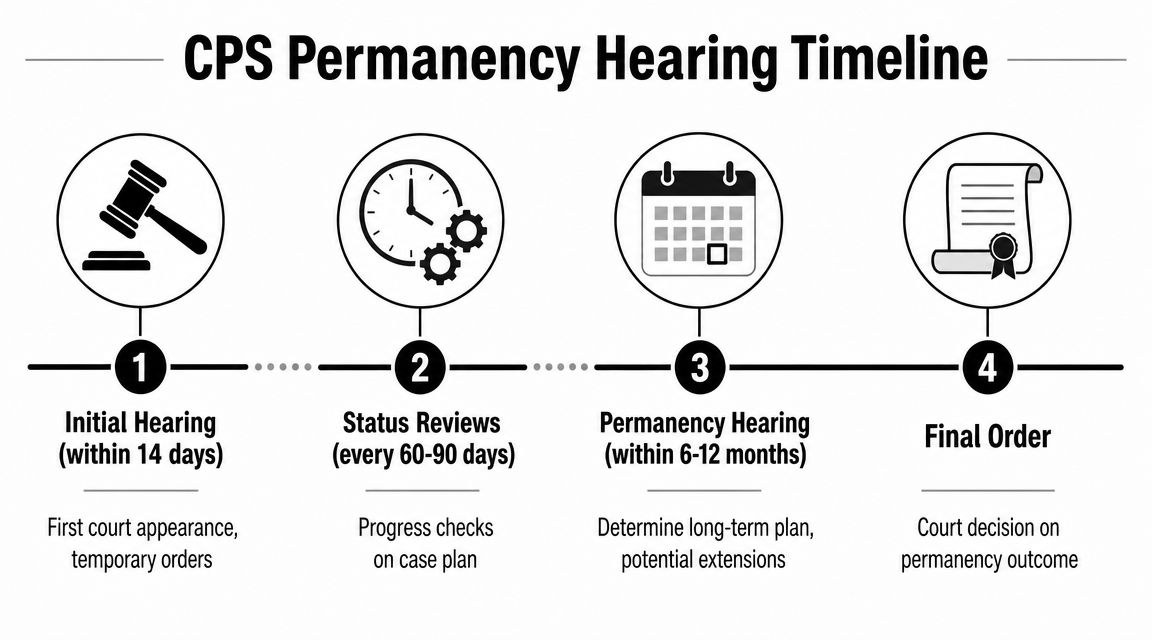
A Texas CPS case has a legal clock running in the background. If your child is in conservatorship, the court doesn't just glance at the case once and disappear. It reviews progress repeatedly, and the permanency plan is one of the main reference points.
Texas law requires a Permanency Review Hearing at least every 120 days after the initial review hearing, and all children in conservatorship must have a permanency plan that states the steps, responsibilities, and timeframes for reaching the goal, as described by Texas Law Help's overview of the conservatorship phase.
What these hearings are really for
Parents sometimes think permanency hearings are routine check-ins. They're more serious than that. Each hearing gives the judge a chance to ask whether the child's placement is still appropriate, whether the parent is making progress, and whether the long-term goal still makes sense.
If you're unclear on what happens at one of these court settings, this explanation of a Texas CPS permanency hearing can help you understand the role these hearings play.
What to do before each hearing
The best approach is to prepare as if every hearing matters, because it does.
- Update your records with certificates, test results, counseling attendance, housing documents, and anything else showing progress.
- Review the current goal so you know whether CPS still says reunification is primary or whether another outcome is gaining ground.
- Talk to your lawyer early about missed services, scheduling conflicts, placement concerns, or anything inaccurate in the file.
- Show patterns, not excuses because courts tend to trust repeated responsible behavior more than verbal promises.
The case does not stay still
Federal and state permanency rules, implemented in 1998, require courts to render a final order for children in agency custody within 12 months of removal, a requirement summarized by Texas DFPS in its permanency options materials. That deadline creates pressure, but it also means the case cannot drift forever without decision points.
Some parents hear “12 months” and assume they have plenty of time. In reality, those months move fast when services, visitation, evaluations, and repeated hearings are all happening at once.
Protecting Your Rights by Engaging with the Plan
Feeling powerless is one of the hardest parts of a CPS case. Many parents assume the permanency plan arrives fully formed, and their only job is to comply. That view gives away too much.

Texas practice gives you meaningful opportunities to participate. The permanency plan must be provided to persons entitled to notice at least 10 days before the first permanency hearing, and the plan acts as a benchmark for later court review, as noted in the Texas Children's Commission bench book discussion of permanency plans. If the plan is incomplete, unfair, or disconnected from the facts, that matters legally.
What engagement looks like in practice
You don't need to become a lawyer overnight. You do need to become an active reader of your own case.
A parent who engages with the plan should:
- Read every version carefully and compare it to what happened in the home, in visits, and in services.
- Flag errors fast if dates, allegations, living arrangements, or service expectations are wrong.
- Raise practical barriers such as work conflicts, lack of transportation, waitlists, or referral problems that make compliance harder.
- Document your responses so concerns aren't lost in verbal conversations.
If the issue is confusion about how the service plan fits into the bigger CPS case, this page on the Texas CPS family service plan helps draw that distinction.
When to push back
Not every objection needs a fight in open court. Some problems can be corrected through communication with your attorney and the caseworker. But some issues do require a formal response.
Examples include a plan that assigns services unrelated to the allegations, ignores your actual progress, overlooks a safe relative placement, or sets expectations that no one could realistically complete as written. In those moments, silence can look like agreement.
One way parents get grounded in this process is by hearing it explained plainly. This short video gives a useful overview before or after you review the paperwork.
Legal help can change how the plan is framed
A lawyer can do more than stand next to you at hearings. Counsel can challenge vague language, ask for clarifications, present evidence of compliance, and push back when a proposed goal change isn't supported by the record. The Law Office of Bryan Fagan PLLC is one option for parents who need representation in Texas CPS hearings and related permanency disputes.
If CPS has written the roadmap, your attorney's job is often to question whether that roadmap is accurate, fair, and legally supportable.
Common Questions from Texas Parents
Parents usually ask the same hard questions because the process is confusing by design. Here are straight answers.
Is the permanency plan the same as my family service plan
No. They overlap, but they do different jobs. The family service plan focuses on tasks and services a parent may be expected to complete. The permanency plan is broader. It addresses the child's long-term placement goal and the path toward that result.
Can CPS change the goal from reunification to adoption if I disagree
CPS can recommend a goal change even if you oppose it. Your disagreement still matters. A goal change can be challenged with evidence, legal argument, and proof that reunification remains safe and realistic. That's one reason every hearing matters.
Can the plan still change after the first permanency hearing
Yes. The permanency plan is reviewed no less than every 180 days and must be updated within 30 days after a significant case change or a change in the permanency goal, according to Texas administrative rules on permanency plan review and updates.
What if I haven't finished everything by the final deadline
That depends on what remains incomplete, why it remains incomplete, and whether the court believes the child can be safely returned anyway. Courts usually look at the whole picture, not just whether every box is checked. Still, unfinished services can be dangerous if they involve the core safety concerns in the case.
What should I ask my lawyer right now
Start with these:
- What is the current primary permanency goal
- What is the backup goal
- What facts is CPS relying on to support that goal
- What documents should I gather before the next hearing
- What parts of the plan can we challenge or clarify
Your Family's Future Is Worth Fighting For
A permanency plan can sound like just another legal phrase, but in a Texas CPS case it often becomes the document that shapes where your child lives and what the court expects from you. That's why parents need more than general reassurance. You need a clear reading of the plan, a realistic strategy, and someone who knows how to challenge unfair assumptions before they harden into court findings.
If CPS is involved with your family, don't wait for the next hearing to get serious about the roadmap in front of you. The earlier you understand the permanency plan, the better chance you have to influence it.
If you're facing a Texas CPS case and need help understanding or challenging a permanency plan, contact Law Office of Bryan Fagan PLLC for a free consultation. A lawyer can help you review the plan, prepare for hearings, protect your rights, and build the strongest case possible for your child's future.