Skip to content
Getting served with a CPS court petition can feel like the floor drops out from under you. One day you're managing school pickup, work, bills, and bedtime. The next, someone hands you legal papers with serious allegations and a court case name you may have never seen before: a Suit Affecting the Parent-Child Relationship, often called a SAPCR.
Most parents in that moment ask the same questions. Is this already over? Am I about to lose my child? What do I do first? Who do I call? Those reactions are normal. Fear and confusion are part of almost every CPS case because the system moves fast, uses legal language, and puts your family under a microscope.
A petition is serious, but it is not a final decision. It is the beginning of a formal court process. Once CPS files, the case stops being just an investigation and becomes a lawsuit with deadlines, hearings, evidence, court orders, and specific rights for parents. That shift matters. It means the judge, not just CPS, now decides what happens next.
A common situation looks like this: a parent opens a thick envelope, sees allegations they disagree with, and freezes. They miss a call from the caseworker, don't read the hearing date carefully, and show up to court unprepared. That early confusion can create problems quickly. A different parent gets legal help immediately, gathers records, starts tracking every appointment, and walks into the first hearing with a plan. The facts of the case may be the same, but the response is very different.
The first days after a CPS petition is filed often shape the rest of the case.
If you're trying to understand what happens after CPS files a petition in Texas, the most useful thing you can do right now is learn the sequence. When you know what each stage means, the case becomes less mysterious. You can stop reacting blindly and start making decisions that protect your child, your rights, and your credibility with the court.
Introduction The Day Your World Changes with a Court Petition
The day a CPS petition arrives usually doesn't feel procedural. It feels personal. The papers may refer to your child by initials, list allegations in stiff legal language, and ask the court for powers that sound frightening. Parents often read the petition once, then again, looking for some sign that there has been a mistake.
That emotional reaction makes sense. A CPS case touches the most important part of your life. But from a legal standpoint, the filing of the petition means something very specific. The court is now involved, and the case will move on a defined schedule.
What the petition really means
A petition is CPS asking the court to step in. Depending on the case, CPS may be asking for temporary orders, continued state custody, services for the parent, restrictions on contact, or, in more serious cases, longer-term relief that could affect parental rights permanently.
The key point is this: the petition starts a court-supervised process. It doesn't automatically prove the allegations. It doesn't mean the judge has already made up his or her mind. It does mean your actions from this point forward matter more than ever.
Parents usually feel pressure to explain everything at once. That impulse is understandable, but a better approach is controlled, documented, and strategic.
- Read every page carefully: Look for the cause number, the court, the hearing date, and what CPS is requesting.
- Keep the envelope and papers together: Small details matter later.
- Avoid emotional texts or social media posts: Those often become distractions at best and evidence at worst.
- Get legal advice quickly: Early decisions in CPS cases often carry lasting consequences.
A practical example
Consider a parent who receives a petition after allegations involving unsafe supervision. She knows the allegation doesn't tell the whole story, but she also knows the court won't decide the case based on frustration alone. She starts collecting school records, medical information, names of relatives who can help, proof of housing, and any messages that put the allegation in context. She also begins writing down every contact with CPS.
That doesn't guarantee a result. It does something just as important. It replaces panic with preparation.
Practical rule: Treat the petition as the start of a case you must actively defend, not a misunderstanding that will fix itself.
The Initial Shock Understanding the Petition and First Court Dates
Once CPS files, the first stage moves quickly. That speed catches many parents off guard. The court isn't trying to decide the entire future of the case right away, but it will make early decisions that can affect where your child stays, what restrictions apply, and how the case is framed.
Early CPS hearings are a form of legal triage. The judge is deciding what needs to happen immediately to address safety concerns while the larger case continues.

What a SAPCR is asking the court to do
A SAPCR is the formal lawsuit involving the parent-child relationship. In the CPS context, it gives the court a vehicle to issue orders about conservatorship, possession, services, placement, and other urgent matters.
If the child was removed without a prior court order, the deadlines are especially strict. Texas law requires an initial hearing no later than the next business day after removal, and a full adversary hearing must occur within 14 days of that initial hearing, as explained by the Texas District and County Attorneys Association discussion of CPS litigation.
If you want a closer look at that first court appearance, this guide on what happens at your first CPS court hearing in Texas is a helpful companion.
What the first hearing is really about
The first major hearing is not a final trial. It is usually focused on whether CPS's requested temporary orders should remain in place and whether the child must stay out of the home while the case proceeds.
Expect the judge to pay attention to questions like these:
- Immediate safety concerns: Does CPS have enough evidence to argue there is a continuing danger?
- Parent stability: Is there safe housing, sober caregiving, and a workable plan for the child?
- Available support: Can a relative step in, or is there another safe placement option?
- Counsel and due process: Does the parent have a lawyer, or need one appointed?
Texas guidance also reflects how quickly due process is supposed to attach after filing. If a parent is indigent, the court must appoint an attorney ad litem immediately, and a hearing must be held no later than 14 days after the petition is filed, with a possible 14-day extension for good cause, according to the DFPS litigation guidance on court proceedings.
The video below walks through common concerns parents have at this stage.
What helps and what hurts
Parents often think the first hearing is won by telling the judge they love their child. Of course that matters, but courts also look for organization, credibility, and practical solutions.
What tends to help:
- Showing up prepared: Bring documents, names, addresses, and contact information for helpful witnesses or relatives.
- Being respectful and direct: Judges notice whether a parent can answer questions calmly.
- Focusing on current safety: The court wants to know what can be done now, not only what feels unfair.
What usually hurts:
- Arguing with everyone in the courtroom
- Ignoring the allegations because they feel false
- Promising to do things later instead of showing present action
Navigating Temporary Orders and Service Plans
After the first hearings, many parents enter the part of the case that feels most demanding day to day. The court may sign temporary orders, and CPS may be named Temporary Managing Conservator. That doesn't permanently end your rights, but it does mean CPS has legal authority over many immediate decisions while the case continues.
For parents, this is the point where the case becomes concrete. There may be visitation rules, drug testing requirements, counseling referrals, class schedules, home expectations, and regular contact with a caseworker.

What temporary orders mean in real life
Temporary orders often address where the child will live, what visits will look like, who may supervise contact, and what each parent must do while the case is pending. Some parents hear "temporary" and assume these orders don't matter much. In practice, they matter a lot because they shape the judge's view of how the case is progressing.
If the orders require clean drug tests, stable housing, counseling, or no contact with a certain person, the court expects compliance. A parent who treats temporary orders casually often struggles later to rebuild trust with the court.
Why the service plan matters so much
The family service plan is usually the roadmap CPS and the court use to measure progress. It often includes services designed to address the reasons CPS became involved in the first place.
A parent might be asked to do some combination of the following:
- Counseling or therapy: Often tied to mental health concerns, trauma, family conflict, or parenting issues.
- Drug or alcohol testing: Common when substance use is part of the case.
- Parenting classes: Meant to build skills and demonstrate engagement.
- Stable housing and employment: The court wants to see a safe, consistent environment.
- Regular visitation: Visits are often both a chance to preserve the bond and a place where CPS evaluates parenting.
For a deeper look at this part of the process, review this explanation of a service plan in a Texas CPS case.
A service plan is not busywork. It is often the clearest record the court sees of whether a parent is addressing the problems alleged in the case.
What works better than good intentions
Here's a common trade-off. A parent says, "I'm trying," but misses appointments, forgets paperwork, and assumes the caseworker knows they mean well. Another parent keeps a folder with certificates, test results, therapy attendance, pay stubs, lease information, and a calendar of every visit. Courts usually respond better to the second approach.
Use a simple system:
| Task | What to keep |
|---|---|
| Counseling | attendance records, provider contact information |
| Drug testing | results, test dates, any chain-of-custody paperwork you receive |
| Classes | enrollment confirmation and completion certificates |
| Housing | lease, utility bills, photos if appropriate |
| Visits | date, time, what went well, any concerns |
A realistic scenario
A father working long shifts may struggle to fit in classes, testing, and visits. The mistake is going silent. The better move is to tell your lawyer quickly, ask about scheduling conflicts, document your work hours, and request practical solutions before missed services pile up.
What doesn't work is assuming the court will fill in the blanks for you.
The Discovery Phase Gathering Evidence and Building Your Case
While you're working through services and court orders, the legal case keeps moving. CPS is gathering records, witness statements, and documentation. Your attorney should be doing the same. This phase is called discovery, and it matters because judges and juries decide cases based on evidence, not just accusations.

What discovery usually includes
Discovery can involve written questions, requests for documents, medical and school records, photographs, text messages, recordings, and sworn testimony taken outside the courtroom. In plain terms, it is the formal process for finding out what the other side has and forcing important information into the open.
Some common tools include:
- Interrogatories: Written questions that must be answered formally.
- Requests for Production: Demands for documents, messages, records, and other materials.
- Depositions: Sworn testimony taken before trial.
Contextual details are paramount. A screenshot with no context may look damaging until full text threads are produced. A medical note may sound troubling until the provider is questioned. A supervised visit summary may be less persuasive if the observer left out positive interactions.
The DFPS timeline in the background
At the same time, DFPS investigators are working under internal timelines that affect what evidence exists and when. Investigators must interview or attempt to interview alleged victims within 72 hours of stage progression to investigation and document interviews and observations in the narrative within 24 hours of contact. The investigation phase is ordinarily completed within 45 days from intake, with a possible 45-day extension for good cause, meaning no later than 90 days after intake unless a longer extension is approved, according to the DFPS handbook section on investigation timeframes.
That matters because the case file often reflects what investigators gathered early, what they missed, and how carefully they documented it.
If you're facing disputed allegations, this resource on how to challenge CPS evidence in a Texas case can help you understand the pressure points.
Evidence cuts both ways. CPS uses it to support removal or restrictions. A parent's lawyer uses it to expose gaps, contradictions, missing context, and proof of progress.
Your role in building the record
Your lawyer can't produce documents that you never save or identify witnesses you've never mentioned. Good defense work is collaborative.
Bring your attorney:
- Names of helpful witnesses
- Records that show treatment, sobriety, housing, or parenting involvement
- Messages that put disputed events in context
- A timeline of important events in plain language
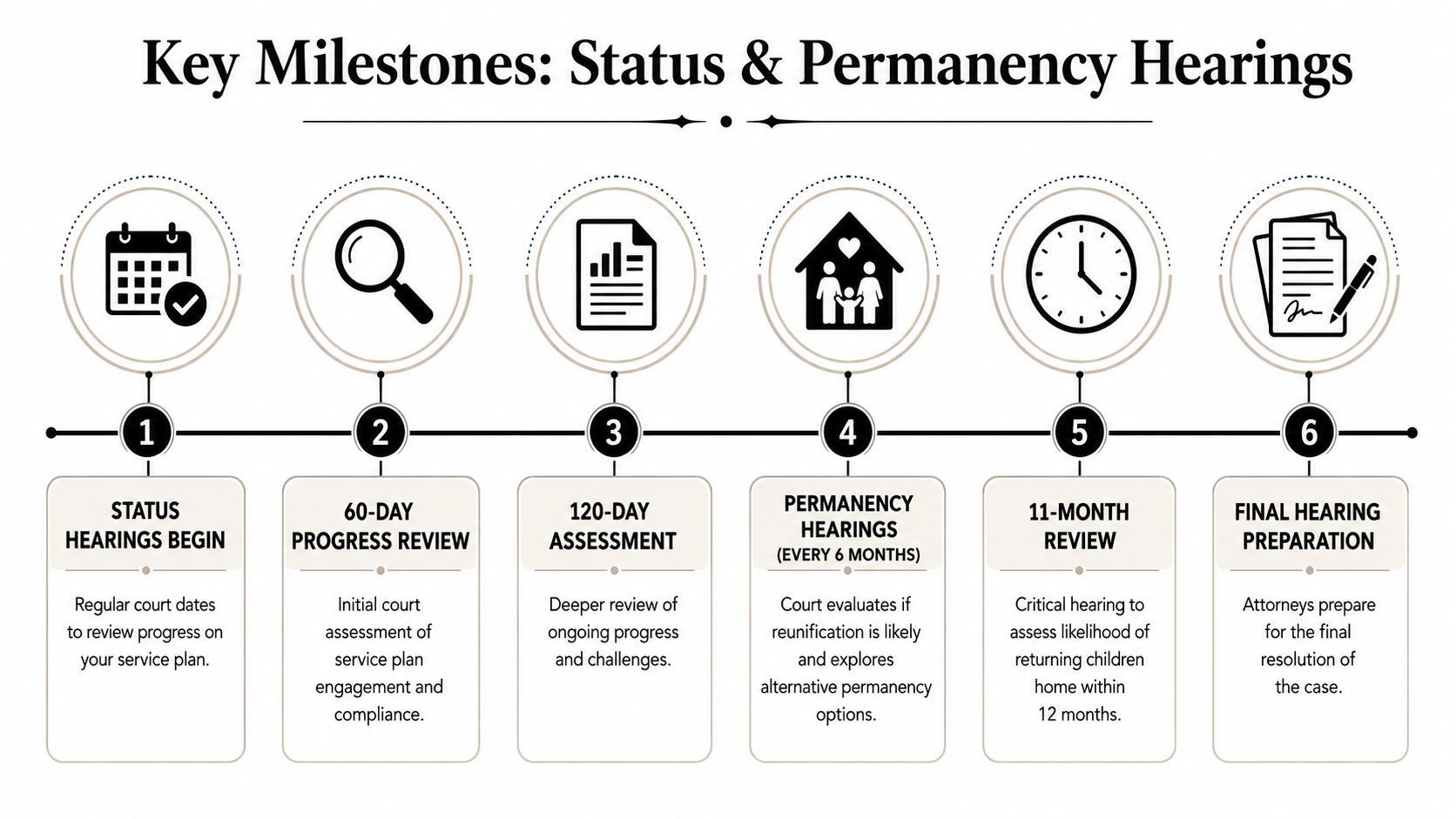
Key Milestones Status Hearings and Permanency Hearings
The middle part of a CPS case can feel strange. You're doing services, attending visits, talking with your lawyer, and waiting for court dates that may seem brief compared to how much the case affects your life. But these hearings are where the court tracks momentum.
Some hearings are mainly progress check-ins. Others ask a harder question: what permanent plan is developing for this child?
Status hearings and what judges watch for
A status hearing often focuses on compliance and logistics. Has the parent started services? Are visits happening? Is there movement toward stability? Has anything improved, or has the case stalled?
These hearings may feel routine, but they create a running court record. If a parent repeatedly shows partial compliance, blames others for every missed step, or arrives without documentation, that pattern matters. If a parent consistently follows through, that pattern matters too.
A useful way to think about status hearings is simple. They answer whether your case is moving forward, sideways, or backward.
Permanency hearings and the bigger question
A permanency hearing asks the court to focus on the child's long-term plan. The first permanency hearing must be held no later than 180 days after DFPS is named temporary conservator, and the court must render a final order or dismiss the case within one year, with only one 180-day extension possible for extraordinary circumstances, as summarized in this discussion of key events in Texas CPS litigation.
That timeline changes the practical strategy of the case. Parents often assume they have endless time to show improvement. They don't. The court is working toward a permanent resolution.
What the court is measuring by this stage
By the time permanency becomes the focus, the court is often looking at several themes at once:
- Consistency: Did the parent start strong and fade, or keep going?
- Insight: Does the parent understand why CPS became involved?
- Protective capacity: Can the parent now make safer choices for the child?
- Feasibility of return: Is reunification realistic within the court's timeline?
Courts don't just ask whether a parent loves the child. They ask whether the parent can provide safe, stable care on a reliable basis.
If reunification is still realistic, the court may continue moving in that direction. If not, the case may start turning toward another permanency option.
The Final Stretch Possible Outcomes and Your Rights
By the end of the case, the court must move from temporary decision-making to a final legal result. For parents, this is the part of the process that carries the most weight because it determines what your legal relationship with your child will look like going forward.
There are several possible outcomes, and they are not equal in consequence.
Reunification compared with other outcomes
The outcome most parents want is reunification. That generally means the child returns home and the case ends with the court satisfied that safety concerns have been addressed. In practical terms, reunification is most likely when a parent has shown consistent progress, credible insight, and the ability to maintain a safe home without ongoing court supervision.
Another possibility is permanent conservatorship with a relative or another caregiver. In those cases, the court may decide the child should not return to the parent, but termination is not the chosen outcome. This can preserve some legal relationship or future contact, depending on the orders entered and the facts of the case.
The most serious result is termination of parental rights. That permanently severs the legal parent-child relationship. In a case involving termination, the stakes are at their highest because the court is not deciding a temporary placement question anymore. It is deciding whether the legal relationship itself should continue.
What a final trial looks like
If the case does not resolve by agreement, it may end in a final trial, sometimes called a trial on the merits. Witnesses testify. Documents are offered into evidence. CPS presents its case. The parent's attorney cross-examines witnesses, challenges weak points, and presents the parent's evidence and witnesses.
At this stage, parents sometimes make a costly mistake. They assume the trial is only about old allegations. It isn't. The court usually sees the full picture, including what happened after filing, how the parent handled services, whether visitation was consistent, and whether the parent became more stable over time.
A simple comparison helps:
| Outcome | What it means for the parent |
|---|---|
| Reunification | Child returns home and the case moves toward closure |
| Permanent conservatorship | Someone else receives long-term custody |
| Termination | Legal parent-child relationship ends |
Rights that still matter at the end
Even late in the case, you still have rights. You have the right to participate in your defense, work with your attorney, review evidence through counsel, challenge witness testimony, and present your own side of the story.
If CPS is seeking termination, the case should never be treated casually. Every missed hearing, every incomplete service, and every undocumented improvement becomes more important, not less.
If termination is on the table, the case has to be defended as if every detail matters, because it does.
How an Experienced Attorney Can Defend Your Family
A CPS petition puts you in a court system with deadlines, rules, and records that can shape how the judge sees your family. An experienced attorney's job is not just to appear at hearings. It is to protect your position early, correct the record when needed, and help you make decisions that improve your chances of keeping or regaining time with your child.
That starts with strategy.
A good lawyer reads the petition closely, compares the allegations to the actual evidence, and identifies what needs an immediate response. Sometimes the priority is fighting removal. Sometimes it is fixing a temporary order that makes compliance harder than it should be. In other cases, the smartest first move is to create a clean record of sobriety, housing, counseling, employment, or family support before the next hearing.
Lawyers also help parents avoid common mistakes that hurt otherwise defensible cases. I often see parents assume they can explain everything directly to the judge later. By then, the record may already reflect missed visits, incomplete services, positive tests, or gaps in communication that were never put in context. A lawyer helps present those facts accurately and, when possible, with documentation instead of excuses.
That matters in practical ways. If a service plan is unrealistic because of work hours, transportation, language barriers, or cost, your attorney can raise that issue early and ask the court to address it. If CPS relies on weak hearsay, incomplete records, or one-sided summaries, your attorney can challenge that. If you are doing what the court asked, counsel can make sure your progress is organized and put in front of the judge instead of getting buried in the file.
Parents also face a real choice about representation. Some qualify for court-appointed counsel. Others hire private counsel for more direct access and more time outside the courtroom. The right option depends on the seriousness of the allegations, whether termination is being sought, how contested the facts are, and how much guidance you need between hearings. One option for parents dealing with Texas CPS litigation is to seek representation and guidance in CPS matters involving petitions, hearings, service plans, and reunification efforts through the Law Office of Bryan Fagan PLLC.
The larger point is simple. Truth alone is not enough in CPS court. Facts must be gathered, explained, documented, and defended in a way the judge can act on.