Skip to content
A Texas CPS Family Service Plan is a mandatory written roadmap for family reunification that must be created within 21 calendar days after an FBSS case opens. If you're holding one in your hands right now, you're probably not thinking about “roadmaps.” You're thinking about your child, your home, and whether one wrong move could make things worse.
When parents search what is a family service plan CPS Texas, they're usually already in the middle of a stressful call, home visit, or court process. The document may look formal and cold, but it has real consequences for your family's future. It can shape where your child lives, what services you must complete, how CPS measures your progress, and whether reunification stays realistic.
The hardest part is that many parents receive a service plan when they're exhausted, scared, and trying to make quick decisions. That's when confusion becomes dangerous. A vague task, an unrealistic deadline, or an agreement you misunderstood can create problems that follow you through the entire case.
A Family Service Plan is not the same thing as a final judgment that you're a bad parent. It's a legal document that lays out CPS's concerns, the changes they want to see, and the steps they expect you to take. Understanding it early gives you something many parents feel they've lost in a CPS case: control.
Your World Turned Upside Down by a CPS Plan
Maria had never dealt with CPS before. A caseworker came to her home, asked difficult questions, and left her with paperwork full of phrases like “safety concerns,” “services,” and “parental tasks.” She read the pages three times and still couldn't tell what was required, what was optional, or what would happen if she disagreed.
That kind of confusion is common. Parents often tell me the same thing: “I wanted to cooperate, but I didn't understand what I was agreeing to.” That fear is real, especially when CPS talks fast and the stakes feel immediate.
Some parents freeze. Others sign first and ask questions later. Neither reaction makes you weak. It means you're under pressure.
Why this document feels so overwhelming
A CPS service plan usually arrives at the worst possible moment. Your family may already be dealing with school issues, work stress, housing problems, a relapse, a mental health crisis, or conflict with the other parent. Then the state hands you a written plan and expects you to act like a lawyer, therapist, scheduler, and recordkeeper all at once.
You don't need to know everything on day one. You do need to slow down enough to understand what CPS is asking from you.
This is also where parents sometimes make the mistake of treating the document like ordinary paperwork. It isn't. In a civil injury case, a person might learn how to increase settlement value by building strong documentation and avoiding preventable mistakes. In a CPS case, that same habit of careful documentation matters even more, because your notes, certificates, messages, and attendance records may become proof of compliance later.
First steps if you just got the plan
If CPS has already scheduled a visit or meeting, practical preparation matters. A parent can reduce confusion by reviewing a resource on how to prepare for a CPS home visit before the next interaction.
Start here:
- Read every page slowly. Don't assume a class, test, or counseling referral is minor.
- Circle vague language. Terms like “improve parenting” or “maintain stability” need specifics.
- Write down your questions. Ask what each task is supposed to prove.
- Keep a copy. If CPS revises the plan, save the old version too.
You are not powerless because CPS is involved. You are a parent in a legal process, and the words in that process matter.
What Is a Texas Family Service Plan Really
A parent often sits down with this document expecting a checklist and finds something much heavier. The plan usually reads like a mix of CPS concerns, required services, deadlines, and expectations about how you will prove change. If you are asking what is a family service plan CPS Texas cases rely on, the short answer is this: it is the written plan CPS uses to define the problems it says exist and the steps it expects you to complete to reduce those safety concerns.
In a Family-Based Safety Services case, CPS must create the plan early in the case and develop it with the parent, identifying strengths, needs, and goals, as required by 40 Tex. Admin. Code Section 700.716. That matters for one reason. A service plan is not casual paperwork. It can shape what CPS says about your progress for months.
A better way to view it is as the instruction manual CPS writes for your case. If the manual is clear and tied to the safety issue, you know what is being asked and why. If it is vague, overbroad, or loaded with terms that do not match the allegation, it can set a parent up to fail.
What the plan does, and what parents often miss
A Texas Family Service Plan usually serves three jobs at once. It states CPS's theory of the case, assigns tasks meant to reduce the claimed risk, and creates a record CPS may later use to argue whether the parent made enough progress.
That third part is easy to miss.
Many parents focus on the services themselves. The harder question is whether the plan is fair, specific, and connected to an actual safety concern. A parenting class may sound harmless, but if the case is really about housing instability, transportation problems, or a disputed Parental Child Safety Placement agreement, the wrong services can waste time while CPS claims you are "not engaging enough."
What it is and what it is not
| What it is | What it is not |
|---|---|
| A written plan CPS uses to state concerns and expected corrective steps | A final decision that your parental rights are already lost |
| A document that can affect court reports, visitation, and reunification arguments | A paper you should sign before you understand the terms |
| A plan that should relate to the specific safety issue in your case | Permission for CPS to pile on unrelated services without explanation |
The difference matters because parents are sometimes handed language that sounds routine but carries hidden risk. One example is a PCSP agreement. A parent may believe the child is staying with a relative for a short time, while CPS may later treat the arrangement as proof that the parent accepted certain allegations or accepted restrictions that were never fully explained. The service plan and any safety placement paperwork should fit together logically. If they do not, that inconsistency needs attention early.
Why the wording can help you or hurt you
Clear wording protects everyone. Vague wording protects no one.
If CPS says the problem is methamphetamine use, the plan should explain what services address sobriety and what proof CPS will accept. If the claim is neglectful supervision, the plan should identify the supervision problem, not bury the parent under unrelated counseling, evaluations, and open-ended demands to "maintain stability" without saying what that means in practice.
Parents can be proactive. Ask direct questions in writing. What specific act or condition is this task supposed to address? What counts as successful completion? Who pays for it? How quickly must CPS make the referral? What happens if the provider has a waiting list? Those questions are not confrontational. They are how you protect yourself from being blamed for confusion that the plan itself created.
Parents also benefit from reviewing something like The CPS Service Plan: Requirements and Reunification, which explains how service plans are used and why completion alone does not always end the dispute.
Practical rule: Each task in the plan should connect to a stated safety concern, have a clear purpose, and give you a fair way to show completion.
A good service plan gives a parent a real path to reunification or case closure. A bad one can become a moving target. Knowing the difference early gives you a better chance to challenge unfair terms before they turn into bigger problems.
The Key Components Inside Your Service Plan
When you first read a service plan, it can feel like one long block of accusations and instructions. It helps to break it apart. Most plans contain a few core pieces, and each one serves a different purpose.
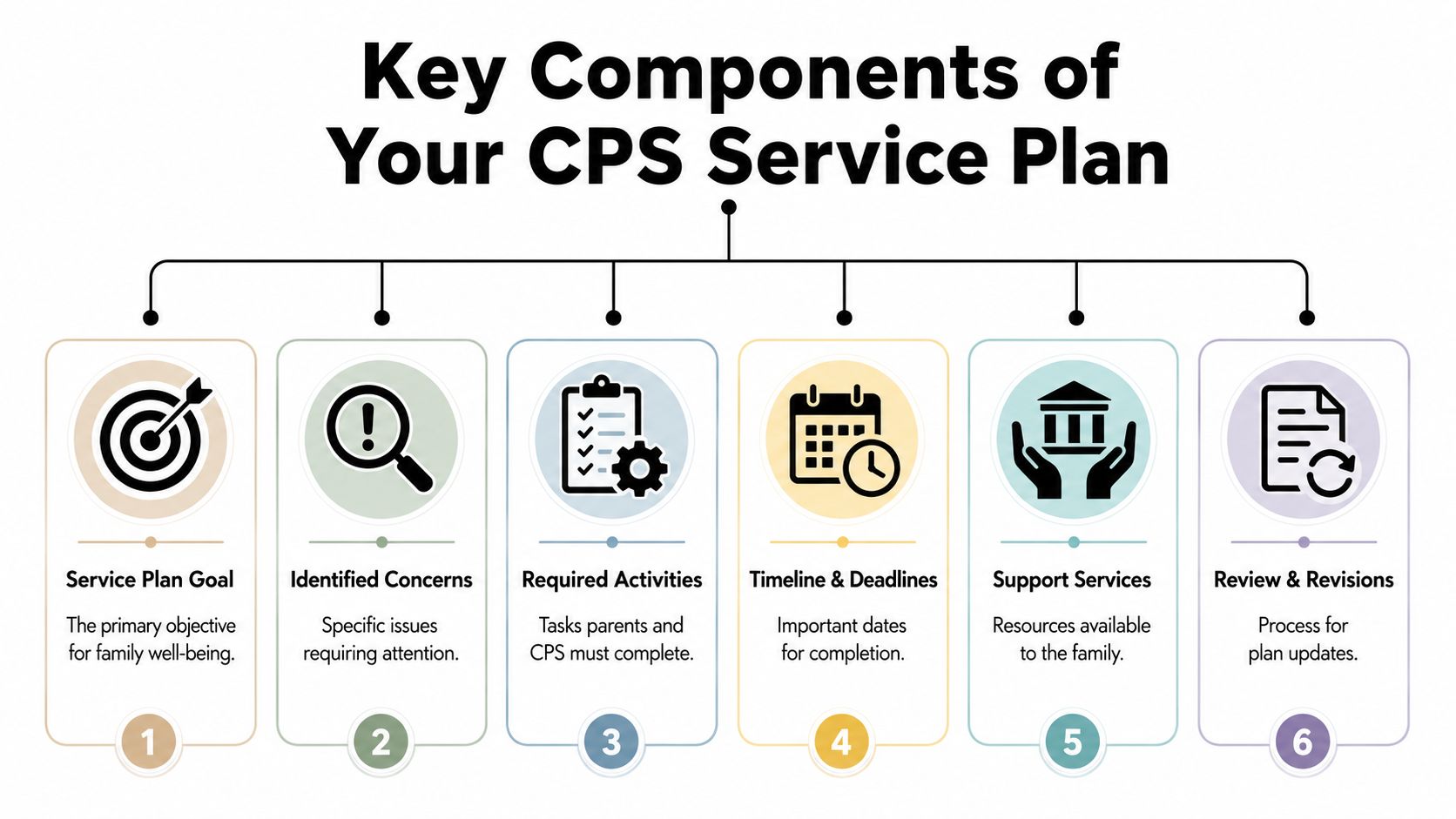
The concerns CPS says it is addressing
This section should tell you why CPS is involved. In a family preservation case, Texas law requires a Family Preservation Services Plan to include a safety risk assessment, state the reasons for department involvement, and be designed to address only the specific factors that make the child a candidate for foster care under Texas Family Code Section 262.407.
If this section is vague, the rest of the plan may be too. You should be able to point to the concern in plain language.
For example, if CPS alleges neglectful supervision because a child was repeatedly left with an unsafe caregiver, the plan should identify that supervision problem directly. It should not drift into unrelated tasks without explanation.
The goal and the tasks
Most plans state a primary permanency goal and at least one alternative goal. The plan should also spell out the behavioral changes or skills CPS says you need to develop.
You may see tasks such as:
- Counseling or therapy: Usually meant to address coping, trauma, anger, or decision-making concerns.
- Drug or alcohol assessment: Often used when the allegation involves substance use or impaired supervision.
- Parenting classes: Supposed to target discipline, supervision, routines, or child development issues.
- Stable housing or employment tasks: Used when CPS believes instability affects child safety.
Here's where many parents get trapped. They assume every listed service must be accepted without question. But the key issue is whether each task addresses the stated concern.
If the allegation is substance use, but your plan is loaded with unrelated classes and vague “insight” requirements, ask for an explanation in writing.
The services CPS says it will provide
A service plan doesn't just assign duties to parents. It should also identify what CPS will do. That may include referrals, provider information, scheduling help, or contact with a placement.
The plan should also describe how progress will be evaluated and what completion looks like. That's important because “start counseling” and “successfully complete counseling” are not the same thing.
A simple example helps. Suppose a father is accused of marijuana use while caring for his child. A targeted plan might require a substance abuse assessment, random testing, counseling if recommended, and a sober caregiver backup plan. That makes sense because each task connects to the alleged risk. A bloated plan that also demands unrelated parenting classes, anger counseling, and vague “life skills” work may waste time that could be spent fixing the underlying problem.
The CPS Service Plan Process and Key Timelines
Time matters in every CPS case. Parents often focus on the tasks in the plan and overlook the calendar. That's a mistake. Deadlines shape whether CPS sees a parent as progressing, stalling, or failing to engage.
A basic timeline can make the process easier to follow.

The early stage of the case
In FBSS, the Family Plan of Service must be developed within 21 days after the case opens unless a supervisor approves an exception, and it must explain why DFPS is involved, what tasks are required, how those tasks address the concern, and how progress will be measured, as explained by Texas Law Help's overview of FBSS and the Family Plan of Service.
If your child has been removed, the timeline changes fast. When a child is removed from the home, the caseworker must file the Family Service Plan with the court no later than 45 days after the court order, which formally starts the legal timeline for parents to complete the plan's requirements under the DFPS CPS Handbook on family service plans.
For parents trying to understand where they are in the bigger process, a guide to the Texas CPS timeline and key expectations for parents can help place the service plan in context.
What happens after the plan is signed or ordered
Once the plan is active, CPS doesn't just wait until the end to check on you. Progress is monitored throughout the case.
A parent may find it useful to compare the service-plan process with The Texas CPS Case Timeline From Start to Finish, which maps every stage and deadline in a Texas CPS case for parents.
Here's the practical flow:
- Plan creation. CPS drafts the document and discusses it with you.
- Plan becomes effective. This may happen by signature or court order.
- Services begin. Referrals, classes, therapy, testing, and visitation conditions start.
- Progress checks happen regularly. Missed appointments and incomplete tasks are noticed early.
- Formal reviews shape the next step. The plan may be revised, extended, or used against you.
Missed time at the beginning of a CPS case is hard to recover later. If a referral is wrong, delayed, or unclear, raise that problem immediately.
This timeline is also where parents confuse a safety plan with a service plan. A safety plan usually addresses immediate risks. A service plan is the longer legal roadmap. Treating them as the same document can create serious misunderstandings.
Understanding Your Parental Rights and Obligations
You are sitting at your kitchen table with a CPS plan in front of you. One line says counseling. Another says drug testing. Another mentions housing, parenting classes, and supervised visits. Your first reaction may be that you have no choice but to sign and hope for the best.
That reaction is common. It is also dangerous.
A Texas family service plan creates duties for you, but it also gives you room to ask questions, correct mistakes, and challenge terms that do not fit the allegations in your case. Parents get into trouble when they treat the plan like a simple checklist or, just as often, when they assume every line is untouchable. Neither approach protects you well.

Texas law requires CPS to prepare the service plan with the parent, not merely hand it over for signature. The plan is supposed to be specific, understandable, and tied to the changes CPS says are needed before a child can safely return home. That matters because vague instructions are hard to complete and easy for CPS to criticize later.
Your rights in the planning process
Your role is supposed to be active. You can ask what each requirement is meant to address, how completion will be measured, and what proof CPS expects from you.
Your rights generally include the right to:
- Take part in developing the plan. You should be included in the discussion, not treated like an observer.
- Receive terms you can understand. If the wording is unclear, too broad, or not in a language you read well, say that immediately.
- Get specific tasks instead of vague commands. “Maintain stability” is far less useful than a concrete request for lease documents, pay stubs, or counseling attendance records.
- Know what success looks like. You should be told what steps CPS believes will support reunification or continued placement with family.
One practical point matters here. If CPS adds a service that does not match the reason for removal or investigation, speak up early. A plan should address the alleged safety concerns. It should not become a catch-all list of classes and evaluations just because they are commonly used.
That is especially important if a Parental Child Safety Placement, or PCSP, is involved. Parents often agree to a relative placement under pressure and later realize the written expectations are murky, broader than discussed, or are treated like admissions. Read those papers carefully. If the placement terms and the service plan seem to conflict, ask for clarification in writing.
Your obligations under the plan
You also have real responsibilities. A service plan works like a roadmap, but CPS and the court will look at whether you followed the route.
Here is what that usually means in day-to-day terms:
| Obligation | What it looks like in practice |
|---|---|
| Attend services | Go to the intake, participate consistently, and keep attendance proof |
| Stay in contact with the caseworker | Confirm appointments, report scheduling problems, and respond promptly |
| Meet deadlines | Start early, because delayed services can still be counted against you |
| Keep your own file | Save certificates, emails, texts, test results, and provider notes |
Documentation matters more than many parents realize.
If you complete a class but cannot prove it, CPS may treat it as incomplete. If a provider cancels your intake, save the email or screenshot. If you need identity verification for a background check or related service, keep records from appointments such as FD258 Fingerprinting with the rest of your case paperwork. A good paper trail can stop a small misunderstanding from becoming a larger accusation.
A frequent question is whether refusing to sign makes the plan disappear. It does not. CPS may still ask the court to adopt the plan, and the court may expect compliance even if you objected to parts of it. The better approach is usually to note the disagreement clearly, ask for corrections, and get legal advice before silence is mistaken for refusal to cooperate.
A calm, specific objection is usually stronger than signing in confusion or refusing without explanation.
Where parents should speak up, and how
Raise concerns as soon as you spot them. Waiting often makes the problem look like noncooperation, even when the issue is bad drafting or poor communication.
Speak up if:
- A required task has no clear connection to the allegation
- The provider list is wrong, full, or too far away
- Work hours, transportation, disability, childcare, or language barriers make compliance difficult
- CPS gives verbal instructions that do not appear in the written plan
- A PCSP or safety-related agreement is being treated as broader than what you accepted
Be specific. Ask for the concern to be written into an email or case note. If you can comply with part of a requirement while disputing another part, do both. That shows effort without giving up your position.
Cooperation and self-protection can happen at the same time. That is the balance parents need to understand.
Consequences of Not Following the Service Plan
This is the part parents least want to hear, but it's the part you need to understand clearly. A service plan is not busywork. If you don't make meaningful progress, CPS may use that failure as part of the case for stronger intervention, including termination proceedings.
The typical Family Service Plan in Texas runs for 6 to 12 months, and parents generally get about one year to make lasting changes. If the goals are not met in that time, the state may begin proceedings to terminate parental rights, as noted in the TexProtects State of the State report discussing Texas CPS timelines and outcomes.
How noncompliance builds over time
Noncompliance usually doesn't happen in one dramatic moment. It often builds through smaller problems:
- Missed intake appointments
- Failed or skipped tests
- Dropped counseling
- No proof of attendance
- Repeated excuses without documentation
One missed class may not define your case. But a pattern can. Chapter 161 of the Texas Family Code is where termination issues become especially serious, because CPS may argue that a parent failed to do what was required to make reunification safe.
Consider a mother whose plan requires counseling, substance abuse treatment, and stable housing documentation. She completes some sessions, misses others, changes phones without telling the caseworker, and never turns in proof of what she did complete. From her point of view, she “tried.” From CPS's point of view, the record may show inconsistency and incomplete compliance.
A hidden danger with practical consequences
Parents also run into trouble when the plan asks for supporting steps that require paperwork from third parties. If a background-related task includes fingerprinting, for example, don't wait until the last minute to find a provider. A practical local option for some families may be FD258 Fingerprinting, depending on what documentation or identity verification a related service requires.
Another overlooked issue is long-term stability after services end. The same TexProtects report states that 4 in 10 families participating in Texas FBSS are re-reported for abuse or neglect within 5 years after completing the program. That doesn't mean your case is hopeless. It means CPS and the courts care not just about completion, but whether the changes look sustainable.
Finishing tasks matters. Showing that the tasks changed daily life matters more.
If you're falling behind, don't disappear. Ask for clarification, document barriers, and get legal help before the problem becomes the story of your case.
How to Proactively Respond and Work With an Attorney
You open the service plan after the meeting ends, and the first reaction is often the same. Too many boxes to check, too little time, and no clear sense of which items matter most. That moment matters because the plan is not just a to-do list. It works like the file CPS may later use to argue whether you recognized the problem, took action, and protected your child.
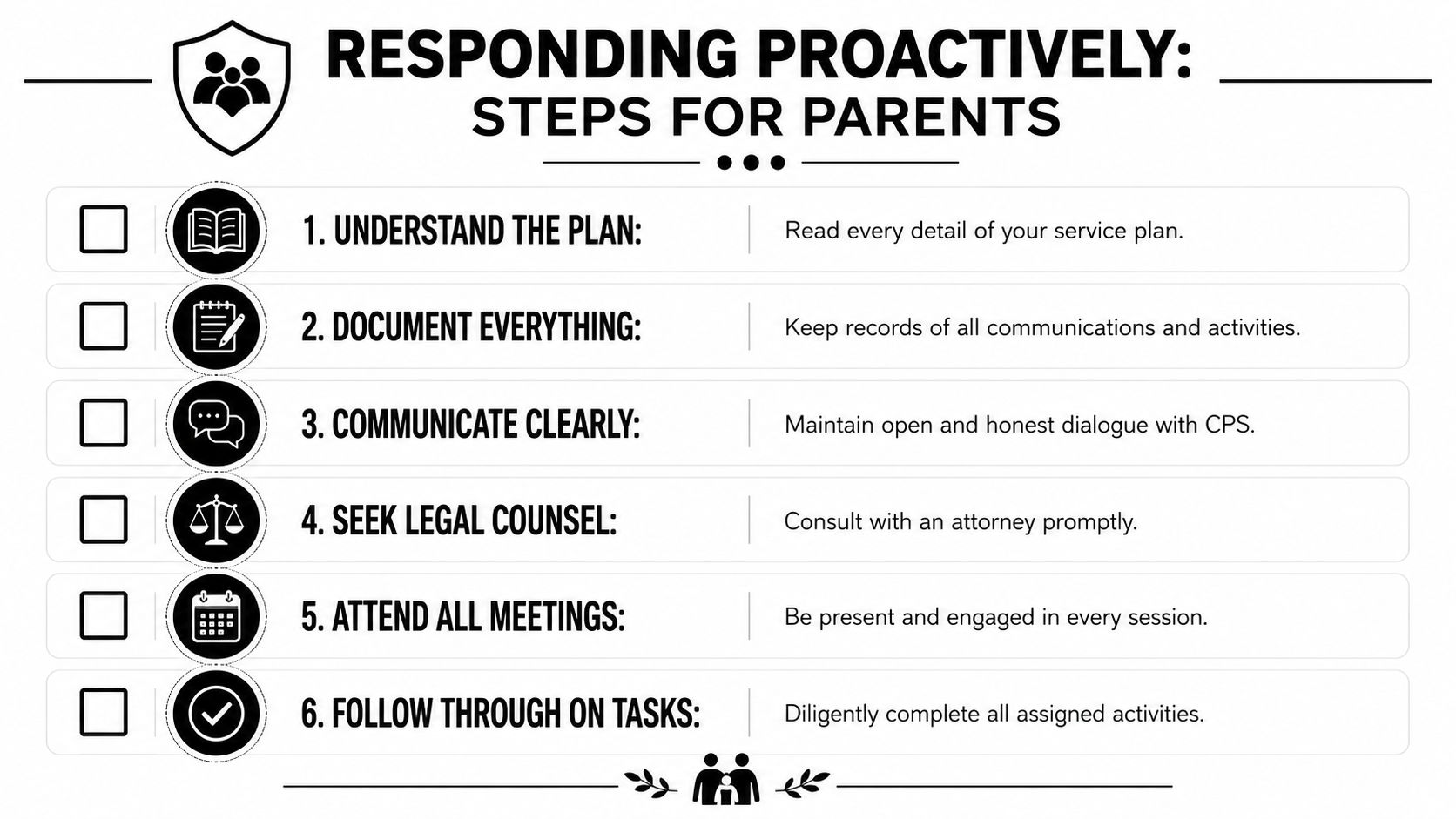
Early legal review can change the direction of the case. Some plans contain tasks that sound reasonable at first glance but have a weak connection to the actual safety allegation. An attorney can examine whether a requirement fits the facts, object to terms that are too vague to measure, and push to remove tasks that waste time without addressing the issue CPS says put the child at risk. That kind of focused review matters, especially in cases involving misunderstood side agreements such as PCSP arrangements. More detail appears in this explanation of challenging misaligned CPS service plan requirements in Texas.
Start with the paper, not the meeting
Read the written plan line by line. Parents often leave a meeting with one understanding, then discover later that the document says something broader, stricter, or less clear. A lawyer can help you compare what was said out loud with what CPS put in writing.
Then ask a simple question for each item: what safety concern is this supposed to fix? If the allegation involves unsafe supervision, the link to parenting instruction may be obvious. If the plan also demands unrelated services, broad releases, or open-ended counseling with no stated goal, that deserves a closer look.
This is a common trap for parents. They try to cooperate with everything, even terms that are poorly defined or unfair, and they lose time that should have gone toward the tasks that affect the case.
A practical checklist for a stronger response
- Read the full plan yourself. Do not rely on summaries from a caseworker, family member, or meeting notes.
- Match each task to the allegation. If the connection is weak or missing, write down your question and raise it with counsel.
- Build a compliance file from day one. Keep referrals, certificates, sign-in sheets, screenshots, emails, and proof of every call or attempted appointment.
- Record barriers in real time. If work hours, illness, transportation, waitlists, or language access cause delays, document that immediately and ask for alternatives.
- Ask for dates and definitions. Terms like “stable housing,” “participate,” or “follow recommendations” can create disputes later if nobody defined them clearly at the start.
- Get legal advice early. A parent comparing options can start with this guide on choosing the right CPS defense attorney in Texas.
What an attorney should help you do
A good lawyer does more than attend hearings. Your lawyer should help you identify vague language, preserve objections, request written clarification, and create a paper trail showing that you asked reasonable questions and made real efforts to comply.
That is especially important with Parental Child Safety Placement agreements. Many parents treat a PCSP like an informal family arrangement because the child is staying with a relative or family friend. In practice, those agreements can create serious risk if the deadlines pass and nobody pushes for a clear legal plan. A lawyer can explain whether the placement is still voluntary, whether CPS is expecting more from you than the written agreement says, and whether delay is putting you in a weaker position.
The practical answer is this: a family service plan is a legal roadmap, and it can also become evidence. Treat every page, every task, and every communication as part of the record from the first day.
If CPS has handed you a service plan, you don't have to guess what it means or whether its terms are fair. The attorneys at Law Office of Bryan Fagan PLLC help Texas parents understand service plans, respond strategically, and protect their rights during CPS cases. Contact the firm for a free consultation if you want a clear review of your plan, your options, and the steps that can put you in a stronger position starting now.