Skip to content
A police officer hands you a ticket after a loud argument, and your stomach drops. The charge says Class C misdemeanor, maybe disorderly conduct, maybe public intoxication, maybe something else that sounds small compared to the fear racing through your mind. For a parent, the first question usually isn't about the fine. It's whether this can hurt your job, your custody case, or the way a CPS worker sees your home.
That fear is understandable. A minor criminal charge can feel much bigger when you're already dealing with stress at home, conflict with a co-parent, or questions from Child Protective Services. Many parents make the same mistake in that moment. They assume paying the ticket is the fastest way to make it disappear. In Texas, that can create the very record you were trying to avoid.
If you're asking can a class c misdemeanor be dropped, the answer is often yes. But the answer depends on how the case is handled from the start, what court it's in, your prior history, and whether you follow through on the final step of clearing the record.
That Ticket Is More Than Just a Fine It’s Your Family’s Future
A father gets cited after neighbors call police during a late-night argument. No one goes to jail. The officer writes a ticket for disorderly conduct and leaves. By morning, the house is quiet, but the panic has set in. He isn't thinking about the amount of the fine. He's thinking about the custody order already in place and whether the other parent will use this in court.
That's how these cases usually feel in real life. The legal system treats a Class C charge as the lowest level of misdemeanor. Families don't experience it that way. They experience it as a threat to stability.
Why parents feel this so intensely
A Class C case can raise several worries all at once:
- Your children: You may worry that CPS will view the incident as proof your home is unsafe.
- Your co-parent: In a custody dispute, the other side may try to frame the citation as evidence of poor judgment.
- Your work: Even a low-level offense can create anxiety about background checks and professional reputation.
- Your future choices: You may feel pressure to resolve it quickly, even if the quickest option isn't the safest one.
A small charge can become a big family problem when it gets misunderstood, oversimplified, or left unaddressed.
For parents, the hardest part is often the uncertainty. You may not know whether this was a one-time mistake, a misunderstanding, or a charge that can be negotiated away. You may also not know that paying the fine often acts like a guilty plea in practical terms, which can make later family court explanations much harder.
The family law angle people often miss
In CPS matters and custody litigation, context matters. But records matter too. A judge, caseworker, or opposing lawyer may not see the whole story right away. They may first see a citation, a court record, or a background report. That is why the goal isn't just to "get through" the ticket. The goal is to protect your record and your credibility as a parent.
If you're carrying the fear that one bad night could change how the system sees your family, you're not overreacting. You're recognizing the stakes.
What a Class C Misdemeanor Really Means in Texas
In Texas, a Class C misdemeanor is the lowest level of criminal offense. Under Texas Penal Code § 12.23, the penalty is a fine of up to $500 and no jail time, as noted in this Texas Class C misdemeanor overview and reflected in the verified legal data above.

That sounds minor. It's not minor when a conviction lands on your record.
Common examples and the hidden problem
Class C charges often involve low-level conduct such as disorderly conduct, public intoxication, traffic-related matters, or minor theft under $100. Because they are fine-only offenses, people often treat them like parking tickets. That comparison causes damage.
A criminal citation can still become a record that follows you. In family law settings, even a low-level conviction may be used to suggest instability, poor impulse control, substance misuse, or conflict in the home. A CPS investigator or opposing parent may not care that there was no jail risk. They may care that there was a criminal case at all.
Why prior history matters more than people expect
Prosecutors don't always look at a new Class C charge in isolation. Verified guidance tied to Texas judicial and court management reporting notes that repeat-offender algorithms and local district attorney charging policies increasingly treat a history of technical or non-jail infractions as a risk factor, even for Class C cases, as discussed in this article on navigating Class C misdemeanors in Texas.
That means even old tickets, dismissed citations, or other minor contacts can affect whether a prosecutor is willing to offer a favorable resolution.
Practical rule: If you've had other low-level citations before, don't assume this new one will be handled as a simple first-time mistake.
Why paying the fine can hurt you
Here's the confusion point. Many people hear "no jail time" and think "no real consequence." But the legal question isn't just punishment. It's whether the case ends in a conviction or in a dismissal path that can later be cleared.
A quick comparison helps:
| Choice | Immediate feeling | Long-term effect |
|---|---|---|
| Pay the fine | Fast and easy | May leave you with a conviction record |
| Fight for dismissal or deferred disposition | More work now | Better chance to protect your record |
| Ignore the ticket | Temporary avoidance | Can create much bigger court problems |
For a parent in a CPS investigation or custody dispute, that distinction matters. The difference between "I paid it and moved on" and "the case was dismissed" can shape how your judgment is perceived later.
How We Get Class C Misdemeanors Dropped
A Class C misdemeanor can be dropped in several ways. The right path depends on the facts, the court, your history, and what the prosecutor is willing to consider. If you want the practical answer to can a class c misdemeanor be dropped, these are the typical ways it occurs.
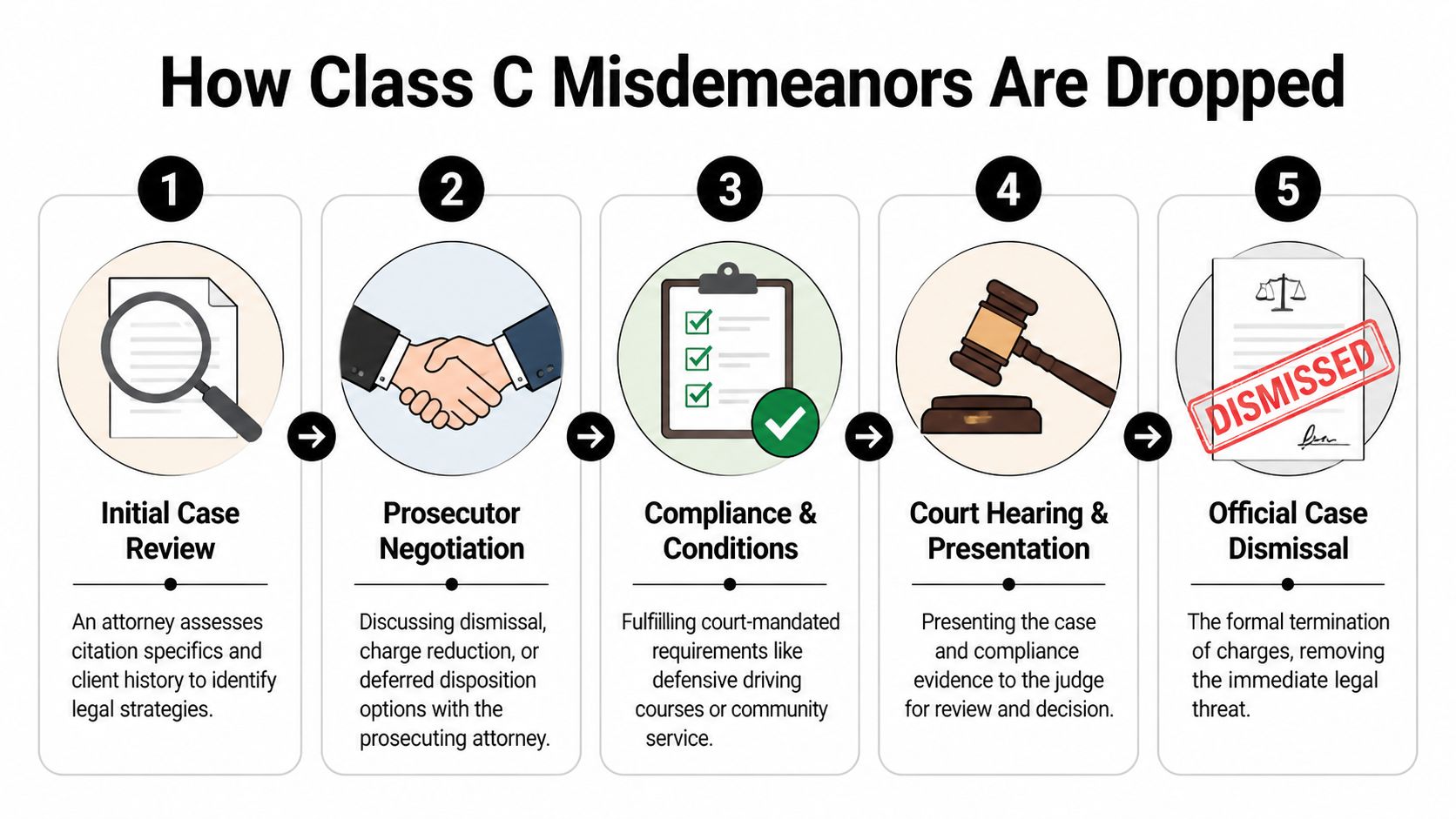
Many families feel better once they understand that there isn't just one outcome. There are several. You can read more about the broader dismissal process in this guide on how to get criminal charges dropped.
Outright dismissal
Sometimes the cleanest result is a prosecutor dismissing the case. That may happen if the evidence is weak, the witness situation is unreliable, the officer's version doesn't hold up, or the circumstances make prosecution unnecessary.
This isn't automatic. Someone has to present the problem clearly and early. In a family-related incident, details matter. Was there an actual disturbance, or just a heated verbal disagreement? Was the citation based on incomplete information? Was the officer trying to separate people and calm things down, rather than documenting a serious offense?
A dismissal means the case ends without a conviction. For many parents, that's the best immediate result.
Deferred disposition
This is often the path people use. Verified data states that deferred disposition is the most common pathway for Class C offenses, typically requiring 90 to 180 days of compliance with court conditions. After successful completion, the person becomes automatically eligible for expunction, according to this Texas expunction discussion for Class C misdemeanors.
The conditions vary by court and offense. They can include things like a class, community service, fines, or other compliance requirements. The key point is that you complete the conditions first, and then the court dismisses the case.
That is very different from pleading guilty and paying the ticket.
Pretrial diversion or similar local programs
Some courts or prosecutors offer first-offender style resolutions for low-level cases. These programs are designed to give people a path to dismissal if they meet certain conditions. Availability depends on the county, the court, the charge, and your prior record.
Local practice matters. One court may be open to a practical resolution. Another may be stricter, especially if your history shows repeated low-level citations.
What the process usually looks like
Most Class C dismissal work follows a sequence like this:
Review the citation and background
Your lawyer looks at the charge, the court, any reports, and your prior history.Contact the prosecutor or court
The goal is to identify whether dismissal, deferred disposition, or another favorable outcome is available.Complete any required conditions
If the court offers a deferred route, you must finish every requirement on time.Return to court or submit proof
The judge or clerk needs confirmation that you've done what was required.Get the dismissal entered properly
This step matters because later record-clearing depends on how the case was formally resolved.
If the court offers a second chance, treat every condition like it affects your children, your job, and your future. Because it might.
For parents, the emotional trap is impatience. People want the stress over immediately, so they choose the fastest option. The better strategy is usually the one that avoids a final conviction.
A Tale of Two Tickets A Real-Life Scenario
Maria and David are both parents. Both receive a Class C citation for public intoxication after a rare night out that ends badly. No one is accused of harming a child. No one goes to jail. On paper, their situations look almost identical.
David decides to pay the fine online. He tells himself it's minor and he doesn't have time to miss work over a ticket. Months later, he's applying for a new position while also trying to show the other parent he's stable and reliable. The charge now requires explanation. What felt like a shortcut became a record he has to carry.
Maria pauses before doing anything. She's already in tense custody negotiations, and she knows the other side will seize on any criminal record. She asks a lawyer to review the case before entering a plea.
Why their outcomes diverge
Maria's attorney learns that the court is open to a deferred resolution. She completes the required conditions, keeps proof of everything, and the case is dismissed. Later, she pursues the final record-clearing step.
David, by contrast, doesn't get to tell the story as a dismissed case. He has to explain a conviction.
Neither parent was a bad person. Neither one thought a low-level citation could carry that much weight. The difference was not morality. It was strategy.
What this means in family court
In a custody case or CPS matter, that difference changes the conversation.
A dismissed case allows a parent to show responsiveness, compliance, and follow-through. A paid ticket may still be survivable, but it gives the other side more room to argue that the parent admitted criminal wrongdoing. That doesn't automatically decide a family law case, but it can complicate one.
A simple comparison makes the point:
| Parent | First reaction | Legal result | Family law impact |
|---|---|---|---|
| David | Paid the fine | Conviction risk | Must explain the record |
| Maria | Sought advice first | Dismissal path | Better position to protect credibility |
The same citation can lead to two very different futures, depending on what you do in the first few days.
This scenario is fictional, but the pattern is real. Parents often assume the least serious charge deserves the least attention. In practice, low-level cases often deserve fast, careful attention precisely because they seem so easy to mishandle.
The Final Step Expunging the Record for Good
Many people relax once the court dismisses the case. That relief is understandable, but dismissal and disappearance are not the same thing. A dropped case does not automatically vanish from every system that collected information about the arrest or citation.

For many Class C cases, the final protective step is expunction. You can learn the basics in this Texas guide on how to expunge a misdemeanor.
What expunction does
Verified data states that, under specific statutory conditions in Texas law, a Class C misdemeanor can be erased through expunction after deferred disposition and dismissal, allowing the matter to be treated as though the arrest never occurred. Verified data also states that completion of deferred adjudication for a Class C can allow immediate eligibility for expungement, with the applicable legal framework discussed in the cited materials above.
A dismissed charge can still sit in databases until someone takes action to clear it. In family and employment settings, old data can cause new problems.
Why delay can still hurt you
One of the most overlooked issues is timing. Verified guidance explains that even after a court-ordered expunction, outdated arrest information can remain on commercial background-check platforms for months, as noted in this discussion of whether a Class C misdemeanor stays on your record in Texas.
That means a parent can do everything right in court and still face headaches afterward if a private screening company hasn't updated its records.
What to do after the court signs the order
The practical side matters here. Keep copies. Follow up. Be ready to dispute stale records.
- Keep the signed paperwork: Save certified copies of the dismissal and expunction order.
- Check background reporting issues: If an employer or landlord sees old information, ask what vendor supplied it.
- Dispute outdated records: Commercial screening companies may need direct notice and supporting documents.
- Tell your attorney about lingering entries: Sometimes the legal victory is complete, but the data cleanup isn't.
Clearing the case in court is only part of the job. Clearing the record in the real world may take more follow-up.
For Texas parents, this step has a very human purpose. It reduces the chance that an old citation resurfaces when you're applying for work, renewing a license, or trying to show a judge that your family is stable and moving forward.
Your Action Plan in Houston Dallas Austin and San Antonio
When a citation lands in your hand, anxiety can make you freeze or rush. Neither reaction helps. A short plan gives you something solid to do next.

Whether your case is in Houston, Dallas, Austin, San Antonio, or a surrounding county, local procedure matters. Municipal courts and Justice of the Peace courts can handle Class C matters differently, even when the charge sounds familiar.
What to do first
Start with these steps:
- Don't pay the fine just to get it over with: That may shut down better options.
- Read the citation carefully: Confirm the offense, court, appearance date, and any instructions.
- Write down your memory now: Names, time, location, what was said, who was present, and anything police missed.
- Save documents and messages: Receipts, videos, texts, witness names, and photographs can matter later.
- Find out what court has the case: Procedure can differ depending on whether it's a municipal court or JP court.
The appearance date on the ticket often confuses people. It usually isn't the final trial date. It's the date by which you must respond or appear.
Why local knowledge matters
The same Class C citation can unfold differently depending on the county, the court staff, and the prosecutor's office. A lawyer who regularly practices in the area can often identify practical options faster because they know how that court tends to handle first-time low-level cases, family-related disturbances, and deferred resolutions.
If CPS is already involved, or if custody litigation is pending, tell your lawyer immediately. A criminal strategy should take the family law context into account from day one.
This short video gives additional context on handling a Texas criminal matter with care:
A simple checklist for worried parents
| Task | Why it matters |
|---|---|
| Respond before the deadline | Missing court can create avoidable problems |
| Preserve evidence | Small details often help low-level cases |
| Avoid discussing facts casually | Statements can be repeated or misunderstood |
| Coordinate criminal and family strategy | CPS and custody issues can overlap |
| Ask about dismissal paths early | The best options are often time-sensitive |
If your main question is still can a class c misdemeanor be dropped, the practical answer is this. Often yes, but only if you treat it like a legal problem instead of a minor inconvenience.
A Minor Charge Doesn’t Have to Cause a Major Crisis
A Class C misdemeanor can feel humiliating, especially when you have children depending on you and other legal stress already hanging over the house. But a citation is not the same thing as a permanent label. In many Texas cases, there is room to pursue dismissal, deferred disposition, and later expunction.
The biggest mistake is passive acceptance. Parents who act early usually have more room to protect their records, explain the surrounding facts, and prevent a low-level charge from becoming a larger family problem. That is especially true when CPS concerns or custody disputes are part of the picture.
If you're scared, that doesn't mean you're weak. It means you understand that family stability can be fragile when legal issues collide. A thoughtful response can make an enormous difference.
Your next step doesn't have to be dramatic. It just needs to be smart. Keep the paperwork. Protect the facts. Don't assume paying the fine solves the problem. Ask how the case can be resolved in a way that protects both your record and your role as a parent.
If you're facing a Class C misdemeanor and you're worried about how it could affect your children, your custody case, or a CPS investigation, talk with Law Office of Bryan Fagan PLLC. The firm offers free consultations and can help you understand your options, protect your record, and build a plan that puts your family first.