Skip to content
The call comes in. Or there's a knock at the door. A caseworker says your child is being removed, and suddenly nothing feels stable anymore.
Most parents in that moment aren't thinking about statutes, deadlines, or courtroom procedure. They're thinking, “How do I get my child back?” They're scared, angry, confused, and often too overwhelmed to tell their side clearly. That's normal.
What many parents don't realize is that Texas law gives them an early chance to challenge what happened. If CPS has removed your child, one of the most important events in your case is the adversary hearing. This is often your first real opportunity to push back, present facts, and ask the court to return your child or place your child somewhere safer and more appropriate than foster care.
If you're asking What Is an Adversary Hearing in Texas CPS Cases?, the short answer is this: it's not the end of the case, but it may be the first moment your voice can change its direction.
The Moment Your World Stops A CPS Removal
A CPS removal can feel unreal.
One parent is at work when the call comes. Another is standing in the kitchen while a caseworker explains that the agency believes the child can't safely stay home. A grandparent is trying to make sense of what just happened while everyone talks over each other. In many families, those first hours are filled with panic and bad decisions. People argue. They post online. They call relatives before they call a lawyer.
That reaction is understandable. It also makes a hard situation harder.
What parents usually feel first
Most parents I speak with after a removal say some version of the same thing. They feel blindsided, even when CPS had been involved before. They don't understand what evidence CPS has, what the judge will look at, or whether anyone is going to listen to them at all.
The emotional shock matters because it can trick you into becoming passive. You may start to believe the system has already decided everything. It hasn't.
Practical rule: The period right after removal is not the time to freeze. It's the time to get organized, get legal advice, and prepare for the first hearing that can test CPS's claims.
The first opening to fight back
An adversary hearing is often the first meaningful checkpoint after removal. It's where the court starts examining whether CPS had a legal basis to act and whether your child needs to remain out of your home while the case continues.
That's why I tell parents to stop thinking of themselves as bystanders. Start thinking of yourself as a participant in your own defense. Gather names. Save messages. Write down what happened while it's still fresh. Identify safe relatives. Ask what documents CPS filed. Learn what happens at your first CPS court hearing in Texas, because that first hearing can shape everything that follows.
A removal is terrifying. But it is not the same thing as a final judgment against you.
Defining the Adversary Hearing Your 14-Day Lifeline
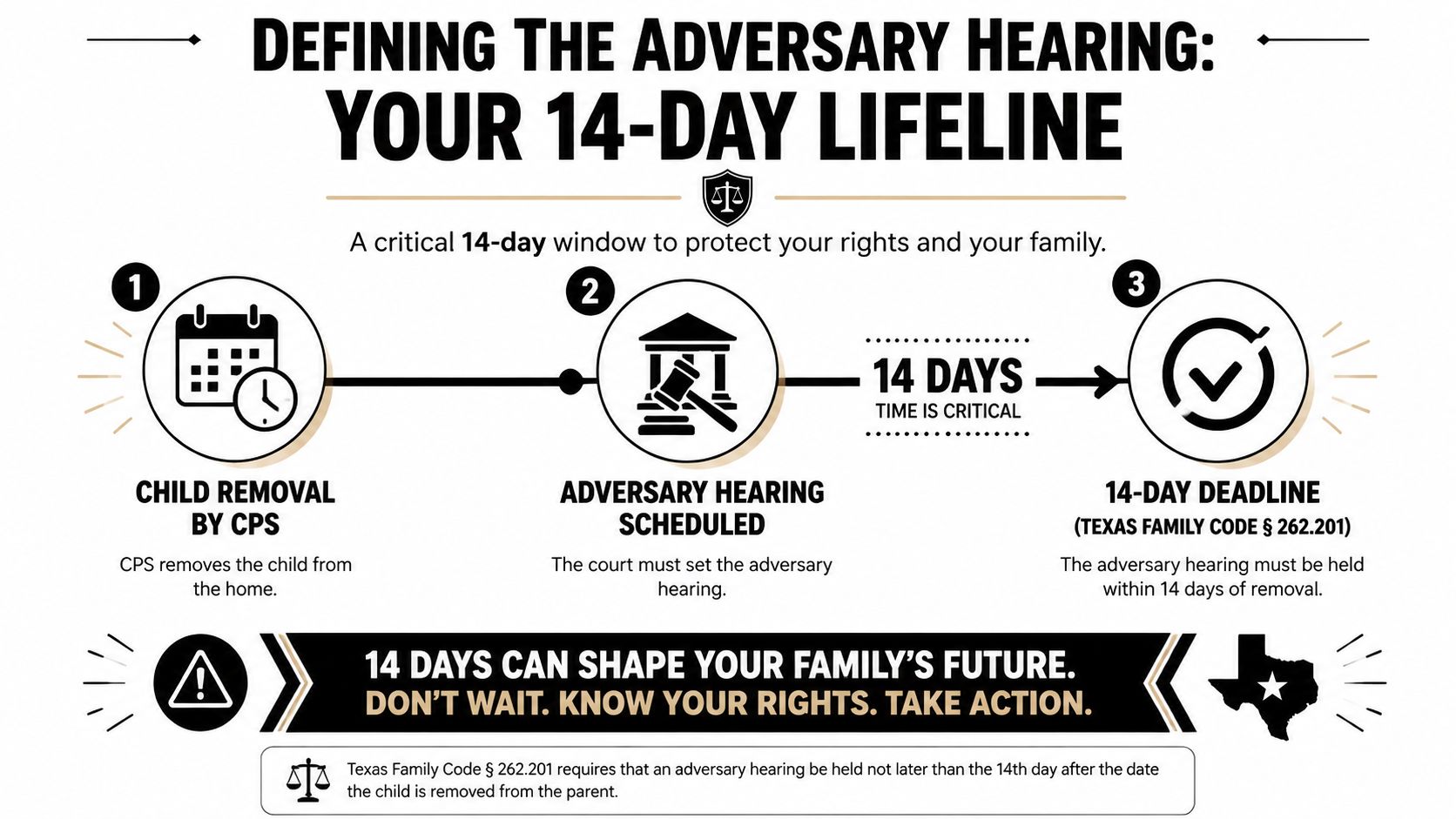
A child has been removed, and the clock starts immediately. In Texas, the adversary hearing is usually the first real chance to ask a judge to look past CPS's emergency version of events and decide whether your child must stay out of the home while the case continues.
This hearing happens early for a reason. Texas law generally requires it within 14 days of removal or the filing of the suit, unless the child is returned or the court allows more time. For parents, that short window matters because the outcome can determine where your child lives for the duration of the case.
What the judge is deciding
The judge is not deciding permanent custody or whether parental rights will be terminated. Those questions come later under different parts of the Texas Family Code and under a different record.
At this stage, the court is deciding a narrower and very practical set of issues. Was there a legal basis for the emergency removal? Does the child need to remain outside the home right now? What temporary orders should control contact, services, placement, and day-to-day decision-making until the next phase of the case?
That narrower focus can help parents. A hearing like this is often won or lost on specific facts, specific safety concerns, and whether a less drastic option was available.
What CPS must show
CPS still has work to do at this hearing. The agency does not keep custody just because it filed a case first.
The court looks at whether CPS has evidence of immediate danger to the child's physical health or safety, whether urgent removal was necessary, and whether reasonable efforts were made to avoid taking the child from the home. The legal standard at this stage is often described in Texas practice as what a person of ordinary prudence and caution would believe.
In plain terms, CPS must connect the facts to present safety risk. Concerns about parenting, a messy house, family conflict, or an isolated mistake do not automatically justify continued separation. If a sober grandparent was available, if the alleged danger had already been addressed, or if CPS left out facts that change the safety picture, those details can matter a great deal here.
What this means for you
Parents often come into this hearing with the wrong assumption. Some expect the judge to return the child automatically. Others assume the removal means the court has already chosen CPS's side.
Neither view helps.
The better approach is to treat the adversary hearing as your first opportunity to challenge the removal with evidence, witnesses, documents, and a safe plan. At this stage, a parent can do more than react. A parent can point out gaps in the affidavit, explain what really happened, identify relatives for placement, show steps already taken to protect the child, and ask the court for return or for a less restrictive temporary arrangement.
That is why I call it a lifeline. It is a short deadline, but it is also your first meaningful chance to be heard and to push the case in a better direction early.
The Key Players in the Courtroom and What They Want
Courtrooms feel less intimidating when you know who is there and why. In a CPS adversary hearing, each person in the room has a different job, and those jobs don't always align with what you want.
Who's who at your adversary hearing
| Player | Role | Primary Goal |
|---|---|---|
| Judge | Neutral decision-maker | Decide whether CPS has shown the child should remain out of the home and what temporary orders are necessary |
| CPS Attorney | Lawyer for the state agency | Defend the removal and ask the court to keep protective orders in place |
| CPS Caseworker | Fact witness involved in the removal or investigation | Explain what CPS observed, what actions were taken, and why removal was requested |
| Attorney Ad Litem | Lawyer appointed for the child | Advocate for the child's best interest |
| Parent's Attorney | Lawyer for the parent | Challenge CPS evidence, present the parent's side, and seek the child's return or a less restrictive option |
| Parent | Central witness and decision-maker for the defense | Help counsel with facts, documents, witnesses, and testimony |
The judge and the CPS side
The judge is not there to punish you for being accused. The judge's role is to listen, evaluate the evidence presented at this hearing, and decide what temporary arrangement is legally justified.
The CPS attorney is trying to preserve the removal. That lawyer will rely on the affidavit, the caseworker's testimony, and any supporting evidence to persuade the judge that the child should remain out of the home. The presentation may sound confident. That doesn't mean it's complete or unchallenged.
The caseworker is often a central witness. What the caseworker did, saw, heard, and documented can carry major weight. But caseworkers can also rely on incomplete information, secondhand reports, or assumptions that need to be tested in court.
The child's lawyer and your side
The attorney ad litem represents the child, not you and not CPS. In some hearings, the ad litem may agree with CPS. In others, the ad litem may support a return home, placement with a relative, or conditions that better preserve the family bond.
Your attorney has a very different task. Your lawyer looks for gaps, context, safer alternatives, and evidence that CPS left out. That can include housing records, medical information, school information, witness testimony, messages, photographs, or proof that another caregiver is available.
Knowing each person's role helps you stop reacting emotionally to the room and start responding strategically to it.
What doesn't work in this room
A few approaches consistently hurt parents:
- Arguing with everyone: The judge won't be persuaded by anger directed at the caseworker or CPS attorney.
- Treating the hearing like a chance to vent: Relevant facts matter more than outrage.
- Assuming the truth will “just come out”: It usually won't unless your side presents it clearly.
The hearing is not informal. It's a legal contest over temporary custody and safety.
The Legal Hurdle CPS Must Clear Immediate Danger
Parents often hear legal phrases in court that sound larger than life. The phrase that matters most here is immediate danger.
In plain English, CPS must connect the removal to a safety threat serious enough to justify emergency action and continued separation at this early stage. The agency also has to show that removal was necessary rather than merely preferable.

What immediate danger does and does not mean
Immediate danger does not mean a parent has flaws. It does not mean a home is under stress. It does not mean CPS disapproves of your choices.
It means CPS is claiming the child faces a serious enough safety risk that the court should allow the child to remain outside the home right now.
A useful way to think about it is this. CPS must do more than point to a problem. It must persuade the court that the problem creates a current safety concern that cannot be managed by a less drastic option.
How your lawyer challenges that claim
A defense at this stage usually focuses on the weak points in the agency's story.
That can include:
- Questioning the facts: Were the injuries explained by medical records, school records, or ordinary childhood activity?
- Questioning the urgency: Was the risk current, or was CPS relying on stale or exaggerated information?
- Questioning alternatives: Could a safety plan, another parent, or a relative have protected the child without removal?
Parents who want a clearer explanation of this issue often benefit from reading about the burden of proof in a Texas CPS case, because the hearing turns on how well CPS supports its allegations, not just how strongly it states them.
If CPS cannot tie its evidence to an ongoing safety need, the judge has room to reject continued removal or order a less restrictive solution.
Why this standard matters emotionally and legally
This legal standard gives worried parents something concrete to focus on. You are not fighting every criticism anyone has made about you. You are addressing a specific legal claim about current danger.
That shift matters. It changes preparation from “defend my whole life” to “answer the exact safety allegations with evidence, witnesses, and context.”
Your Rights A Parent's Toolkit for the Hearing
When CPS removes a child, many parents feel like they've lost all power. That isn't true. You still have rights, and at an adversary hearing those rights can become tools.
Your rights are active, not symbolic
A right is only useful if you use it.
You have the right to an attorney. If you cannot afford one, the court may appoint one if you qualify. You have the right to know what CPS is relying on. You have the right to present your own evidence and witnesses. You also have the right to challenge the people testifying against you.
Those rights matter because adversary hearings move fast. If you wait for CPS to tell your story fairly, you may never hear your side fully presented.
The tools parents can use
- Your attorney: This is the person who organizes your defense, raises legal objections, questions witnesses, and frames your evidence in a way the judge can act on.
- Your documents: Photos of the home, medical records, school records, text messages, calendars, and proof of employment can all help provide context.
- Your witnesses: Relatives, teachers, doctors, counselors, coaches, clergy, or neighbors may help the court understand what CPS missed.
- Cross-examination: Your lawyer can question the caseworker and test assumptions, timelines, and missing steps in the investigation.
What strong preparation looks like
A prepared parent usually brings order to a chaotic situation. That means collecting records rather than relying on memory alone. It means identifying people who can testify clearly and calmly. It means telling your lawyer facts that are helpful and facts that are uncomfortable.
Some parents worry that being honest with their attorney will make the case worse. Usually the opposite is true. Hidden facts become courtroom surprises. Known facts become issues your lawyer can prepare for.
Bring your lawyer the whole story, not the polished version. A lawyer can work with difficult facts. A lawyer can't work with facts revealed for the first time by CPS in court.
What works and what does not
What works is simple, organized, and credible. A clean timeline. Relevant records. Real witnesses. Calm testimony.
What usually does not work is denial without backup, emotional outbursts, blaming everyone else, or bringing stacks of irrelevant papers that never answer the judge's core safety concerns.
The hearing is your chance to participate, not just endure.
How It Works in Real Life The Garcia Family's Hearing
The Garcia family's situation started with a report from a school. Their young son came to class with a bruise on his arm and seemed withdrawn. A report was made. CPS investigated. Before the family understood how quickly things were moving, their child had been removed.
The parents were devastated, but they did one thing right early. They stopped arguing about fairness and started gathering proof.

What they gathered before court
The Garcias collected a pediatrician's note showing their son had recently been seen after a playground fall. They pulled recent photographs of the home, including the child's bedroom, kitchen, and common areas. They also contacted a family friend and the child's aunt, both of whom had regular contact with the family and could speak about the parents' care and the child's routine.
That evidence didn't erase the accusation. It changed the picture.
What happened at the hearing
At the hearing, CPS presented the school report and the caseworker's concerns. The agency focused on the bruise, the child's demeanor, and its belief that removal was necessary to protect him.
The parents' attorney then questioned the caseworker closely. Had the worker confirmed the timing of the bruise with the doctor? Had anyone interviewed the aunt who frequently cared for the child? Had CPS considered whether the child could safely stay with a relative while concerns were evaluated? The answers exposed gaps.
The defense then presented the pediatric note, the home photographs, and witness testimony. The aunt testified that she had seen the child repeatedly in the days before removal and had no concerns about abuse. The family friend described the parents as attentive and involved. The records and testimony gave the judge a fuller account than the emergency paperwork alone.
Why the story matters
In this example, the judge ordered the child returned with temporary conditions rather than leaving the child in foster care. That result came from preparation, not luck.
The lesson is practical. Good adversary hearing outcomes often come from ordinary evidence handled well. Parents don't need a dramatic courtroom moment. They need facts, witnesses, and a clear theory of why the child can be safe without continued removal.
Fictional examples like the Garcias' mirror what happens in real cases. CPS often enters court with a head start. Parents can close that gap quickly when they act early and focus on evidence the judge can trust.
How to Prepare for Your Adversary Hearing Your Action Plan
The days before an adversary hearing usually feel chaotic. Parents are sleeping badly, replaying the removal, and wondering what to say in court. That reaction is normal. The hearing still has to be prepared like a case, not a crisis.
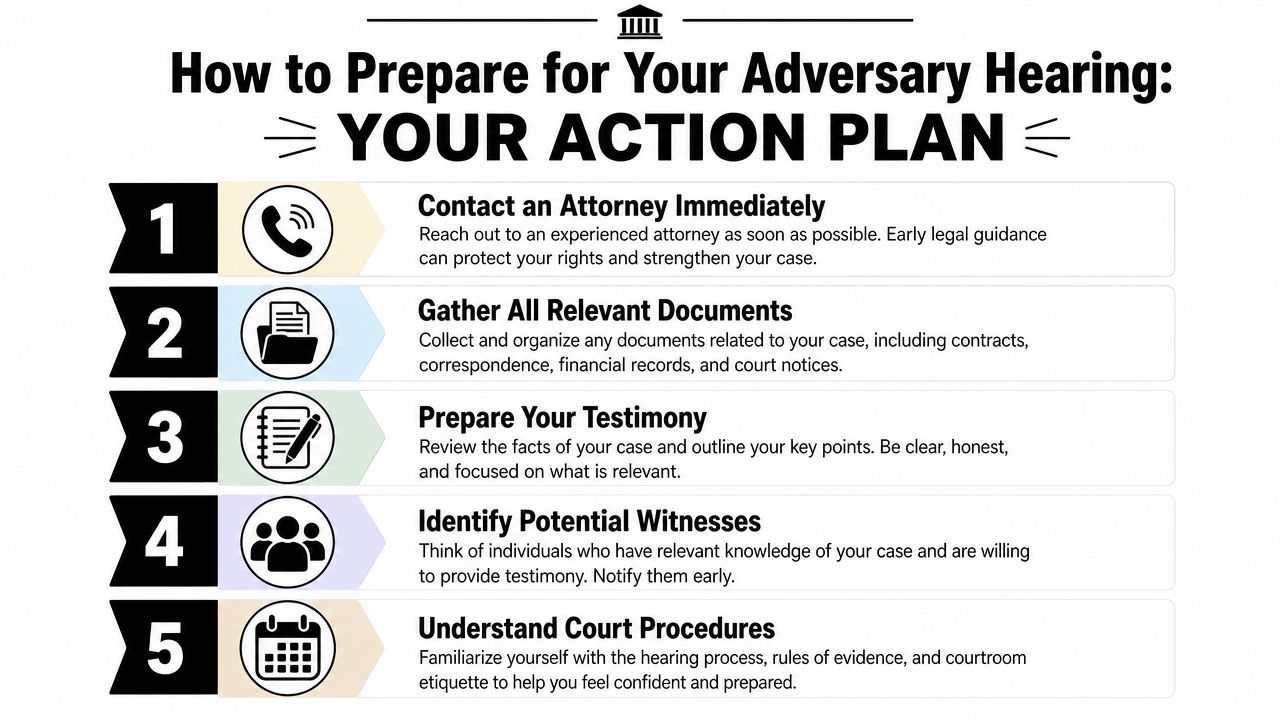
Your job is to help your lawyer give the judge a safer, fuller, and more credible picture than the one CPS presented at removal. This is often the first real chance to challenge the agency's version of events, offer a workable safety plan, and push for your child's return or placement with family instead of foster care.
Five steps to take right away
Get a lawyer involved as soon as possible
Time matters in CPS court. A lawyer who handles Texas removal cases can identify what CPS still has to prove, what evidence can help, and whether the court should hear from relatives right away. If you need a practical overview, this step-by-step guide to fighting a CPS removal case in Texas explains the early decisions that can shape the hearing.Collect proof that answers the specific accusation
Judges are persuaded by organized, relevant records. Gather medical records, school attendance records, counseling records, text messages, photos of the home, prescription information, drug test results if substance use is an issue, and proof of services already started. A short set of targeted documents is more useful than a stack of unrelated papers.Write a clean timeline while the details are fresh
Put events in order. Include who was present, what CPS asked, what you said, when the child was removed, and any facts the investigator got wrong or left out. This helps your lawyer prepare your testimony, question the caseworker, and catch inconsistencies.Line up witnesses and relative placement options
The court will want practical solutions, not just objections. Identify grandparents, aunts, uncles, close family friends, teachers, doctors, therapists, pastors, or daycare staff who know your child and can speak from personal knowledge. If a relative can take placement immediately, give your lawyer names, addresses, phone numbers, and any reason that person is safe and reliable.Learn enough about courtroom procedure to avoid preventable mistakes
Parents often focus only on the facts and overlook how testimony is presented. That can hurt. If sworn statements or later testimony may become part of the case, reading about related procedures can help. WhisperAI's guide on demystifying the court deposition gives a useful plain-English explanation of how formal testimony works.
Here's a short video that may help you get oriented before court:
What to avoid while preparing
- Do not post about the case online: Photos, comments, and angry updates can show up in court and distract from the core issues.
- Do not give casual explanations to CPS without legal advice: Be polite and cooperative, but understand that your statements may be quoted in reports or testimony.
- Do not hide bad facts from your lawyer: A hard fact handled early is manageable. A hard fact revealed in court is much harder to contain.
- Do not wait to suggest family placements: Judges often want to know what safe alternative exists right now.
- Do not confuse panic with preparation: The goal is to present evidence that answers the court's safety concerns clearly and fast.
Law Office of Bryan Fagan PLLC handles Texas CPS matters, including adversary hearings, temporary orders, and reunification issues.
Good preparation does not promise an immediate return in every case. It does change your position. Instead of walking into court as the subject of a report, you walk in ready to challenge CPS, present a safety plan, and ask the judge for a decision grounded in evidence rather than assumptions.