Skip to content
When CPS enters your life in Texas, the first feeling is often shock. Then comes confusion. A caseworker says one thing, a court notice says another, and suddenly you're hearing phrases like "adversary hearing," "temporary orders," and "burden of proof" while you're worried about where your child will sleep tonight.
If you're searching for burden of proof in cps case texas, you're probably not looking for abstract legal theory. You're trying to answer a painful, urgent question: What does CPS have to prove before the state can interfere with my family?
That question matters because the burden of proof is the rulebook. It tells the judge how much evidence CPS must bring at each stage of the case. It also tells your lawyer where to push back, what to challenge, and when a weak case can start to fall apart. If you understand that rulebook, even in simple terms, you stop feeling quite so powerless.
The Moment Your World Stands Still A Courtroom Introduction
A parent sits in a Texas courtroom, hands folded tight, listening to strangers talk about their family. One lawyer calls CPS the "petitioner." Someone refers to the parent as the "respondent." The judge asks about "immediate danger" and "reasonable efforts." The words come quickly, and none of them seem to match the reality of home life the parent knows.
That moment feels unreal. You want to stand up and say, "That's not what happened," but the hearing keeps moving. CPS may already have filed an affidavit. The investigator may sound confident. The courtroom may feel like a place where decisions have already been made.
But that isn't how the law is supposed to work.
In a CPS case, the state doesn't get to remove a child, restrict your contact, or ask for termination of parental rights solely because someone made an accusation. CPS has to meet a legal standard. That standard changes depending on where you are in the case, but the central idea stays the same. The government must prove its case.
Why this concept matters right away
For many parents, "burden of proof" sounds technical and distant. It isn't. It's the question underneath every hearing:
- Who has to prove something
- How much proof is enough
- What kind of proof a judge will accept
- What your lawyer can do to expose weak spots
If you're preparing for your first hearing, it helps to know what typically happens in Texas CPS court proceedings. Once you know the sequence, the courtroom starts to feel less like chaos and more like a process you can manage.
Practical rule: The burden of proof is not your job to carry. Your job is to protect your rights, stay organized, and make CPS prove every part of its case.
A simple example
Say CPS claims your home was unsafe because the house was messy, your child had a bruise, and a neighbor reported yelling. Those facts may sound alarming when grouped together. But a judge still has to decide whether that evidence proves legal danger under the standard for that hearing.
That's where cases are won and lost. Not in vague suspicion. In proof.
And proof can be tested.
What Is the Burden of Proof A Simple Analogy
A CPS case works less like one big decision and more like a series of checkpoints. At each checkpoint, CPS has to bring enough proof for that specific hearing. If the proof falls short, the judge is not supposed to give CPS the order it wants.
That matters because many parents hear one alarming allegation and assume the case is already decided. It is not. What matters in court is whether CPS can support its claims with admissible evidence, under the legal standard that applies that day.
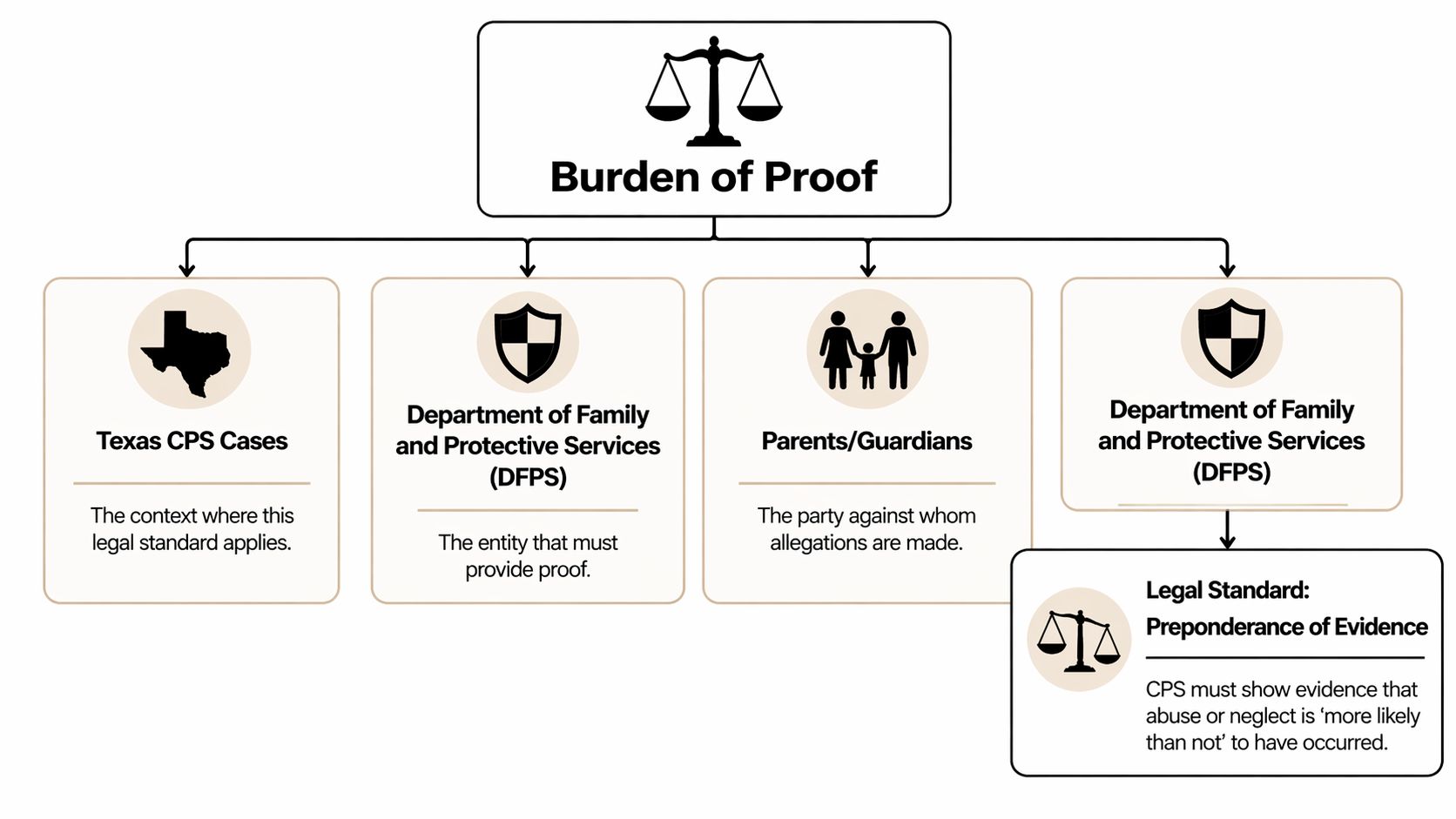
In Texas, DFPS carries that burden at every phase of the case because it is the party asking the court to act under Chapter 262. According to the DFPS attorneys' guide on evidence, the early removal standard is "sufficient evidence to satisfy a person of ordinary prudence and caution," which is the probable-cause level and lower than preponderance of the evidence.
How the analogy works in real life
A better way to understand the burden of proof is to compare it to climbing a staircase. The first step is lower than the last one. CPS may get an early temporary order with relatively limited proof, but if it wants stronger orders later, it has to climb higher with better evidence.
For a parent, that means your defense also changes step by step. At the first hearing, your lawyer may focus on immediate holes in the affidavit, whether relatives were ignored, or whether there was a safe alternative to removal. Later, the focus may shift to service-plan progress, credibility problems in witness testimony, missing records, or whether CPS can prove grounds for termination at a final trial in a Texas CPS case.
Two standards every parent should know
Preponderance of the evidence means the judge believes something is more likely true than not true.
A kitchen scale is a useful comparison here. If one side weighs even a little more, that side wins under this standard. The evidence does not have to be overwhelming. It just has to tip the balance.
Parents often miss the practical point. If CPS brings school records, medical notes, photos, and a consistent witness, and a parent comes to court with no documents and no timeline, the scale can tilt faster than expected. That is why organized records, text messages, names of witnesses, and dated photos can matter so much.
The higher standard
Clear and convincing evidence requires a much firmer level of proof.
Texas uses that higher standard when CPS asks to permanently terminate parental rights. The law demands more because the consequence is permanent. CPS cannot rely on suspicion, general concern, or a weak chain of assumptions and expect that to be enough.
This is often the point where careful parents begin to see the difference between an accusation and proof. A statement in a report may sound damaging. A statement that falls apart under cross-examination is something very different.
What this means for your defense
The burden of proof is not just a legal phrase for lawyers to argue about. It tells you what to do in the hours and days before each hearing.
- Ask what CPS must prove at this specific hearing
- Match your evidence to that issue, not every issue in the case
- Bring documents, photos, names, dates, and messages that test CPS's story
- Push for details when CPS uses vague words like unsafe, unstable, or concerning
- Make the judge look at what is missing, not just what is alleged
A parent who understands the burden of proof usually makes better decisions. Instead of trying to answer every accusation at once, you and your lawyer can challenge the weak point that matters most at that stage.
What parents often misunderstand
Parents often believe that telling the truth should be enough by itself. Truth matters, but courts work through evidence. Judges compare testimony, documents, timelines, and credibility. They also watch whether one side can answer detailed questions without changing the story.
That is why calm preparation matters so much. If CPS says you missed medical care, bring the appointment records. If CPS says your home was dangerous, bring dated photos and repair receipts. If CPS says no safe family placement existed, bring the relative's information and proof that the person was available.
The key takeaway is simple:
- CPS starts with the burden
- The burden gets heavier as the case becomes more serious
- Early orders can happen on a lower standard
- Parents protect themselves by forcing CPS to prove each claim with real evidence
The Burden of Proof at Each Stage of Your CPS Case
A Texas CPS case doesn't stay in one legal posture from start to finish. The burden changes as the case moves through removal, review, trial, and possibly termination. Understanding that timeline helps you see where to focus your energy.
At the beginning, the standard is lower than many parents realize. At the end, if CPS seeks termination, the standard is much higher. That gives your defense room to grow stronger as the case develops.
The first crisis hearing
The most shocking stage is usually the initial post-removal hearing. In Texas, the adversary hearing must occur within 14 days of removal, and the burden for initial removal is probable cause, which is less than 50% of the evidence and far below preponderance, as described in this discussion of the Texas adversary hearing standard.
That low standard explains why some removals happen on thin evidence. At this stage, CPS is trying to justify emergency action. The judge is not deciding every issue in the case forever. The judge is deciding whether CPS has shown enough to continue the removal for now.
What CPS must show early on
At the early Chapter 262 stage, CPS generally has to support the idea that there was immediate danger and that removal was necessary rather than avoidable through other means. Details are critical. Did CPS really consider a safety plan? Did it assess relatives? Did the investigator rely on firsthand facts or broad conclusions?
A parent's lawyer often attacks the case here by narrowing the issue. Not "Are we perfect parents?" but "Did CPS prove the legal basis for removal at that hearing?"
A weak affidavit can sound stronger than it is. Once the investigator has to answer precise questions under oath, the picture may change.
As the case moves forward
After the first emergency phase, the focus shifts. Later hearings often involve whether the allegations are supported well enough for the court to continue restrictions, issue temporary orders, or make findings that affect placement and services.
Parents usually do better when they stop treating the case as one giant accusation and start treating it as a series of contested decisions. Each hearing has its own purpose. Each hearing creates a new chance to challenge the state's proof.
A simple hearing map
| Hearing Stage | Governing Law (Texas Family Code) | Burden of Proof Standard | What CPS Must Prove |
|---|---|---|---|
| Emergency removal and adversary hearing | Chapter 262 | Probable cause | Immediate danger and the legal basis for continuing removal |
| Temporary orders and review-related decisions | Chapters 262 and 263 | Preponderance of the evidence | That continued court intervention is supported by the evidence |
| Final adjudication issues | Chapter 263 | Preponderance of the evidence | That abuse or neglect allegations are more likely than not supported |
| Termination of parental rights trial | Chapter 161 | Clear and convincing evidence | A statutory ground for termination and the required level of proof for ending parental rights |
The middle phase often decides momentum
The period after the initial hearing is where many parents can change the direction of the case. By then, the court has more than an affidavit. It may have school records, medical records, family testimony, photographs, service plan history, and cross-examination from both sides.
That means the case often becomes less about panic and more about preparation.
Some practical questions matter a lot during this phase:
- What exactly did CPS rely on
- Which witnesses have firsthand knowledge
- Are there records that contradict the allegations
- Did CPS leave out facts that help the parent
- Were relatives or less restrictive options overlooked
For parents preparing for a contested ending to the case, it helps to understand what happens at a final CPS trial in Texas, because the strategy should begin well before trial day.
Termination is different
Termination cases belong in a separate mental category. Temporary orders are serious. Termination is permanent.
Under Chapter 161, CPS must prove far more than concern, suspicion, or imperfect parenting. It must meet the clear and convincing evidence standard. That's a meaningful protection, and it is one reason careful preparation matters so much. The same case that looked overwhelming at the first hearing may not survive that higher burden later if the evidence doesn't hold up.
Why scared parents need to hear this
A parent often leaves the first hearing thinking, "The judge believed CPS." That's not always the right way to read what happened. Often, the judge applied a low emergency standard to limited evidence and preserved the status quo while the case continued.
That isn't a final judgment on your worth as a parent.
It means the next hearing matters. Your documentation matters. Your witnesses matter. The precision of your legal strategy matters.
A Real-Life Scenario The Garcia Family's Journey
The Garcias are a fictional family, but their situation looks a lot like what many Texas parents face.
CPS received a report after eight-year-old Sofia came to school with a bruise on her arm. Her teacher also noted that Sofia seemed tired that week. When an investigator visited the home, the apartment was cluttered, Mr. Garcia was at work, and Mrs. Garcia became upset and defensive. Within days, the family was in court.
At the first hearing, the Garcias felt blindsided. The investigator's affidavit described the bruise, the clutter, and a concern about stress in the home. To the family, those details had explanations. Sofia bruised easily and had bumped into a bedframe. The clutter came from moving furniture after a plumbing leak. Mrs. Garcia had sounded upset because she was frightened.
But the hearing moved quickly.

Why the first result felt unfair
The Garcias learned the hard way that the early burden is low. CPS didn't need to prove every allegation in a final sense at that hearing. It needed enough to persuade the judge that emergency intervention should continue temporarily.
That distinction matters, even though it doesn't feel comforting in the moment.
Mrs. Garcia kept saying, "But they didn't prove abuse." Her lawyer answered carefully: "Not yet, and that's the point. They haven't won the whole case. But we have to treat the next hearing like it matters, because it does."
What changed their case
Once the family understood the legal stage they were in, their response improved.
They started gathering:
- Medical context: pediatric records showing Sofia had no injury pattern consistent with repeated abuse
- Housing context: photographs documenting the plumbing issue and repair work
- Witness support: statements from relatives and neighbors who regularly saw the family interact
- Daily functioning records: school communications showing Sofia was generally doing well
They also worked with counsel to identify the weak points in the affidavit. Was the bruise dated accurately? Did the investigator speak with the child's doctor? Were alternatives to removal seriously explored?
The emotional shift
The Garcias stopped reacting to every accusation as if they had to disprove their entire lives in one afternoon. Instead, they started asking a better question: "What does CPS have to prove at the next hearing, and what evidence undercuts that claim?"
Fear makes everything feel final. In CPS court, many early rulings are temporary. What matters is how quickly you begin building the record.
That change didn't erase the pain. It gave them direction.
And that's what many parents need most after the first hearing. Not false comfort. A plan.
How to Challenge the Evidence and Defend Your Rights
At this stage, many parents feel pulled in two directions at once. Part of you wants to explain everything immediately. Another part wants to say as little as possible because every word feels dangerous. In court, the better approach is usually more disciplined than either instinct. You and your lawyer should treat each hearing like a specific test CPS must pass, then challenge the proof tied to that one hearing.

A CPS case often turns on small details. A missing date. A witness who never saw the event firsthand. A medical note that sounds serious until the full record is produced. Parents sometimes look for one dramatic piece of evidence that will end the case. More often, strong defense work looks like brick-by-brick repair. You gather records, correct omissions, question assumptions, and make the judge slow down long enough to see where CPS is asking the court to fill gaps with fear.
Build a hearing-by-hearing defense file
Your evidence file should help answer one practical question: what can we prove, today, that weakens CPS's claim at the next court date?
That file may include texts, emails, photos, school records, medical records, counseling records, names of favorable witnesses, and a written timeline. Organization matters. If records are scattered across phones, kitchen counters, and screenshots with no dates, useful evidence can become hard to use under pressure.
Try to keep one master folder with:
- A dated timeline: visits, injuries, doctor appointments, school issues, CPS contacts, and court dates
- Records with short notes: explain why each document matters so your lawyer can use it quickly
- Photos and videos with dates: conditions change fast, and visual proof can lose value if no one can place it in time
- A witness list: teachers, relatives, neighbors, coaches, doctors, counselors, babysitters, or clergy with firsthand knowledge
- Proof of compliance: drug test results, class certificates, counseling attendance, clean-home photos, and messages showing cooperation
That last category matters more than many parents realize. If CPS tells the judge you are resisting services or refusing to work with the agency, a stack of dated proof can answer that claim in minutes.
Challenge labels, not just facts
CPS reports often use phrases that sound settled even when they are still open to challenge. Terms like "immediate danger," "unsafe environment," or "no reasonable alternative to removal" can carry a lot of emotional weight. In court, those labels still need factual support.
A good defense does not stop at saying, "That isn't true." It asks narrower questions that expose weak foundations.
For example:
- What specific fact showed immediate danger on that day?
- Who personally observed it?
- Did that person write it down at the time, or only later?
- What did CPS do to verify the claim?
- Which relatives were considered for placement?
- What less restrictive safety options were discussed, and why were they rejected?
An analysis of how parents can fight weak CPS evidence suggests that parents should press for missing context, favorable evidence, and alternatives to removal when CPS presents a one-sided account. That is often where the case starts to shift. Judges hear many allegations. What gets attention is a clear showing that the agency left out facts that matter.
Understand hearsay before it hurts you
Hearsay confuses many parents because it sounds technical, but the basic idea is simple. One person is testifying about what someone else said, instead of the court hearing directly from the original speaker.
That matters because each retelling can distort the story. It works a little like a message passed through several people. By the time it reaches the judge, the wording may sound firmer, cleaner, and more certain than the original statement really was.
At a hearing, your lawyer may challenge statements such as:
- an investigator repeating what a neighbor allegedly said
- a report summarizing what another worker was told
- a witness describing a child's statement without enough context
- a narrative built from layered secondhand accounts
Some hearsay still comes in under legal exceptions. Even so, it should be tested. If there are concerns about the way evidence was obtained or introduced, your lawyer may also consider filing a motion to suppress evidence in Texas.
Use each hearing like a checkpoint
Different hearings call for different defensive moves. The burden on CPS changes over time, and your strategy should change with it.
At an early emergency hearing, the focus is often speed. You may need to show the judge that CPS acted on thin information, ignored available relatives, overstated danger, or failed to consider a safety plan.
At an adversary hearing, the questions often get sharper. What facts are firsthand? What parts of the affidavit are assumptions? Which records are missing? What did the investigator fail to check before asking the court to separate a child from a parent?
At later status or permanency hearings, your defense often becomes more document-driven. You may need to prove compliance, challenge service-plan complaints, and show that continued restrictions are no longer justified by the evidence.
The point is practical. Do not prepare for every hearing as if you must disprove every allegation ever made. Prepare for the decision the judge will make that day.
Questions that often help in court
Ask your lawyer whether the next hearing should focus on questions like these:
- Who observed the alleged danger firsthand?
- What document, photo, test result, or medical record supports that claim?
- What facts were left out of the affidavit, report, or testimony?
- Which favorable witnesses did CPS fail to interview?
- What alternatives to removal, restriction, or continued placement were considered?
- What has the parent done since the last hearing that the court needs to see clearly?
A short explainer can help you think about these issues before court:
Daily habits that protect your case
Courtroom defense starts at home, on your phone, and in every contact with CPS.
- Stay calm in meetings and messages: a frustrated reaction can be quoted back without the surrounding context
- Do not guess or fill in blanks: if you do not know, say you do not know
- Save every communication: texts, emails, voicemails, and service referrals may later show cooperation or inconsistency in CPS's account
- Follow court orders carefully: if something is impossible, raise it through your lawyer and document the problem
- Ask before making major statements: this matters even more if there is a related criminal investigation
- Keep your home and records ready for inspection: clean spaces, medication storage, school attendance, and medical follow-up can become evidence quickly
These are not small things. In CPS court, disciplined conduct creates credibility. Credibility helps judges trust your evidence when the facts are contested.
Common Reasons CPS Fails to Meet Its Burden
A CPS case can look strong in an affidavit and still fall apart in a courtroom. Paper allegations are only the starting point. Once testimony begins, records are compared, and dates and details are tested, weak spots often show up.
That matters to parents because the burden stays on CPS. The agency has to connect the accusation to proof that fits the legal standard for that hearing. If the proof is patchy, inconsistent, or based on guesswork, the judge may give it less weight.

Where CPS cases often break down
One common problem is weak proof dressed up as certainty. A report may use firm language like "unsafe" or "neglectful," but the supporting facts may be thin. Judges usually look past labels and ask what happened, who saw it, when it happened, and what records back it up.
Common weak points include:
- Thin documentation: serious allegations without medical records, school records, photographs, or firsthand witnesses
- Contradictory accounts: the caseworker's summary does not match what a teacher, doctor, relative, or parent says under oath
- Overstated danger: clutter, missed appointments, poverty, or family conflict gets treated as immediate danger without proof of a real safety threat
- Missing causation: CPS points to an injury, absence, or argument but cannot show who caused it or how it proves abuse or neglect
- Old facts presented as current risk: past problems are real, but CPS does not show how those facts create present danger right now
A good way to picture it is a chain. CPS needs each link. If one important link is missing, such as a reliable witness, a clear timeline, or a record that confirms the accusation, the chain may not hold.
Procedure can weaken the case too
CPS can also lose ground by handling the investigation poorly. Courts expect more than concern. They expect careful work.
If a caseworker failed to interview an obvious witness, ignored information that helped the parent, mixed up dates, relied on hearsay when better evidence existed, or came to court without the records needed to support removal, those problems matter. They give a parent and attorney specific points to press at the hearing.
This is often where practical defense begins. At each hearing, a parent should be asking, through counsel if possible: Who observed the event? Which document proves that point? Is the witness repeating someone else's statement? What was left out of the investigation? Those questions turn the abstract idea of burden of proof into something concrete.
Courts act on evidence that is tested, not on a troubling story by itself.
Why parents should pay attention to these weak spots
Parents sometimes hear an accusation and assume the case is already decided. It is not. A misunderstanding can harden into a written report very quickly, especially when the first visit happens during stress, lack of sleep, family conflict, or a messy week at home.
The defense work is often very practical and very immediate. Save texts that show who had the child. Get school attendance records. Ask for medical records. Write down names, dates, and times while they are fresh. Tell your lawyer about the witness CPS never called. Bring order to the facts before CPS's version becomes the only version in the file.
Hope comes from preparation, not wishful thinking. If the accusation does not match the full picture, the job is to show the court exactly where CPS's proof falls short and exactly what evidence fills in the missing facts.
Let Our Experience Be Your Shield Contact Bryan Fagan Today
By the time a parent reaches court, the hardest part is often the sense that life is moving faster than they can think. CPS uses legal terms. Hearings come quickly. The consequences feel enormous. In that pressure, understanding the burden of proof in cps case texas becomes more than a legal lesson. It becomes a way to steady yourself.
The state must prove its case. At the first emergency stage, the standard is low. Later, the burden becomes heavier. If CPS seeks to terminate parental rights, the law requires clear and convincing evidence. Those differences matter because they create opportunities to challenge weak testimony, missing records, unsupported assumptions, and unfair shortcuts.
Parents don't need to carry the state's burden for it. They do need to protect themselves. That means documenting facts, staying organized, avoiding impulsive statements, and preparing for each hearing with a clear legal strategy.
If you're in this position now, you don't have to sort through it alone. The Law Office of Bryan Fagan works with Texas families dealing with CPS investigations, hearings, and related legal issues. A focused legal review can help identify what CPS must prove, what evidence is weak, and what steps may strengthen your position before the next court date.
What matters most right now is acting quickly and carefully. Early decisions shape the rest of the case. The sooner you get clear guidance, the better your chances of protecting your rights and your relationship with your child.
If CPS has contacted you, filed a case, or removed your child, contact Law Office of Bryan Fagan PLLC for a free consultation. A confidential case review can help you understand the burden of proof, the next hearing, and the practical steps you can take right now to defend your family.