Skip to content
A police officer leaves. The house is finally quiet. Your child is in the next room, confused and scared. Then, maybe the next morning or later that week, someone knocks at the door and says they’re from CPS.
If that’s where you are right now, you’re probably trying to answer ten questions at once. Can they take my child? Do I have to let them in? Should I explain what happened? What if there’s also a criminal domestic violence charge? What if I’m the parent who was hurt, not the one who caused it?
A cps case for domestic violence texas often puts families on two tracks at the same time. One track is the criminal case. The other is the child welfare case. They move under different rules, but each can affect the other in ways that aren’t obvious when you’re under stress. What you say to a CPS investigator may matter in criminal court. A bond condition or protective order may make it harder to do what CPS is asking you to do. Parents get in trouble when they treat those cases as separate problems.
The good news is that a CPS investigation is not an automatic loss of your children, and a domestic violence allegation does not mean the court has already decided your future. Texas law gives CPS broad authority to investigate, but it also gives parents rights. If you understand the process early, you can make better decisions and avoid mistakes that create bigger problems later.
The Knock at the Door What Happens When CPS Is Called
A common scenario starts with an argument that turned physical, or was reported as physical. Police come to the house. Maybe one parent is arrested. Maybe no one is arrested, but the officers note that a child was present. Then CPS gets a report.
When the investigator arrives, most parents feel the same things. Panic. Shame. Anger. Confusion. Even loving, attentive parents can look suspicious in that moment because they’re overwhelmed and afraid of saying the wrong thing.
Take a simple example. A mother calls police after her boyfriend throws a chair and punches a wall. The child is never touched. By the next day, she thinks the crisis is over. Then CPS shows up because the child heard the yelling, saw the damage, and was in the home during the incident. From CPS’s point of view, the question is no longer only what happened between the adults. The question is whether the child is safe now, tonight, and next week.
That first conversation matters. So does your pace. You don’t have to make every decision at the doorstep.
Practical rule: Stay calm, ask for the investigator’s name and contact information, and don’t guess at facts you aren’t sure about.
Parents also get confused about entry into the home. In many situations, you can refuse entry unless CPS has consent, a court order, or a legal basis to enter. But refusing entry can push the caseworker to seek court involvement more quickly if they believe there is a safety risk. If you need a clearer explanation of that decision, this guide on whether you can refuse CPS entry in Texas is a helpful starting point.
The first knock at the door feels personal. It also feels final. It isn’t. It’s the beginning of a process, and your next steps matter more than your fear.
Why CPS Investigates Domestic Violence Cases in Texas
Parents often ask the same question first. “Why is CPS involved if my child wasn’t the one who got hurt?”
Because Texas looks at more than direct physical injury. CPS also looks at the child’s environment, the danger created by violence in the home, and whether the adults can protect the child from future harm. That’s why domestic violence and child welfare so often overlap.

In Texas, domestic violence is not a rare issue that only affects a small number of families. 1 in 3 Texans experience domestic violence in their lifetime, and 29.1% of CPS cases involve domestic violence exposure, according to Texas domestic violence statistics compiled by Texas Advocacy Project. That same source states that a boy who witnesses abuse of his mother is 10 times more likely to abuse partners as an adult. Those numbers help explain why CPS does not treat “the child only saw it” as a minor detail.
What CPS is really looking at
CPS is not supposed to treat every report the same way. Investigators try to decide whether the violence created a dangerous home setting for the child. That can include:
- What the child saw or heard: Screaming, threats, broken objects, visible injuries, or police intervention can all matter.
- How often this happens: A single reported incident and a repeated pattern raise different concerns.
- Whether the adults separated the child from danger: Did someone move the child to another room, call for help, or leave the home?
- What happened after the incident: Seeking a protective order, staying with safe relatives, or starting counseling can affect how CPS sees risk.
A lot of parents hear the word “exposure” and assume CPS is saying they intentionally harmed their child. That isn’t always what’s happening. Sometimes CPS is examining whether a child is living in a home where violence could escalate, where a parent may be intimidated into silence, or where daily instability affects the child’s emotional wellbeing.
Why this feels unfair to non-offending parents
Many survivors feel betrayed by the system. A parent may have been the one assaulted, yet CPS still asks that parent hard questions. Why didn’t you leave sooner? Why did the child remain in the home? Why was the other parent allowed back?
Those questions can feel cold. But they’re tied to the agency’s legal duty to assess protection going forward, not just blame for the original event. Texas policy draws an important distinction here, and families often need help understanding it in plain language.
A survivor of domestic violence isn’t automatically neglectful just because abuse happened in the home. CPS looks closely at whether the parent had reasonably available ways to protect the child and whether the child remained in danger.
That’s why practical steps matter so much. A parent who promptly reaches out to family, domestic violence services, counseling, or legal help often presents a different picture than a parent who minimizes the incident and returns to the same unsafe setup.
If you want a fuller picture of how witnessing abuse can affect children emotionally and developmentally, this article on the impact of domestic violence on child development gives useful context.
The CPS Investigation Process Step by Step
The investigation stage usually feels fast and disorganized from the parent’s side. From CPS’s side, it is supposed to be structured. The investigator is gathering facts, checking for immediate danger, and deciding whether the family needs services, court action, or closure.

In domestic violence cases, Texas investigators use a structured risk assessment that looks at issues such as recent violence in the home, substance use, and the child’s age or fragility, according to Texas child protection investigation guidance summarized by TexProtects. That same guidance explains that a Reason to Believe finding can issue when the evidence shows harm occurred, but that exposure alone is not neglect unless a non-offending parent fails to act despite available supports.
Step one is the first interview
The caseworker usually starts by identifying the allegation and asking for your version of events. They may ask about the recent incident, prior arguments, police contact, protective orders, weapons, alcohol or drug use, and where each adult is staying now.
The dual-track problem begins with this scenario. A parent may think, “If I cooperate fully with CPS, they’ll see I’m trying.” But if there is a pending criminal domestic violence case, a rushed explanation can create admissions, contradictions, or details that later appear in police reports, affidavits, or testimony.
That doesn’t mean you should be hostile or evasive. It means you should be careful. You can be respectful while also asking for time to speak with counsel.
Step two is contact with the child and the home
CPS often wants to see the child, the living conditions, and the current safety setup. The worker may note sleeping arrangements, food, visible damage in the house, medications, and who else lives there.
A younger child raises different concerns than an older teen. A baby, a medically fragile child, or a child with limited language skills can increase CPS concern because that child may be less able to report danger or protect themselves.
Here’s a simple way to think about what the worker is assessing:
| Question CPS asks | What it means in plain language |
|---|---|
| Is the child safe today? | Can the child remain where they are tonight without immediate danger? |
| Is there a pattern? | Was this isolated, or is the home regularly unstable or violent? |
| Is the protective parent acting? | Has the parent taken meaningful steps to reduce risk? |
| Does the family need court oversight? | Will voluntary cooperation be enough, or does a judge need to step in? |
Step three is collateral interviews
The investigator may speak with other people who know the family. That can include relatives, teachers, doctors, neighbors, or law enforcement. They do this to compare stories and evaluate credibility.
Parents sometimes feel blindsided by this. They thought they were discussing a private family matter, and now school staff or relatives know CPS is involved. That can be upsetting, but it is part of how the agency verifies whether the child faces an ongoing safety risk.
This video gives a practical overview of how CPS cases can unfold and why early decisions matter:
Step four is the disposition
At the end of the investigation, CPS assigns a result. In domestic violence cases, the terms that matter most are usually:
- Reason to Believe: CPS concluded the evidence supports abuse or neglect.
- Ruled Out: CPS concluded the allegation was not supported.
- Unable to Determine: CPS did not have enough evidence to make a firm finding.
- Administrative Closure: CPS ended the matter without a full finding because later information changed the need for investigation.
A Reason to Believe finding can follow you. It can affect later CPS involvement, family court disputes, employment in some fields, and your overall credibility with the court.
Don’t treat the end of the investigation as paperwork only. A bad finding can shape everything that comes next.
Step five is services, safety plans, or court
Some investigations close with no further action. Others lead to a safety plan, placement of the child with relatives, family-based services, or a petition asking the court to intervene.
In a domestic violence setting, CPS may focus heavily on whether the protective parent can maintain separation from the alleged aggressor, comply with court orders, and create a stable daily routine for the child. If you understand that focus early, your decisions become more strategic and less reactive.
Understanding Your Rights as a Parent
A parent in your position often feels pulled in two directions at once. CPS wants answers about the child’s safety. A criminal case, or the threat of one, raises a different question. Anything you say now may show up later in a police report, a prosecutor’s file, or a courtroom.
That is why your rights need to be part of your strategy from the start.
In a domestic violence case, it helps to picture two tracks running side by side. One track is CPS. The other is the criminal case. They are separate systems, but they constantly affect each other. A statement that seems helpful to a CPS investigator can create problems in the criminal matter. A bond condition, protective order, or no-contact order in the criminal case can also shape what CPS expects from you as a parent.
You have the right to know the allegation
Start by asking a calm, direct question: What exactly is CPS investigating?
You may not receive every detail right away, but you should be told the general concern. Is CPS looking at violence between adults in the home? A child hearing threats or seeing injuries? A parent’s judgment after an arrest? Those are very different problems, and each calls for a different response.
This information is important because a scattered explanation can do real harm. Parents under stress sometimes talk far beyond the original report, and that can hand both CPS and law enforcement new facts to examine.
You have the right to consult a lawyer before you make major decisions
If domestic violence allegations and a CPS case are both in play, legal advice is not a luxury. It is protection for your family.
A lawyer helps you sort out which decisions affect only CPS and which ones may affect both cases. For example, agreeing that someone should move out of the home may fit a criminal bond condition and also reassure CPS. On the other hand, signing a statement that accepts blame without legal advice can damage your defense in one case while doing little to help in the other.
That kind of coordination matters. You need one plan, not two conflicting ones.
You have the right to refuse consent in some situations
Many parents do not realize how much of a CPS investigation depends on consent. A caseworker may ask to enter your home, interview your child, review records, or have you sign releases. In some situations, you can say no and ask CPS to come back with court authority.
That does not mean refusing every request is the best move. It means you should understand what you are agreeing to before you agree. A rushed yes can create a record that is hard to correct later.
The same caution applies to safety plans. These documents can feel informal, almost like a checklist. In practice, they often function more like a road map for the rest of the case.
You have the right to challenge an unfair finding
A CPS finding is not just paperwork filed away in a cabinet. It can affect future custody disputes, later CPS reports, and how your decisions are viewed by the court.
If CPS makes a Reason to Believe finding against you, you may be able to challenge it through an Administrative Review of Investigative Finding, often called an ARIF. A lawyer can tell you whether that review makes sense in your case and how the evidence from the criminal matter may affect the challenge.
Do not assume the first result is the final word.
If a caseworker says, “Sign it now and explain it later,” slow the conversation down. In both CPS and criminal cases, early paperwork often shapes everything that follows.
A parent who has been abused is not automatically a neglectful parent
This point causes a lot of confusion.
Texas CPS policy does not treat every survivor of domestic violence as a parent who failed to protect. The question is usually narrower. What steps did the parent take to reduce danger to the child once the risk became clear? Calls to law enforcement, medical care, shelter placement, separation from the abusive partner, compliance with court orders, and efforts to keep the child away from further violence can all matter.
That distinction is especially important when criminal charges exist against the other parent. CPS may focus closely on whether you are following protective orders, respecting no-contact terms, and making day-to-day choices that keep the child safe. The issue is usually not whether you experienced abuse. The issue is what happened next.
What to do before you sign or agree to anything
Pause and read closely. Then ask how the document affects both tracks of your case.
Use these questions as a guide:
- Who is being restricted: Does the plan match any protective order, bond condition, or no-contact order already in place?
- What facts are you admitting: Does the wording set out a temporary plan, or does it read like an admission that could be used later?
- Where will the child stay: If relatives are involved, is this a short-term arrangement, and who controls when the child comes home?
- What services are expected: Are classes, counseling, or assessments voluntary, recommended, or required by a court?
- How long does the agreement last: What has to happen before CPS says the concern has been addressed?
Small wording changes can have big effects. In these cases, a signature is not just cooperation. It is often evidence.
Your rights are not tools for fighting with CPS. They are guardrails. They help you protect your child, avoid avoidable mistakes, and make choices that support both your family case and your criminal defense.
Navigating Removals Hearings and Court Timelines
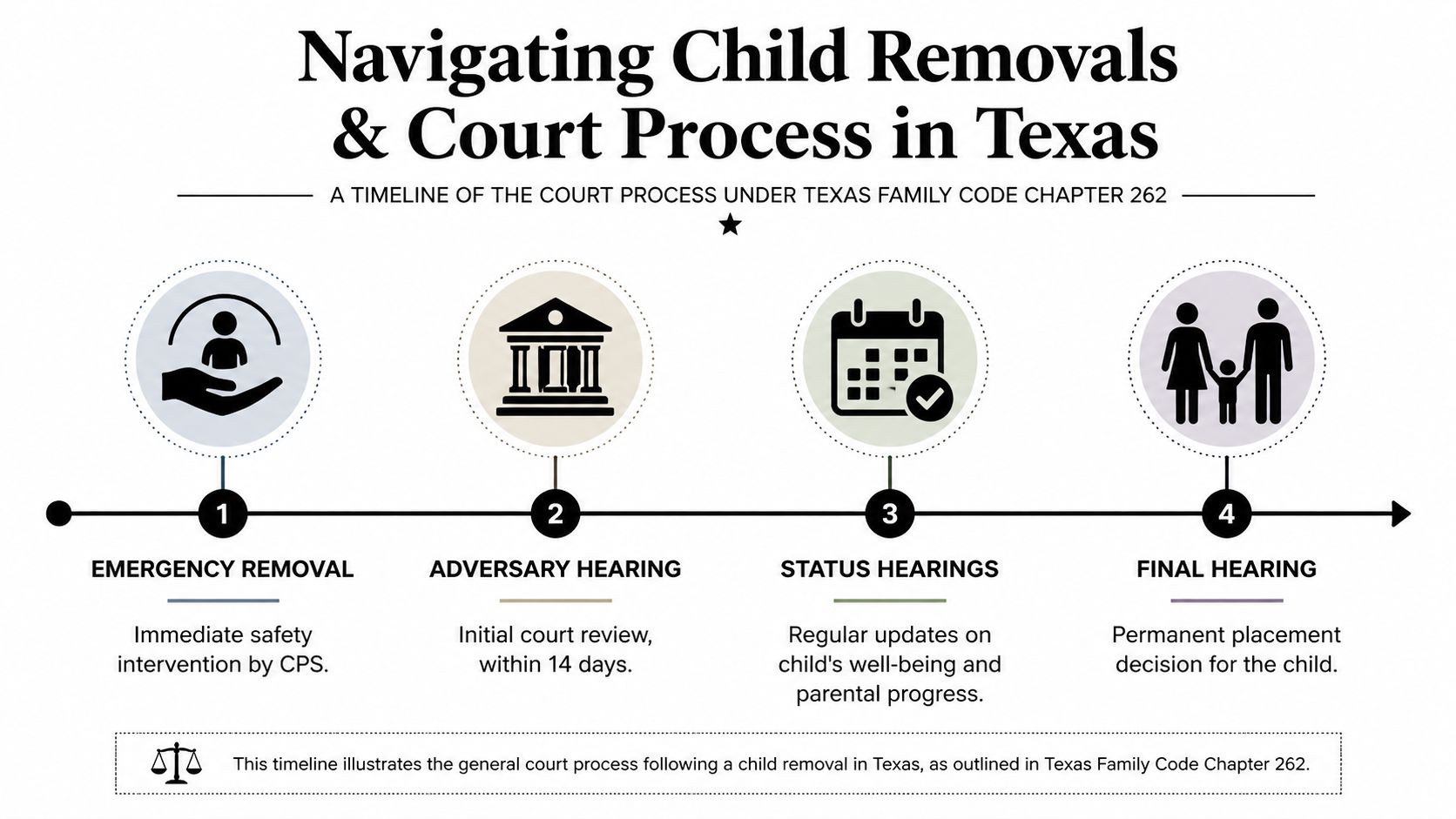
The moment CPS removes a child, the case changes from an agency investigation to a court case with deadlines, hearings, and real consequences. At this stage, Texas Family Code Chapter 262 matters most, because it governs emergency removal and the hearings that follow.
For many parents, the hardest part is not knowing which hearing is which. The names sound formal, but each hearing has a practical purpose. If you know what the court is deciding at each stage, you can prepare instead of reacting.
The scale of the system matters here. In Texas, 29.1% of CPS cases are linked to domestic violence exposure, and 207,429 cases were screened in for a CPS response, with 16,028 children removed in a recent year, according to the University of Texas report on children exposed to domestic violence. Those numbers show that removal is not rare enough to dismiss, and they also show why parents need to understand court deadlines immediately.
Emergency removal
This is the first crisis point. CPS may remove a child if it believes the child faces immediate danger and there is no less drastic way to protect the child. Sometimes that happens before a full court hearing, but CPS must then go to court quickly to justify the removal.
In plain language, the judge wants to know whether the emergency was real and whether the child had to leave right away. Domestic violence cases often turn on the seriousness of the incident, whether a parent was arrested, whether the child was present, and whether there was a safer relative placement available.
The adversary hearing
Parents often know this as the 14-day hearing. It is one of the most important hearings in the whole case. The judge reviews whether CPS should keep temporary custody of the child and whether the child can be returned home under a safety plan or other restrictions.
This is not a hearing to “tell your whole life story.” It is a hearing about immediate safety, available alternatives, and whether CPS met its burden to keep the child out of the home for now.
A parent who comes to this hearing organized usually does better than a parent who comes in angry but unprepared. Helpful materials may include:
- Proof of housing: Lease records, utility bills, or proof that the alleged aggressor has moved out.
- Protective actions: Police reports, shelter records, counseling intake, or evidence you sought safety assistance.
- Family support: Names and contact information for safe relatives who can supervise or provide placement.
- Compliance records: Bond documents, protective order paperwork, and anything showing you followed court rules.
Status hearings and service plans
Once the case continues, Texas Family Code Chapter 263 becomes central. The court starts monitoring progress. It wants to know whether the parents are doing what is required for the child’s safe return.
This usually means a service plan. That plan can include counseling, parenting classes, domestic violence education, substance use assessment, psychological evaluation, stable housing, and consistent visitation.
The service plan is not just a checklist. It is the court’s framework for deciding whether you are becoming a safe and stable parent in practice. If a criminal no-contact order prevents communication with the other parent, that issue needs to be raised carefully in court so you are not punished for failing to do something another court order forbids.
Judges often focus less on promises and more on patterns. If your paperwork shows steady effort, timely attendance, and compliance, that matters.
Permanency hearings
These hearings track whether the case is moving toward reunification, relative placement, or another permanent outcome. The court reviews the child’s placement, your progress, visitation, school or medical issues, and any setbacks.
Inconsistency proves detrimental. Missing services, violating bond conditions, contacting a protected person, or minimizing violence can undermine months of progress. The court is asking whether the child can safely return home and stay safe there, not whether the parent loves the child.
A short comparison helps:
| Hearing stage | Main question |
|---|---|
| Emergency removal | Did CPS need to act immediately? |
| Adversary hearing | Should CPS keep the child out of the home for now? |
| Status hearing | What does the parent need to do next? |
| Permanency hearing | Is reunification realistic and safe? |
| Final hearing | What permanent legal order should the court enter? |
Final hearing and the long-term stakes
The final hearing can result in reunification, placement with another caregiver, managing conservatorship decisions, or in severe cases, movement toward termination concerns under Chapter 161. Not every case ends near termination, but parents should understand that failing to address the case early can move it in that direction.
A relatable example helps. Suppose a father is charged with assault family violence after a loud altercation in front of his children. CPS removes the children because the mother says she’s afraid and has nowhere else to go. At the adversary hearing, the father’s lawyer focuses on bond compliance and housing, while the mother’s lawyer shows she entered counseling and arranged safe family support. Over time, the court may return the children to the mother if she demonstrates protection and stability, while the father’s access may depend on criminal case developments, services, and future court orders.
That is why deadlines, documents, and strategy matter from day one.
How Criminal Charges and CPS Cases Intersect
A parent can be doing bond paperwork in criminal court on Tuesday morning and answering CPS questions that same afternoon about the very same incident. That overlap confuses many families. It also creates risk, because one choice can echo in both cases.

The easiest way to understand this is to picture two trains running on parallel tracks. One track is the criminal case. The other is the CPS case. They are separate systems with different legal standards and different goals, but they are carrying many of the same facts, witnesses, photos, texts, and statements. What you hand to one train often ends up on the other.
The same incident gets interpreted in two different ways
In criminal court, the prosecutor is asking whether a crime occurred and whether the state can prove it. In the CPS case, the agency and the family court are asking whether the child is safe and what conditions must change before the case can close.
That difference matters.
A parent may say, “I only shoved the door,” hoping to reduce criminal exposure. A prosecutor may treat that as part of an assault narrative. CPS may hear the same sentence and focus on fear, chaos in the home, and whether the children were exposed to violence. One statement can create two different problems at once.
Cooperation needs a plan
Suppose a father is out on bond after an assault family violence arrest. A CPS investigator calls and asks for his version of events. He wants to seem honest and cooperative, so he gives a detailed explanation. He admits there was pushing, says both adults were yelling, and adds that the children were asleep and “probably didn’t see much.”
That response may feel reasonable. In practice, it can supply the prosecutor with a useful admission while also signaling to CPS that he is minimizing the seriousness of the event. Parents often get into trouble here because they assume silence looks bad and detailed talking looks better. In overlapping cases, the safer approach is usually informed, limited communication after getting legal advice.
For parents trying to understand the criminal side of these accusations, this guide on how to drop domestic violence charges gives useful background on how these cases may develop.
Orders from one court can make the other case harder
This is another point that catches families off guard. A criminal judge may order no contact with the other parent, no return to the home, or no indirect communication. At the same time, CPS may ask for visitation planning, joint decisions about the children, or updates that seem to assume the parents can speak freely.
You cannot solve that conflict by guessing. If a no contact order is in place, follow it exactly, even if a caseworker informally suggests a shortcut. The right response is to tell your lawyer and ask the court to clarify what is allowed. If your case involves a protective order or related restriction, this article on a temporary restraining order in Texas CPS matters explains how those orders can affect access to your children and your case strategy.
A unified strategy protects you better than treating these as separate problems
Parents often divide the cases in their minds. They focus on “winning” the criminal case while assuming CPS will sort itself out, or they pour energy into CPS services while making damaging statements in the criminal matter. That split approach can backfire.
A better approach is coordinated decision-making:
- Get advice before giving detailed statements. What sounds cooperative in a CPS interview may be used against you in the criminal case.
- Follow every active order exactly as written. Bond conditions, protective orders, and no-contact rules can affect visitation, housing, and reunification.
- Choose services that help in both forums. Counseling, parenting education, or family violence intervention may show the family court that you are addressing safety concerns.
- Document safe, practical steps. Housing changes, supervised exchanges, third-party communication tools, and relative support can show CPS that risk is being reduced without violating criminal orders.
Law Office of Bryan Fagan PLLC manages cases involving CPS investigations, protective orders, and related criminal allegations in Texas.
One final point often reassures parents. A criminal charge does not automatically mean CPS will remove your children forever, and cooperation with CPS does not require careless admissions. The goal is careful action, consistent order compliance, and one strategy that accounts for both courtrooms at the same time.
Actionable Steps to Protect Your Parental Rights
When parents feel powerless, structure helps. You do not control every part of a CPS case, but you do control how organized, consistent, and thoughtful you are from this point forward.
Start with documentation. Keep a notebook or digital file with every contact from CPS, law enforcement, service providers, and the court. Write down dates, times, who called, what was requested, and what you provided.
Next, focus on protective behavior, not arguments about fairness. A judge may eventually care that a report was exaggerated or incomplete, but first the court wants to see whether your child is safe now.
A short checklist that helps immediately
- Save records carefully: Keep police paperwork, bond conditions, protective orders, CPS letters, and service referrals in one place.
- Follow every active order: If a criminal court says no contact, obey it exactly, even if the other parent invites communication.
- Begin appropriate services early: Counseling, parenting classes, or domestic violence-related support can show the court you are taking the issue seriously.
- Use safe relatives wisely: If grandparents, siblings, or other relatives can help with transportation, supervision, or temporary housing, document that support.
- Stay off social media about the case: Posts, messages, or indirect comments can become evidence.
Understand the service plan before you sign onto it
A service plan usually becomes the roadmap for reunification. Read it closely. Ask what is mandatory, what is recommended, what deadlines apply, and how completion will be verified.
If a task is impossible because of your criminal case, say so early through counsel. For example, don’t wait months to explain that a no-contact order prevented attendance at a joint family session. Courts are more receptive to problems raised early than excuses raised late.
Be careful with the “drop the charges” idea
Many families get hung up on one question. If the complaining witness wants the case gone, can the domestic violence case disappear? The answer is often more complicated than people expect. If you need a plain-English explanation of that process, this guide on how to drop domestic violence charges is a useful overview of why the state, not just the other parent, controls many charging decisions.
The bigger point is this. Don’t build your CPS strategy around the hope that the criminal case will vanish. Build it around compliance, child safety, and documented progress.
You Are Not Alone Navigating Your Case with Confidence
A cps case for domestic violence texas can make even strong parents feel cornered. But these cases are not won by panic. They’re managed through calm decisions, careful legal strategy, and steady proof that your child’s safety comes first.
Many families also need emotional support while the legal process unfolds. If you or your child are trying to recover from the stress of violence, separation, or investigation, resources like trauma therapy can be part of a healthier path forward. Legal protection and emotional healing often need to happen together.
If you’re facing both a criminal allegation and a CPS investigation, get advice that accounts for both problems at the same time. That’s often the difference between reacting and protecting your future.
If you’re dealing with CPS after a domestic violence report in Texas, you don’t have to sort through it alone. The attorneys at Law Office of Bryan Fagan PLLC help Texas parents understand investigations, hearings, protective orders, and the overlap between criminal and family law issues. Reach out for a free, confidential consultation and get clear guidance on the next step for you and your family.