Skip to content
When CPS contacts your family, the first feeling is usually panic. Your mind jumps straight to the worst-case scenario. You may be standing in your kitchen, children in the next room, trying to make sense of a stranger asking questions that feel personal, urgent, and threatening.
That fear is real. So is the confusion.
A Texas CPS investigation can move quickly, and many parents make important decisions before they understand what CPS can do, what it can't do, and what rights still belong to them. That's especially hard for working families who earn too much for free legal help but can't comfortably pay a large retainer on short notice. In that gap, parents often feel pressured to cooperate blindly, sign paperwork they don't fully understand, or agree to “temporary” arrangements that shape the whole case.
Knowledge changes that. If you understand the process, the timelines, and the pressure points, you can respond calmly and protect your family more effectively.
That Knock on the Door What a CPS Investigation Means
A parent's first encounter with CPS often happens without warning. A caseworker knocks. You open the door. They say they need to ask questions about your child. In that moment, it's common to feel ashamed, angry, defensive, or frozen.
Take a breath. A CPS investigation in Texas begins with an allegation, not a finding. A report is not proof that you abused or neglected your child. Many parents are investigated because someone misunderstood a situation, repeated incomplete information, or made a report during a family conflict.
Consider a familiar example. A single mother leaves work early because her child's school calls about a bruise on his arm. By evening, CPS is at her door. The bruise came from rough play at recess, but she's tired, scared, and worried that one wrong sentence will be used against her. That kind of situation happens more often than parents expect.
You do not need to solve the entire case at the front door.
Your first job is to stay calm and gather information. Ask the investigator's name, agency information, and the basic reason for the contact. Keep your tone respectful. Don't argue, guess, or fill silence with nervous explanations.
If you need a starting point for that first interaction, this guide on how to respond when CPS shows up at your door in Texas gives a practical overview of what parents commonly face.
Why this feels so overwhelming
CPS cases sit at the intersection of family life, legal procedure, and state power. Parents often don't know whether a request is voluntary, whether they must answer immediately, or whether refusing something will make the situation worse.
That uncertainty is even harder for families in the representation gap. Some qualify for early legal aid. Others can hire counsel quickly. But many working parents are stuck in the middle. They need advice on day one and may not have easy access to it.
What to hold onto right now
Keep these points in mind:
- A report isn't a conviction: CPS still has to investigate.
- Your words matter: Early statements can shape the case.
- Your rights still exist: Fear doesn't erase them.
- Preparation helps: Calm, organized parents usually make better decisions.
The First 72 Hours After a CPS Report
The first few days after a report are usually the most confusing because things happen fast. Parents often think CPS is acting randomly when, in reality, the agency is working inside a priority system.
Under DFPS rules, Child Protective Investigations must initiate a Priority I report within 24 hours of intake, while Priority II reports must be initiated within 72 hours according to the DFPS investigations process. Priority I generally means CPS believes there may be an immediate risk of abuse or neglect. Priority II still matters, but the agency treats it as less urgent.
Why an investigator may arrive so quickly
If CPS shows up the same day or the next morning, that doesn't automatically mean the allegation is true. It usually means the report was classified as urgent.
During that first contact, the investigator is trying to answer basic questions:
- Is the child safe right now?
- Who lives in the home?
- What exactly is being alleged?
- Does anything require immediate action?
The investigator may ask to see the child, speak with parents separately, and observe the home. They may also ask about injuries, supervision, medical care, substance use, school attendance, or who helps care for the child.
What to do during the first contact
The best response is measured, not panicked.
- Ask for specifics: You can ask what allegations are being investigated.
- Take notes: Write down the investigator's name, date, time, and requests.
- Stay factual: Answer carefully. Don't speculate.
- Pause before signing: If you don't understand a form or safety document, don't rush.
A useful companion resource is The Texas CPS Investigation Process Explained, which gives a step-by-step breakdown of how a Texas CPS investigation unfolds and a parent's rights at each stage.
Practical rule: Treat the first 72 hours like the foundation of the case. What you say, allow, and sign during this window can affect everything that follows.
A simple way to think about the first visit
| What CPS is doing | What you should do |
|---|---|
| Checking immediate safety | Stay calm and watch your words |
| Identifying people in the home | Give basic, accurate information |
| Assessing urgency | Don't assume every request is mandatory |
| Starting a record of the case | Keep your own written record too |
For working parents without immediate legal help, this period is often where the pressure is greatest. You may be at work, arranging child care, or trying not to lose wages while CPS asks for quick decisions. That's why clarity matters so much.
The Investigation Process A 45-Day Timeline
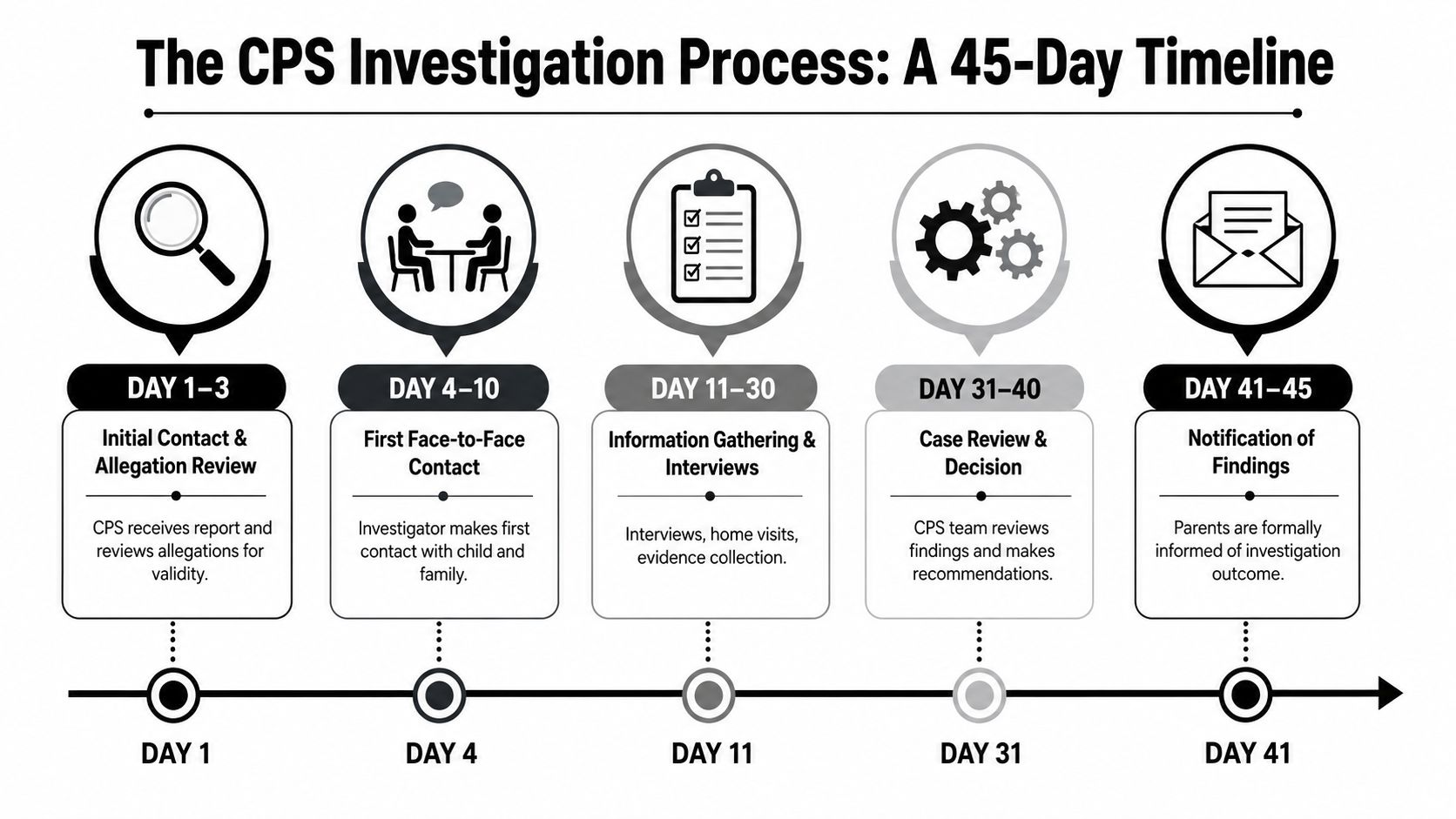
Once CPS makes initial contact, the case usually moves into a more structured investigation. In Texas, CPS typically has 45 days to complete an investigation from intake. On average, 60 to 65 percent of all reports are investigated, and around 40 to 50 percent of investigated reports are ultimately unsubstantiated as noted in the Texas CPS investigation guide.
That last point matters. Many parents assume an investigation means CPS has already decided something is wrong. Often, it hasn't.
What CPS usually does during those 45 days
A CPS investigation in Texas often unfolds in recognizable stages. The exact order can vary, but most families see some version of the same pattern.
Early phase
CPS reviews the report, confirms household details, and makes face-to-face contact with the child and caregivers. That contact may happen at home, school, or another location.
Middle phase
This is the information-gathering stage. Investigators may interview:
- Children: Sometimes separately from parents
- Parents: About discipline, supervision, home life, and the allegation
- Third parties: Teachers, doctors, relatives, neighbors, or others with relevant information
They may also look at the home environment, ask for records, and compare statements for consistency.
Final phase
The investigator reviews what was collected, consults internally, and decides whether the allegation is supported, unsupported, or whether another response is needed.
Why many parents get tripped up here
The process feels personal because your home and parenting are being examined. But CPS investigators also follow a checklist-driven system. That means parents can prepare.
A clean explanation beats a long emotional defense. Short, accurate answers usually carry more weight than trying to talk your way out of every concern.
What the 45-day window means for you
This period is often when CPS decides whether to close the case, seek services, propose a safety plan, or push toward court involvement. If the agency says it needs more time, there may be an extension in some cases, but parents should act as though the most important decisions are being made early.
Use this time deliberately:
- Organize records: Medical papers, school attendance records, prescriptions, counseling records, and names of helpful witnesses.
- Correct visible issues: If your home has obvious safety problems, address them immediately.
- Document communication: Keep a dated log of calls, visits, and requests.
- Get legal guidance if possible: Even limited advice early can prevent larger mistakes later.
For parents in the middle-income squeeze, strategy matters. If full representation isn't immediately realistic, targeted early advice can still help you prepare interviews, evaluate requests, and avoid admissions that don't reflect the truth of your situation.
Your Fundamental Rights During a CPS Investigation
Many parents think they have no choice but to do whatever the investigator asks. That's one of the most damaging myths in a CPS case.
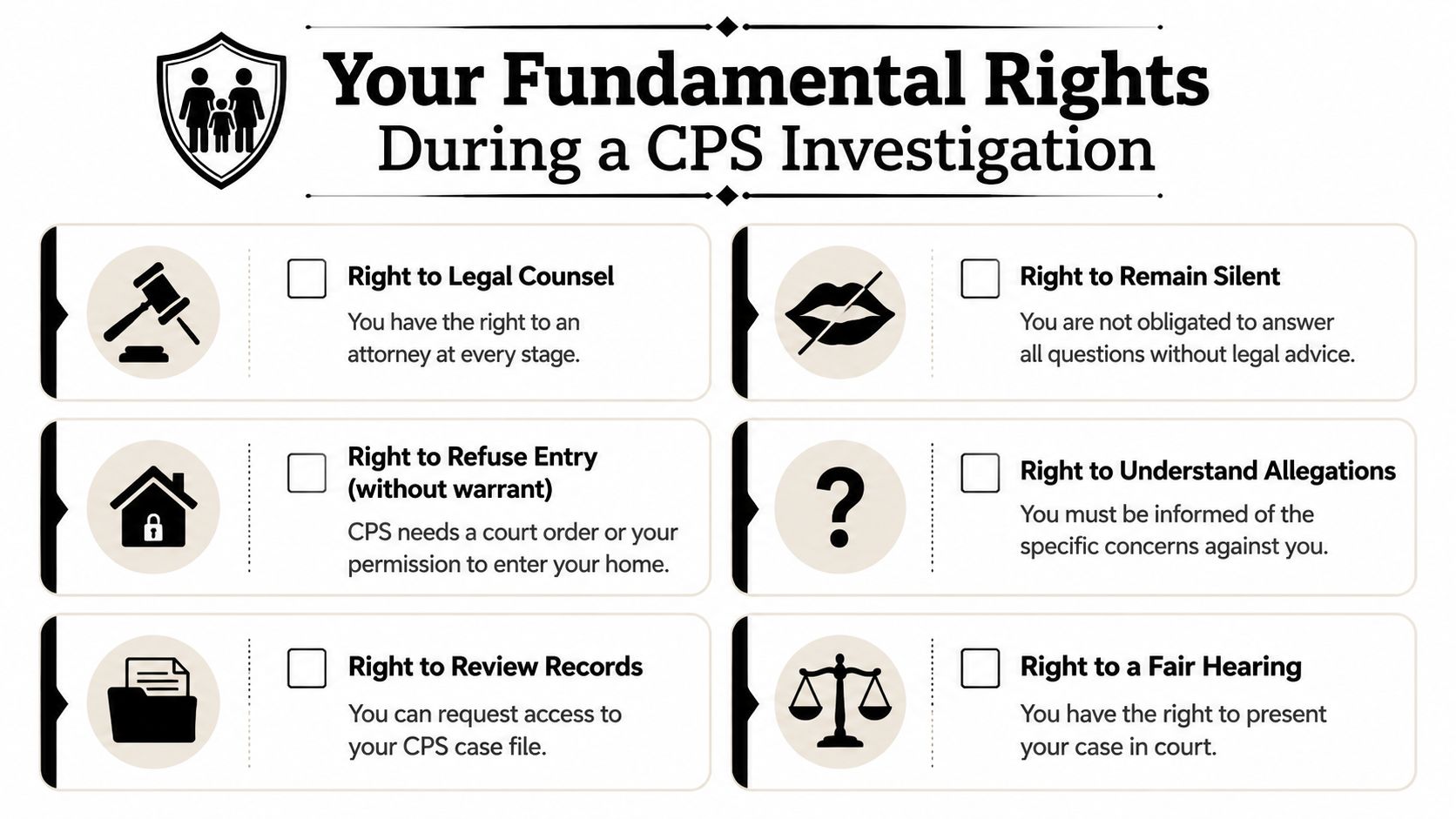
Under the Texas Family Code, parents retain important constitutional rights during an investigation, including the right to refuse entry into their home without a court order, the right to have an attorney present during questioning, and the right to challenge CPS findings in court. If a child is removed, a hearing must occur within 14 days according to this discussion of steps to take after a Texas CPS investigation.
Rights you should take seriously
These aren't technicalities. They shape the case.
- Right to counsel: You can ask to speak with an attorney before answering detailed questions.
- Right to refuse entry: Without a court order or emergency circumstances, you don't have to allow entry into your home.
- Right to challenge findings: If CPS reaches a harmful conclusion, that isn't always the end of the matter.
- Right to a hearing after removal: Court review has to happen quickly if CPS removes a child.
A calm parent who knows these rights usually communicates more clearly than a frightened parent who feels trapped.
A real-world example
A father answers the door after working a double shift. The investigator asks to come inside and “clear a few things up.” He's tempted to let them in immediately because refusing feels suspicious. Instead, he politely asks what the allegations are and says he wants legal advice before answering detailed questions or consenting to anything he doesn't understand.
That response isn't hostile. It's disciplined.
Here's a short video that addresses rights and practical concerns parents often have during CPS contact.
What exercising your rights should sound like
You don't need a dramatic speech. Plain language works.
“I want to cooperate, but I'd like to understand the allegations and speak with an attorney before I answer detailed questions.”
That kind of sentence protects you without escalating the interaction.
What not to do
Parents often hurt their own cases by:
- Talking too much: Long explanations create inconsistencies.
- Signing under pressure: Safety plans and releases can have lasting effects.
- Mistaking a request for an order: CPS asks for many things that are not automatically mandatory.
For families who can't immediately afford a full-retainer attorney, brief legal advice, in such instances, can be invaluable. Even one focused consultation can help you decide what to say, what to defer, and how to document each interaction.
Understanding Child Removal and Safety Plans
The question parents usually ask first is blunt and heartbreaking. Can CPS take my child today?
In Texas, the legal standard is higher than many people think. Under Texas Family Code §262.104, CPS may remove a child without a court order only in true exigent circumstances where waiting would place the child in immediate danger to physical health or safety. Removal based solely on suspicion is legally insufficient under this explanation of what Texas law says about emergency CPS removal.

Removal versus a safety plan
Parents often confuse these two situations because both feel coercive.
Emergency removal
This is the most serious step. CPS claims the child cannot safely remain in the home right now. If the agency acts without a court order, it must later justify that emergency action.
Safety plan
A safety plan is often presented as a voluntary alternative. It may ask a parent to leave the home temporarily, place the child with a relative, avoid certain people, submit to services, or follow supervision rules.
That doesn't mean a safety plan is harmless. It can shape later court arguments and case recommendations.
A scenario many families face
A mother is told CPS won't remove her child if she agrees that the child will stay with a grandparent “for now.” She's exhausted and afraid, so she signs. Days later, that temporary arrangement becomes the baseline CPS points to when arguing the child shouldn't return home yet.
That doesn't mean every safety plan is bad. Some are reasonable. Some help avoid removal. But you should understand what you're agreeing to before you sign.
A more detailed discussion of these arrangements appears in this guide to a Texas CPS safety plan.
Questions to ask before agreeing
- How long does this last?
- What exactly am I admitting, if anything?
- What happens if I disagree?
- What must I do to end the plan?
If CPS is asking for a “voluntary” arrangement, ask yourself whether it is truly voluntary or whether the agency is using the threat of removal to secure consent.
When family services become part of the path forward
Some cases involve allegations tied to substance use, relapse, or instability in the home. In those situations, parents may benefit from support that addresses the whole household dynamic, not just the accusation itself. A practical overview of family therapy for addiction recovery can help families understand how therapy may support communication, accountability, and safer home routines during or after a CPS case.
How to Legally Challenge a CPS Finding in Texas
If CPS reaches a negative finding, you still have options. Many parents wrongly assume the investigation result is final because it arrives in official language and carries the weight of the state. It isn't always final.
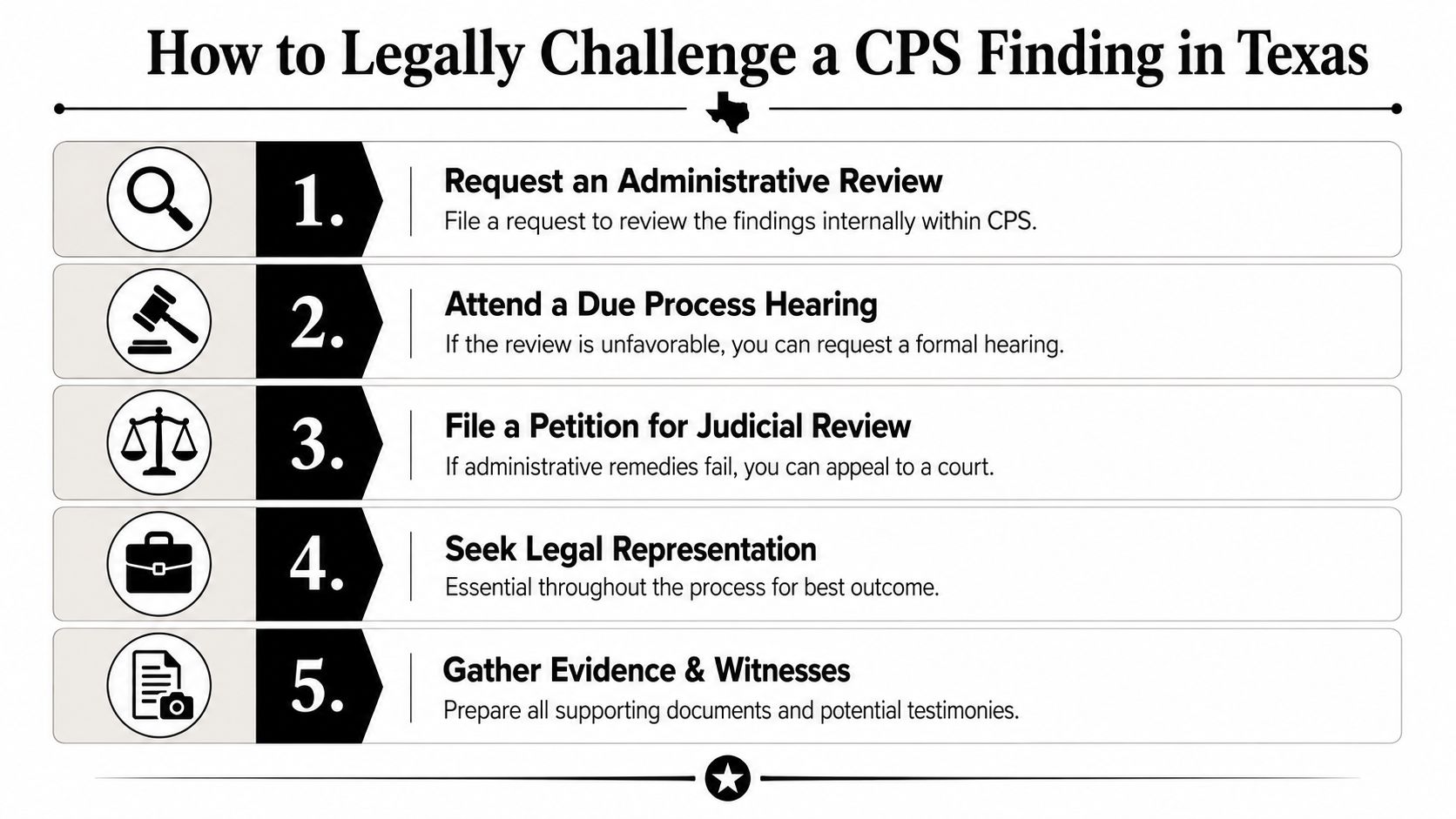
A CPS case can move along two tracks. One is the agency's internal and administrative process. The other is the court process if removal, conservatorship, or other judicial action follows. Your strategy has to account for both.
A practical challenge plan
Start with the finding itself. Read it carefully. Compare it to what was said, what documents CPS reviewed, and what witnesses were contacted.
Then think in terms of proof.
Administrative review
If CPS substantiates abuse or neglect, the designated person may request an administrative review. These findings can significantly affect employment, future custody disputes, and how the agency treats later reports.
Hearing preparation
If the matter reaches court, the focus shifts from agency conclusions to admissible evidence, testimony, procedure, and whether CPS followed the law.
Evidence building
Don't rely on your memory alone. Gather:
- Documents: Medical records, school records, counseling records, text messages
- Witnesses: Relatives, teachers, coaches, doctors, neighbors with firsthand knowledge
- Timeline notes: A dated sequence of visits, calls, requests, and statements
Why SB 1141 matters
New Texas Senate Bill 1141, effective September 1, 2025, requires courts to confirm that DFPS informed alleged perpetrators of their right to record interviews and request administrative review of findings. If DFPS failed to give that notice, evidence from the investigation or interview may be barred from consideration unless the court finds the child is in imminent danger according to the Texas SB 1141 legislative analysis.
That is a meaningful procedural protection. If notice wasn't properly given, your lawyer may have grounds to challenge the use of that evidence.
If you're in the representation gap
Many working families often feel cornered. They may not qualify for free legal aid, but they also can't easily fund full litigation from the start. In that situation, targeted legal help still matters. A lawyer can review findings, identify procedural mistakes, prepare you for hearings, and focus limited resources where they will matter most.
For parents weighing appeal options, CPS appeal in Texas is a helpful resource on the review process. Another useful distinction is whether your matter is still an investigation or has already shifted into court. If you need one factual reference point, the Law Office of Bryan Fagan PLLC publishes Texas-focused information on CPS and related family law issues.
The strongest challenges usually combine three things. A clean timeline, reliable documents, and a parent who understands the procedural rules.
Your Next Steps and Frequently Asked Questions
When parents search for help with a CPS investigation in Texas, they usually need answers fast. Here are a few of the questions that come up most.
Common questions
Can CPS force me to take a drug test?
CPS may ask, but whether you must comply depends on the posture of the case, any court involvement, and what orders exist. Don't assume every request is mandatory. Get legal advice before agreeing when possible.
What if the report was malicious?
Malicious or exaggerated reports do happen. The key is not anger. The key is evidence. Keep records, identify witnesses, and stay consistent.
Can CPS interview my child without my consent?
In many investigations, CPS may attempt to speak with a child as part of its safety assessment. How, when, and where that occurs can depend on the facts and the stage of the case.
Should I investigate the person who made the allegation?
Sometimes parents want to understand whether a former partner, neighbor, or relative may have supplied false information. If lawful fact-gathering becomes relevant, outside resources about private investigator background checks can help you understand what kinds of background information investigators may look for. That said, your main focus should stay on responding effectively to CPS.
What to do today
If CPS has contacted you, do these things now:
- Write everything down: Dates, names, phone numbers, and what was said.
- Gather records: School, medical, and counseling documents if they help explain the situation.
- Stay measured: Don't vent by text, social media post, or angry voicemail.
- Get legal advice early: Even limited guidance can change the direction of the case.
You don't have to face this process blind, and you don't have to let fear make every decision for you.
If CPS has contacted your family, you need clear answers and a plan. The Law Office of Bryan Fagan PLLC helps Texas parents understand investigations, protect their rights, and respond strategically from the very first contact through hearings, safety plans, and challenges to CPS findings. Contact the firm for a free consultation to discuss your situation confidentially and take the next step toward protecting your family's future.