Skip to content
A CPS investigator is at your door. Your child is in the next room. Someone slides a form across the table and calls it a “voluntary” safety plan.
Most parents hear one thing in that moment: sign this or risk losing your child.
That fear is real. So is the confusion. If you're dealing with a CPS safety plan in Texas, you need more than general advice. You need to know what this document is, what it can do to your family, and where the pressure points are before you make a decision that affects your home, your parenting, and your rights.
Parents often end up in this position after a report that may be exaggerated, incomplete, or flatly false. Sometimes it grows out of a medical misunderstanding, a custody fight, a domestic dispute, or concerns surrounding behavior and prescriptions. In families already struggling with school issues or treatment decisions, even common challenges like children's ADHD medication challenges can become part of a larger narrative that CPS doesn't fully understand on day one.
If CPS has already contacted you, slow the moment down. Read this carefully, then review practical guidance on how to respond when CPS shows up at your door in Texas.
The Knock at the Door Your Introduction to CPS Safety Plans
A mother answers the door after work. The house is messy from real life, backpacks on the floor, dinner half-started. A CPS caseworker says there was a report. The worker speaks calmly and says they're not there to remove the child today, but they need a safety plan signed before they leave.
The proposed terms sound “temporary.” Maybe the boyfriend can't stay in the home. Maybe grandma has to supervise. Maybe mom has to drug test tomorrow morning. Maybe the child should stay with an aunt “just until this is sorted out.”
To a scared parent, that can sound reasonable. It can also be the point where a family gives up far more control than they realize.
You don't have to panic, but you do need to treat this as a legal moment, not a casual conversation.
I've seen parents make two dangerous mistakes in that first hour. One signs immediately because the worker sounded helpful and polite. The other refuses angrily, says too much, and turns a manageable investigation into a credibility problem. Neither approach is strategic.
A CPS safety plan sits in a gray area that frightens parents for good reason. It isn't a court order. But once you sign it, CPS may start treating your compliance as the test by which everything else is judged. If the plan pushes a parent out of the home or moves a child to a relative, the family may be living under major restrictions before any judge has reviewed the situation.
That's why this issue deserves calm, informed attention. You can protect your child without surrendering your parental authority blindly.
What a Texas CPS Safety Plan Is and Is Not
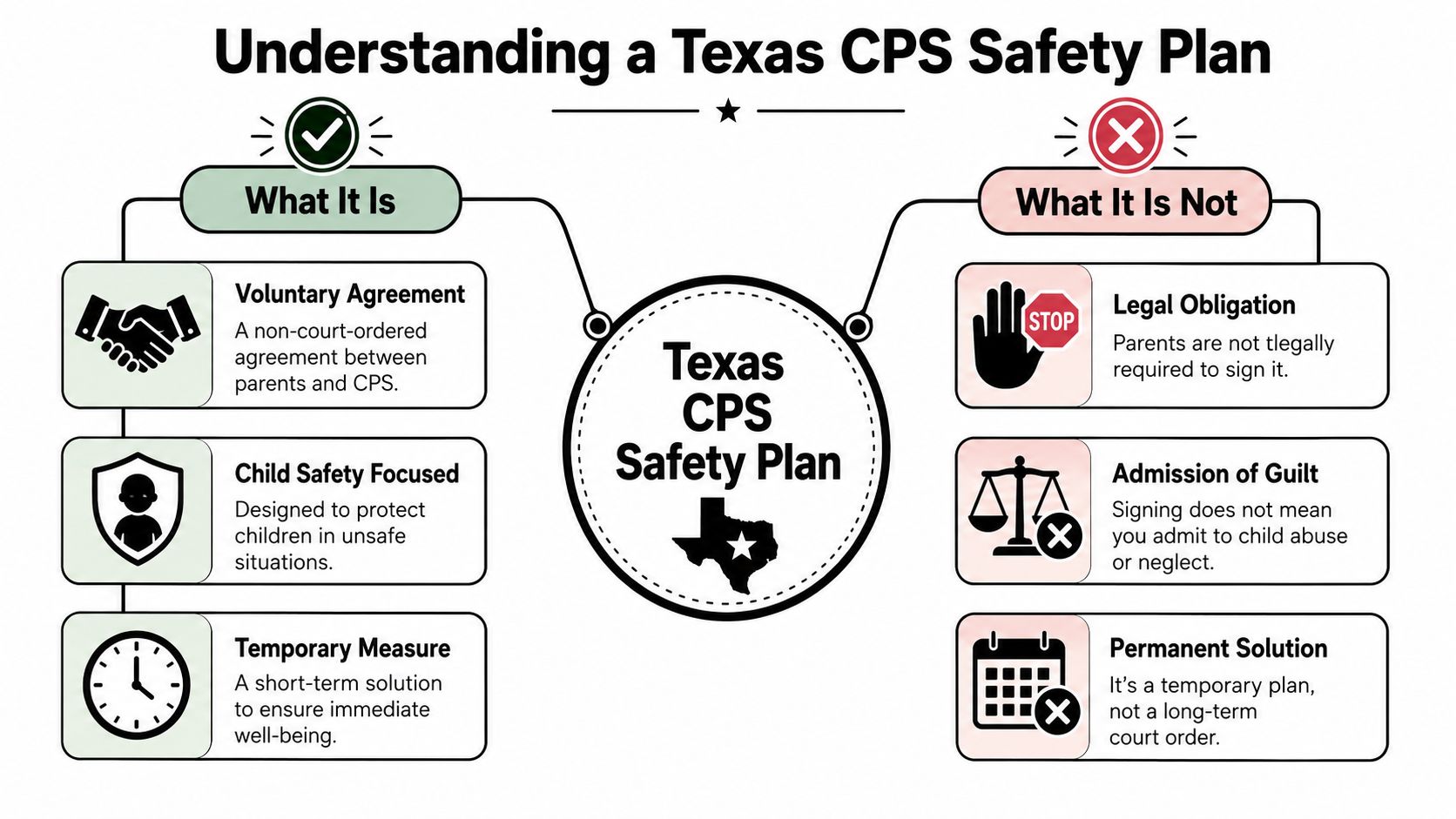
A Texas CPS safety plan is a written agreement CPS uses during an investigation when the caseworker claims there is an immediate safety concern that can be addressed without going to court right away. It usually shows up in the narrow space between doing nothing and filing for an emergency removal.
What it is
This is a temporary safety tool. In theory, it is supposed to address a specific danger with clear, immediate steps while CPS continues investigating.
A properly written plan should say what CPS believes the danger is, what action is supposed to reduce that danger, who is responsible for each step, and how the plan will work in the family's actual daily life. Vague directions such as “keep the child safe” or “use appropriate supervision” are a problem. If the rule is unclear, CPS can later claim you failed to comply even when you were trying to cooperate.
Typical examples include:
- Supervised contact with a parent or other adult
- One adult leaving the home for a period of time
- Drug testing tied to a stated concern
- A support person helping monitor the child's safety
Parents should also understand the practical reality. Even though the document is labeled temporary and voluntary, CPS often treats it as the operating rule for your family until the investigation ends or the agency decides to escalate the case.
What it is not
A safety plan does not carry judicial authority. No judge signed it. No court hearing happened before it was placed in front of you.
That matters because parents are often pressured to treat the plan like an order they have no choice but to obey. The legal posture is different.
| Issue | What the safety plan is not |
|---|---|
| Court authority | Not a court order signed by a judge |
| Legal duty to sign | Not automatically required because CPS asks for it |
| Admission | Not a formal admission of abuse or neglect by itself |
| Long-term custody order | Not a final custody arrangement for your child |
Practical rule: If a caseworker says, “just sign and we'll sort it out later,” slow down. That is often the moment parents give up control before they understand the consequences.
Safety plan versus PCSP
Parents also need to separate a safety plan from a Parental Child Safety Placement, or PCSP. Under the DFPS Safety Plan Resource Guide, a safety plan is supposed to be created with the family and written in specific, action-based terms. A PCSP involves the child living apart from a parent through a different process and different paperwork.
On paper, that distinction is clear. In real life, families can still end up in a shadow removal. If CPS gets you to agree that your child will stay with a relative, or that you must leave the home so the child can remain there, the loss of parental control can be immediate even without a court order. For a frightened parent, “voluntary” can function a lot like compelled.
That is why labels do not protect you. The primary question is whether the plan changes where your child lives, who controls access, and how quickly CPS can claim you failed to cooperate.
Common Rules and Conditions in a Safety Plan
The actual pressure point in a CPS safety plan is not the title of the form. It is the day-to-day control the plan gives CPS over your home, your movements, and your time with your child.
Some terms are manageable. Some function like a quiet transfer of parental authority. Parents need to know the difference before they sign.
What often appears in the document
A Texas safety plan often includes conditions like these:
- No unsupervised contact: A parent, partner, or other adult cannot be alone with the child.
- Temporary exclusion from the home: CPS may demand that one adult leave the residence right away.
- Third-party supervision: A grandparent, adult sibling, or family friend must remain present during contact.
- Drug or alcohol testing: CPS may require immediate testing as part of the plan.
- Counseling or assessment: The family may be told to start services before the investigation is closed.
- School or daycare coordination: Another adult may be assigned to handle pickup, drop-off, or communication with staff.
Those conditions do not carry the same legal and practical weight. Requiring a relative to supervise after school is one thing. Requiring a parent to leave the home or a child to stay elsewhere changes control of the family immediately.
What the paperwork should say
Under DFPS guidance, a safety plan should be specific enough for a real person to follow under stress. It should identify the safety concern, state the exact protective step, name who will do it, and make clear when the plan will be reviewed.
Vague language creates risk for parents. “Maternal grandmother supervises from 4:00 p.m. until bedtime each weekday” is enforceable because everyone knows what it means. “Family will maintain a safe environment” is not. A caseworker can later claim you failed a term that was never clearly defined.
That ambiguity helps CPS, not you.
Terms that deserve extra caution
Parents should slow down when they see broad language such as:
| Better term | Riskier term |
|---|---|
| “Mother's sister supervises evening contact” | “Approved adult supervision at all times” |
| “Hair test by Friday” | “Submit to any testing CPS requests” |
| “Review on stated date” | “Until CPS decides concerns are resolved” |
Open-ended terms give the agency room to expand the plan later. They also make it easier to accuse a parent of noncompliance. In practice, that can turn a supposedly temporary agreement into a tool for pushing the parent farther out of the home and farther from the child.
A common example
A father is accused of drug use after a breakup turns ugly. CPS presents a plan requiring him to move out and stop all contact with the child. Parents often sign in that moment because they are afraid refusal will trigger an immediate removal.
Sometimes there are narrower options. Supervised contact with a known relative, prompt testing, and a defined review date may address the claimed safety issue without handing over the entire field. That is the trade-off parents need to see clearly. Once you agree to sweeping restrictions, CPS may start treating those restrictions as the new baseline.
A plan you cannot realistically follow can become the record used against you later. A plan that implicitly shifts where your child lives, who watches visits, or who decides when contact resumes can work a lot like a removal before any judge reviews what happened.
The Hidden Danger of Shadow Removals
This is the part most online articles miss.
A “voluntary” safety plan can operate like a shadow removal. The child leaves home, often to stay with a relative or another placement, but no court has yet approved that separation. The family starts living under removal-like conditions without the normal judicial check that Chapter 262 is supposed to provide.
How it happens in real life
A caseworker may say, “We're not removing your child. We just need the child to stay with your sister for now.” To a frightened parent, that may sound like the less dangerous option.
But if your child is no longer living with you, and that arrangement continues because CPS says the home still isn't safe, your family may be experiencing the functional equivalent of a removal without immediate court review.
A 2025 Texas Policy analysis found that over 40% of these plans involved a child being moved to a relative or foster home without a court order, a practice critics call shadow removals because they bypass judicial review and avoid the requirement that a judge validate a removal within 14 days.
Why this matters legally
When CPS removes a child through formal court action, the agency has to justify that decision under Chapter 262. A judge gets involved. Deadlines apply. Evidence matters.
When CPS gets a parent to agree to “temporary” separation under a safety plan, the pressure still exists, but the oversight may not.
That creates a real trade-off:
- Short-term peace: The caseworker leaves without filing that day.
- Long-term danger: The child may remain out of the home while CPS keeps control over the timeline.
A common scenario
A mother is told her teenage son should stay with an aunt because of allegations involving her boyfriend. She signs because she thinks it will last a weekend. Two weeks pass. Then more interviews are scheduled. Then CPS says counseling must begin before the child returns. No judge has ruled. No formal removal order exists. Yet the child still isn't home.
That's not a harmless administrative detail. That's a major disruption of family life.
If CPS wants the child out of your home, you need to know whether you're agreeing to a temporary safety step or allowing a de facto removal without court review.
The phrase “voluntary” doesn't erase the coercion many parents feel in these moments. It also doesn't erase the legal consequences. If the plan separates parent and child, treat it with the seriousness you would give any emergency custody issue.
Your Rights When Presented with a Safety Plan
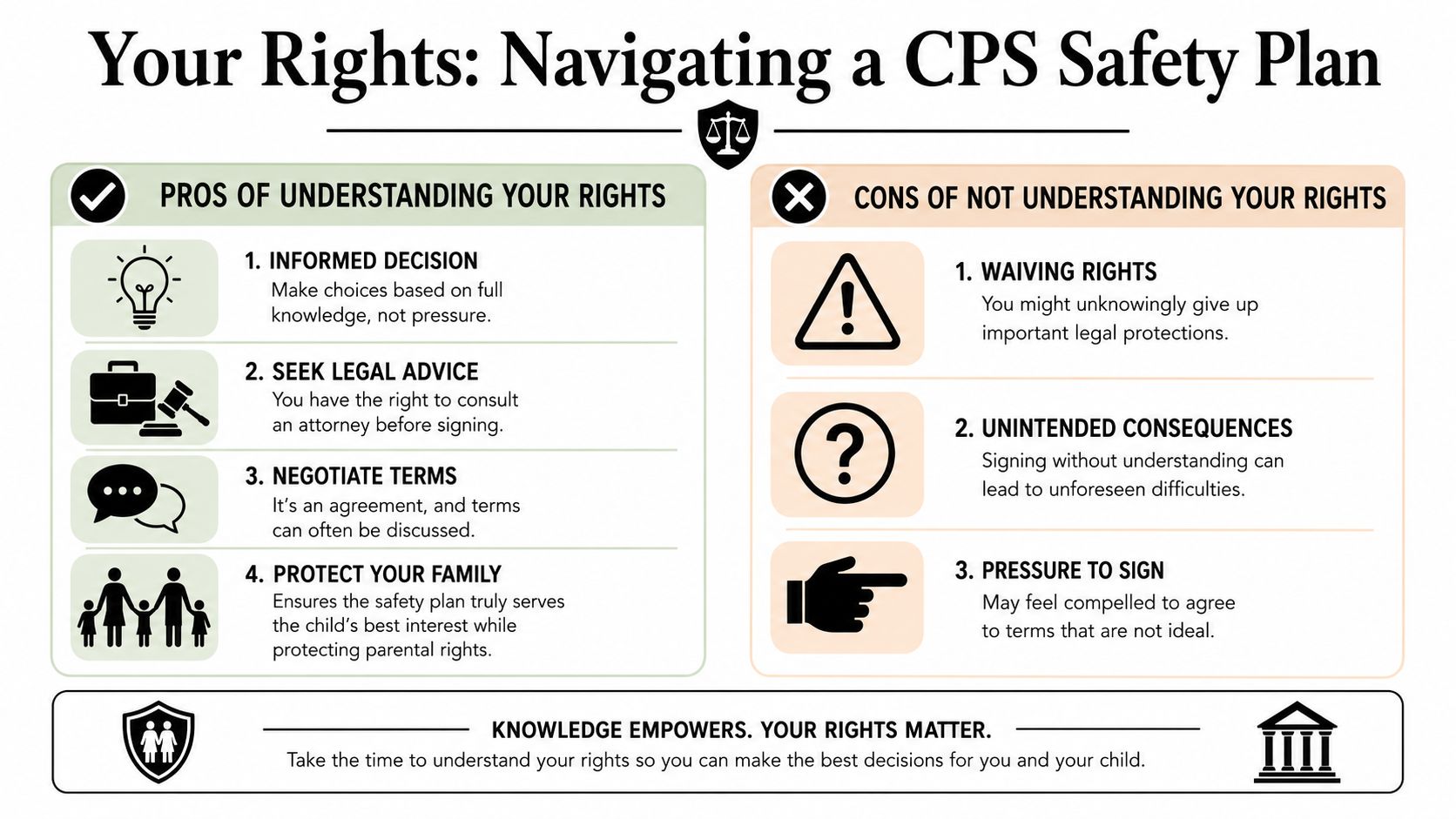
The most important thing to know is simple. You are not legally required to sign a CPS safety plan in Texas. It is a voluntary agreement, and refusal by itself does not authorize removal. If CPS wants emergency removal, the agency still has to prove immediate danger under Chapter 262 by looking at issues like supervision, whether the home is physically safe, whether anyone in the home is violent or intoxicated, and whether the child has food, medical care, and a safe place to sleep, as explained in Texas CPS safety plans and how they work.
Signing versus refusing
Neither choice is automatically right. The question is whether the plan is fair, specific, limited, and survivable for your family.
Here's the practical comparison:
| Choice | Possible benefit | Serious risk |
|---|---|---|
| Sign | May lower immediate conflict with CPS | You may agree to restrictions that reshape your case and can later be used against you if you violate them |
| Refuse | Preserves your right not to accept unsupported terms | CPS may escalate if it believes danger is immediate |
The answer depends on the allegation, the proposed restrictions, and whether there is a narrower safety option available.
What to do in that moment
Parents need a script. Not a speech. A script.
- Ask for time to review: Tell the caseworker you want to cooperate with legitimate safety concerns but need legal advice before signing.
- Get the plan in writing: Never agree to terms you haven't read.
- Check for an end date: If there's no review point or stated timeline, that's a serious problem.
- Offer a safer alternative if needed: If you won't agree to the plan as written, propose something concrete and protective.
- Stay calm: Your tone becomes part of the caseworker's narrative.
- Document everything: Keep the proposed plan, names, times, and follow-up messages.
Immediate advice: “I want to cooperate with child safety, but I won't sign this until I understand every term.”
A more detailed discussion of this choice appears in refusing to sign a CPS safety plan in Texas.
Do and don't table
| Do | Don't |
|---|---|
| Read every line before answering | Don't sign on the spot just because the room feels tense |
| Ask what exactly triggered the plan | Don't accept vague language like “until further notice” |
| Name a real support person if supervision is proposed | Don't offer a relative casually if that person can't actually do the job |
| Request changes in writing | Don't rely on verbal side promises |
| Think about whether you can comply fully | Don't assume minor violations won't matter |
This video gives a helpful overview for parents trying to get oriented:
If you're preparing for a fight over agency overreach, many parents also benefit from reading broader strategy materials on how to challenge CPS effectively. The main point is this: don't confuse being cooperative with surrendering terms that damage your case.
After the Plan Is Signed The CPS Timeline
Once the plan is signed, many parents assume they just have to wait. That's a mistake. A safety plan should be tracked actively, because silence from CPS often benefits the agency, not the family.
What usually happens first
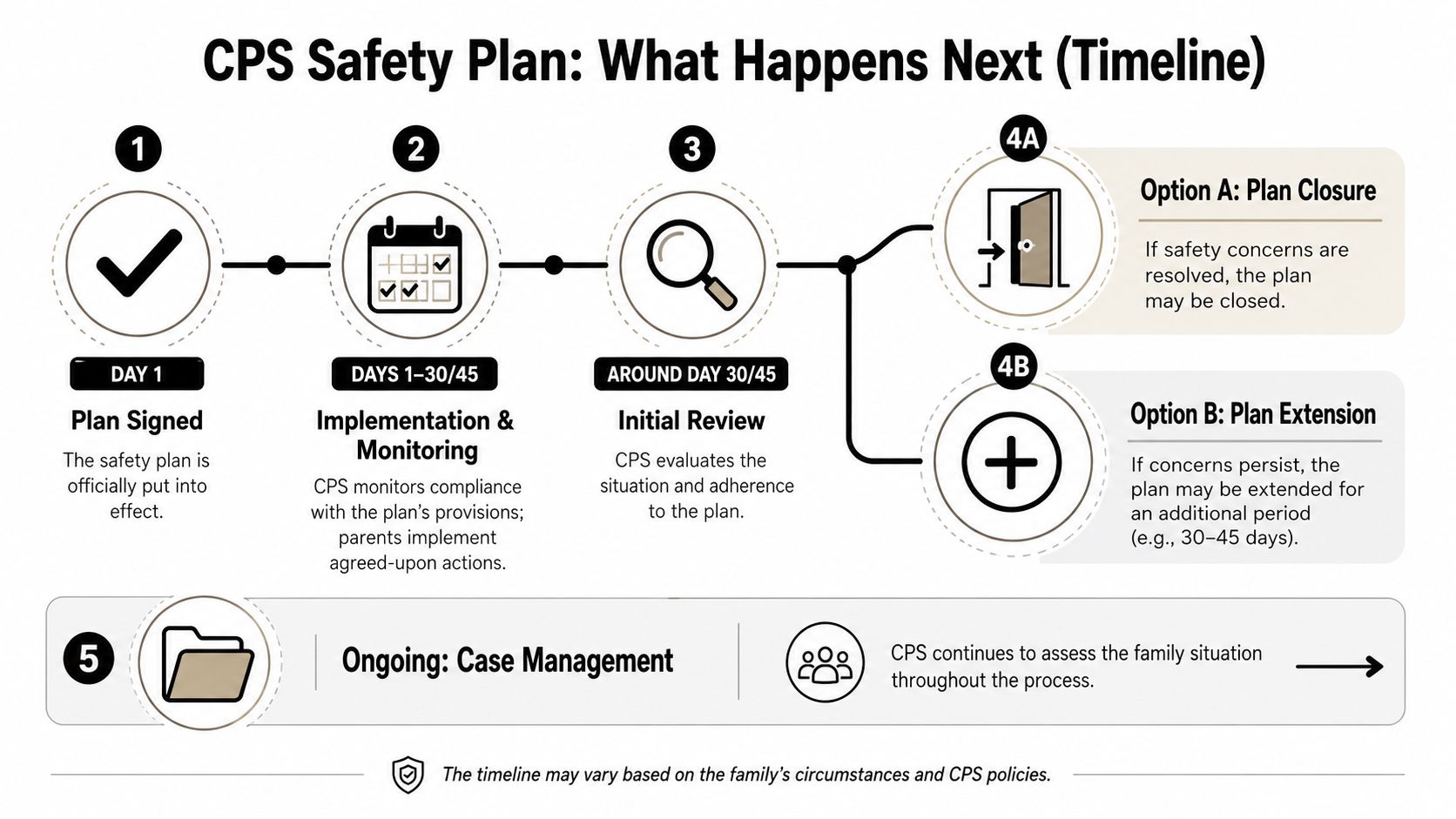
The plan goes into effect immediately. CPS then watches whether the family is following the stated restrictions.
Parents should create a file right away that includes:
- The signed plan
- Any review dates
- Proof of completed tasks
- Names of supervisors or support adults
- Written requests for clarification or modification
If the plan says drug testing, counseling intake, or supervised contact, handle those items quickly and keep records. Don't assume the caseworker is keeping a complete file in your favor.
The investigation window
A Texas CPS safety plan is tied to the investigation period and is typically active during a 30 to 45 day window, with review required at least every 30 days, as discussed earlier from the Texas CPS safety plan guidance. That means parents should not treat it as indefinite background noise.
If CPS says the restrictions need to continue well beyond the investigation, that can signal a shift toward court involvement or informal extension pressure. Ask for the legal basis, the current status of the investigation, and the exact reason the plan is still being enforced.
The plan shouldn't drift forever. If CPS still wants restrictions after the investigation stage, the question becomes whether the agency is prepared to defend them in court.
If the case goes to court
If DFPS becomes the child's Temporary Managing Conservator, Chapter 263 controls the case timeline. Under Texas Family Code Chapter 263, a Visitation Plan must be in place no later than 30 days after DFPS is named TMC, and the court reviews it at the Status Hearing and each later Permanency Hearing, according to the Texas Children's Commission bench book on Chapter 263.
That timeline matters because many parents fail to connect the early safety-plan stage with later court review. What happened at your kitchen table can echo into supervised visitation, service-plan expectations, and how the court views your judgment.
Practical steps during the timeline
- Track dates carefully. Know when the investigation started.
- Request updates in writing. Don't rely on phone calls alone.
- Ask whether the plan is being reviewed. If there's no review, ask why.
- Gather compliance proof. Negative tests, school attendance, counseling intake, housing documents.
- Prepare for the next phase. If the case is escalating, your strategy must change fast.
If your case later involves a service plan, that is a different document with different consequences from the initial safety plan.
Why You Need a Lawyer on Your Side
A CPS safety plan is one of those moments where the legal answer and the practical answer aren't always the same. Yes, the document is voluntary. But the pressure is real, the consequences are serious, and one wrong move can change the trajectory of the entire case.
A lawyer helps in ways that matter immediately.
What counsel actually does
An attorney can:
- Review the proposed terms before you sign
- Push back on vague or overbroad restrictions
- Offer safer alternatives that still address the child-safety concern
- Create a written record showing cooperation without surrender
- Prepare for Chapter 262 court action if CPS escalates
- Protect against spillover issues when CPS allegations overlap with criminal accusations, custody disputes, or protective-order issues
This is especially important when CPS concerns touch domestic violence allegations, drug accusations, or claims that may later affect conservatorship or even parental rights under Chapter 161.
For parents trying to decide whether legal help is necessary, this guide on whether you need a lawyer for a CPS case in Texas is a good starting point.
The Law Office of Bryan Fagan PLLC is one option for Texas families who need counsel on CPS matters that overlap with emergency removals, criminal allegations, protective orders, or later court proceedings. A key benefit of getting legal help early is not drama. It's control.
Parents usually have more options before they sign than after they sign.
If CPS has put a safety plan in front of you, don't guess your way through it.
If you're facing a CPS investigation, being pressured to sign a safety plan, or dealing with a child who has already been placed with a relative, contact Law Office of Bryan Fagan PLLC for a free consultation. You don't have to face this alone. A calm legal strategy can help you protect your child, your home, and your parental rights before a temporary crisis becomes a lasting case.