Skip to content
A parent usually doesn't expect a medical appointment to turn into a CPS threat. Yet that's exactly where many families find themselves. You ask more questions about a surgery. You hesitate over a treatment plan because you want a second opinion. You miss an appointment while juggling a child with a complicated diagnosis. Then someone says the words that stop everything cold: “We may have to call CPS.”
That moment feels unfair because, in many cases, the parent involved is not careless. The parent is worried, overwhelmed, and trying to make the right call for a child they love. When the state enters a disagreement about medical care, fear rises fast. Parents start asking the same question: Can CPS take your child for medical decisions you make?
The short answer is yes, under some circumstances. But not every disagreement with a doctor is medical neglect, and CPS does not get unlimited power just because a report is made. In Texas, the legal line matters. The process matters. What you do in the first hours and days matters even more.
The Unthinkable Phone Call When You Disagree with a Doctor
Texas law allows parents to make a wide range of decisions for their children. That includes asking questions, requesting records, seeking a second opinion, and choosing among medically accepted options. A hard conversation with a doctor is not, by itself, proof of neglect.
The concern becomes more serious when CPS or a hospital believes a parent is failing to provide necessary medical care in a way that places the child's health or safety at risk. That's when a medical disagreement can be reframed as a child-protection issue instead of a treatment debate.
When concern turns into an allegation
A common example looks like this. A child needs ongoing specialty care. The parent is exhausted, scared about side effects, and unsure whether the proposed treatment is the only option. The doctor hears resistance. A nurse documents missed follow-up. A social worker becomes involved. By the end of the day, the discussion is no longer only about medicine. It's about whether the child is receiving necessary care.
That shift is what catches parents off guard.
Practical rule: If a provider starts talking about “safety,” “noncompliance,” or “failure to follow medical advice,” treat that as a legal warning sign, not just a bedside disagreement.
Parents dealing with rare or serious conditions often face especially difficult choices because there may be no easy treatment path. If your child has a complex diagnosis, families sometimes find it helpful to review a comprehensive guide to rare disease care so they can better understand supportive and palliative options before speaking with doctors and, if needed, legal counsel.
What usually helps and what usually hurts
Some responses calm the situation. Others make it worse.
- Helpful: Ask the provider to explain why they believe the treatment is necessary now.
- Helpful: Request that your request for a second opinion be placed in the chart.
- Helpful: Bring another adult to take notes.
- Risky: Walking out without a discharge plan or follow-up instructions.
- Risky: Saying you won't do anything further, especially in front of staff documenting the encounter.
You don't have to surrender your role as a parent. But once CPS is mentioned, you need to think like both a caregiver and a witness in your own case.
Understanding Medical Neglect Versus Parental Rights in Texas
A medical-neglect case often starts with a misunderstanding that grows legs. At 10:00 a.m., a parent is arguing for more time. By afternoon, hospital staff are using words like “neglect” and “report.” By evening, CPS is calling.
That doesn't mean the report is justified. It means the system has moved from healthcare decision-making into child-welfare screening.

A relatable hospital scenario
Consider a parent whose child has a serious but non-obvious condition. The parent has been to multiple specialists, has questions about a proposed procedure, and asks for another consult before agreeing. The hospital team may see caution. It may also see delay.
If the child's condition worsens, chart notes begin to matter. Staff may focus on missed appointments, delayed consent, or a parent's refusal to follow a recommendation. Once that happens, the issue may be framed as whether the child's necessary medical care is being withheld.
That framing matters because, nationally, neglect accounts for 75% of substantiated child maltreatment cases according to the policy material cited by Los Angeles County DCFS at their policy reference page. In plain terms, a medical-care dispute can get pulled into the most common pathway for state intervention.
Protected judgment is not the same as neglect
Parents still have legal space to make reasonable choices. Texas parents are not required to agree blindly with every provider recommendation. A second opinion is not neglect. Asking whether a less invasive option exists is not neglect. Choosing between valid treatment paths is not neglect.
Families in birth-related disputes often run into this same tension between personal choice and institutional concern. For example, some parents trying to sort through delivery and care decisions look for practical background to understand Texas home birth legality, not because every home birth issue leads to CPS, but because legal and medical judgment often overlap in emotionally charged ways.
Where the line usually gets drawn
Courts and investigators tend to focus on a few recurring questions:
| Issue | Why it matters |
|---|---|
| Is the treatment medically necessary? | Necessary care gets more scrutiny than optional care. |
| Is the child facing serious harm without it? | Risk to the child drives intervention. |
| Did the parent seek alternatives? | A second opinion can show reasoned decision-making. |
| Is the parent engaged with care at all? | Total disengagement looks different from thoughtful disagreement. |
If you're dealing with a case that specifically involves this issue, our discussion of medical neglect and CPS in Texas may help you compare your facts to the kinds of allegations CPS often makes.
A calm parent with records, follow-up plans, and a documented request for another opinion presents very differently from a parent who simply refuses care and disappears.
How a Medical Disagreement Becomes a CPS Investigation
Modern child protection was shaped in part by the 1962 publication of Henry Kempe's “The Battered-Child Syndrome,” which is widely credited with changing child abuse from a hidden family issue into a recognized clinical and public policy problem. Over time, the system grew into one built for reporting, screening, and investigating. One cited national summary notes 3.6 million reports involving 6.6 million children in 2014, with 60.7% screened in for further investigation at Public Health Post's discussion of CPS history and scale.
That matters because CPS does not wait for a criminal conviction before acting. A report can trigger immediate screening and investigation.
What usually happens first
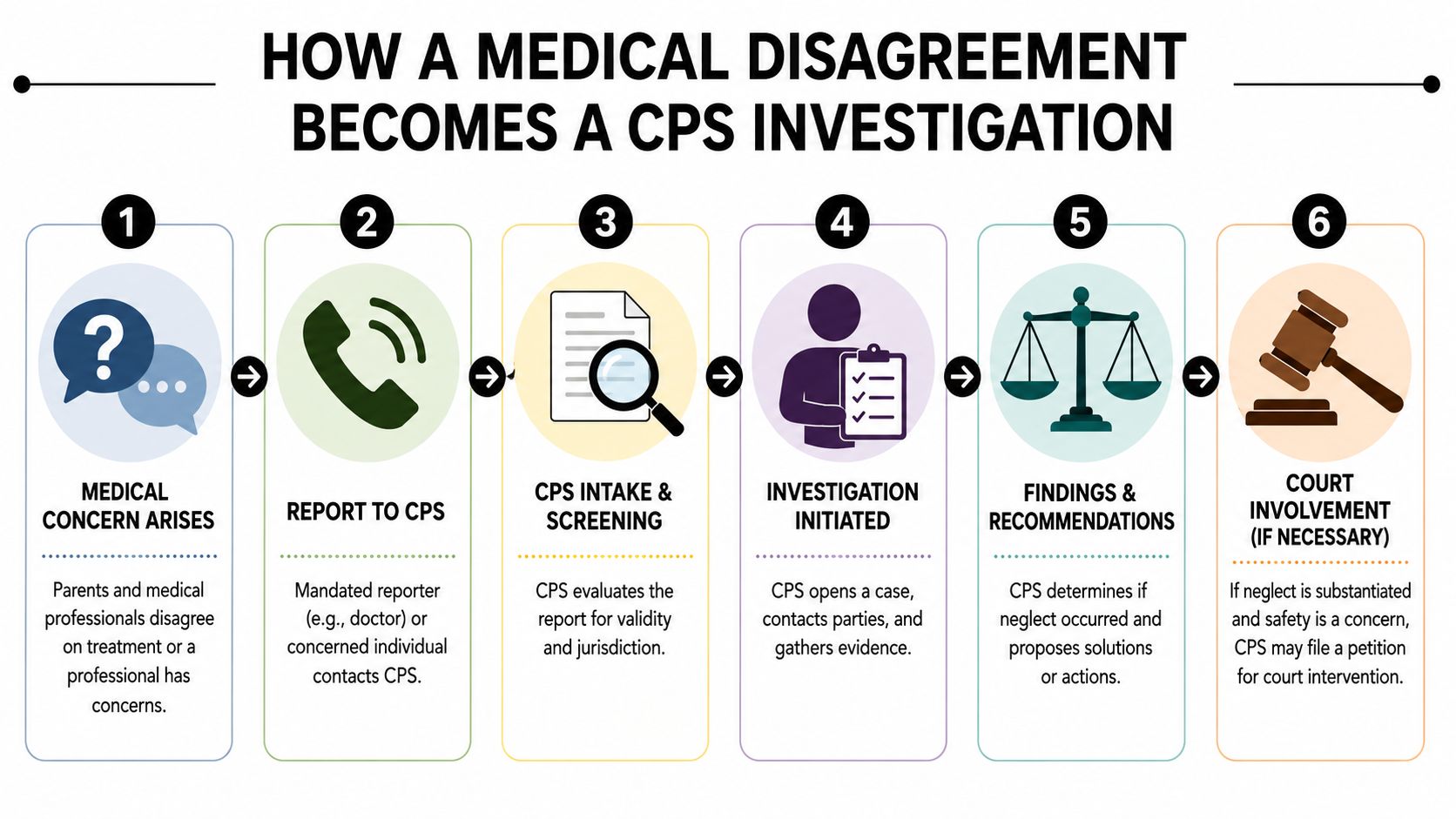
In a medical setting, the process often starts with a doctor, nurse, social worker, or other professional who believes the child may not be receiving necessary care. The report goes to the hotline. Then CPS decides whether the allegation fits its jurisdiction and whether the facts justify opening a case.
If a case opens, the investigator usually wants to answer practical questions quickly:
- What treatment was recommended
- What the parent agreed to or refused
- Whether the child faces current medical risk
- Whether another safe caregiver can help
- Whether court action is needed now
Parents are often shocked by how little time they have to get organized.
The first days are about risk, not perfect fairness
The first day or two of a CPS medical case can feel one-sided because the agency is not starting from neutral curiosity. It's asking whether a child is unsafe right now. That is why records, discharge instructions, text messages, appointment logs, and second-opinion requests become so important so quickly.
If you want a more detailed look at the mechanics, this guide on how Texas CPS investigates reports step by step breaks down the sequence from intake through field investigation.
What can trigger emergency action
An investigation does not automatically mean removal. But emergency action becomes more likely when CPS believes all of the following are true in substance:
- Necessary treatment is being withheld
- The child could suffer serious harm without prompt care
- There isn't time to wait for a slower court process
- A lesser option won't protect the child
That's the point where families need to stop treating the matter like a misunderstanding that will “blow over.”
The Emergency Removal Process Under Texas Law
Emergency removal is governed by Texas Family Code Chapter 262. For parents, this is the most frightening point in the case because events can move very fast. But even here, Texas law does not give CPS a blank check.
The basic legal issue is whether the child faces an immediate danger to physical health or safety such that removal is necessary. If CPS believes the risk is urgent, it may seek emergency court action. In some situations, law enforcement may also be involved in carrying out the removal.
CPS does not simply declare itself in charge
One of the biggest myths in these cases is that a caseworker can decide, on the spot, to take over every part of a child's life. That isn't how the process is supposed to work. Court involvement is central.
After a removal, the court begins reviewing whether the state's intervention should continue and under what terms. Texas cases then move into the statutory framework many parents hear about only after the crisis has started, including Chapter 262 on emergency removals, Chapter 263 on review and permanency, and, in the most serious cases, Chapter 161 on termination of parental rights.
Power after removal is layered
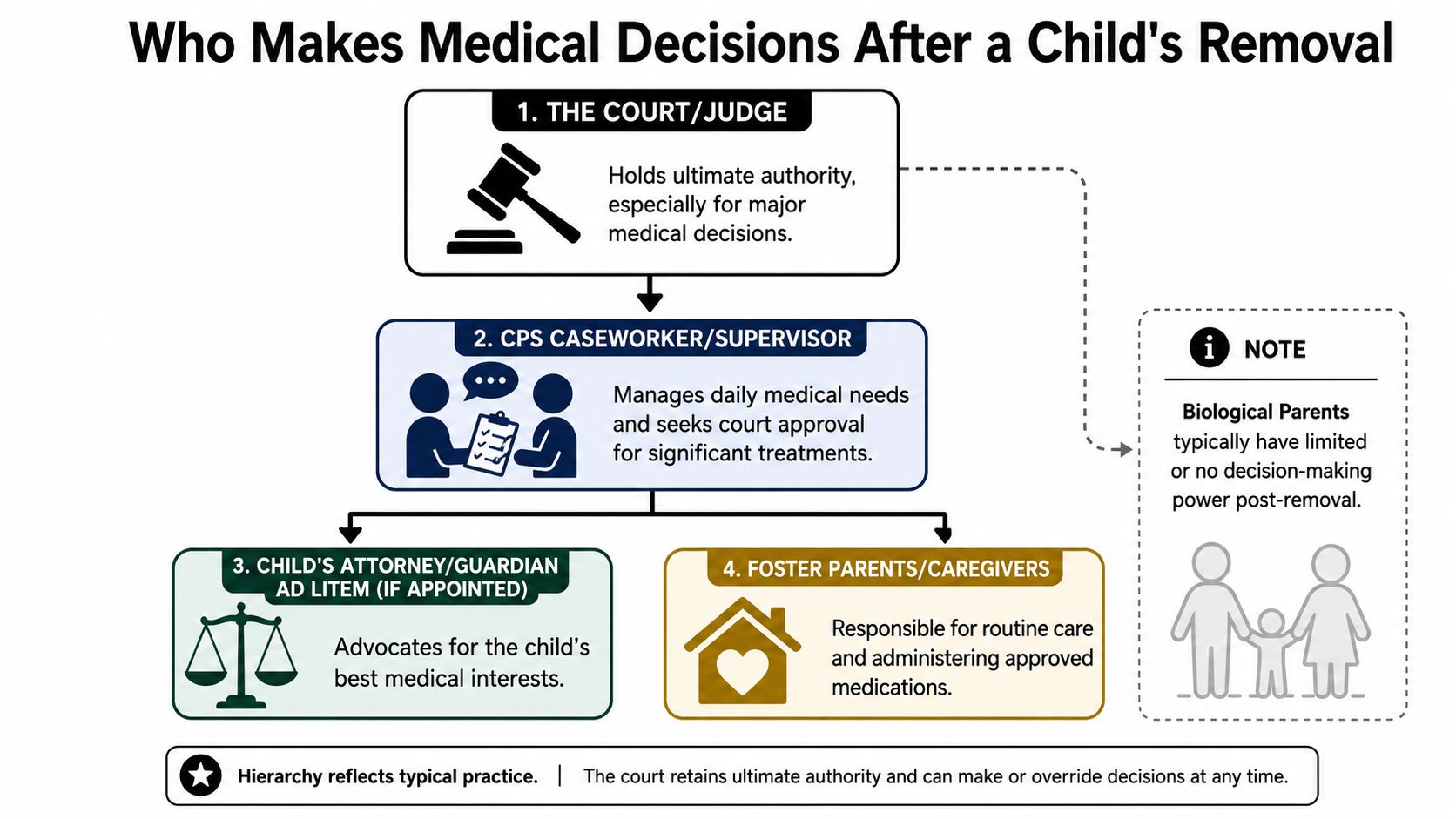
Once a child is removed, there is a chain of authority. The court sits at the top. CPS may request authority, manage placement, and recommend services, but it still operates within what the judge orders.
That distinction becomes especially important in medical cases. In Texas DFPS conservatorship matters, CPS does not have automatic medical authority. A court must specifically authorize DFPS or another named person to consent to care, and the agency must designate a medical consenter and backup consenter under the Texas Children's Commission benchbook at the medical-consent benchbook reference.
Why that distinction matters to parents
If your child has been removed, the fight is no longer only about whether CPS should have intervened. It is also about who gets to make medical decisions now, how broad that authority is, and whether the state is following the required process.
The most important early question is often not “Can CPS do anything?” It is “What exactly did the judge authorize, and what did the order leave open?”
That's where careful reading of temporary orders becomes critical. A rushed parent may hear “CPS has custody” and assume all decision-making is gone. In reality, the court order may be narrower than people think, and that can shape your strategy at the first hearing.
Who Makes Medical Decisions After a Removal
After removal, parents often assume the caseworker now decides everything. In Texas, that is not accurate. The court decides whether a youth may consent to all, some, or none of their own medical care, and the court may authorize either DFPS or a specific individual as the medical consenter according to the DFPS medical-consent guidance at the Texas DFPS medical consent page.
That means the key question is not whether CPS has total control. The key question is who the judge authorized to consent, and on what scope.
The hierarchy parents need to understand
A typical post-removal structure looks like this:
- The judge decides ultimate authority questions, especially in disputed situations.
- DFPS or another court-authorized consenter may be allowed to consent to treatment.
- A youth may have some consent rights if the court gives them.
- Parents may still provide information and advocate, even if they no longer control consent.
Texas also recognizes that some treatment disputes can become serious enough that even a youth's refusal may be overridden, but only if a judge finds clear and convincing evidence that the treatment is in the child's best interest, as explained on the same Texas DFPS medical consent page. That is a high-stakes legal standard, not a casual administrative choice.
What a parent should do immediately
If CPS contacts you over a medical dispute, focus on protecting both your child and your record.
- Ask for the allegation in plain language. You need to know whether CPS is claiming refusal of treatment, missed care, poor supervision, or something else.
- Gather the medical paper trail. Pull discharge instructions, prescriptions, referral notes, portal messages, and proof of follow-up efforts.
- Request your own consults quickly. If another doctor supports a different course or more evaluation, that matters.
- Keep communication measured. Anger is understandable, but angry language gets quoted.
- Get legal counsel before signing broad safety terms.
If your case has moved into conservatorship territory, this overview of temporary managing conservatorship in Texas CPS cases can help you understand how control shifts after court involvement.
What works better than arguing
Parents often think they must “win” a medical debate with a hospital or a caseworker. Usually, a better approach is to show organized, reasonable judgment.
“I am not refusing care. I am asking for clarification, a second opinion, and a written plan so I can make an informed decision for my child.”
That kind of statement is far more useful than a long emotional explanation.
Protecting Your Parental Rights During an Investigation
When CPS enters a medical dispute, small mistakes can become big evidence. A parent who is scared may talk too much, guess at timelines, sign a vague safety plan, or miss another appointment because they're overwhelmed. Those choices can damage the case.
A disciplined response protects your rights better than a defensive one.
A practical checklist for the first phase
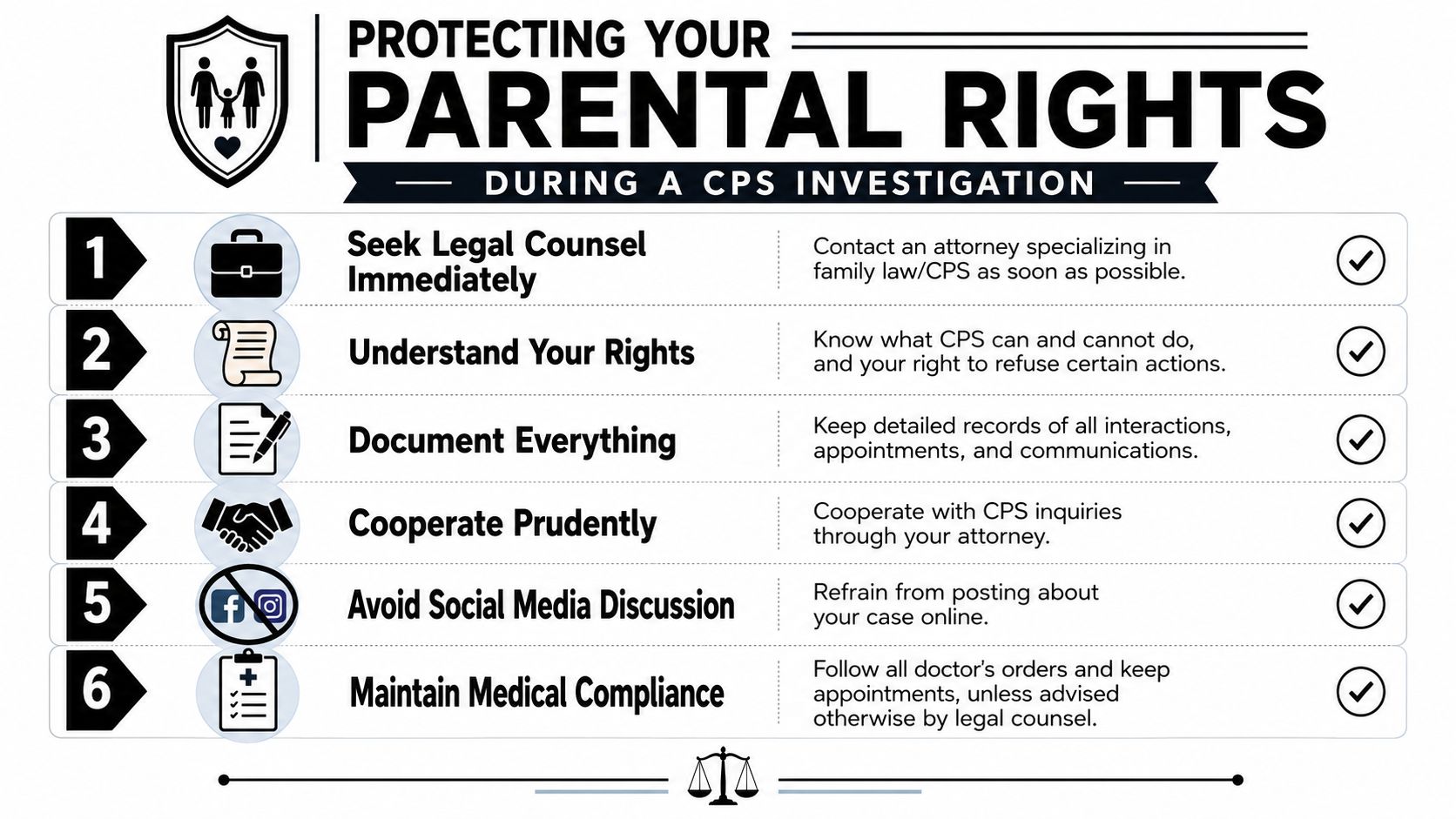
- Get a lawyer involved early. A CPS case can move from conversation to court faster than most parents expect.
- Document every contact. Write down names, dates, what was requested, and what you provided.
- Stick to verifiable facts. If you don't know an answer, say so. Don't guess.
- Keep treating the medical issue seriously. Continue appropriate follow-up unless your lawyer advises otherwise.
- Read before you sign. Safety plans can create obligations that affect later hearings.
- Stay off social media. Posts made in frustration can be misread and reused.
Parents often benefit from hearing practical guidance explained out loud. This short video covers common CPS pressure points and how to respond carefully:
The lawyer's leverage points
A lawyer changes the dynamic by narrowing the case to what can be proved. In a medical-neglect case, that often means asking hard questions:
- Was the recommended treatment indeed necessary at that moment?
- Did the parent seek alternatives in good faith?
- Are chart notes incomplete or slanted?
- Did CPS overstate urgency to justify intervention?
- Did the court order indeed authorize the action taken?
Those issues don't sort themselves out just because a parent is innocent or well-intentioned.
For families also dealing with custody overlap, some parents look for broader background from resources such as Austin child custody attorneys to understand how court orders, parent decision-making, and child welfare concerns can interact. In a CPS case, though, the analysis must stay tightly focused on the statutory standards and the evidence.
One sentence that can protect you
There is a moment in many investigations when cooperation stops being helpful and starts becoming risky.
I'm willing to cooperate, and I want my child safe. I'd like to speak with my attorney before answering more questions or signing anything.
That is not hostility. It is self-protection.
How a Texas CPS Attorney Can Change the Outcome
A CPS medical case is rarely won by emotion alone. It turns on records, timing, court orders, witness credibility, and whether the state followed the rules. That is where counsel matters.
An attorney can challenge whether the facts supported emergency intervention under Chapter 262. At the adversary stage and later review settings under Chapter 263, counsel can test the state's narrative, push for the child's return, and expose the gap between a provider disagreement and true medical neglect. If the case starts drifting toward a termination theory under Chapter 161, early legal work becomes even more important because those cases can harden quickly.
Medical-consent issues are another area where lawyers make a concrete difference. When DFPS becomes temporary managing conservator, it still does not receive automatic medical authority. A court must authorize consent authority, and DFPS must designate and train a medical consenter who is required to understand the diagnosis, treatment benefits, consequences of non-treatment, and risks before agreeing to care, as described in the Texas Children's Commission material at the conservatorship medical-consent benchbook. If that process was sloppy, rushed, or beyond the court's order, it can be challenged.
Parents also need someone who can translate panic into action. That may include preparing for the first hearing, preserving favorable medical evidence, obtaining second-opinion support, objecting to overbroad safety plans, or insisting that CPS and providers separate a reasonable parental judgment call from actual endangerment. Law Office of Bryan Fagan PLLC is one Texas option families may contact when a CPS case intersects with child medical care, emergency hearings, and conservatorship issues.
The fear behind the question “Can CPS take your child for medical decisions you make?” is real. The answer is not simple, but it is not hopeless either. Texas law gives the state tools to intervene when a child faces real danger. It also gives parents rights, hearings, standards of proof, and opportunities to fight back with evidence and counsel.
If CPS has contacted you over your child's medical care, don't wait for the next phone call or hearing to figure out your options. The attorneys at Law Office of Bryan Fagan PLLC help Texas parents understand their rights, respond strategically, and challenge overreach in CPS cases involving medical decisions. Contact the firm for a free consultation and get clear guidance on how to protect your child, your rights, and your family.