Skip to content
Your phone rings during dinner, or someone knocks on the door just after school pickup. A CPS investigator says they received a report. Then comes the phrase that makes many parents freeze: mental health concerns.
For most parents, that moment feels personal, humiliating, and dangerous all at once. You may have a diagnosis. You may take medication. You may have gone through a hard stretch after a divorce, a loss, or a medical crisis. Or the allegation may be completely false and tied to a custody fight. In any of those situations, the same fear hits fast. Are they going to take my child?
In Texas, CPS and mental health allegations don't automatically mean a parent is unsafe. They also can't be brushed off as harmless gossip. Once a report is accepted, a legal process starts. That process can move quickly, and the way you respond in the first days often matters as much as the allegation itself.
A parent with anxiety who follows treatment and safely cares for a child is in a very different position from a parent whose untreated condition creates an immediate danger in the home. CPS does not always make that distinction cleanly at the start. That is why a calm, evidence-based response matters so much.
The Phone Call Every Parent Dreads
A common version of this starts in the middle of an ordinary week. A mother takes her child to school after a rough morning. The child is upset. Later that day, a school employee calls CPS after hearing the child say, “Mom cries all the time and sleeps a lot.” By evening, a caseworker is asking whether the mother is depressed and whether the child is safe at home.
Another version starts with a custody exchange. One parent tells CPS the other is “unstable,” “off medication,” or “acting irrational.” The words are vague, but they are powerful. They trigger questions about judgment, supervision, and safety.
Why this hits so hard
Mental health allegations cut deeper than many other accusations because they attack both your parenting and your credibility. Parents often think, “If I admit I've ever had counseling, they'll use it against me.” Others make the opposite mistake and deny obvious treatment history that can easily be verified.
Both reactions can hurt your case.
Practical rule: Treat the allegation as a legal problem, not just an insult. Hurt feelings are real, but strategy has to come first.
The first goal is to slow your own panic. CPS workers are trained to assess risk. They watch what you say, how you say it, whether the home appears stable, and whether your explanation is consistent. If you start arguing, oversharing, or accusing everyone around you, you may confirm the very narrative you want to defeat.
What worried parents need to remember
A mental health diagnosis alone does not decide a CPS case. The key question is whether CPS believes your condition affects your child's safety or daily care.
That distinction matters:
- Diagnosis is not the same as danger. Many parents manage depression, anxiety, PTSD, or other conditions while raising children safely.
- Symptoms matter if they affect parenting. Missed supervision, unsafe decisions, threats of self-harm in front of a child, or repeated crises will get attention.
- Documentation often matters more than denial. A parent who can show treatment compliance, medical follow-up, and daily stability is usually in a stronger position than a parent who asserts, “I'm fine.”
If CPS has contacted you, the situation is serious. It is also navigable. Texas law gives CPS tools, but it also gives parents rights. The key is using those rights carefully and early.
How Mental Health Becomes a CPS Issue in Texas
Mental health becomes a CPS issue when someone reports that a parent's condition, behavior, or treatment history may affect a child's safety. Sometimes that report comes from a legitimate concern. Sometimes it comes from misunderstanding. Sometimes it comes from a family conflict where one person knows exactly which accusation will do the most damage.

Texas CPS handles a very large caseload. According to Texas DFPS child protection information, in Fiscal Year 2025, Texas CPS completed over 13,000 Child Protective Investigations and identified over 5,000 confirmed victims of child abuse or neglect. In a system working at that scale, investigators often cast a wide initial net when they hear allegations involving emotional instability, crisis behavior, or possible trauma in the home.
Where these reports usually start
Some reports begin with people who interact with your child regularly. A teacher may notice a child is anxious and says a parent “can't get out of bed.” A doctor may hear that a parent stopped medication and is acting erratically. A counselor may become concerned after a child describes chaos at home.
Other reports start in private family conflict. During a breakup, one parent may claim the other is bipolar, suicidal, paranoid, or abusing prescription medication. Sometimes there is some truth mixed in. Sometimes there isn't. CPS still has to decide whether the report describes neglect or danger, not just unpleasant behavior.
Here are common triggers:
- A reported crisis at home. Police visits, welfare checks, or emergency-room episodes can lead to scrutiny.
- Statements by a child. Children may describe what they saw accurately, partially, or in a confused way.
- Missed treatment or abrupt changes. A lapse in counseling or medication can be framed as instability.
- Custody litigation pressure. An ex may use loaded mental health language to gain an advantage.
The difference between concern and weaponization
Not every report is malicious. Some are made by adults who believe a child needs help. But in contested family cases, mental health allegations can become a shortcut accusation because they are hard to disprove with a single conversation.
Consider a parent who tells a school counselor, “I've been overwhelmed since the divorce and I'm starting therapy.” That can reflect responsible parenting. In the wrong hands, it can turn into, “Mom admitted she's mentally unstable.”
The issue in these cases is rarely the label alone. The issue is whether anyone can tie that label to specific facts showing a child is unsafe.
That is why parents need to stop focusing only on whether the allegation is “fair.” CPS is asking a different question. They want to know whether there is enough concern to justify intervention. Your job is to answer with records, context, and a stable presentation.
The First 72 Hours Your Role in the Investigation
The first few days shape the rest of the case. When CPS contacts you, the investigator is trying to answer basic questions fast. Is the child safe right now? Does this parent seem stable? Is there a need for immediate court action or a safety plan?
That pressure cuts both ways. A rushed investigator may miss context. A panicked parent may hand over too much.
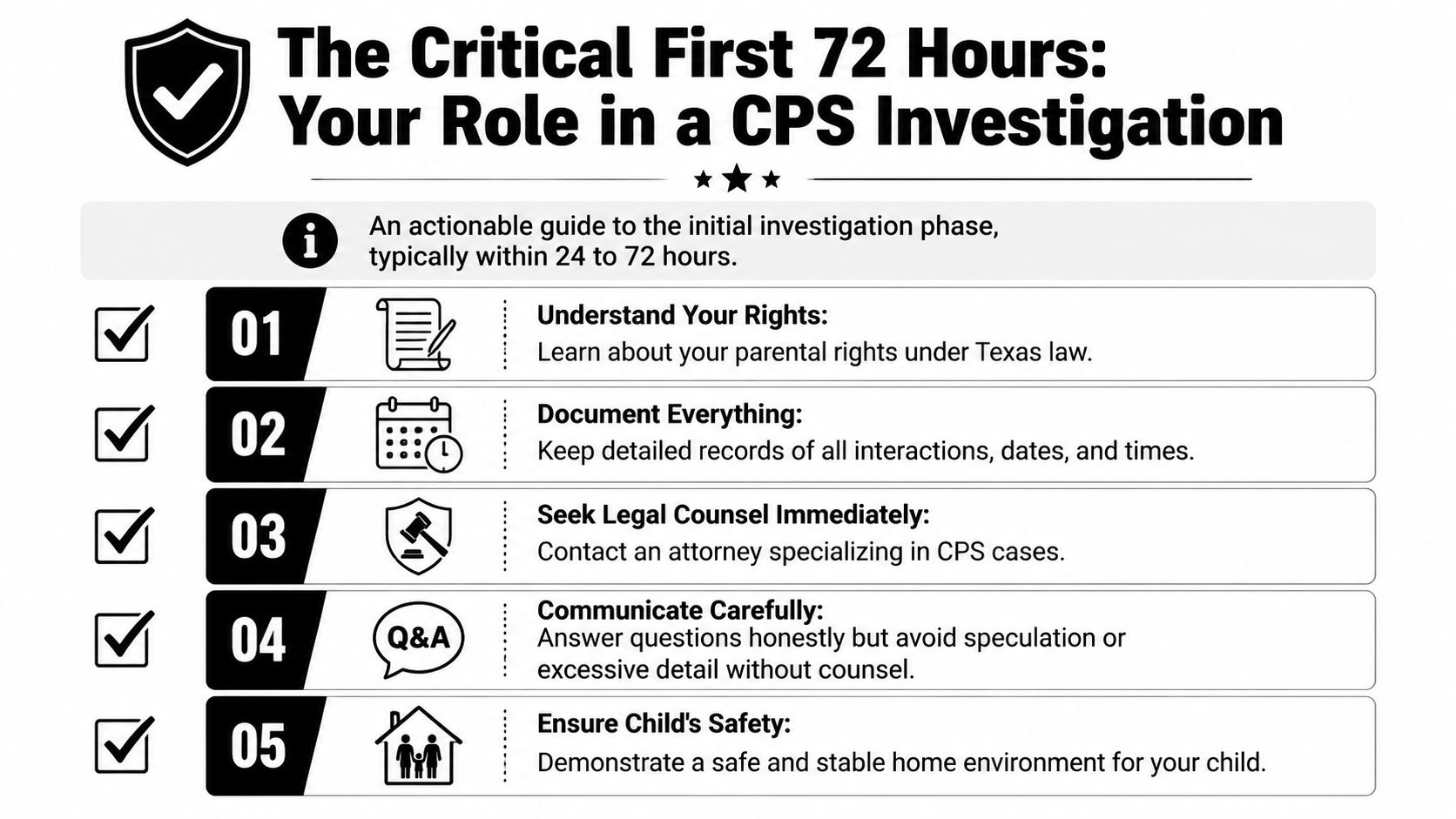
What the investigator is looking for
During an early home visit or interview, CPS usually wants to observe the child, the home, and the parent's functioning. If the allegation involves mental health, expect questions about diagnosis, medication, therapy, hospitalizations, and daily routines.
The investigator may also look for practical signs of functioning, such as whether the child is fed, supervised, attending school, and living in a safe environment. In a mental health case, small details matter. A stocked kitchen, a child's school routine, and calm communication often carry more weight than a speech about how unfair the report is.
Texas child welfare cases also unfold in a strained system. The Hogg Foundation's child welfare overview notes ongoing shortages in treatment and placements, ongoing problems involving children without placement, and a long-running foster-care lawsuit. It also notes that in April 2024, a judge held Texas Health and Human Services in contempt and imposed a daily fine of $100,000 for repeatedly failing to investigate abuse and neglect claims in foster care. That environment can push caseworkers toward cautious, defensive decision-making.
What you should do right away
Use a disciplined approach. Do not treat the first contact as casual.
- Write everything down. Get the investigator's name, phone number, supervisor, date, and reason for contact.
- Ask focused questions. You need to know the general allegation, not every rumor.
- Be polite and measured. Hostility gets documented. So does visible chaos.
- Do not sign documents on the spot. Safety plans and releases can affect your case more than parents realize.
- Call a lawyer early. Mental health allegations often overlap with custody litigation, medical privacy, and sometimes criminal risk.
What not to do
A lot of parents damage their own position by trying too hard to look innocent.
| Misstep | Why it causes problems |
|---|---|
| Talking nonstop | It creates inconsistencies and gives CPS extra statements to analyze |
| Denying any mental health history when records exist | It hurts your credibility |
| Handing over full medical access immediately | It may expose irrelevant history |
| Arguing about the reporter | It distracts from the current safety question |
If CPS asks a broad question, give a truthful, narrow answer. Do not guess. Do not speculate. Do not fill silence because you feel nervous.
If the allegation is false, your defense begins immediately. If the allegation has some truth behind it, your response still needs structure. Either way, your role in the first 72 hours is to present stability, protect your rights, and avoid preventable mistakes.
Navigating Psychiatric Evaluations and Medical Records
When CPS raises mental health concerns, the next pressure point is usually medical information. The investigator may ask you to sign releases, provide treatment records, or submit to a psychological or psychiatric evaluation. Parents often assume they have only two choices. Hand over everything or refuse everything. Neither response is usually wise.
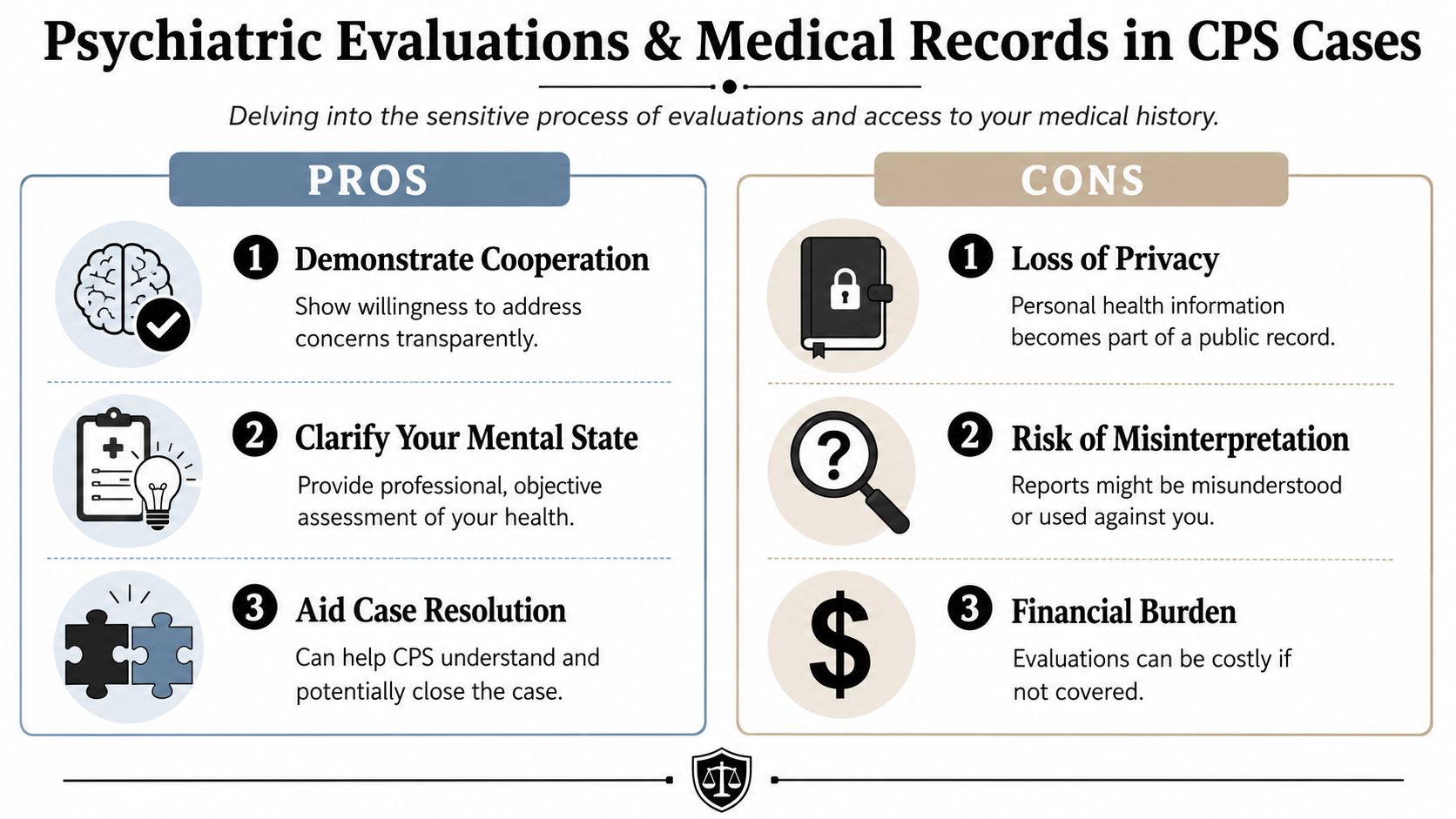
Broad releases are rarely your friend
A CPS investigator may present a release that allows access to wide categories of records. That can include therapy notes, medication history, hospital records, and communications with providers. Some of that may be relevant. Some of it may be old, incomplete, or easy to misread outside clinical context.
The safer approach is targeted disclosure. If the issue is whether you are currently stable and following treatment, then recent records showing attendance, medication management, discharge status, or provider summaries may be enough. Your lawyer can often help narrow what is produced and how it is framed.
If you need help gathering records from multiple doctors or facilities, a practical step is transferring your health records in an organized way before CPS defines the story for you.
Evaluations can help or hurt
A psychological evaluation can support a parent who has been falsely labeled unstable. It can also create problems if the evaluator receives bad collateral information, reviews slanted records, or answers a question broader than the issue before the court.
Consider the trade-offs:
- Cooperation can show confidence. A reasonable, well-scoped evaluation may reassure the court.
- Scope matters. The right question is not “Is this parent perfect?” It is whether the parent can safely care for the child.
- Therapy notes require caution. Process notes and raw counseling material often contain sensitive statements without full context.
- Old records may distract. A past episode does not automatically prove current danger.
Parents dealing with allegations tied to healthcare judgment should also understand how these cases can overlap with medical decision-making disputes. This discussion of whether CPS can take your child over medical decisions helps show how quickly a treatment disagreement can become a safety accusation.
A better way to respond
When mental health records are in play, think in terms of controlled proof.
You usually want to gather:
- Current treatment records showing attendance or follow-up
- Medication documentation if prescribed and taken as directed
- Provider letters or summaries focused on functioning and parenting capacity
- Hospital discharge paperwork if there was a past crisis and you are now stabilized
Cooperation does not mean surrender. It means giving relevant proof in a way that supports your case instead of burying it.
The central question is not whether you have ever struggled. Many strong parents have. The question is whether you can show a pattern of safe parenting, insight, and stability with evidence that is accurate and limited to what is relevant.
When CPS Removes Your Child Emergency Hearings and Timelines
The hardest cases are the ones where CPS removes a child before the parent feels heard. In Texas, emergency removal is governed by Chapter 262 of the Texas Family Code. The basic legal issue is immediate danger. CPS must persuade a court that the child could not safely remain in the home without urgent intervention.
That standard matters because a mental health allegation, by itself, should not equal removal. The state still needs facts that connect the allegation to a current safety threat.
A common example is a parent accused of being suicidal, psychotic, or too impaired to supervise a child. If the state can show recent conduct that points to immediate danger, removal becomes more likely. If the allegation rests on old history, a hostile ex, or vague descriptions of instability, the defense needs to attack the gap between label and proof.
To visualize the court sequence, keep this timeline in mind.

The first hearing that changes everything
If CPS has already removed your child, one of the first major court events is the 14-day adversary hearing. That hearing is critical. It is the point where a judge reviews whether the emergency action should continue.
At that stage, your lawyer should be focused on specific weaknesses in the state's case:
- What exactly was the immediate danger
- What evidence was firsthand and what was hearsay
- Whether less restrictive options existed
- Whether the parent has family support, treatment compliance, or a safe supervision plan
A parent's courtroom presentation matters. So does preparation. The judge will pay attention to whether you appear organized, realistic, and responsive to concerns.
Here is a plain-language hearing flow that often applies in CPS cases:
| Stage | Why it matters |
|---|---|
| Emergency removal | CPS takes temporary action before a full hearing |
| 14-day adversary hearing | Judge reviews whether removal should continue |
| Status hearing | Court addresses service plan and case direction under Chapter 263 |
| Permanency hearings | Court checks progress and placement over time |
| Final orders | Court decides reunification, conservatorship, or another final result |
The next part of the process is often easier to understand when you hear it discussed out loud. This overview can help:
Chapters 263 and 161 matter later, but preparation starts now
After the immediate removal phase, Chapter 263 governs review, status, and permanency hearings. During these hearings, service plans, compliance issues, and progress toward reunification are tracked. If the case deteriorates badly, Chapter 161 becomes important because that chapter governs termination of parental rights.
Parents sometimes walk into the adversary hearing thinking they only need to beat removal that day. In reality, the record starts building immediately for every later stage. What you do now affects how the judge sees your willingness to protect your child, follow treatment recommendations, and work a plan.
A parent can lose ground fast by treating the early hearing like a misunderstanding that will sort itself out. Judges want evidence, not outrage.
If your child has been removed, you need counsel immediately. This is not the moment to rely on informal conversations with the caseworker. It is the moment to prepare testimony, records, treatment proof, witnesses, and a workable safety alternative that the court can trust.
Building Your Defense Against Mental Health Allegations
In these cases, denial by itself usually fails. Courts and investigators expect a parent to say the report is false or exaggerated. What changes outcomes is a defense built around corroboration.
Texas recognizes the problem of false reporting, but the practical reality is difficult. According to DFPS investigations information, knowingly making a false CPS report is a crime in Texas, yet proving malicious intent is difficult. That same guidance supports what experienced lawyers see in practice. The better defense is usually to systematically disprove the allegation with records, witness testimony, and documentation showing a pattern of stability. It also matters that a 2024 Texas law gave parents under suspicion of physical abuse the right to seek a second medical opinion, which reflects broader concern about overreliance on a single assessment.
What strong defense evidence looks like
If your mental health is being weaponized, build the file a judge would want to see. Not a pile of loose papers. A clear, dated record.
That often includes:
- Treatment consistency. Appointment records, medication management, discharge summaries, or provider letters.
- Daily functioning proof. School attendance records, childcare routines, calendars, and communications showing stable parenting.
- Neutral witnesses. Teachers, doctors, counselors, relatives, neighbors, or supervisors who have seen you parent.
- Timeline evidence. Texts, emails, and dated records that expose exaggerations or contradictions.
- False-report context. If the claim arose during a custody fight, preserve messages and court filings that show motive without making motive your only argument.
What doesn't work well
Some defenses sound strong to parents but fall apart in a CPS case.
Saying “I have rights” without producing supporting records doesn't solve the safety issue. Attacking your ex for being manipulative may be true, but if that is all you offer, the court still has unanswered questions. Refusing any evaluation, any release, and any service can also backfire if the judge concludes you are hiding the ball.
A better approach is controlled cooperation. Provide what is relevant. Challenge what is excessive. Correct what is false.
If the accusation overlaps with allegations of neglect, medical judgment, or failure to follow care instructions, this discussion of a Texas CPS medical neglect defense is often useful because it shows how evidence can separate a parenting dispute from a true safety threat.
When legal strategy has to widen
Some mental health allegations spill into criminal territory. Threat allegations, assault accusations, drug possession claims, or alleged child endangerment can turn a CPS case into two cases at once. When that happens, every statement carries more risk.
This is one place where coordinated counsel matters. Law Office of Bryan Fagan PLLC handles Texas CPS defense and criminal matters that can intersect with family cases, which is relevant when a parent faces both child safety allegations and possible criminal exposure.
The strongest defense usually looks calm from the outside. Behind that calm is a lot of work: records, witnesses, provider coordination, and a disciplined decision about what to say and what not to say.
If you are mentally healthy and being accused unfairly, prove it. If you have a real diagnosis but it is managed, prove that. If you had a crisis but recovered, prove the recovery. In CPS and mental health allegations in Texas, evidence of stable parenting beats argument almost every time.
The Path Forward Reunification Services and Final Outcomes
Most parents want one thing. Their child home, their family intact, and a path out of court. In many CPS cases, the practical route to that result runs through services, compliance, and credibility over time.
If the case remains open, CPS may push for counseling, parenting classes, psychiatric follow-up, medication management, or supervised visitation. Some families deal with Family-Based Safety Services while the child remains at home or with relatives. Other families work under court orders after removal. In either setting, the judge is looking for more than attendance. The judge wants to see whether you understand the concern, follow through, and create a safer, more stable routine.
How reunification usually gets won
Parents often fail service plans for avoidable reasons. They miss appointments, show up late, argue with providers, or treat classes as a hoop to jump through rather than part of the record. Every missed step gives CPS another line in a report.
A stronger approach looks like this:
- Follow the plan exactly. If a service is impossible because of cost, transportation, or scheduling, raise that issue early and in writing.
- Keep proof of completion. Save certificates, attendance logs, provider notes, and prescription records.
- Stay child-focused. Judges respond better to parents who discuss the child's routine, needs, and safety than parents who stay fixed on blaming the other side.
- Ask for updates in writing. Clear communication reduces disputes later.
When the stakes rise further
Not every case ends in reunification. Some end with modified conservatorship, monitored return, placement with relatives, or another permanency arrangement. The most severe outcome is termination of parental rights under Chapter 161 of the Texas Family Code.
Termination does not happen because a parent had therapy or took medication. It happens in much more serious circumstances, usually when the state claims there is a statutory ground for termination and that termination is in the child's best interest. That is why a mental health allegation needs to be addressed early, before it hardens into a broader narrative of instability or noncompliance.
Families dealing with trauma and recovery issues often benefit from understanding the support side of these cases too. This resource on CPS intervention and mental health support can help frame what healing and compliance should look like when the case is moving toward reunification.
The right mindset is simple. Take the case seriously. Do not accept false labels. Do not ignore real concerns either. Build a record that shows safety, honesty, and consistency. That is how many parents get out of the defensive posture and back into a position of strength.
If CPS has contacted you about mental health allegations, don't wait for the case to define you before you respond. A calm, early legal strategy can protect your rights, your records, and your relationship with your child. The Law Office of Bryan Fagan PLLC offers free consultations for Texas families facing CPS investigations, emergency hearings, and cases where mental health is being questioned or used to influence the situation. Reach out for confidential guidance on what to do next.