Skip to content
A CPS investigator at your door after a domestic violence incident can make your whole body go cold. Parents often tell me the same thing in different words: “I thought the argument was over, and then suddenly I was terrified I could lose my child.” That fear is real. So is the confusion, especially when you were the one harmed.
In Texas, CPS cases involving domestic violence move fast because the agency is trained to treat these reports as child-safety matters, not just adult relationship conflict. Nationally, the system works against a backdrop where the National Domestic Violence Hotline cites an average of 24 people per minute experiencing rape, physical violence, or stalking by an intimate partner in the United States, totaling more than 12 million victims in a single year, and one evidence summary estimates 3.3 million to 10 million children are exposed to adult domestic violence annually according to the SSWR evidence summary on domestic violence and child welfare.
That doesn't mean removal is automatic. It does mean every early decision matters. If you're the non-offending parent, your case often turns on whether CPS sees you as the child's protector, or as someone who failed to act when danger was present. That distinction can change everything.
That Knock on the Door Understanding the Start of a CPS Case
It usually starts with a police response, a neighbor call, or a report from someone who heard yelling and knew children were in the home. Then comes the knock. The investigator may arrive calm and polite, but the moment still feels like a threat to your family's future.
A common Texas scenario looks like this: police respond after a late-night fight between parents. No one is arrested, or only one parent is. The next day or two, CPS appears and says they need to “check on the children.” The parent who called for help is stunned. The parent who was hurt feels punished for reporting violence. The other parent may already be denying everything.
What matters in that moment is understanding what CPS is trying to assess. The investigator is not deciding whether your relationship is healthy. The investigator is deciding whether your child is safe right now, and whether the home is likely to stay safe over the next few days.
What the investigator is looking for
CPS usually starts with practical questions:
- Was the child present during the incident, even if asleep in another room?
- Has this happened before, even if no police report was made?
- Is the alleged aggressor still in the home or likely to return?
- Does the non-offending parent have a plan to keep the child safe tonight?
Practical rule: The first conversation often shapes the entire case. Calm, specific answers are better than broad denials or emotional arguments.
Parents sometimes think they need to prove the entire history of the relationship on day one. You don't. You need to show that you understand the danger, that your child's safety comes first, and that you are making concrete protective decisions.
Why CPS Investigates Domestic Violence in Texas
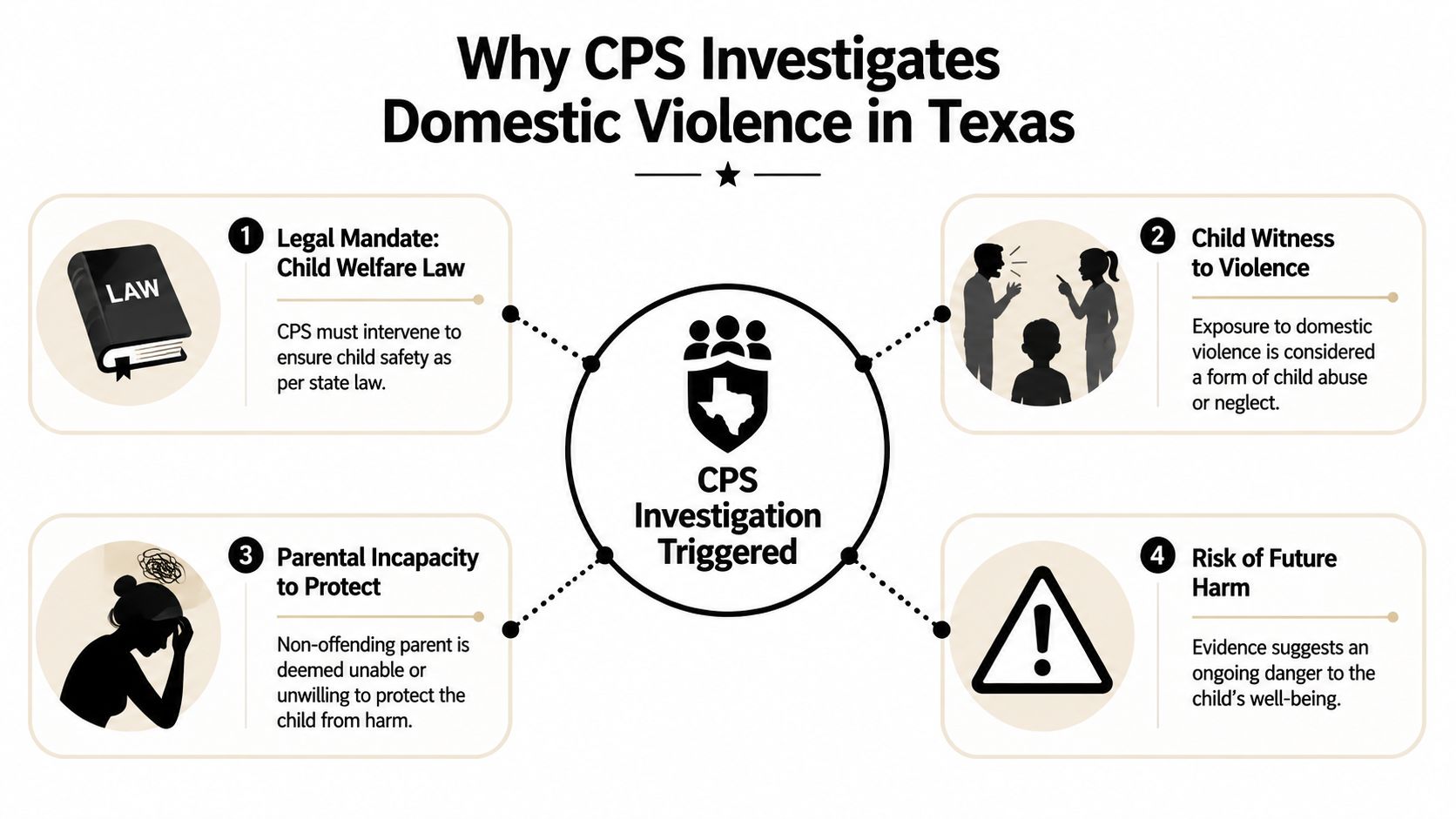
Texas law gives CPS broad authority to investigate risk to a child, and domestic violence fits squarely into that analysis. A child doesn't have to be physically struck for CPS to become involved. If a child is exposed to violence, chaos, threats, injuries, or repeated police responses, CPS may treat that home as unsafe.
Why the agency treats these cases so seriously
Domestic violence cases often come with other concerns. Research summarized by CHOP reports that 30% to 60% of families where domestic violence is identified also have some form of child maltreatment, and CPS systems increasingly treat domestic violence as a co-occurring maltreatment multiplier, meaning it raises the chance of parallel neglect or abuse findings according to CHOP's overview of domestic violence and child abuse.
That explains why a parent may say, “The fight was between adults,” while CPS responds, “Your child was still at risk.” In the agency's view, violence between adults can impair supervision, disrupt sleep and routine, expose children to trauma, and make future harm more likely.
How this connects to Texas Family Code cases
In practice, CPS decisions often lead into the court process under Texas Family Code Chapter 262 if the agency believes emergency intervention is needed. If a case stays open, Chapter 263 governs the court's review of service plans, status hearings, permanency hearings, and the timeline toward reunification or another permanent result. If a parent doesn't complete services or the court finds severe ongoing endangerment, Chapter 161 becomes the chapter people fear most because it addresses termination of parental rights.
A parent doesn't need to memorize those chapters. But it helps to understand the basic structure:
| Texas Family Code chapter | What it usually means in real life |
|---|---|
| Chapter 262 | Emergency action, removals, and the first court fight over whether CPS can keep control |
| Chapter 263 | Ongoing review of the case, services, placement, visitation, and progress |
| Chapter 161 | The legal standards for termination if the case goes badly and the court finds statutory grounds |
The practical takeaway is simple. CPS investigates domestic violence because Texas child-safety law focuses on risk, not just visible injury.
The First 48 Hours Your Rights and Immediate Actions
The first two days matter more than most parents realize. A bad first interview can create months of damage. A careful first response can stabilize the case before it snowballs.
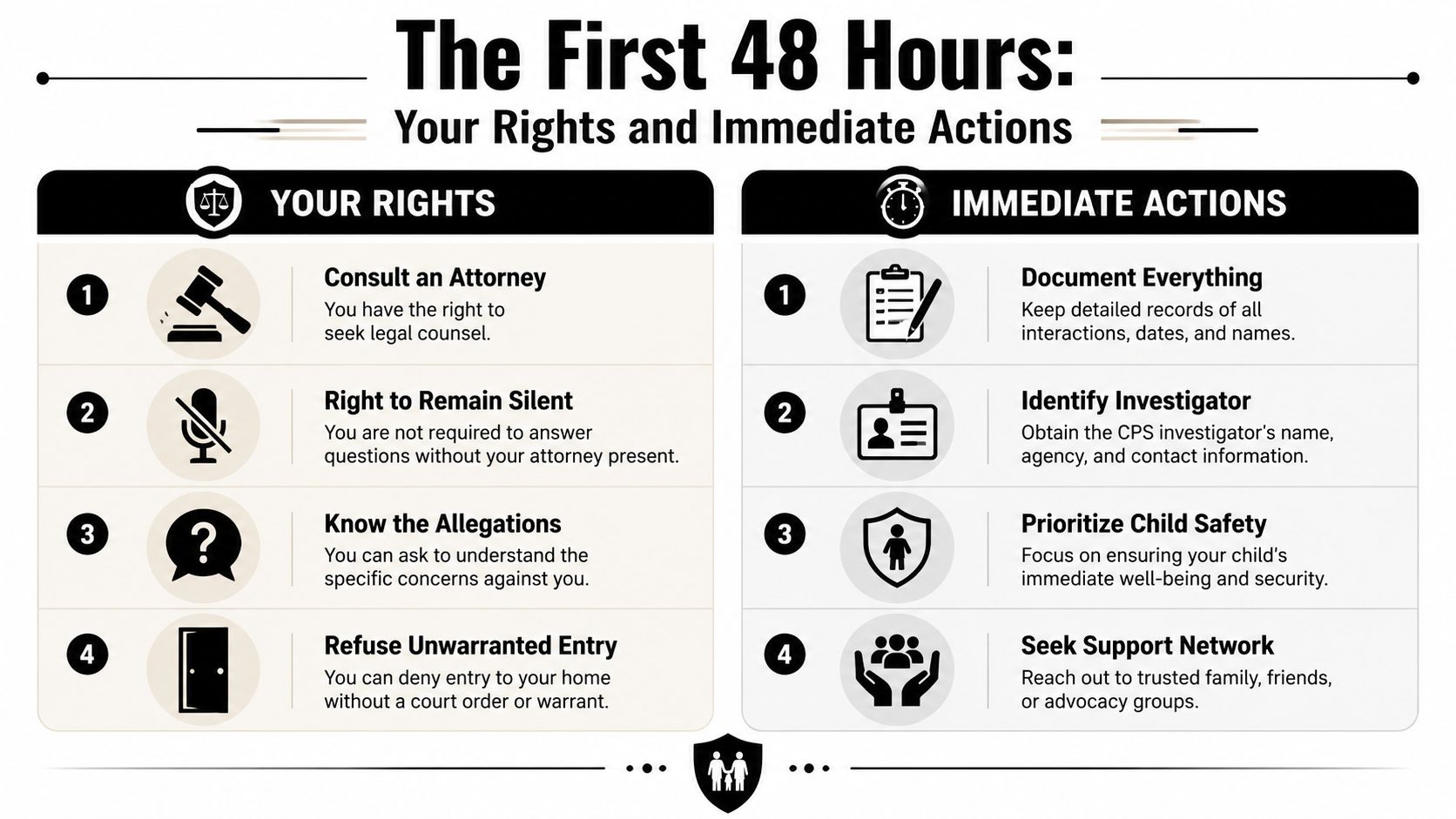
What to do immediately
Start with control and clarity.
- Get the investigator's full name and contact information. Write it down.
- Ask what the specific allegations are. Don't guess.
- Ask whether there is a court order, warrant, or emergency removal request.
- Do not sign a safety plan or other document before legal advice if you can avoid it.
- If you are the victim, ask for separate interviews.
Texas DFPS guidance states that a domestic violence victim is not automatically held responsible for abuse or neglect just for being victimized, that seeking help from a Family Violence Program does not automatically trigger DFPS involvement, and that parents can ask for separate interviews and should seek legal help before signing documents, as explained by Texas DFPS guidance for domestic violence investigations.
Here's a practical resource if you're trying to avoid saying something that gets twisted later: what to say and not say to CPS investigators.
Cooperation is not the same as surrender
Many parents make one of two mistakes. They either refuse everything and look obstructive, or they overshare and hand CPS inconsistent statements, speculation, and emotional admissions that become evidence.
A better approach is measured cooperation.
- Be respectful. Hostility rarely helps.
- Be accurate. If you don't know, say you don't know.
- Keep your focus on child safety. Explain what steps you've taken.
- Don't fill silence with guesses. Investigators notice changes in your story.
Later in the first day, many parents benefit from hearing a straightforward explanation of the process. This video can help frame what you're dealing with before the next call or visit.
Ask for the allegation in plain language. Ask what CPS wants done immediately. Then pause before agreeing to anything you don't fully understand.
Questions parents ask right away
| Question | Short answer |
|---|---|
| Do I have to answer every question on the spot? | You should be careful. You can ask for time to speak with an attorney. |
| Do I have to let CPS into my home without a court order? | Not automatically. The facts matter, and emergency circumstances change the analysis. |
| Can they talk to my child? | CPS often seeks to interview children. How and when that happens depends on the situation. |
| Should I sign a safety plan just to look cooperative? | Not without understanding every term and how it affects custody, possession, and future court arguments. |
Am I Being Blamed The Primary Aggressor vs Failure to Protect Rule
This is the part that feels cruel to many parents. You were abused, but now CPS is asking why you didn't stop it. That question can sound like blame, and sometimes it becomes a formal allegation that you failed to protect.
A common example: a mother calls police after her child's father shoves her into a wall during an argument. The child hears screaming from the hallway. CPS later asks why she let him come back after a previous incident. The mother hears that question as an accusation. CPS hears it as a safety inquiry.

What primary aggressor means
Child-welfare guidance in states like Kentucky directs workers to identify the primary aggressor and not treat the non-offending caregiver as responsible for controlling the perpetrator's violence. Texas takes a similar approach, but may still examine whether the parent used reasonably available supports to protect the child, as reflected in Kentucky's domestic violence CPS tip sheet discussing primary aggressor analysis.
That's the nuance parents miss. Texas CPS should not automatically say, “You were victimized, therefore you are neglectful.” But CPS may ask whether you took available protective steps once the danger became clear.
What helps and what hurts
What helps is evidence of action. What hurts is minimization.
Helpful facts might include:
- You sought medical care after an assault.
- You called law enforcement or a shelter.
- You moved out or changed locks if it was legally possible.
- You arranged supervised exchanges for the child.
- You asked the investigator to keep your location confidential from the abusive parent.
Facts that often create trouble:
- Saying it was “just verbal” when there are threats, property damage, or prior assaults.
- Allowing immediate contact again without a clear safety plan.
- Defending the aggressor more than protecting the child.
- Signing vague agreements you cannot realistically follow.
Key distinction: CPS is supposed to ask who caused the danger. It will also ask what the safer parent did after the danger became obvious.
Protective orders also intersect with these cases. If you're dealing with one, or defending against allegations tied to one, this guide on how to fight a protective order in Texas can help you understand the court side of the issue.
The CPS Process Unfolded From Safety Plans to Court Hearings
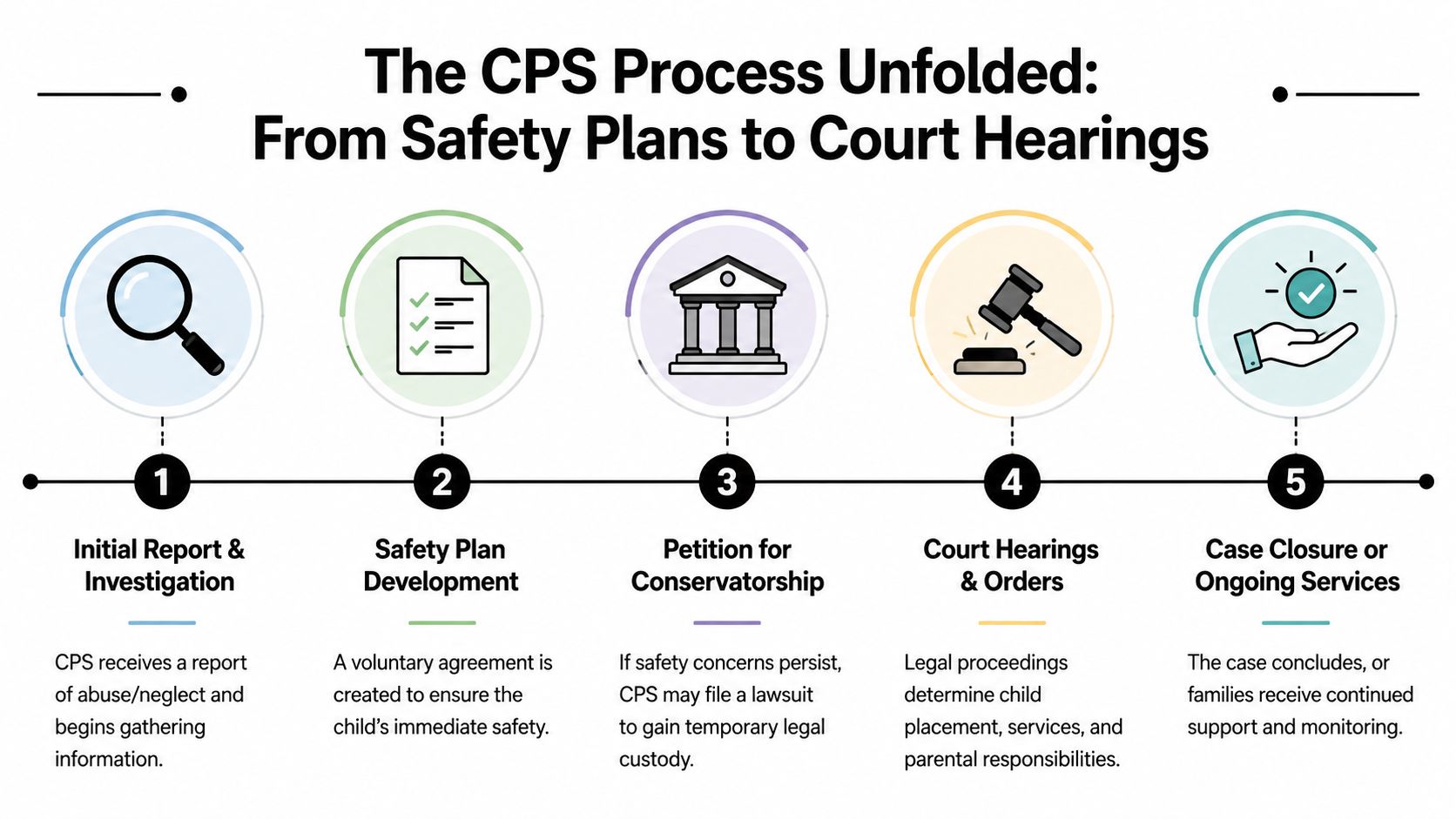
Parents usually experience the CPS system as a blur. The better way to think about it is a sequence of pressure points. Each stage asks a different question.
The early stages
First comes the report and investigation. CPS interviews people, reviews police records if available, and tries to determine whether there is immediate danger.
Then comes the pressure to agree to a safety plan or a Parental Child Safety Placement. These arrangements are often presented as temporary and cooperative. Sometimes they are as presented. Sometimes they become the bridge to a court case.
In one large county-level study, child exposure to domestic violence was flagged in 5.9% of CPS investigations, yet those cases accounted for 17.9% of all out-of-home placements. At the same time, over 70% of children in those specific cases were not removed, which is an important reminder that early parental response can influence outcome, as shown in the PMC study on child exposure to domestic violence and CPS outcomes.
When the case moves into court
If CPS believes a child cannot remain safely at home, it may file suit under Chapter 262 and seek conservatorship. That leads to emergency orders and an adversary hearing, where the court reviews whether the removal or continued state control is justified.
A few practical points matter here:
- CPS recommendations are not the same as court orders. A judge decides what becomes legally enforceable.
- Temporary orders shape the whole case. Early hearings affect visitation, placement, services, and momentum.
- The paper trail matters. Judges often see a case first through affidavits and reports.
If substance use is also part of the CPS allegation, treatment can become a condition of keeping or regaining parenting time. For a plain-English overview of how rehab and legal obligations can intersect, parents sometimes find Tru Dallas Detox's insights on court-ordered rehab useful when trying to understand what a treatment requirement can mean in a family case.
What the timeline usually feels like
| Stage | What parents are deciding |
|---|---|
| Investigation | Do I understand the allegation and protect my rights? |
| Safety planning | Is this truly voluntary, and can I actually comply with it? |
| Court filing | Do I have counsel and a strategy before the first hearing? |
| Ongoing reviews under Chapter 263 | Am I documenting every service, visit, and safety step? |
| Case closure or escalation | Have I shown stable protection, or is CPS building toward stronger action? |
The biggest mistake in this phase is assuming the case will “work itself out.” Silence gets filled by agency paperwork, not by your intentions.
Documentation Is Your Defense How to Gather Evidence
In these cases, the parent with the better record often has the stronger position. CPS may hear three different versions of the same incident in a single day. The non-offending parent needs more than a truthful explanation. That parent needs proof that shows what happened, who created the danger, and what steps were taken to protect the child.
Start one evidence file now. Use a binder, a cloud folder, or both. What matters is that everything is in one place and updated as events happen, not reconstructed weeks later after details start to blur.
Include records that help answer two questions CPS always asks in domestic violence cases: Who was the primary aggressor, and what did the protective parent do once the risk was clear?
- Police reports from disturbances, welfare checks, arrests, or protective order calls
- Photos of injuries, damaged property, broken locks, smashed phones, holes in walls, or the condition of the home after an incident
- Texts, emails, call logs, and voicemails showing threats, intimidation, stalking, apologies, admissions, or repeated unwanted contact
- Medical records for injuries, anxiety, panic symptoms, or stress-related issues affecting the child
- School records, attendance notes, and counselor communications showing behavior changes, missed days, or fear-related disruption
- Proof of protective action such as shelter intake, hotel stays, lock changes, lease changes, relocation, daycare changes, or supervised exchange arrangements
- A CPS contact log with the date, time, name, title, and summary of each call, visit, or request
For a more detailed Texas-focused checklist, review how to document your case to protect yourself from CPS.
Good evidence is organized evidence.
Put documents in date order. Rename screenshots so the sender, date, and subject are obvious. Save voicemails in more than one location. If a neighbor, relative, teacher, or family friend saw an incident or saw the child right after it, ask for a short written statement while the memory is still fresh. A vague stack of records helps far less than a clear timeline.
Medical and counseling records need extra care. If you need to send records to your lawyer, a provider, or another professional involved in the case, follow best practices for secure medical faxing so private information stays protected.
Some records carry more weight than others. CPS and courts tend to focus on evidence created close in time to the event and records from neutral third parties.
| Evidence type | Why it matters |
|---|---|
| Photos taken right after an incident | They show condition and injury before stories change |
| Threatening or apologetic messages | They can show fear, control, pattern, and admissions |
| Shelter, hotel, or relocation records | They show concrete protective action |
| A calendar of missed, denied, or unsafe exchanges | It creates a timeline tied to parenting and safety |
| Attendance records for counseling or domestic violence services | They show follow-through without relying on memory |
One caution from practice. Do not alter screenshots, delete parts of message threads, or hand CPS a pile of mixed documents without context. Sloppy records can make a protective parent look evasive. Clear, dated, complete records do the opposite.
The Path to Closing Your Case Service Plans and Reunification
Once the immediate crisis settles, your case becomes about consistency. CPS and the court will usually focus on whether the home has stabilized, whether the dangerous adult has been addressed, and whether the parent can maintain safe routines over time.
Treat the service plan like a legal document
A service plan can include counseling, domestic violence services, parenting classes, substance abuse evaluation, drug testing, psychological assessment, or other tasks. If your case is in court, these requirements often get folded into orders reviewed under Chapter 263.
Don't treat the plan as a suggestion. Don't assume partial compliance is “good enough.” And don't wait until the month before a hearing to start.
What works is plain and disciplined:
- Start services quickly
- Keep completion certificates and attendance logs
- Show up on time for visits
- Avoid new police contact
- Tell your lawyer about problems before they become violations
Parents reunify more effectively when they stop arguing with the existence of the case and start building a visible record of safety, stability, and follow-through.
Reunification is about proof of change
If your child has been removed, reunification usually depends on showing the court that the child can return without renewed danger. That often means a stable residence, separation from the aggressor if necessary, compliance with counseling or treatment, and safe visitation history.
Parents also need to understand trauma. Children don't always “bounce back” just because the violent incident stopped. This adverse childhood experiences guide from Children Psych is a useful starting point for understanding how exposure can affect a child's behavior, fear responses, and healing.
If the case is heading in the wrong direction, delay is dangerous. Under Chapter 161, the consequences can become permanent. Early legal strategy is always easier than late-stage damage control.
If CPS is involved in your family because of domestic violence, you do not have to sort through it alone. The facts matter. Your early decisions matter. The record you build matters. The attorneys at Law Office of Bryan Fagan PLLC help Texas parents respond to investigations, challenge unsafe assumptions, address safety plans, prepare for Chapter 262 and 263 hearings, and protect the bond between parent and child. If you need clear answers and a practical plan, contact the firm for a free consultation today.