Skip to content
Your phone rings. A school counselor, a CPS investigator, or a process server tells you there’s a temporary restraining order connected to your child. Your chest tightens. You may be asking the same questions almost every parent asks in that moment. Is my child being taken? Am I about to lose my rights? What am I supposed to do first?
If you're searching for temporary restraining order cps texas, you probably don't need abstract legal theory. You need clear answers, fast. You need to know what this order means today, what happens next in court, and how to avoid making a bad situation worse.
Texas CPS cases move quickly, and fear can push good parents into rushed decisions. The better path is a calm, informed one. A temporary restraining order is serious, but it is not the end of your case. It is an emergency court tool, and your response in the first hours and days matters.
What a CPS Temporary Restraining Order Means for Your Family
The first thing to understand is simple. A temporary restraining order, often called a TRO, is not a final judgment that you are an unfit parent. In a CPS case, it is an emergency order a court can sign to stop certain actions while the investigation moves forward.

In plain language, think of a TRO as a legal pause button. The court uses it when someone claims a child could face immediate harm if nothing happens right away. The order is meant to hold things still long enough for the judge to look more closely.
Under the Texas DFPS handbook, TROs used by the Department of Family and Protective Services in CPS cases are limited to a maximum of 14 days from issuance and are meant as an emergency measure to prevent immediate harm, with time for a follow-up hearing to be set under the DFPS CPS handbook.
What a TRO can do
A parent often gets confused because the phrase sounds broader than it is. A TRO may tell someone not to remove a child from Texas, not to hide the child, not to interfere with an investigation, or not to take another action the court believes could create immediate risk.
That does not automatically mean the court has already terminated your rights, awarded permanent custody to someone else, or decided the full truth of the allegations. Those bigger decisions require more process, more evidence, and more hearings.
Practical rule: Read every line of the order before you react. A TRO is about what the court is temporarily restricting, not a final label on you as a parent.
What a TRO does not mean
Many parents hear “restraining order” and assume the worst. In CPS-related matters, that assumption can be damaging. A TRO is often the court's first emergency response, not its last word.
Here’s where parents commonly get tripped up:
- It doesn't automatically equal removal. A TRO can exist with or without a child being physically removed.
- It isn't a final custody order. Temporary emergency restrictions are not the same as long-term conservatorship decisions.
- It doesn't mean you should give up. Parents still have rights to appear, contest allegations, present evidence, and ask the court to reconsider emergency relief.
- It isn't open-ended. The short lifespan of a TRO is one reason immediate legal action matters so much.
Why CPS uses this tool
CPS workers are often trying to preserve the status quo during a crisis. If they believe a parent may leave with the child, block access to the child, or create a new safety risk before a hearing can happen, they may ask the court for emergency restrictions.
A common example is a report that one parent plans to move the child out of state before CPS can complete interviews. Another is a claim that a child may be concealed from investigators or relatives. In those situations, the court may decide temporary restraint is better than waiting.
A TRO is designed to buy the court time, not to decide your family's future in one stroke.
That distinction matters emotionally too. Parents often feel branded before they've had a chance to speak. In reality, the legal system still requires the next steps. Service, hearing, evidence, and judicial review all still matter.
What you should focus on right now
If you’ve just been served, your first job isn't to win the entire case in your head by midnight. Your first job is to understand the order, preserve evidence, and get ready for the hearing that follows.
Start with this short checklist:
| Immediate question | Why it matters |
|---|---|
| What exactly am I prohibited from doing? | You need to avoid accidental violations |
| When was the order signed? | Deadlines begin running right away |
| When is the next hearing? | Your chance to respond may come very quickly |
| Has CPS removed my child, or is the order only restricting conduct? | Those are different legal situations |
| Do I have a lawyer yet? | Early legal guidance changes how you prepare |
If you're feeling panicked, that's normal. But panic is not a plan. A TRO is serious because it can shape the next hearing. It is not the same thing as losing your child forever.
Your First 24 Hours The Immediate Steps to Take
The first day after a CPS TRO is about control. Not emotional control alone, but legal control. Parents who slow down, organize, and get advice usually put themselves in a stronger position than parents who argue, guess, or post online about the case.
Start with these five moves
Call an attorney with CPS experience
You need someone who understands how Texas CPS cases intersect with emergency orders and fast hearings. General legal advice from a friend, relative, or internet forum won't protect you in court.
Read the TRO line by line
Don’t skim it. Look for names, dates, hearing information, restrictions, and anything that sounds vague. If you don't understand a sentence, flag it for your lawyer.
Create a paper trail
Gather the order, any CPS notices, prior emails or texts with investigators, school records, medical records, and names of witnesses. Put everything in one folder, whether digital or physical.
Write down your timeline
Do it while the facts are fresh. Note who contacted you, when, what was said, who was present, and whether your child was interviewed.
Stay off social media
Angry posts, vague posts, even “support me” posts can create problems. Screenshots travel fast, and context disappears even faster.
What not to do
Parents often hurt their own cases by trying to “clear everything up” on the spot. That instinct is understandable, but risky.
Avoid these common mistakes:
- Don't violate the order, even if you think it is unfair.
- Don't coach your child on what to say to CPS, teachers, doctors, or attorneys.
- Don't destroy messages or records because they seem embarrassing.
- Don't sign extra documents casually just because someone says it will “look better.”
- Don't consent to broad requests until you've had legal advice.
If you're unsure about entry into your home or what CPS can require during an investigation, review this guide on whether you can refuse CPS entry in Texas.
Comply without surrendering your rights
This balance is hard. Parents hear “cooperate” and think that means agreeing to everything. It doesn't. You can comply with a court order and still preserve your legal defenses.
For example, if the TRO says you must not remove the child from a particular location, follow that instruction exactly. But you don't have to make broad admissions about neglect or abuse just to seem cooperative. Let your actions show stability and respect for the court.
Keep your tone calm in every text, email, and conversation. Judges notice who follows directions under pressure.
Build your emergency file
A strong first-day file often includes:
- Core court papers such as the TRO, petition, and hearing notice
- Contact list with names of teachers, doctors, therapists, relatives, and neighbors who know your family
- Timeline notes about the allegation and what happened
- Safe-home evidence such as lease records, utility bills, school attendance, or treatment compliance records if relevant
- Communication log of every contact with CPS from this point forward
One parent may need to show the child was with a grandparent at the time of the alleged incident. Another may need to show a bruise came from a documented sports injury that was already evaluated. Details matter. They matter more when you gather them early.
The first day feels chaotic because so much is happening at once. The way through that chaos is structure. Follow the order, stop unnecessary talking, preserve documents, and get legal advice before the next hearing arrives.
Navigating the Court Process and Key CPS Hearings
Once a TRO is in place, the legal calendar becomes the center of your life. Hearings come quickly. Judges expect parents to show up prepared. CPS will come to court with a theory of the case, and you need to understand what the court is deciding at each stage.
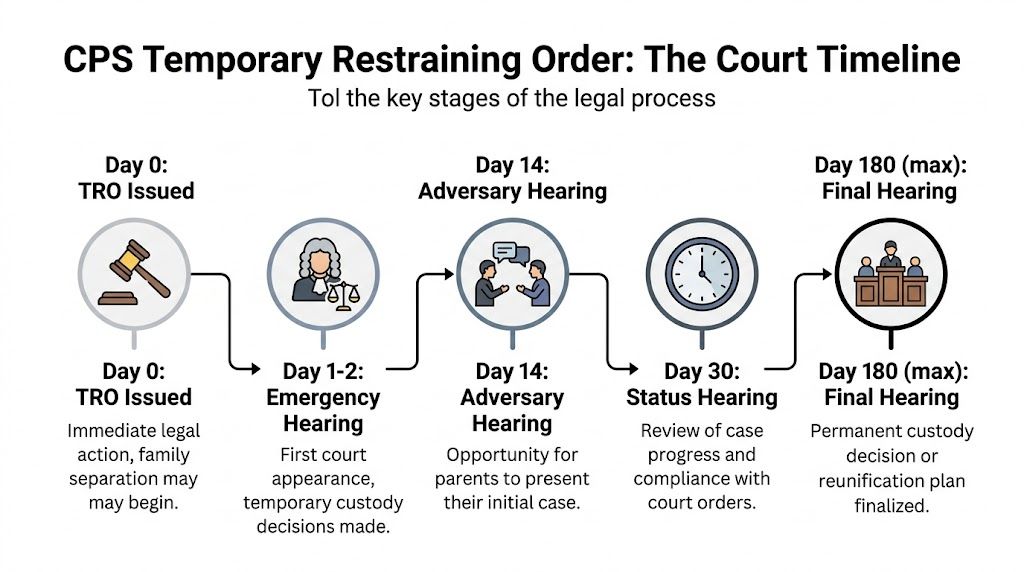
Texas courts move fast in emergency protection matters. From 2021 through 2023, 93% of temporary ex parte orders were resolved in under 30 days, according to the Texas Judicial Branch protective order report. For parents, that means delay is dangerous. Waiting to “see how things go” is rarely a sound strategy.
The early hearing stage
Soon after the TRO is issued, there may be an emergency appearance or show-cause setting. Names can vary by county and case posture, but the purpose is similar. The judge wants to know whether emergency restrictions should remain in place and whether temporary decisions about the child need to be made.
If CPS has sought removal under Chapter 262 of the Texas Family Code, the court is looking at immediate safety, the urgency of the situation, and whether there were reasonable alternatives. If the child has not been removed, the court may still impose conditions while the case develops.
People typically in the courtroom include:
- The judge, who decides what temporary orders are needed
- The CPS attorney, who presents CPS's position
- The CPS caseworker, who may provide information about the investigation
- Your attorney, who challenges weak facts and protects your rights
- The child's attorney ad litem or guardian ad litem, if appointed
- You and sometimes the other parent, depending on the case
The adversary hearing and why it matters
A parent in a Texas CPS case must pay close attention to the hearing that follows the emergency filing. This is often where the court takes a harder look at whether temporary removal or continued restrictions should remain in place.
At this point, the judge is not deciding a final termination case under Chapter 161. But the court is deciding facts that can shape everything that follows, including placement, visitation, services, and the path toward reunification under Chapter 263.
This guide to Texas CPS court hearings and timelines for parents and guardians can help you understand how these stages fit together.
Show up early, dress respectfully, and assume the judge is evaluating both your evidence and your judgment.
How the timeline often unfolds
| Stage | What the court is focused on |
|---|---|
| TRO issued | Immediate risk and preserving the status quo |
| Early emergency hearing | Whether emergency relief should continue |
| Adversary hearing | Whether CPS has enough basis for ongoing temporary orders or removal-related relief |
| Status and review hearings | Compliance, services, visitation, and case progress |
| Final hearing | Long-term orders, reunification, or more serious permanency outcomes |
What judges want to see from parents
Parents often think the hearing is only about denying allegations. That’s too narrow. Judges are also looking for stability, judgment, and whether you can follow court instructions.
Helpful signs include:
- Prepared records that support your version of events
- A realistic plan for the child’s safety, schooling, and care
- Respectful testimony without angry outbursts or evasiveness
- Compliance with temporary orders
- Willingness to address concerns, even if you disagree with the allegations
If your case continues, Chapter 263 becomes especially important because it governs review hearings, permanency planning, and the court's oversight of efforts toward reunification or another permanency outcome.
A courtroom can feel cold when your family is on the line. But the process becomes less frightening when you know what each hearing is for. You're not walking into random court dates. You're moving through a sequence of decisions, each with a specific purpose and a specific opportunity to be heard.
Protecting Your Parental Rights and Building a Strong Defense
Many parents enter a CPS case feeling powerless. That feeling is real, but it isn't the full story. You have rights, and using them wisely can change the direction of your case.
The biggest mistake I see is silence mixed with panic. A parent says too much at the wrong time, then says nothing when it matters in court. A strong defense is calmer and more deliberate than that.
According to Texas Law Help's explanation of temporary restraining orders, an ex parte TRO in Texas lasts a maximum of 14 days, is issued without prior notice, and a parent's most powerful immediate defense is often a Motion to Dissolve. The same resource explains that violating a TRO can lead to Class A misdemeanor consequences, which is why strict compliance matters even while you challenge the order.
Your rights still matter
A CPS investigation does not erase your constitutional protections or your procedural rights in court. Depending on the posture of your case, those rights can include the right to an attorney, the right to present evidence, the right to question witnesses, and the right to avoid making damaging admissions without legal advice.
That matters because CPS cases often begin on incomplete information. A report may come from a misunderstanding, a high-conflict co-parent, a neighbor who guessed wrong, or a professional who saw one moment but not the whole family context. Emergency orders are based on urgency, not a full trial record.
The Motion to Dissolve
If the TRO was issued without your side being heard, a Motion to Dissolve may be one of the most important tools available. It asks the court to reconsider whether the emergency order should remain in effect.
A motion like this is not magic. It works when backed by facts. Your lawyer may use it to show that the alleged emergency doesn't exist, that the order is too broad, or that less restrictive options would protect the child just as well.
Here are the kinds of facts that often matter:
- Witness statements from relatives, teachers, neighbors, or caregivers with direct knowledge
- Medical or school records that contradict the timeline or nature of the allegations
- Messages and emails showing cooperation, not concealment or threats
- Photos, calendars, and receipts that place the child somewhere safe
- Proof of services or treatment if CPS is relying on old concerns rather than current conditions
The judge doesn't need perfect parents. The judge needs reliable evidence about whether there is an immediate danger that justifies emergency restraints.
Defense is evidence, not outrage
Parents are often tempted to build their defense around one point. “I would never hurt my child.” That may be true, and it matters morally, but courts decide emergency questions with evidence.
That means your defense should answer specific concerns. If CPS says the home was unsafe, show the current condition of the home and who lives there. If CPS says you were impaired, gather records that support your condition, treatment, or sobriety. If CPS says you refused cooperation, preserve every respectful message and every request you made for clarification.
For legal help specific to these cases, this page on a Texas CPS lawyer outlines the role counsel can play in protecting a parent's position.
A short explanation from a legal professional can also help parents understand what they are up against:
Practical ways to strengthen your position
Not every defense looks the same. But parents in stronger positions usually do several things well.
- They organize early. They don't wait until the night before court to search for records.
- They follow the order exactly. Compliance keeps the focus on the allegations, not on new violations.
- They choose one spokesperson. Mixed messages from relatives and friends can create confusion.
- They avoid emotional traps. Yelling at a caseworker, the other parent, or school staff can become part of the case narrative.
- They prepare for testimony. Truthful, concise, direct answers are more persuasive than speeches.
If the case continues beyond the TRO
Even when the court leaves some temporary protections in place, that isn't the end of your defense. It means the next phase matters. Parents who engage carefully with services, document progress, and remain consistent often improve their position over time.
This is especially important if the case moves deeper into the system under Chapters 262, 263, and 161. Temporary hearings can affect visitation and placement. Review hearings track compliance and progress. Termination issues require an even higher level of preparation because the stakes are permanent.
The key is to stop thinking of the TRO as the whole case. It is one emergency chapter. Your defense must address it, but it also must prepare for what comes after.
From Accusation to Reunification A Real-Life Scenario
The Martinez family is fictional, but the situation is very realistic. Their daughter came to school with a bruise on her arm. She had gotten it during weekend soccer, but the school couldn't confirm that quickly. A report was made, CPS got involved, and the parents were suddenly dealing with a court order they barely understood.
At first, Mr. and Mrs. Martinez made the same mistake many parents make. They thought if they told CPS, “This is all a misunderstanding,” the case would disappear. It didn't. The emergency order restricted certain contact and movement involving the child while the court reviewed the allegations.
What the family did right
Once they understood the seriousness of the order, the family changed course. They stopped trying to solve everything through phone calls and started building proof.
They gathered:
- A coach's statement confirming the soccer incident
- Photos from the weekend game
- Urgent care paperwork showing the child had already been checked
- School emails showing the parents had informed staff about the injury
- A calm written timeline of everything that happened
Families usually turn the corner when they move from reacting emotionally to documenting carefully.
How the hearing changed the case
At the hearing, the judge wasn't deciding whether the Martinezes were flawless parents. The judge was deciding whether there was enough evidence of immediate danger to justify continuing emergency restrictions.
The parents' evidence mattered because it was specific. The bruise had a documented explanation. The medical visit happened promptly. The family had not tried to hide the child, avoid school, or obstruct the investigation. Their preparation gave the judge a clearer picture than the initial report alone.
That didn't mean the family walked out carefree. CPS cases rarely feel resolved in one moment. But the tone of the case changed. The court saw a family that responded with records, compliance, and stability.

What parents can learn from this
The Martinez story shows why a temporary restraining order cps texas case should never be treated as “just paperwork.” Emergency allegations can grow if parents freeze, lash out, or fail to gather records.
Three lessons stand out:
- Misunderstandings do happen, but courts need evidence, not just sincerity.
- The fastest response isn't always the best response. The best response is accurate, organized, and legally guided.
- Reunification and case improvement often begin with small disciplined choices like obeying the order, keeping records, and preparing carefully for each hearing.
Many parents want reassurance that a CPS case can calm down after a frightening start. It can. Not always quickly, and not without work, but it can. Families put themselves in the best position when they face the process directly instead of hoping it blows over on its own.
How a Bryan Fagan Attorney Can Fight for Your Family
A CPS temporary restraining order puts your family on a fast legal track. The deadlines are short, the consequences are profound, and every decision matters. Trying to handle that alone is like walking into a storm without knowing where the exits are.
An attorney from The Law Office of Bryan Fagan can step in immediately to review the TRO, explain what the court ordered, and help you avoid mistakes that can damage your position. That includes managing communications, identifying weak points in the CPS allegations, gathering useful records, and preparing you for the hearings ahead.
In cases involving emergency relief, timing matters almost as much as substance. A lawyer can determine whether a Motion to Dissolve or another immediate response is appropriate, present counter-evidence, and make sure the court hears more than one side of the story. If the case continues, your attorney can also help you manage the larger framework under Texas Family Code Chapters 262, 263, and 161, including review hearings, service plans, visitation issues, and reunification strategy.
Parents don't need lectures in a crisis. They need a plan. They need someone who understands both the legal process and the emotional weight of a CPS case. Most of all, they need someone ready to act before a temporary order turns into a much bigger problem.
If your family is facing a CPS TRO, don't wait for the next hearing to get answers. The Law Office of Bryan Fagan PLLC helps Texas families understand their rights, respond strategically, and fight for the best possible outcome. Contact the firm today for a free, confidential consultation and get clear guidance on the next step for your family.