Skip to content
A CPS investigator is at your kitchen table. Your child is in the next room. A form is slid in front of you and the message is clear even if the words are polite: sign this now, or things may get worse.
That moment rattles good parents. It also pushes people into fast decisions that follow them for months. If you're dealing with refusing to sign cps safety plan texas, the primary concern usually isn't whether the paper is technically voluntary. It's what you do in the next hour, the next day, and the next hearing if CPS decides to escalate.
Parents need a realistic answer here. Refusing can protect important rights. It can also trigger immediate pressure. Signing can buy temporary peace. It can also hand CPS a roadmap for judging every move you make. The safest path is rarely a simple yes or no. The safest path is a strategy.
Understanding the "Voluntary" CPS Safety Plan in Texas
A Texas CPS safety plan is usually presented during an investigation or Family-Based Safety Services process. CPS uses it to manage what the agency says is an immediate safety concern without first getting a court order. The plan may limit who lives in the home, who can supervise the child, whether a parent can be alone with the child, or what services a parent must start right away.
What it is not matters just as much. A safety plan is not the same thing as a court order. It does not become enforceable like a judge's ruling because a caseworker places it in front of you. That distinction matters because many parents are spoken to as if there is no choice.
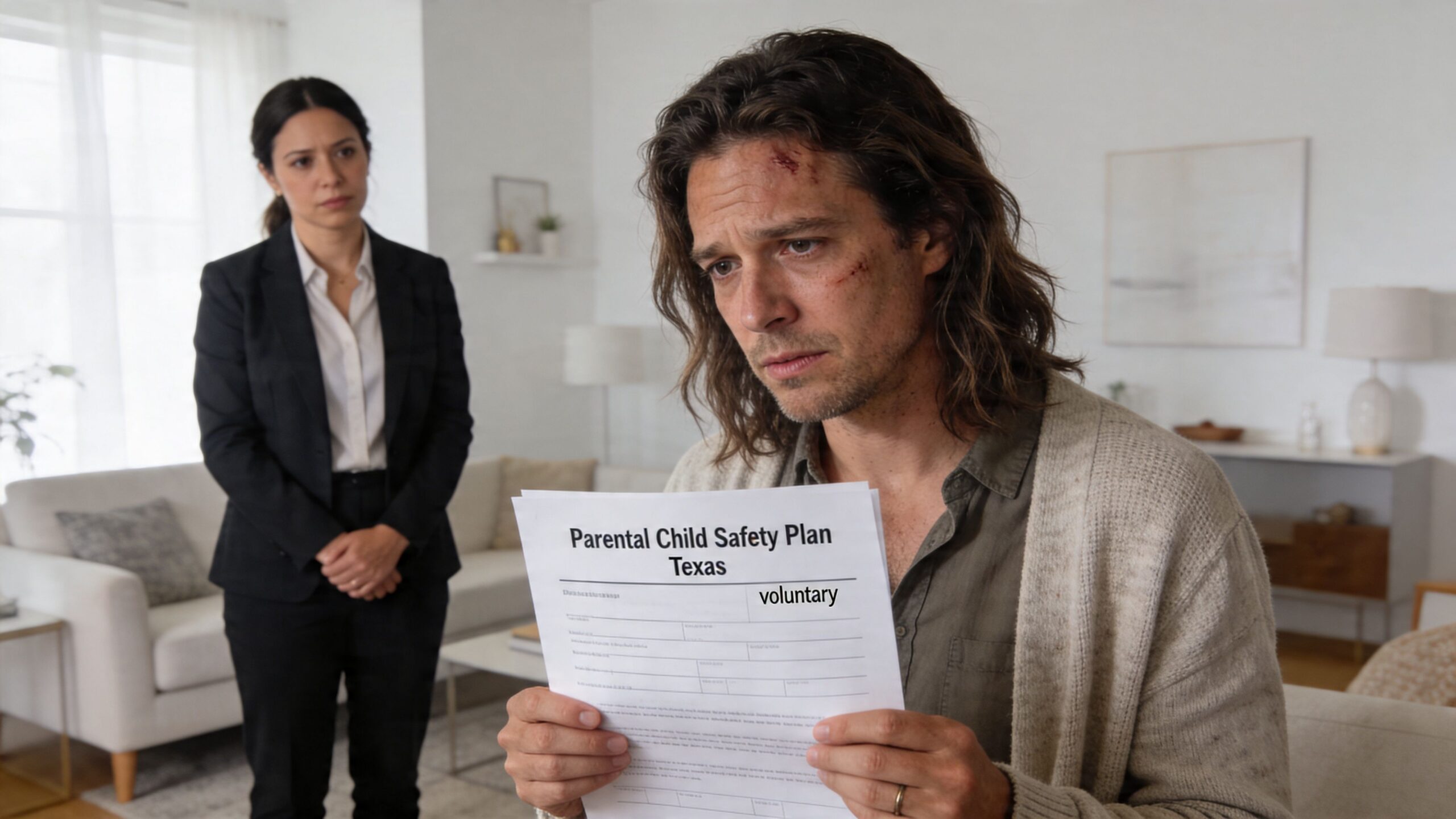
Why it feels mandatory
The best analogy is this: CPS often presents a safety plan like a "voluntary agreement" with a siren playing in the background. On paper, you may be allowed to decline. In practice, refusal often invites a harsher response from the agency.
That pressure isn't imaginary. According to the Texas DFPS Safety Plan Resource Guide, in FY 2024, Texas DFPS handled over 250,000 child abuse and neglect reports, initiated safety plans in roughly 15 to 20% of investigations, and refusal often resulted in removals in 25% of those instances. That tells parents something important. Even when the document is called voluntary, the consequences attached to the decision can be severe.
Plain-English rule: A safety plan may not be a judge's order, but CPS often treats it as a test of whether you will submit to agency control.
What these plans often require
Most parents aren't handed a harmless checklist. They are asked to accept restrictions that can change family life overnight. A plan may require:
- A safety plan monitor who supervises contact between you and your child
- Temporary separation where one parent leaves the home
- Drug testing or evaluations on short notice
- Therapy, classes, or assessments before any court has reviewed the allegation
- Open-ended duration because the plan stays in place until CPS says otherwise
That last issue creates trouble. Parents often ask when the plan ends, and the honest answer is often unclear. If the paperwork gives CPS broad discretion to decide when you've done enough, your daily life can remain under agency supervision with no judge setting boundaries.
Safety plan versus service plan
Parents regularly confuse a safety plan with a court-ordered service plan. They are different tools.
| Document | Who creates it | Is court involvement required | Main effect |
|---|---|---|---|
| Safety plan | CPS during investigation or FBSS | No | Immediate restrictions meant to address alleged danger |
| Service plan | CPS, often after court involvement | Often tied to court case | Ongoing tasks tied to reunification, custody, or case resolution |
If you're trying to understand the broader role these agreements play, this guide on a Texas CPS safety plan helps place the document in the larger CPS process.
The practical point is simple. A safety plan isn't just paperwork. It's an early strategic instrument. Parents who recognize that early are in a better position to respond calmly instead of reacting out of fear.
The High-Stakes Choice Signing vs Refusing a Safety Plan
No parent faces this choice on equal footing. CPS has a caseworker, forms, internal procedures, and the ability to ask a court for emergency relief. You have fear, very little time, and a child you are trying to protect.
That is why signing and refusing both carry risk.
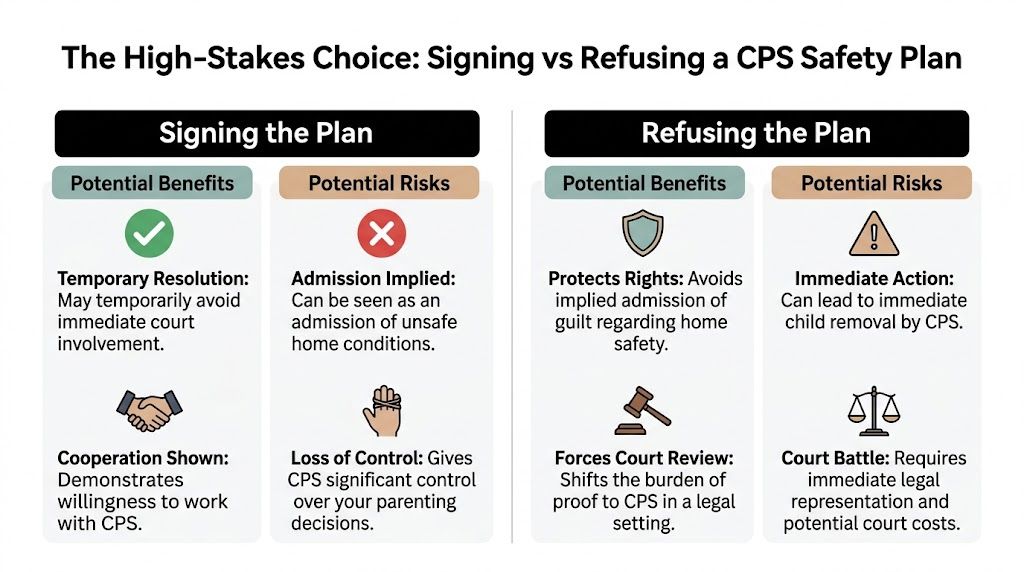
What signing can do
Signing often appeals to parents because it looks cooperative. It may reduce immediate confrontation. It may also prevent a same-day push for court action. In a tense living room conversation, that can feel like the only rational option.
But signing carries a hidden cost. Once you agree to the plan, CPS may treat the document as proof that restrictions were necessary in the first place. Later, if a parent misses a class, allows an unapproved relative around the child, fails a test, or breaks a schedule term by mistake, the agency can characterize that as disregard for safety.
Signing may calm the room today, but it can create a record CPS uses against you tomorrow.
The danger becomes sharper once a signed plan is in place. According to the practical guide from Texas CPS Lawyer on disputing a safety plan, non-compliance with a signed plan can lead to parental-rights termination in up to 20 to 30% of FBSS cases that later become conservatorship cases.
What refusing can do
Refusing protects one important principle. It avoids giving CPS your signature on terms you may not understand, cannot realistically follow, or believe are unsupported.
It can also force the agency to justify its concerns in a more formal setting. If CPS believes your child faces immediate danger, the agency may need to put evidence in front of a judge rather than rely on pressure in your home.
That said, refusal isn't a magic shield. It often triggers escalation. The caseworker may frame refusal as non-cooperation, resistance, or lack of insight. Even when parents are trying to protect their rights, the agency may present their response in the least favorable light.
Refusal without a plan is often what hurts parents most. Refusal with a safer alternative is a different story.
A practical comparison parents can actually use
Here is the decision model I want parents to think through:
| Choice | Main short-term advantage | Main long-term risk |
|---|---|---|
| Sign | May avoid immediate confrontation or court filing | CPS may later treat the plan as proof of danger and use any violation against you |
| Refuse | Preserves your ability to challenge unsupported restrictions | CPS may escalate quickly and portray you as uncooperative |
A relatable scenario
Consider two parents facing the same allegation that one adult in the home may be using drugs. CPS arrives with a plan requiring the accused parent to leave immediately, submit to testing, and have no unsupervised contact.
One parent signs because she is terrified of removal. Two weeks later, the accused parent returns home for a family dinner before the caseworker approves it. CPS treats that as a violation and claims the household can't follow safety restrictions.
Another parent refuses to sign on the spot, stays calm, asks for time to speak with counsel, identifies a sober grandparent willing to supervise, and offers a temporary family placement option while the allegation is tested. CPS may still push hard, but that parent has shown something critical: cooperation with safety, not surrender to vague terms.
The issue isn't bravado. It's structure. Parents do best when they stop thinking in terms of "fight CPS" versus "give in to CPS" and start thinking in terms of "build a defensible record."
Your Immediate Action Plan When Presented with a Safety Plan
The first minutes matter. A parent's tone, word choice, and follow-up can shape what the caseworker writes in the file. Often, many cases go sideways then. Parents either sign too fast or refuse in a way that sounds angry, dismissive, or chaotic.
The stronger approach is controlled, polite, and documented.

Step one ask for a lawyer immediately
The first sentence out of your mouth should lower the temperature and protect your rights.
Try this:
- Use calm language. "I want to cooperate with any legitimate safety concern, but I am not comfortable signing this before speaking with an attorney."
- Repeat if necessary. "I'm asking for time to review this with counsel."
- Keep it short. The more you explain, the more material you give the investigator.
That first move is not cosmetic. It is strategic. As explained by Ridgely Davis Law on CPS safety plans, the first step is to invoke your right to legal counsel, and early attorney intervention can halt 70 to 80% of escalations before they go to court, often by proposing alternatives like a Parental Child Safety Placement.
If you need immediate legal guidance, a Texas DFPS attorney can step in quickly to handle contact, review the proposed restrictions, and help frame a safer response.
Step two don't argue the whole case at the door
Parents often think they can clear up the misunderstanding in one conversation. Usually they can't. Worse, a long explanation can create contradictions, admissions, or statements that sound defensive when written into a report.
Focus on these rules instead:
- Don't guess. If you don't know an answer, say you don't know.
- Don't volunteer history. Stay with the immediate issue.
- Don't insult the reporter or caseworker. Even if the allegation is false.
- Don't let panic decide your tone. A calm parent reads better on paper than a frightened parent who sounds combative.
Step three pivot from refusal to solution
Strategy replaces emotion. If you say "I'm not signing," CPS may write that you rejected efforts to protect the child. If you say, "I'm not signing this as written, but here is a temporary safety alternative," the story changes.
Useful alternatives may include:
- A relative placement option using a trusted grandparent, aunt, or other family member
- A temporary Parental Child Safety Placement if counsel advises it
- A neutral exchange arrangement between parents
- Voluntary testing or evaluation scheduled through counsel rather than agreed to under broad plan language
What matters is that your proposal is specific. "My sister can supervise after school starting today" is better than "I'll figure something out."
Practical rule: Refusal by itself sounds like resistance. Refusal paired with a concrete child-safety solution sounds like responsible judgment.
Step four document every interaction
Write down what happened while it is fresh. Include:
- Who was present
- The date and time
- What the caseworker asked you to sign
- Any deadline or threat communicated
- Any statement suggesting your child would be removed if you didn't sign immediately
- Any alternative you proposed
If lawful in your situation and advised by counsel, preserve communications and records. Save texts, voicemails, business cards, and follow-up emails. If a caseworker later says you were uncooperative, your notes may show something very different.
A short follow-up email can help. It might say: "Thank you for meeting today. I am willing to discuss child safety concerns and temporary alternatives, but I need legal review before signing any safety plan."
That kind of message creates a paper trail of calm cooperation.
Step five identify your strongest monitor or placement option fast
Not every relative is a good choice. Parents sometimes offer the first person who is available, only to learn that CPS sees that person as unsuitable. Think ahead before making the offer.
The strongest candidate is usually someone who:
- Has stable housing
- Can communicate clearly with CPS
- Understands boundaries
- Has no obvious conflict with the allegations
- Will follow the agreed structure
A good monitor is not just a loving relative. The person must also appear credible to the agency and, if needed, to a judge.
Step six prepare for the possibility of court
If CPS decides to escalate, your preparation starts before any hearing is scheduled. Gather the documents your lawyer is likely to want:
- School records
- Medical records
- Counseling or treatment proof if relevant
- Photos of the home
- A timeline of the allegation and your response
- Names of teachers, doctors, relatives, or neighbors who can speak to the child's care
This is a useful overview to watch while you're sorting out the first response:
Step seven let your lawyer become the buffer
After the first contact, one of the most protective changes a parent can make is simple: stop handling every conversation alone. Attorneys can clarify what is being requested, challenge vague language, and stop informal pressure from becoming your normal.
This is one area where the Law Office of Bryan Fagan PLLC may be one option for parents who need Texas counsel in CPS-related matters, particularly where a safety plan, criminal allegation, or emergency removal risk overlaps.
When you refuse to sign, the goal is not to disappear, obstruct, or dare CPS to act. The goal is to show that you take safety seriously enough to insist on a lawful, workable, reviewable response.
Protecting Your Parental Rights During the Investigation
Once the safety-plan moment passes, the investigation becomes a major battlefield. Parents who do well in these cases usually understand one point early: CPS isn't only evaluating the allegation. The agency is also evaluating your judgment, consistency, and ability to protect your child under pressure.
That means your strategy has to extend beyond the form you refused.
Control communication without looking evasive
You don't have to accept every question, every interview setup, or every request in the exact way CPS proposes it. But the way you draw boundaries matters.
A useful posture sounds like this:
- For interviews. "I want counsel present before answering detailed questions."
- For home access issues. "Please have my attorney coordinate scheduling and scope."
- For child contact issues. "I won't interfere, but I want legal guidance before agreeing to any private interviews or broad requests."
At this stage, many parents need structure. They either say yes to everything or no to everything. Neither extreme helps. A controlled response shows you're engaged and careful.
For a fuller explanation of what parents can and can't do during an investigation, review this guide on your rights during a CPS investigation.

Build your own evidence file
Parents often assume the truth will speak for itself. It usually doesn't. CPS files are built by people writing narratives. If you don't gather your own records, the agency's version becomes the default version.
Start building a file that may include:
- Photos and videos showing the condition of the home
- Attendance and school records showing routine and stability
- Medical records if the allegation involves injury, medication, or missed care
- Text messages or emails relevant to the accusation
- Witness statements from adults who regularly see the child and family functioning
This does not mean coaching witnesses or manufacturing support. It means preserving real information before memories fade and documents disappear.
Treat every interaction as if a judge may read it later
That sounds harsh, but it is the safest working assumption. The investigator's notes may later appear in affidavits, hearings, or testimony. Your texts may be printed. Your social media may be reviewed. The relative you picked as a monitor may become part of the story.
A CPS case rewards disciplined parents, not just innocent ones.
That is why practical habits matter. Keep appointments. Avoid emotional texting. Don't post about the case online. Don't bring new romantic partners or unstable relatives into the situation while the investigation is active. A parent can be factually innocent and still lose credibility through avoidable chaos.
Use your lawyer as a filter
An attorney does more than prepare for court. Counsel can also slow down bad momentum during the investigation itself. A lawyer can request clarification, narrow overbroad demands, and make sure your cooperation is documented accurately.
That buffer matters because CPS interactions are not ordinary customer-service exchanges. They are evidence-producing events. When your attorney handles the communication, you reduce the risk of being pressured, misquoted, or maneuvered into consent that doesn't match your family's reality.
The larger strategy is not merely "fight the allegation." It is "create a stable record that shows safe parenting, reasonable cooperation, and lawful boundaries." That combination often matters more than one emotional conversation ever could.
What Happens When CPS Takes Your Case to Court
If CPS decides your refusal justifies stronger action, the next phase often starts fast. The agency may seek emergency relief under Chapter 262 of the Texas Family Code. For parents, this is usually the point where fear peaks because the argument shifts from a living-room discussion to a courtroom with deadlines, affidavits, and a judge.
The first key event after a removal is typically the Adversary Hearing. Under Chapter 262, that hearing must generally occur within 14 days of removal. At that hearing, the judge reviews whether CPS should keep temporary custody while the case continues.
What CPS will argue
In court, CPS usually tries to tell a simple story. The agency will argue there was danger, that less restrictive options were not enough, and that the parent's conduct justified immediate intervention. If you refused to sign a safety plan, CPS may present that refusal as proof that you would not cooperate with measures designed to protect the child.
That framing can sound powerful unless your lawyer has already built a competing record.
What your lawyer will do with the refusal
A good court response doesn't rely on saying, "My client had rights," and stopping there. Judges want practical facts. If your attorney can show that you asked for counsel, stayed calm, proposed a relative placement, offered a structured alternative, and preserved communications, the refusal looks very different.
A judge may then see the core issue as this: not whether you instantly signed what was placed in front of you, but whether there was evidence of immediate danger and whether you acted reasonably under pressure.
Consider a common scenario. A mother refuses a safety plan that would have forced her to leave the home based on an untested allegation from an ex-partner. Instead of signing, she contacts counsel that day, offers the child's grandmother as a temporary supervisor, and gathers school and medical records showing normal care. At the hearing, CPS says she was resistant. Her attorney says she was cautious, child-focused, and willing to use a narrower safety option. Those are very different stories.
Terms the court uses
A few legal phrases matter here:
- Imminent danger usually means CPS claims the child faced an immediate risk of serious harm.
- Best interest of the child means the judge is deciding what arrangement most protects the child's welfare.
- Temporary orders are short-term rulings about custody, placement, visitation, and services while the case continues.
What judges often want is evidence of structure. Parents help themselves in court when they can show stable housing, safe caregiving options, consistent school attendance, appropriate medical care, and a serious plan to address any concern the court finds credible.
The courtroom is where unsupported pressure should meet proof. But that only happens if your response after refusing was strategic rather than reactive.
Texas CPS Safety Plan FAQs
Do I have to sign a CPS safety plan in Texas
A safety plan is generally presented as voluntary unless and until its terms are incorporated into a court order. That doesn't mean refusal is risk-free. It means you should avoid treating the document like a harmless form. The practical takeaway is to pause, ask for counsel, and avoid signing under pressure.
If I refuse, will CPS take my children immediately
CPS may try to escalate after a refusal, but removal is not supposed to happen just because a parent asserted rights. The stronger question is whether CPS believes it can persuade a judge there is immediate danger or whether the agency will use emergency procedures first and justify them shortly after. Your response should be to propose a real safety alternative immediately and get legal help fast.
Is signing always a mistake
No. Some parents sign because the terms are limited, specific, and workable, or because counsel has reviewed the agreement and negotiated changes. The danger is blind signing. If you don't understand the consequences, duration, or what counts as a violation, signing can create more trouble than it solves.
What should I say when the caseworker asks for my signature
Keep it simple: "I want to cooperate with legitimate safety concerns, but I need to speak with my attorney before signing." That statement avoids a confrontation while making clear that you aren't refusing child safety. You're refusing to waive judgment.
Can I offer another plan instead of signing the one CPS wrote
Yes, and in many cases you should. A safer approach is often to reject vague or overbroad terms while offering a concrete alternative such as a relative supervisor, a temporary family placement, or another structure your lawyer has approved. The key is specificity.
What if I already signed and now regret it
Don't ignore it and don't start violating the plan casually. Get legal advice immediately. Sometimes the right move is to seek clarification, modification, or a more formal review before a violation turns into a larger allegation about your parenting.
Does refusing make me look guilty in court
It can be spun that way by CPS if you refused without explanation or without an alternative. But a careful refusal paired with documented cooperation often tells a different story. Courts tend to look more favorably on parents who act deliberately, protect the child, and use counsel than on parents who create confusion or chaos.
If CPS has asked you to sign a safety plan, or you're already dealing with the fallout from refusing, don't try to guess your way through the next step. The Law Office of Bryan Fagan PLLC offers free consultations for Texas families facing CPS investigations, safety plans, emergency removals, and related court proceedings. A calm, early legal strategy can make a real difference for your child and for your rights as a parent.