Skip to content
When CPS takes your child because of suspected drug or alcohol use, most parents feel the same three things at once. Panic. Shame. Confusion. You may be asking whether one relapse, one failed test, or one bad period in your life means you've lost your child forever.
In many Texas cases, the answer is no. But the harder truth is this. Hope alone won't bring your child home. Fast, documented action might.
Texas courts move on a strict schedule. Recovery rarely feels that neat. That gap is where many parents lose ground. If you're dealing with CPS and substance abuse recovery, the real question isn't only whether you love your child or whether you want to change. The court wants proof that your home can become safe again, and it wants that proof early.
Many parents in this situation need straight answers, not judgment. The law under Texas Family Code Chapters 262, 263, and 161 creates deadlines, hearings, and serious risks. But those same laws also create a path. If you understand the first steps, follow your service plan carefully, and present your progress the right way, reunification can remain on the table.
The Phone Call No Parent Wants
It usually starts in a blur. A teacher reports concerns. A neighbor calls. A hospital flags a positive test. Then your phone rings, or someone knocks on your door, and suddenly you're talking to a CPS investigator while trying to understand whether your child is about to be removed.
A mother in this position might think, “I admitted I needed help. Did I just make things worse?” A father might think, “If I go to treatment, will the court see that as responsibility or as proof I'm unfit?” Those are real fears. They aren't dramatic. They are common in Texas CPS cases involving substance use.
That matters because you are not dealing with an unusual problem. A systematic review found that parental substance use appeared across a broad range of child welfare cases, with some subgroup estimates reaching up to 79% in certain samples, showing that this issue is recurring within the child welfare system rather than rare or isolated (review of child welfare samples).
Shame will slow you down
Parents often lose precious time because they feel embarrassed and freeze. They avoid the caseworker. They miss the first evaluation. They tell themselves they'll start treatment after the next hearing. By then, the case may already be moving in the wrong direction.
Practical rule: Treat the first call from CPS like the beginning of a legal case, not just a family crisis.
If CPS has accused you of drug use, get informed quickly about what investigators are looking for and how your statements can affect the case. This guide on what to do if CPS accuses you of drug use in Texas is a useful starting point.
Recovery and reunification have to run together
One of the hardest parts of these cases is that you don't get to pause the legal process while you work on yourself. You need both tracks moving at once. That means legal help, treatment decisions, testing compliance, housing stability, and communication with CPS all start immediately.
Parents also need emotional support that isn't tied only to court orders. If you're trying to understand what real recovery can look like day to day, this overview of support for your recovery process can help you frame the road ahead in a more realistic way.
The first piece of hope is simple. A removal is serious, but it is not automatically the end of your parental rights. The next piece is harder. What you do next matters more than what you say you intend to do.
The First 72 Hours After Removal
The first days after removal are legal triage. Texas Family Code Chapter 262 governs emergency removals and the court review that follows. If CPS has already removed your child, the clock is running whether you feel ready or not.
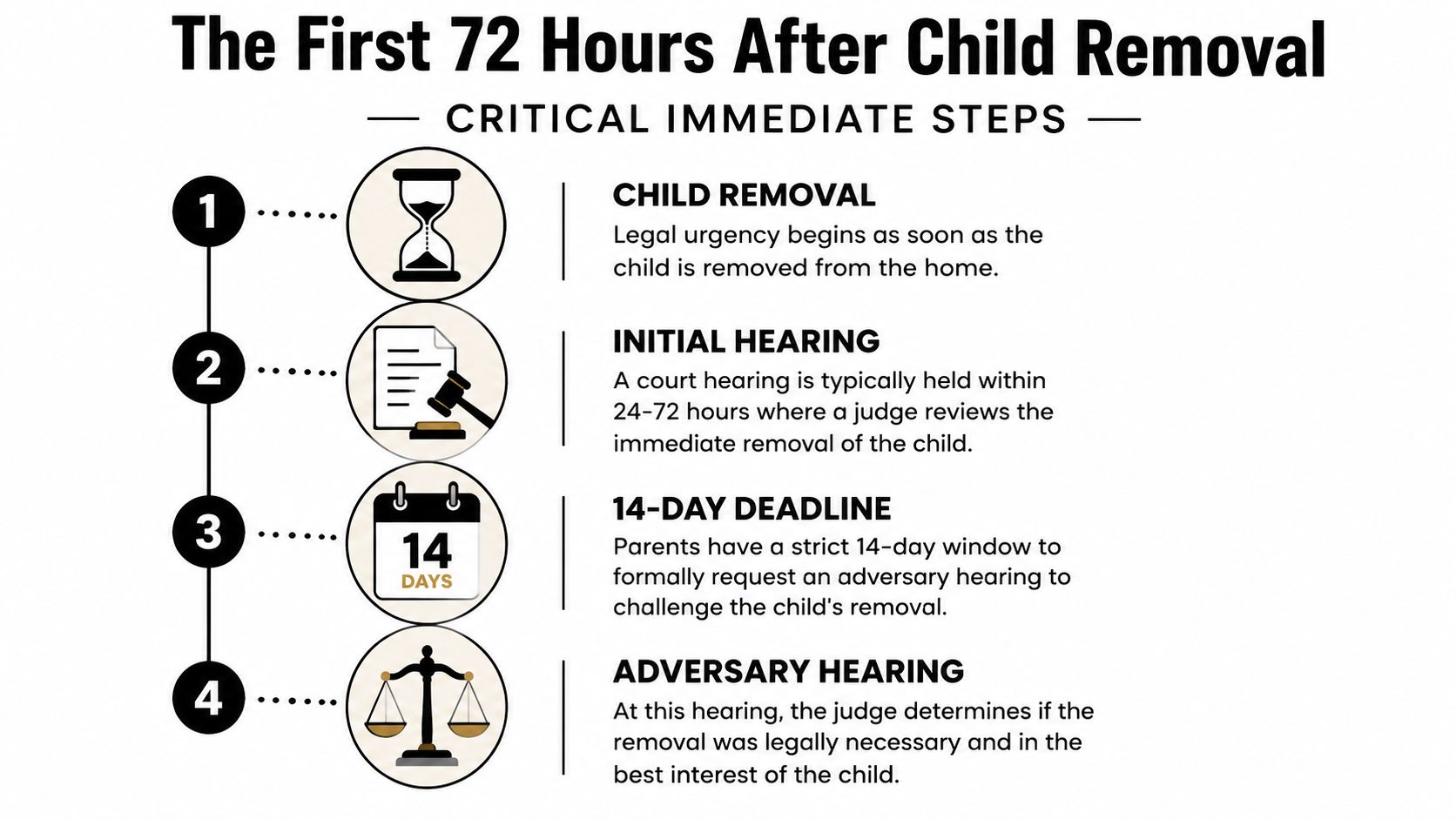
What the court is looking at immediately
Very early in the case, the judge isn't deciding whether you're a good person. The judge is deciding whether the child can safely stay out of danger right now. In a substance use case, that usually means the court is focused on impairment, supervision, the condition of the home, access to drugs, prior history, and whether there is a sober protective adult available.
A quick hearing can happen soon after removal, and the adversary hearing under Chapter 262 follows on a tight timeline. Parents often hurt themselves here by showing up angry, defensive, or unprepared.
Show up. Be respectful. Listen carefully. Let your lawyer do the arguing where needed.
Your first 72-hour checklist
Do these tasks as fast as you can:
Get a lawyer involved
If you qualify for appointed counsel, ask for one immediately. If you can hire counsel, do it early. Your lawyer can help you avoid admissions that sound harmless but damage your case.Ask exactly what CPS is alleging
Don't guess. Find out whether the issue is a positive test, observed impairment, neglectful supervision, unsafe people in the home, or all of the above.Schedule a substance abuse assessment
Don't wait for the second or third reminder. Early treatment entry matters because the first 30 to 90 days are critical, and guidance summarizing child welfare research notes that child welfare timelines often conflict with the time needed for sustainable recovery. That same guidance explains that completing 90 or more days of treatment can double a mother's likelihood of reunification, which is why immediate entry into services matters so much (child welfare guidance on early treatment timing).Start a paper trail
Keep every intake form, appointment confirmation, sign-in sheet, discharge summary, and test result.Prepare for testing
If CPS is requiring urinalysis, hair testing, or both, understand the consequences of any result and of missing the test entirely. This article on what happens if you fail a CPS drug test in Texas can help you understand the stakes.
What not to do in a panic
Parents commonly make three early mistakes:
Arguing instead of acting
You may disagree with the removal. You still need to start services immediately.Entering the wrong treatment casually
A rushed enrollment without records, attendance proof, or communication with CPS can leave you doing work the court never sees.Talking too much online or to the wrong people
Social media posts, angry texts, and conversations with unsafe friends can all come back into the case.
Some parents also benefit from a broader defensive roadmap, especially when allegations are disputed or exaggerated. How to Fight CPS and Win in Texas is a strategic guide to mounting an effective defense against CPS in Texas.
The first 72 hours won't solve the whole case. But they can set the tone. In many CPS and substance abuse recovery cases, the court forms its early impression from those first steps.
Mastering Your CPS Service Plan
Your Family Service Plan is not paperwork to skim. It is the court-facing roadmap CPS expects you to follow if you want reunification. In Texas cases, this plan often includes substance abuse treatment, random drug testing, counseling, parenting classes, stable housing, legal income, and sometimes mental health services.

Don't just complete tasks. Build evidence.
A service plan has two jobs. One is to improve safety. The other is to create proof for the court. If you attend treatment but can't document it, or if you test clean but miss counseling, the judge may see an incomplete picture.
A strong file usually includes:
- Treatment records with intake dates, attendance logs, and progress updates
- Drug test results organized by date
- Counselor letters that describe participation and insight
- Proof of housing such as a lease, utility bill, or letter from a sober sponsor home
- Proof of income like pay stubs or an employer letter
- Parenting records showing classes, visitation attendance, and skills work
For a more detailed breakdown of how to approach these tasks, review how to work your CPS service plan strategically.
Program quality matters
Not all treatment checks the same box in a child welfare case. A peer-reviewed study found that a mother's likelihood of reunification approximately doubled after completing 90 or more days of treatment, and programs with a high level of family and children's services increased reunification odds compared with low-service programs, with an odds ratio of 1.77 (peer-reviewed reunification study).
That tells parents something important. The court isn't only looking for enrollment. It is looking for meaningful treatment in a setting that addresses parenting, family functioning, and daily stability.
A better program often offers:
| Service feature | Why it matters in a CPS case |
|---|---|
| Family-focused counseling | Helps connect recovery progress to parenting safety |
| Case management | Keeps records and referrals organized |
| Mental health support | Addresses issues that often derail compliance |
| Parenting support | Gives CPS concrete evidence of safer caregiving |
| Clear attendance reporting | Makes it easier to prove compliance to the court |
Accountability is part of the evidence
A parent who says, “I'm doing better,” may mean it. A parent who can show verified attendance, clean tests, sponsor contact, and changed routines is much more persuasive.
That's why many parents benefit from learning more about understanding accountability in recovery. In a CPS case, accountability isn't just personal growth. It becomes courtroom evidence.
This short video can also help you think about the service plan as something to work intentionally, not passively:
What parents get wrong about service plans
Some parents treat the plan like a checklist they can cram at the end. Texas courts usually won't see it that way. Late compliance often looks like crisis management, not stable change.
Others complete the substance abuse piece but ignore housing, work, or therapy. That can be a costly mistake. Judges don't return children to sobriety alone. They return children to safe, stable routines.
Navigating the Texas CPS Court Process
Texas CPS cases follow a structured court path, and Chapter 263 is where many parents start to feel pressure they didn't expect. Hearings come faster than recovery milestones. If you don't understand what each hearing is for, you can miss chances to prove progress.

Who is in the courtroom
Several people shape the case:
- The judge decides temporary orders, reviews progress, and ultimately decides placement and parental rights.
- The CPS caseworker reports on your compliance, the child's placement, and safety concerns.
- The child's attorney ad litem or guardian ad litem focuses on the child's interests.
- Your lawyer protects your rights, challenges weak evidence, and helps present your progress clearly.
A hearing can feel personal, but judges usually focus on patterns. Are you testing consistently? Are you participating in treatment? Are visits going well? Is your housing stable? Have you reduced risk, or are the same problems repeating?
The timeline parents need to respect
Texas law expects progress within a fixed case schedule. Chapter 263 includes status hearings and permanency hearings, and the case moves toward a final decision on a strict deadline unless the court extends it under the statute. If parents wait too long to engage, they can run out of time before they've built a convincing record.
A practical way to think about the process is this:
| Stage | What the court wants to know |
|---|---|
| Early hearings | Was removal necessary and what must happen next |
| Status phase | Do you understand and begin the service plan |
| Permanency reviews | Are you making measurable, sustained progress |
| Final stage | Can the child return safely, or is another permanency outcome needed |
If you want a more complete overview of how deadlines fit together, The Texas CPS Case Timeline From Start to Finish maps out each stage and deadline in a Texas CPS case.
What evidence helps reunification
Parents often think clean drug tests alone should be enough. They help, but courts usually want a fuller picture.
Useful evidence often includes:
- Consistent negative drug tests
- Treatment progress letters
- Visitation records showing reliability and appropriate parenting
- Employer letters or pay records
- Housing proof
- Support letters from sober, credible adults
- Mental health compliance records when relevant
Courts want to see changed behavior repeated over time, not a last-minute promise that things will be different.
Family treatment courts can also matter. Casey Family Programs notes that proactive engagement with family treatment courts can reduce the time children spend in out-of-home care, and children whose parents participated in certain Substance Dependence Dependency Court programs were more likely to be reunified within 24 months and spent fewer days in foster care (family treatment court strategies and outcomes).
Where Chapter 161 becomes the real threat
Parents need to understand this clearly. If the court concludes the statutory grounds exist and termination is in the child's best interest, Chapter 161 allows termination of parental rights. That is the point in the case where failures to test, repeated relapse without response, disappearing from services, or ignoring the service plan can become devastating.
The legal system doesn't require perfection. It does require credible proof of safety. Your lawyer's job is to help turn your treatment record, work record, housing record, and parenting record into a case the judge can trust.
Avoiding Common Pitfalls on the Path to Reunification
A lot of parents lose reunification cases for reasons that don't start as major disasters. They start as small avoidable choices. One missed test becomes two. One dishonest answer becomes a credibility problem. One visit with the wrong friend turns into a new safety concern.
Take a common example. A parent enters outpatient treatment, does well for a short time, then misses several sessions because work got hectic. The parent doesn't tell the caseworker. A drug test is missed. Then visitation is late twice. None of those events alone may end the case, but together they create a pattern of instability.

The mistakes that show up again and again
Parents in CPS and substance abuse recovery cases often run into the same traps:
Missing tests or appointments
Courts and CPS often treat a missed test as a serious problem because it creates uncertainty.Keeping unsafe company
If you still live with, date, or regularly spend time with people who use drugs or create chaos, your sobriety claim becomes much harder to prove.Ignoring mental health
Anxiety, depression, trauma, and untreated psychiatric symptoms can undermine everything else if they aren't addressed.Being only partly honest
You do not need to confess carelessly to every allegation without counsel. But if you lie about attendance, use, housing, or relationships and the truth comes out, the court may stop trusting anything else you say.Treating employment and housing like side issues
CPS looks for a stable environment, not just abstinence.
Completion changes outcomes
This isn't just motivational advice. An Arizona State University evaluation of the Families F.I.R.S.T. program found that 84.8% of children were reunified with parents who completed treatment, compared with 52.6% when parents dropped out. The same evaluation found that 52.4% of program completers found or kept jobs versus 32.7% of non-completers (evaluation summary of treatment completion and reunification outcomes).
That difference should change how you think about the case. “Mostly compliant” often isn't enough. Completion, consistency, and proof of stability carry far more weight.
A reunification case usually turns on reliability. The court asks whether your child can count on tomorrow looking safe, not whether you had a good week.
What works better than excuses
When a setback happens, the stronger response is usually direct and documented:
| Problem | Better response |
|---|---|
| Missed counseling | Reschedule immediately and notify your lawyer |
| Positive or disputed test | Follow legal advice, continue treatment, and keep records |
| Transportation issue | Document it and ask for alternatives early |
| Work conflict | Get a letter from your employer and adjust service times |
| Mental health symptoms | Seek evaluation and follow treatment recommendations |
Parents don't need to be flawless. They do need to show that when something goes wrong, they respond like a safe parent, not like someone avoiding accountability.
Your Commitment to Recovery and a Hopeful Future
Getting your child back after a CPS removal tied to substance use is hard. It asks you to do two demanding things at once. You have to recover, and you have to prove recovery in a legal system that runs on deadlines, documents, and courtroom credibility.
The parents who put themselves in the best position usually do four things well. They act fast. They document everything. They engage fully in services. They stay in close contact with their lawyer instead of trying to manage the case by instinct.
Real recovery also has to fit real life. Some parents need local outpatient care. Others need residential treatment, therapy, medication management, or telehealth support because transportation, work, or location gets in the way. If distance or access is part of your struggle, resources on online addiction help in Pennsylvania may still be helpful as a general example of how virtual treatment can support recovery planning when in-person access is difficult.
The court does not expect a rehearsed speech. It expects a believable pattern. Safe housing. Stable income. Consistent treatment. Clean tests. Honest communication. Better choices over time. Those details are what move a judge from concern to confidence.
If you're in the middle of this, don't assume it's too late because the case started badly. Many CPS cases do. The more important question is what you do now, especially in the first part of the case when the court is deciding whether reunification is becoming more realistic or less.
If you're facing a CPS case involving substance use, you don't have to guess your way through Texas Family Code deadlines, court hearings, and service plan requirements alone. The Law Office of Bryan Fagan PLLC helps Texas parents understand their rights, respond to CPS allegations, and build a practical reunification strategy. Contact the firm for a free, confidential consultation and get clear guidance on the next step toward bringing your child home.