Skip to content
You aren't legally required to have a lawyer during the first CPS investigation, but waiting is risky. In Texas, a court-appointed lawyer for a parent usually doesn't come until after a lawsuit is filed, the parent is indigent, and the parent contests the case, while the child must be appointed an attorney ad litem within 14 days after removal.
If CPS has contacted you, you're probably not reading this out of curiosity. You're reading because your phone rang, someone showed up at your door, or your child was interviewed at school, and now your mind is racing. You may be wondering whether cooperating will make this go away, whether saying the wrong thing will make things worse, and whether calling a lawyer will make you look guilty.
It won't.
The better question isn't only, "Do you need a lawyer for a CPS case in Texas?" It's what a lawyer does at each stage to protect your parental rights before small mistakes turn into permanent consequences. Texas CPS cases move fast. They also shift from an agency investigation into a formal court case with strict rules under the Texas Family Code, especially Chapters 262, 263, and, in the most serious cases, 161.
A lot of parents wait too long because no one has explained the difference between those stages. That's where confusion does real damage. The legal help you need on day one is different from the legal help you need in a courtroom, but both matter.
That Knock at the Door Your Heart Stops
It often starts in an ordinary moment. Dinner is half-finished. Your child is in the living room. The doorbell rings, and a stranger says they're with CPS and need to ask questions.
At that point, most parents feel two things at once. Panic and pressure. You want to protect your child, but you also want to avoid looking uncooperative. So you start talking. You explain. You apologize for things that aren't really admissions. You agree to things you don't fully understand because you think that will calm the situation.
That is exactly why early legal advice matters.
Take a common example. A mother gets a visit after someone reports possible neglect because her child came to school in dirty clothes several times. She knows her child is loved and safe. She assumes this is a misunderstanding she can clear up in one conversation. Instead, she ends up answering broad questions about her job schedule, relationships, discipline, mental health, and alcohol use. By the end of the visit, the issue is no longer just clothing. The file has grown.
Practical rule: CPS contact is not the time to guess. It is the time to slow down, get organized, and speak carefully.
A lawyer helps you do that from the first contact. Not by telling you to fight everyone, but by helping you respond in a way that protects your family without creating new problems.
You may also need help staying calm enough to think clearly. If your body feels like it's in survival mode, simple grounding can help you get through the next hour. These strategies for stress relief can help you steady yourself before calls, meetings, or interviews with CPS.
Fear makes people overtalk. Shame makes people agree to things they should review first. A CPS lawyer creates space between your fear and your decisions. That can change the entire direction of a case.
Investigation vs Court Case The Two Worlds of CPS
A Texas CPS matter usually happens in two different worlds. Parents often blend them together, but they operate differently and call for different responses.
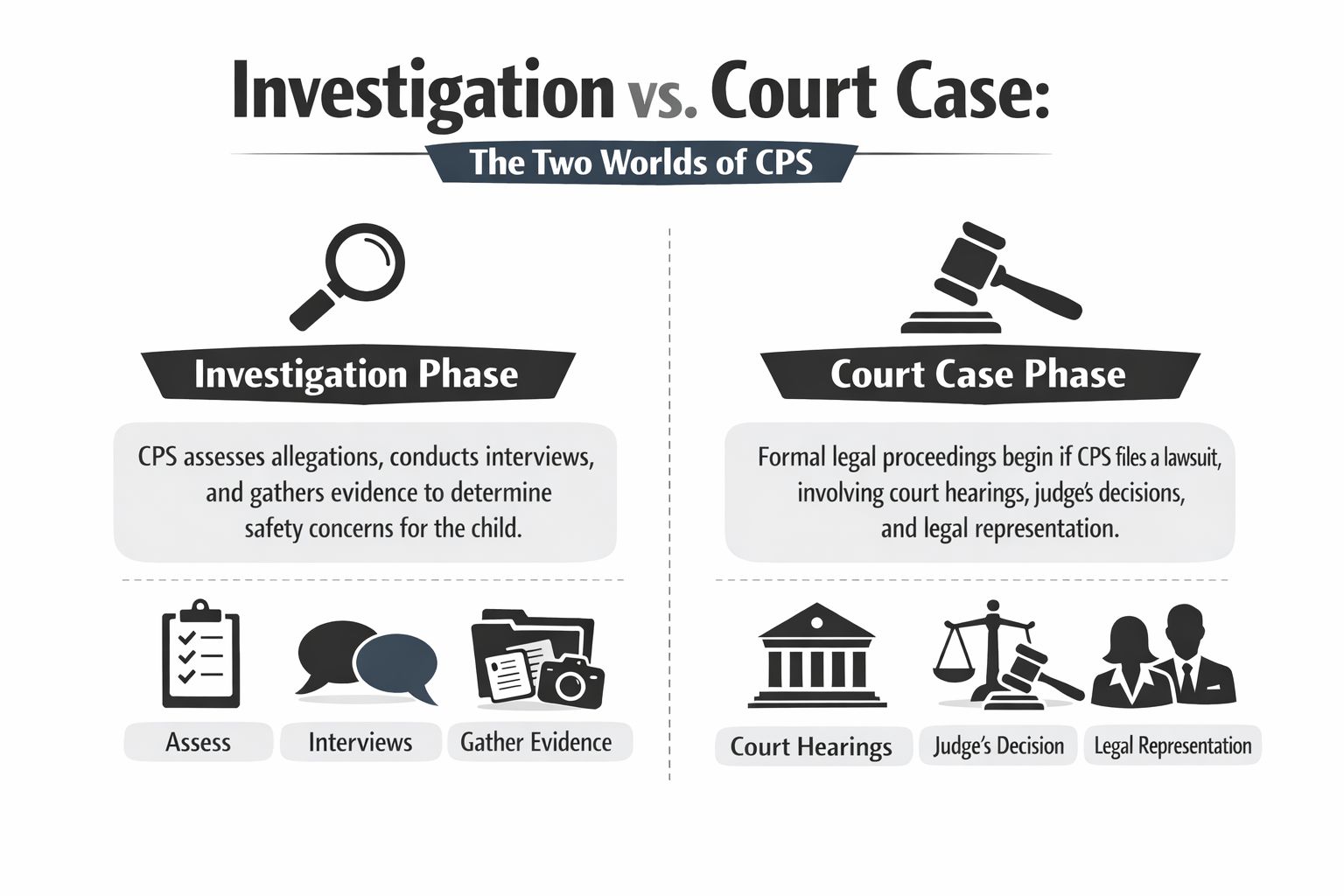
The investigation world
The first world is the investigation. CPS is gathering information, interviewing people, reviewing conditions in the home, and deciding whether it believes your child is safe.
This stage can feel informal because it often happens through phone calls, home visits, school interviews, and paperwork requests. That informality is what makes it dangerous. Parents sometimes assume casual conversations don't matter. They do. Statements made during an investigation often shape everything that follows.
A lawyer in this phase acts like both a shield and an interpreter. The lawyer can help you understand what CPS is asking, why it matters, and what you can do before the agency takes the next step.
The court world
The second world begins when CPS files a lawsuit. At that point, you're not just dealing with a caseworker. You're in court, in front of a judge, under deadlines and legal standards set by the Family Code.
Chapter 262 deals with emergency removals and the beginning of a suit affecting the parent-child relationship involving the state. Chapter 263 governs the ongoing court process, reviews, service-plan issues, and permanency decisions. Chapter 161 addresses the possible termination of parental rights. Those chapters aren't abstract law school material. They shape what happens to your children, your home life, your visitation, and your future.
If you need a simple overview of how the matter shifts from one phase to the next, CPS Investigation vs. Court Case: Know the Difference gives a useful breakdown.
Why the distinction matters
Here's the simplest way to understand this:
| Phase | Main question | Main risk | Lawyer's role |
|---|---|---|---|
| Investigation | Is CPS concerned enough to escalate? | Saying or signing something harmful | Advise, control communication, protect rights |
| Court case | Will a judge order removal, services, restrictions, or worse? | Losing rights through procedure or evidence | Advocate, challenge evidence, present your case |
The same CPS matter can feel like a conversation one week and a lawsuit the next. Parents get hurt when they treat both stages the same way.
What a Lawyer Does During the CPS Investigation
During the investigation stage, a lawyer's job is prevention. The goal is to reduce damage, avoid misunderstandings, and keep a manageable problem from becoming a court case.
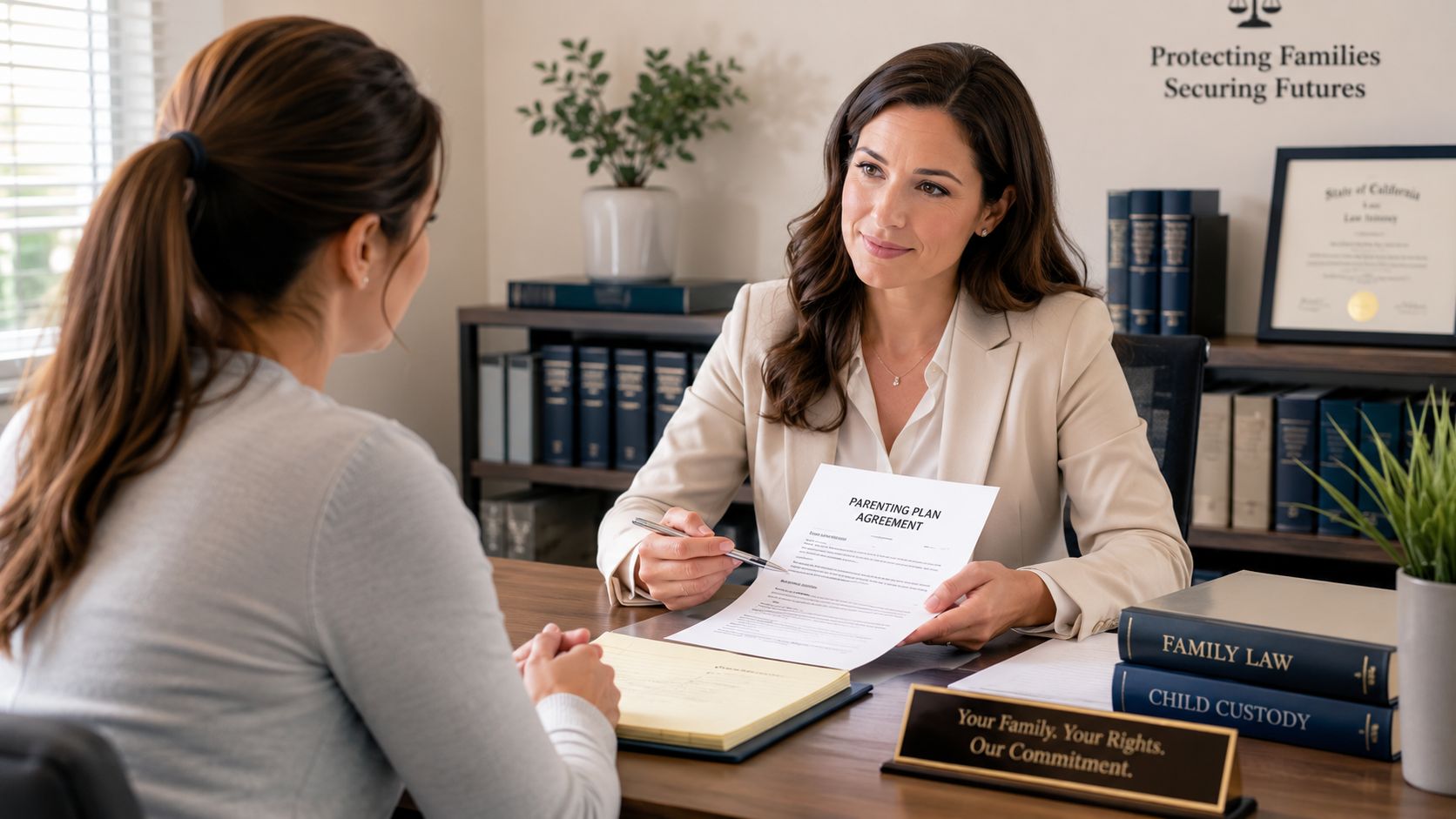
The lawyer becomes your filter
Many parents think hiring a lawyer means they stop cooperating. That's not what good representation looks like. A good lawyer helps you cooperate wisely.
That can include:
- Handling communication: Your lawyer can speak with the investigator, confirm what CPS is requesting, and reduce the chance that stressed, off-the-cuff statements get twisted or misunderstood.
- Preparing you for interviews: Some questions seem harmless but open doors to unrelated issues. A lawyer helps you answer truthfully without volunteering extra material that expands the case.
- Reviewing documents before you sign: Safety plans, releases, and written statements can have major consequences. You need to know what each line means before you agree.
- Organizing proof: School records, medical records, housing information, text messages, and names of family supports may help show the bigger picture.
Parents also underestimate how complex CPS litigation becomes if the case reaches court. A Texas Children's Commission judicial guide explains that CPS cases require over 290 minutes of judicial handling, which is almost 100 minutes more than a first-degree felony, and that counties spent approximately $38 million on about 17,000 cases, averaging about $1,264 per child case and $1,597 per parent case. That gives you a sense of why legal representation is treated as a structural part of these cases, not a luxury add-on, in the Texas Children's Commission judicial guide on funding for legal representation.
The lawyer helps with practical choices
A CPS investigation often turns on small decisions made under pressure.
For example:
Don't sign a safety plan just because the room feels tense. A safety plan may affect where you live, who can be around your child, or whether you can be alone with your own child.
A lawyer can help you ask the right questions before agreeing to anything:
- What specific safety concern is CPS claiming exists?
- How long is this supposed to last?
- Who is expected to do what?
- What happens if I disagree with part of it?
If you're trying to understand how the early stage fits into the larger process, The Texas CPS Case Timeline From Start to Finish helps parents place each contact, hearing, and deadline in context.
You can also review what a juvenile dependency lawyer does for Texas families if you want a fuller picture of how this kind of representation works in practice.
A Lawyer's Role When CPS Takes You to Court
When CPS files a case, the pressure changes instantly. You're no longer dealing with an investigation that might conclude without court involvement. You're in litigation, and the court can issue orders that affect where your child lives, what services you must complete, and how often you can see your child.
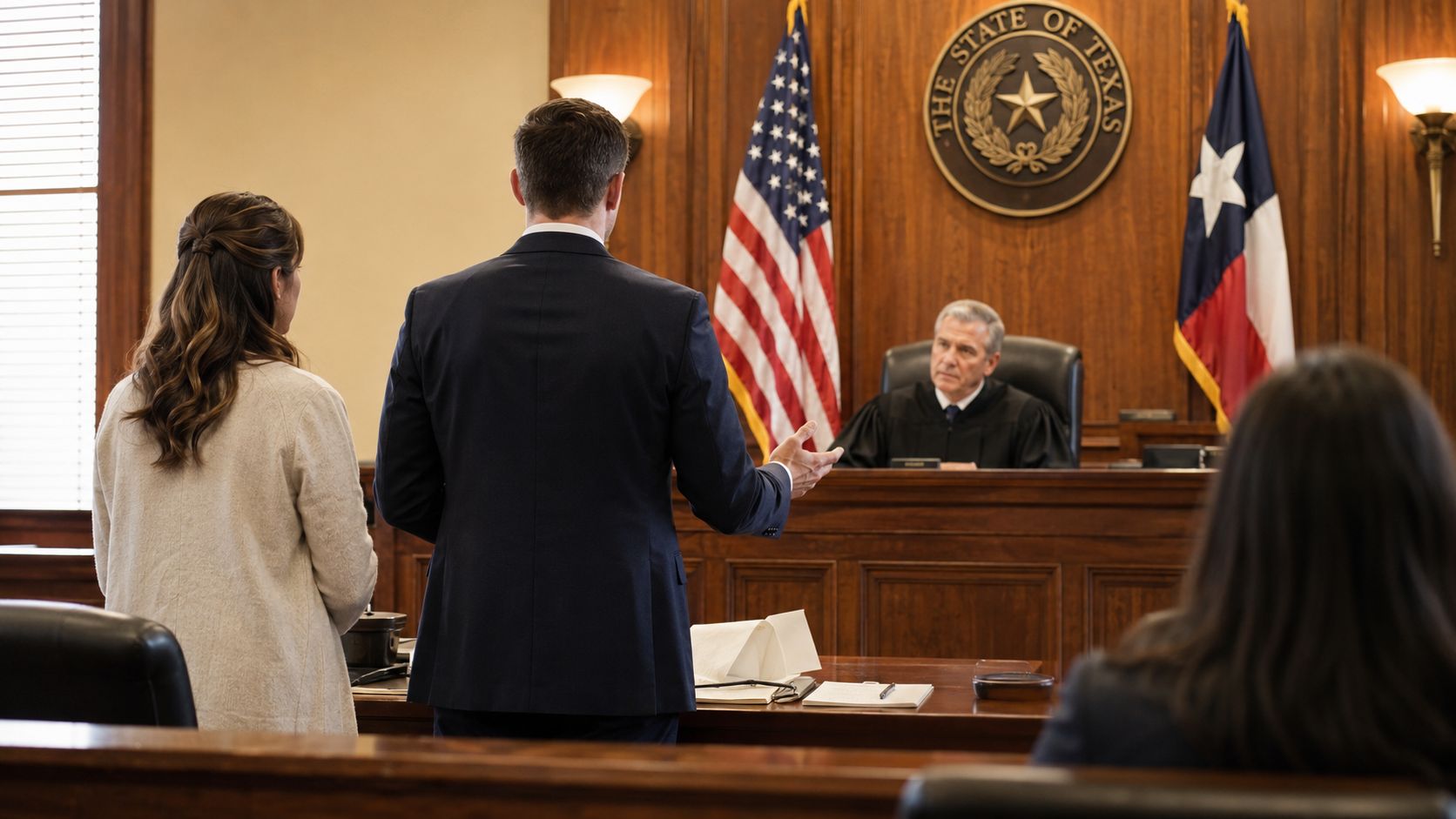
What this looks like in real life
A father gets served with court papers after CPS removes his child. He sees legal terms he doesn't recognize. He hears that there will be a hearing soon. He thinks, "I'll just tell the judge my side."
That is not enough.
In removal cases under Chapter 262, the early hearings can shape the whole case. A lawyer doesn't just stand next to you while you speak. The lawyer builds the legal argument for why removal was improper, why a less restrictive option exists, why a relative placement should be considered, or why visitation and services should be structured differently.
What your lawyer is actually doing in court
A CPS courtroom lawyer handles tasks most parents can't realistically do alone under stress:
- Challenges CPS evidence: The agency may rely on reports, statements, photographs, records, and witness testimony. Your lawyer examines whether that evidence really supports the action CPS wants.
- Cross-examines witnesses: That means asking the caseworker, investigator, or other witnesses targeted questions that expose gaps, assumptions, or missing context.
- Requests specific relief: Courts don't act on vague fairness. Lawyers ask for concrete orders about placement, visitation, services, evaluations, and deadlines.
- Tracks Family Code deadlines: Chapter 263 includes review structures and permanency issues that can subtly shape the direction of the case if no one is watching closely.
- Protects the record: What happens at one hearing can affect the next hearing and, in some cases, an appeal.
Parents also face strategic choices in court. Some issues should be fought immediately. Others may be better resolved through negotiated orders that protect the child and preserve your long-term position. Legal judgment is paramount in making these determinations. If you're weighing that choice, when to settle vs fight a CPS case in court is a helpful resource.
A short video may also help if you're trying to understand how these cases unfold once they reach court.
In CPS court, being honest is necessary. It is not a substitute for being legally prepared.
The High Stakes of Representing Yourself in a CPS Case
A CPS case can make a capable parent feel lost in a matter of days. You know your child, your home, and your daily life better than anyone in that courtroom. But a CPS case is not only about telling your story. It is also about proving the right facts, at the right time, in the right way, under rules that most parents have never had to learn.
That gap matters.
Representing yourself in a Texas CPS case often means trying to do two hard jobs at once. You are living through the crisis and trying to respond to it like a lawyer. Few people can do that well while also keeping up with work, transportation, drug testing, visits, classes, counseling, and court dates.

What parents often miss when they go alone
Some errors are obvious. Missing a hearing can hurt your case immediately. Other errors are quieter. They may not seem serious in the moment, but they can shape how the judge views your case for months.
- You may agree to wording that hurts you later: A safety plan, temporary order, or service-plan term can sound harmless but create duties you did not expect, or language that looks like an admission.
- You may know the facts but struggle to present them clearly: Court is not a conversation at the kitchen table. It works more like building a file cabinet. If the papers, testimony, and timeline are not organized, important facts get lost.
- You may let harmful statements stand unanswered: If a caseworker, report, or witness says something incomplete or misleading, the court may treat it as true unless someone challenges it properly.
- You may do the work but fail to prove it: Parents often complete services, improve housing, or stay sober, but do not gather records, logs, certificates, or witness support that show steady progress.
- You may fall behind before you realize the risk: In serious cases, parental rights can be threatened. By that stage, early misunderstandings about orders, deadlines, or compliance can already be affecting the court's view of the case.
A lawyer's role changes at each stage, and that is part of why self-representation is so risky. Early on, a lawyer helps control what information is shared, what forms are signed, and how your cooperation is documented. After a case is filed, that same lawyer shifts to building evidence, challenging weak claims, shaping court orders, and protecting you from avoidable setbacks. Without counsel, parents often react one problem at a time. CPS cases are won or lost by seeing the full chain of events.
A simple comparison
| If you represent yourself | If you have a lawyer |
|---|---|
| You may answer each demand as it appears | Your lawyer builds a case plan from the first hearing to the final one |
| You may not know which requests are optional, negotiable, or improper | Your lawyer explains what must be done, what can be challenged, and what should be clarified in writing |
| You speak from fear, frustration, or urgency | Your lawyer turns your facts into evidence and legal arguments the judge can use |
| You may focus on today's problem only | Your lawyer watches how today's order affects visitation, placement, services, and the final outcome |
A useful analogy may help. Representing yourself in a CPS case is like trying to repair the roof during a storm while standing in the rain. You can see the damage. You may even know what needs fixing. But the pressure, timing, and tools make the job far harder than it looks from the ground.
That does not mean a lawyer makes the case easy. It means you have someone whose job is to protect your position while you work on the steps the court and CPS are requiring.
One practical reality often surprises parents. Early in the case, before a court appoints counsel, hiring a private attorney may be the fastest way to protect your rights. If you are trying to compare options, this step by step guide to finding a CPS lawyer near you may help. The Law Office of Bryan Fagan PLLC handles Texas CPS and related family law matters.
How to Get a Lawyer for Your Texas CPS Case
There are two basic paths. You can hire a private attorney, or the court may appoint one if the legal requirements are met.
Hiring a private attorney early
If CPS is only investigating and no lawsuit has been filed, hiring private counsel is often the fastest way to protect yourself. Early representation matters because this is the stage where parents often sign forms, consent to plans, or make statements without understanding the consequences.
When you're choosing a lawyer, look for someone who handles Texas CPS cases regularly, understands hearings under Chapters 262 and 263, and can explain strategy in plain English. You want someone who can tell you not only what the law says, but what to do next this week.
If you need help starting that search, how to find a CPS lawyer near you with a step-by-step guide can help you compare options.
When the court appoints a lawyer
Many parents assume CPS contact automatically means they get a free lawyer. That isn't how Texas law works.
Texas Law Help explains that parents can hire a lawyer at any time during a CPS investigation, but a court-appointed lawyer is generally not required until a lawsuit is filed, the parent is indigent, and the parent contests the petition. The same source explains that the child must be appointed an attorney ad litem within 14 days after removal from the home. You can review that rule in Texas Law Help's explanation of a parent's right to a lawyer in CPS matters.
Questions to ask in the first call
Use the consultation wisely. Ask direct questions:
- How often do you handle CPS litigation in Texas courts?
- If CPS hasn't filed yet, what would you do first?
- Will you help review safety plans and releases before I sign?
- If a court case is filed, who handles hearings?
- What should I stop doing right now?
The right lawyer won't just talk about the law. They will give you an action plan.
Your Next Steps and Frequently Asked Questions
If you're overwhelmed, narrow your focus. Don't try to solve the whole case tonight. Protect the next conversation, the next document, and the next hearing.
Can I refuse to talk to a CPS caseworker?
You should be careful, not careless. Refusing every conversation can create problems, but speaking without legal advice can also hurt you. A safer approach is to stay polite, get the worker's information, ask what the allegations are, and tell them you want to consult counsel before answering detailed questions.
Write down names, dates, phone numbers, what was requested, and anything you were asked to sign. Good notes help your lawyer help you.
What if CPS wants me to sign a safety plan today?
Slow down. Read every line. Ask what concern the plan is meant to address, how long it lasts, who must comply, and what happens if you disagree with a term. If possible, have a lawyer review it before you sign.
What if I can't afford a private lawyer right now?
Call anyway. Some parents assume they have no options and then miss the period where early advice could have mattered most. Even a first consultation can help you avoid a harmful statement or rushed agreement. If a lawsuit is later filed and you qualify, you may be able to ask the court to appoint counsel.
Can I just explain everything to the judge myself?
You can speak, but that doesn't mean you'll know how to present evidence, challenge testimony, preserve objections, or ask for the exact orders you need. Court is not just about telling your story. It's about proving facts under legal rules and protecting your rights over time.
If CPS has contacted you, don't wait for the situation to "become serious." It already is. Early legal help can change how the investigation unfolds, what gets put in writing, what happens in court, and how quickly your family can move toward stability.
If you're facing a CPS investigation or court case, talk to Law Office of Bryan Fagan PLLC for a free, confidential consultation. A Texas CPS case can move from one conversation to one courtroom hearing very fast. Getting clear legal advice now can help you protect your parental rights, avoid preventable mistakes, and make decisions from a place of knowledge instead of fear.