Skip to content
When CPS contacts you, fear hits fast. Your mind goes to the worst places. Are they taking my kids today? Did someone lie about me? Do I have to let them in? If I cooperate, will this go away?
Those reactions are normal. A CPS case in Dallas can feel like a family emergency mixed with a legal ambush. You may be dealing with a school interview, a doctor's report, an angry ex, a neighbor complaint, or a misunderstanding that suddenly has government investigators asking questions about your home and your children.
What makes this even harder is that many parents look up CPS attorney Dallas and find general family law information, but not enough guidance about the early investigation stage or the risk that a CPS case can turn into a criminal case. That gap matters. What you say in a “child welfare” conversation can affect your parental rights and your freedom.
This guide is meant to slow the panic and give you a clear path. Texas law has rules. CPS has limits. You have choices. If you understand the process early, you can avoid mistakes that are hard to undo later.
That Knock on the Door Your World Turned Upside Down
A Dallas parent hears a knock late in the afternoon. A caseworker is standing outside. She says there's been a report and she needs to ask a few questions. The parent feels embarrassed, angry, and terrified all at once. The child is in the next room. The caseworker starts asking about bruises, discipline, medical care, and who lives in the home.
That moment changes the temperature in the whole house.
For many families, the first instinct is to explain everything right away. Parents want to show they've done nothing wrong. They talk too much, volunteer documents, and agree to things they don't fully understand because they think cooperation alone will fix the problem. Sometimes that works against them.
Practical rule: The first goal is to stay calm enough to make good decisions, not to win the whole case at the doorstep.
A CPS investigation doesn't always mean your child will be removed. It doesn't always mean the report is true. It does mean the situation is serious, and serious situations need a plan. In Texas, these cases often involve issues under Chapter 262 of the Texas Family Code for removal procedures, Chapter 263 for court review and permanency, and Chapter 161 when CPS seeks termination of parental rights. Those chapter numbers can sound abstract, but they matter because they shape what happens next, how fast it happens, and what the court can order.
What parents usually feel first
- Shock: You didn't expect a caseworker, teacher, police officer, or hospital social worker to question your parenting.
- Confusion: You may not know whether this is only an investigation or the start of a court case.
- Pressure: CPS often acts quickly, and parents feel pushed to answer on the spot.
- Guilt and fear: Even a good parent can sound defensive when frightened.
A more useful way to see the situation is this. You are not powerless. You are at the beginning of a legal process, and the earlier you treat it that way, the better positioned you are to protect your family.
The First 48 Hours What to Do When CPS Contacts You
The beginning of a CPS case is often the most dangerous stage for a parent. Many people assume the government will appoint a lawyer right away. That's not how it works. Texas law does not automatically give parents a court-appointed attorney during the initial CPS investigation. Appointment requires indigency, a filed lawsuit, and active opposition to a CPS petition, as explained by Texas Law Help on your right to a lawyer in CPS cases.
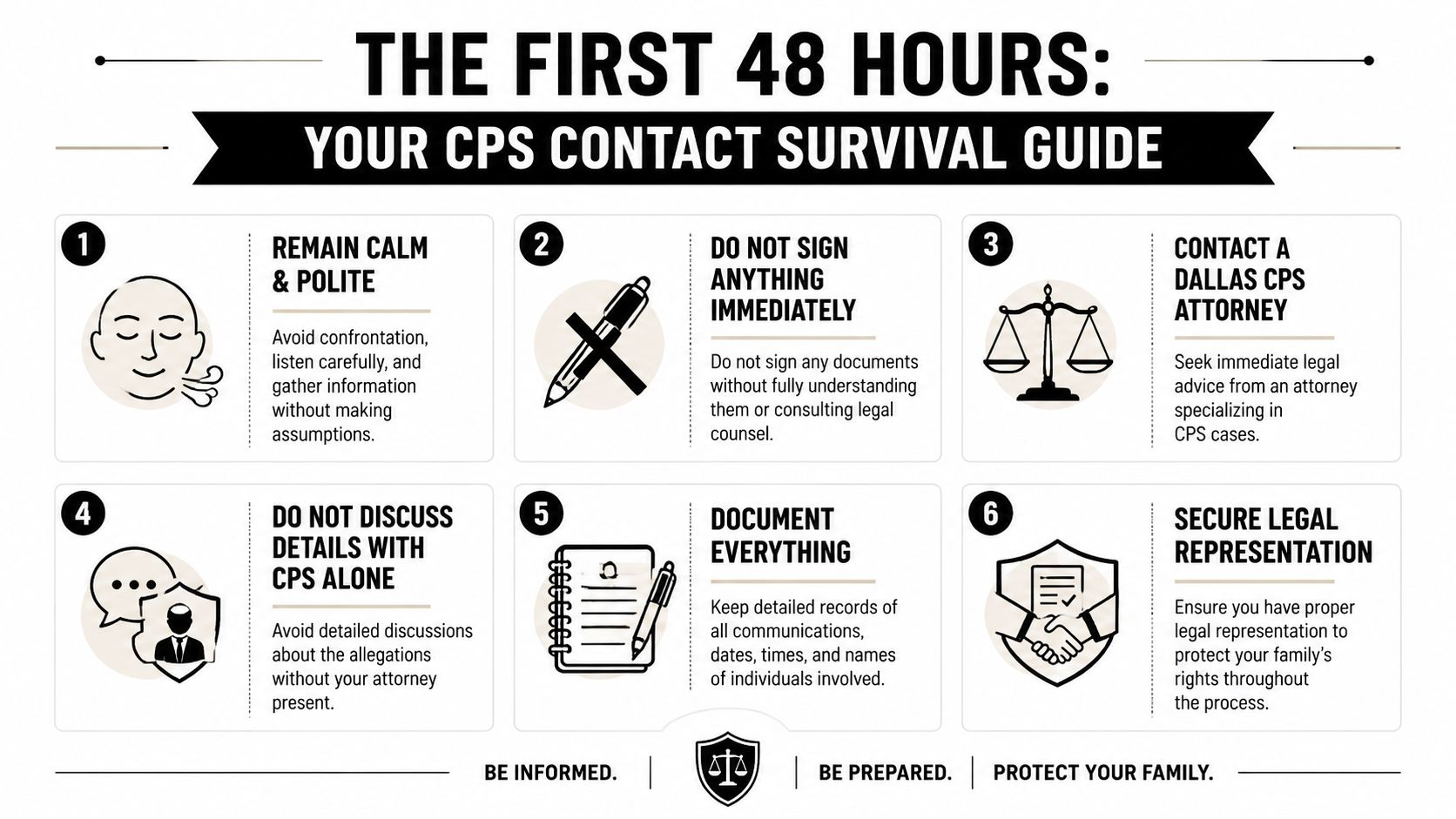
What to do right away
If CPS calls, visits, or asks to meet, keep your response short and controlled.
- Stay polite. Anger creates more risk, not less. Get the worker's name, phone number, office, and the basic allegation if they'll provide it.
- Don't sign anything on the spot. Safety plans, releases, and written statements can have lasting consequences.
- Ask for time to speak with counsel. A simple sentence works: “I want to cooperate appropriately, but I won't answer detailed questions or sign documents until I've spoken with my attorney.”
- Start a written record. Write down dates, times, who contacted you, what was said, and who else was present.
- Be careful with texts and social media. Assume screenshots may later appear in court.
- Get focused guidance. A practical starting point is this article on how to respond when CPS shows up at your door in Texas.
What not to do
Parents under pressure often make one of three mistakes.
- Don't try to talk your way out of it. Long explanations can create inconsistencies.
- Don't coach your child. Even well-meant comments can be twisted into claims that you influenced a witness.
- Don't assume a family law issue can't become permanent. Termination of Parental Rights in CPS Cases addresses when CPS seeks to permanently terminate parental rights and how to contest it.
When you're scared, silence feels risky. In many CPS investigations, uncontrolled talking is riskier.
A relatable example
A father in Dallas gets a call saying CPS received a report about physical discipline. He invites the investigator in, explains the entire family history, admits he was “frustrated,” and signs a document he didn't fully read because he thinks refusing would look bad. Two days later, he realizes his own words may be treated as admissions.
A more protective response would have been calmer and narrower. Confirm identity. Get the allegation. Decline detailed questioning until counsel is involved. Preserve records. That doesn't make a parent look guilty. It shows the parent understands the stakes.
Understanding the CPS Investigation Process in Dallas
Once CPS opens an investigation, the caseworker starts gathering information from multiple directions. Parents often think the worker is only trying to decide whether the home is “good” or “bad.” In practice, the investigation is more specific than that. The worker is trying to assess reported risks, identify the child involved, compare accounts, and decide whether CPS believes immediate intervention is needed.

What investigators usually look at
A Dallas CPS investigation may include:
- Interviews with the parents
- Interviews with the child, sometimes at school or another setting away from home
- Home observations, including sleeping arrangements, food, medication access, and general hazards
- Contacts with relatives, teachers, doctors, or neighbors
- Requests for records or releases
The key problem for parents is that each contact creates evidence. Some evidence may help you. Some may be incomplete or misleading. Some may be taken out of context.
For a plain-English overview of the moving parts, see breaking down the CPS system in Dallas.
Safety plans are not simple promises
One point of confusion is the safety plan. Parents are sometimes told a safety plan is just temporary and informal. They agree because they want to show cooperation. But a safety plan can change where a child stays, who may supervise contact, and what restrictions apply inside your own home.
A parent might be told, “This is voluntary.” That may be technically true in the moment, but the practical pressure is intense. If you agree without understanding the language, you may limit your options later.
A safety plan can shape the entire direction of the case. Read it like it matters, because it does.
CPS can focus on one child and not another
Many parents assume CPS must remove all children or no children. Texas law doesn't work that way. Texas CPS caseworkers can legally remove only one child from a home while leaving others in place, based on a child-specific risk assessment, as discussed in this Dallas-focused explanation of selective child removal in Texas CPS cases.
That detail surprises families. It also explains why CPS questions can seem unusually targeted. If one child has medical needs, behavioral challenges, or a particular allegation tied only to that child, CPS may analyze the household one child at a time.
A practical example
A mother has three children. One child has repeated school absences and a medical issue. CPS may focus heavily on whether that child received care, while not making the same findings about the siblings. That does not mean the rest of the case is minor. It means the agency is building a child-by-child theory of risk.
When parents understand that, they stop treating the investigation like an informal conversation and start seeing it for what it is: a record-building process.
The Texas CPS Legal Timeline A Step-by-Step Guide
If CPS moves from investigation into court, the pace can feel brutal. Hearings arrive quickly. Terms sound unfamiliar. Parents hear words like “adversary,” “status,” “permanency,” and “termination” without knowing which hearing matters most. All of them matter because each hearing can lock in momentum.
One important benchmark shows how quickly the system moves. Under Section 107.012 of the Texas Family Code, an attorney ad litem for a child removed in a CPS case must be appointed within exactly 14 days after removal, according to the Texas Children's Commission judicial guide discussing attorney ad litem appointment timing. Courts treat this as a strict statutory safeguard for the child.
Dallas CPS Case Timeline Overview
| Hearing Type | Typical Timeframe | Purpose |
|---|---|---|
| Emergency removal hearing | Very early after removal | The court reviews whether emergency action was taken and what temporary protections are needed |
| Adversary hearing | Soon after the case begins | The judge considers whether the child should remain out of the home while the case continues |
| Attorney ad litem appointment for child | Within 14 days after removal | The child receives legal representation in the case |
| Status hearing | Later in the case | The court reviews the service plan and whether the parents understand what is required |
| Permanency hearings | Ongoing during the case | The court checks progress, placement, visitation, and long-term planning |
| Final trial or final hearing | At the end of the case | The court decides reunification, continued conservatorship, or termination issues under Chapter 161 |
Why these hearings matter
The first hearings often shape the rest of the case. If a judge hears only CPS's version early, the agency may gain a major advantage in how the case is framed. That's why parents need to prepare immediately, not weeks later.
Under Chapter 262, the court deals with removal and emergency authority. Under Chapter 263, the court tracks progress through reviews, permanency planning, and compliance with the case plan. Under Chapter 161, the court may decide whether legal grounds exist to terminate parental rights. These are not just chapter numbers in a statute book. They mark the path from investigation to possible separation or reunification.
What judges look for
At different hearings, judges usually focus on questions like these:
- Safety now: Does the court believe the child faces a current risk?
- Less restrictive options: Could the child be protected without continued removal?
- Parental participation: Is the parent engaging with services, visitation, and court orders?
- Credibility: Do the records, testimony, and conduct line up?
A simple way to think about the timeline
Early hearings are about emergency risk. Middle hearings are about compliance and progress. Final hearings are about long-term legal outcomes.
That distinction helps parents make better decisions. At the beginning, your lawyer may focus on challenging the need for continued removal or narrowing restrictions. Later, the fight may shift toward service-plan compliance, visitation expansion, or defeating termination claims.
Court deadlines don't wait for a parent to feel ready. Once the case is filed, every hearing matters.
A common point of confusion
Parents often think, “If I just do what CPS asks for a few weeks, the court will see I'm trying.” Effort helps, but undocumented effort is easy to overlook. Keep records of classes, counseling, testing, communication attempts, and every completed requirement. In a CPS case, proof matters as much as intent.
How a Dallas CPS Attorney Defends Your Family
A good lawyer in a CPS case doesn't just stand next to you in court. The lawyer controls damage, organizes facts, and pushes back when CPS overreaches. That matters during the investigation, at hearings, and during reunification efforts.

During the investigation
At the investigation stage, an attorney acts as a filter. Instead of letting CPS gather statements from a frightened parent in an uncontrolled setting, counsel can manage communications, review requests, and help the parent avoid harmful admissions.
That can include reviewing proposed safety plans, preparing the parent for interviews, and correcting factual errors before they harden into the agency's narrative.
In court and case planning
Once the case reaches court, the role changes. The lawyer may challenge removal grounds, object to weak evidence, cross-examine witnesses, and present context that CPS left out. The lawyer also helps the parent understand what the judge expects, not what people in the hallway say is “normal.”
Another major role involves the service plan. Service plans can look straightforward on paper but become difficult in practice. A parent may need to complete classes, counseling, testing, evaluations, or supervised visits while also working, arranging transportation, and dealing with criminal exposure or related family conflict.
If you want a broader strategic overview, How to Fight CPS and Win in Texas offers a focused guide to mounting an effective defense.
Here's a short video that helps frame the legal stakes and the value of representation during a CPS-related crisis.
During reunification efforts
Reunification is not passive. Parents often assume that completing services should automatically lead to return of the child. In reality, someone still has to present that progress persuasively and tie it to the legal standards the court uses.
A Dallas CPS attorney can help by:
- Tracking compliance: Gathering proof that you completed what the court ordered
- Pushing for visitation changes: Requesting more contact when progress supports it
- Clarifying unrealistic demands: Challenging vague or unfair requirements
- Preparing testimony: Helping you speak clearly and carefully in court
The Law Office of Bryan Fagan PLLC handles criminal cases and CPS-related matters where family law and criminal exposure overlap, which can be especially relevant when an abuse allegation triggers more than one legal problem at once.
The Hidden Danger Parallel Criminal Charges
Many parents make one dangerous assumption. They think a CPS case is only about custody, supervision, and home conditions. Sometimes it is. Sometimes it also becomes a criminal investigation.
That distinction is one of the biggest blind spots in online searches for a CPS attorney in Dallas. If the allegation involves physical injury, medical neglect, sexual abuse, drug exposure, or an incident with law enforcement, your statements to CPS may interest police and prosecutors too.
Why this changes everything
In Texas, over 60% of CPS removals involving alleged abuse also result in criminal charges, according to this discussion of CPS defense and parallel criminal charges in Texas. The same source notes that criminal penalties can include incarceration and can also affect parental rights. That means one interview can create two cases moving in different courts with different risks.
A family law strategy alone may not protect you from self-incrimination. Criminal law focuses on defenses, charging exposure, statements, and evidence in a very different way.
A relatable scenario
A child arrives at school with an injury. The school reports it. CPS opens a case. A parent thinks, “I'll explain exactly what happened and they'll close it.” But the explanation includes details about frustration, physical contact, and prior discipline. Those statements may later appear in a criminal file.
At that point, the legal goal is no longer just reunification. It may also be preventing charges, preparing for arrest, or defending against a felony accusation.
The same facts can be used in two court systems at once. Parents who don't prepare for that risk can lose ground fast.
What to do if you sense criminal exposure
- Treat every interview seriously. Casual conversations aren't always casual.
- Ask whether law enforcement is involved. If police are already in the picture, the risk level rises immediately.
- Get advice that accounts for both systems. A parent may need a coordinated response, not separate advice given in isolation.
- Learn the criminal side too. For context on lower-level Texas criminal allegations and how charges are categorized, this page on misdemeanors in Texas can help.
When parents understand the dual risk, they make better decisions from the start. They speak less, document more, and stop assuming that “family court” means freedom is off the table.
Reunification and Taking Back Your Future
Even after a frightening start, many CPS cases turn toward reunification. That path usually depends on consistency. Show up. Complete what the court ordered. Keep records. Stay sober if substance use is an issue. Communicate carefully. Let your lawyer know immediately if a service is unavailable, a visit is canceled, or a caseworker's demand doesn't match the written plan.
Under Chapter 263, progress matters because the court keeps reviewing whether the family is moving toward a safe return. Under Chapter 161, the stakes become even higher if CPS seeks permanent termination. That's why parents need to treat every class, test, visit, and hearing as part of the same story: your ability to provide a safe, stable home.
Small steps that help rebuild credibility
- Follow the written plan: Verbal side deals are hard to prove.
- Create a paper trail: Save certificates, attendance logs, and messages.
- Protect your support network: Family members, sponsors, counselors, and church contacts may become important witnesses.
- Address underlying issues directly: If substance use, mental health, or domestic conflict played a role, real treatment often helps both the case and the family.
For families facing addiction-related concerns, support from relatives often plays a practical role in stability, treatment, and reunification. This article on how family helps in addiction recovery offers useful context for building that support system in Dallas.
You don't have to solve everything in one week. You do need to start moving in the right direction, with the right legal guidance, before deadlines and assumptions harden against you.
If CPS has contacted you, if your child has been removed, or if you're worried that a CPS investigation may also lead to criminal charges, don't carry that fear alone. A prompt legal review can help you understand your rights, your deadlines, and the safest next step for your family. Contact Law Office of Bryan Fagan PLLC for a free consultation and confidential guidance about protecting your children, your rights, and your future.