Skip to content
When a CPS investigator shows up at your home, panic sets in fast. Most parents in Houston don't know whether they should open the door, answer questions, let the investigator inside, or start explaining everything right away. That fear is real. So is the confusion.
The problem is that many parents make their biggest mistakes in the first conversation. They think cooperation always helps. In some cases, it does. In others, over-compliance creates a record that CPS and the court may later use against you. For those in need of a CPS lawyer in Houston, clear answers are likely needed right now, not vague advice.
Texas law gives parents rights, but those rights only help if you use them early. A calm, informed response can change the direction of a case. So can quick legal guidance.
The Knock on the Door That Changes Everything
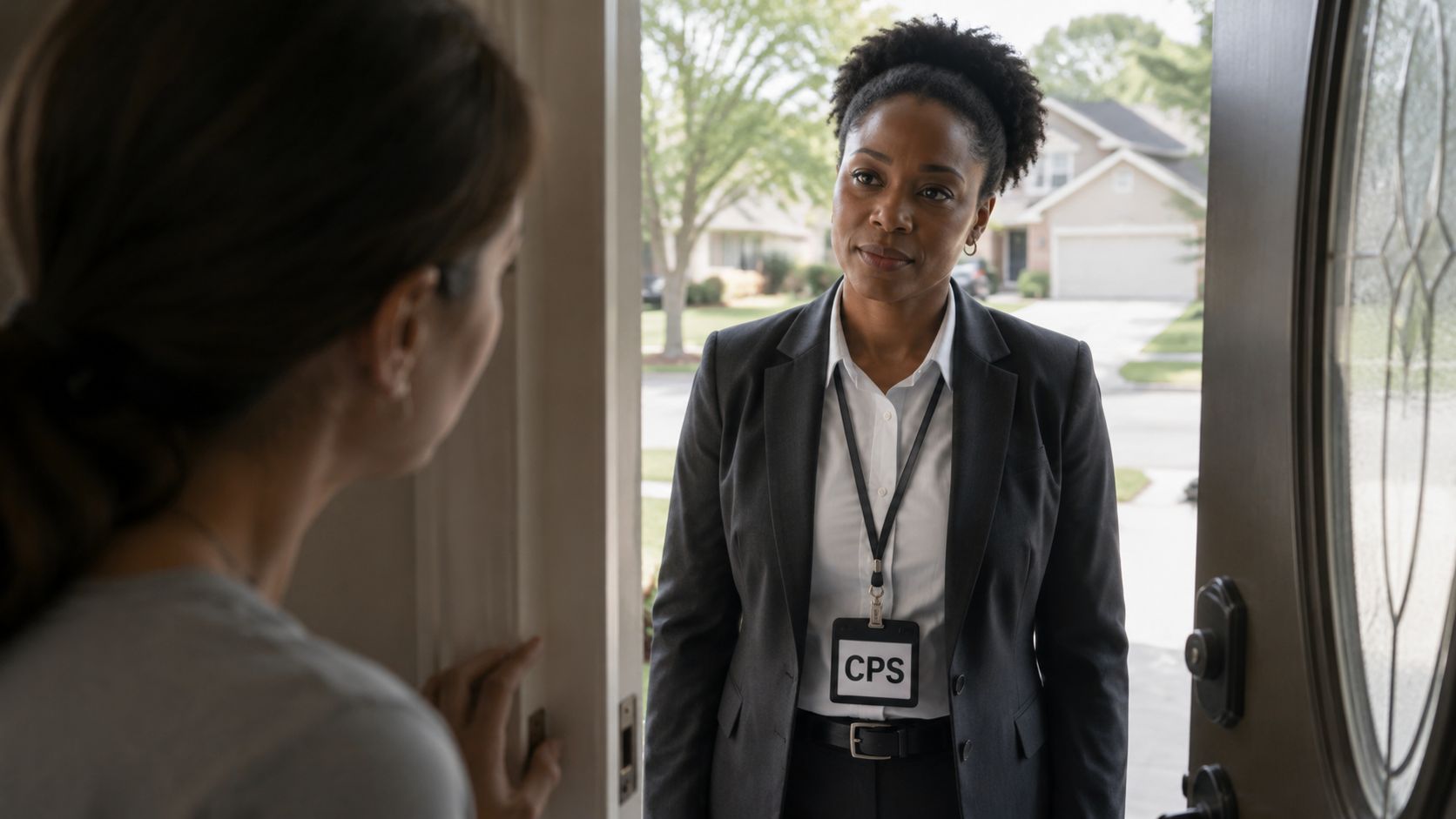
At 2:30 on a weekday, someone knocks. You open the door and hear words no parent expects to hear calmly: "I'm with CPS. We received a report." The investigator asks to come inside, speak with your child, and get your side of the story. In that moment, many parents in Houston start talking fast because silence feels dangerous.
That instinct can hurt you.
Texas sees a high volume of child abuse and neglect investigations every year. The Texas Department of Family and Protective Services child protection information reports roughly 118,000 investigations in 2023, with a substantial share leading to findings that required agency involvement. Harris County accounts for a large portion of that workload, which means Houston parents often face a system that moves fast and documents everything.
That matters because the first conversation often shapes the whole case file. A parent trying to "clear things up" may agree to a home walkthrough, hand over text messages, explain past arguments, or let a child be interviewed without understanding how those details can later appear in an affidavit, a safety plan, or a courtroom record. Cooperation is not always harmless. In some cases, it becomes self-incrimination dressed up as helpfulness.
What that means for Houston parents
A CPS investigation is not proof that abuse or neglect occurred. It means someone made a report and the agency decided to act on it. Reports come from teachers, doctors, counselors, neighbors, relatives, and former partners. Some are made in good faith. Some are wrong. Some start from an accident, a bruise, a missed medication dose, or a heated custody fight.
I have seen parents make serious mistakes because they were trying to look reasonable. One common example is the parent who says, "Come in, I have nothing to hide," then gets questioned room by room without time to think. Another is the parent who keeps talking after a vague allegation, hoping more detail will make the case disappear. It rarely works that way.
Your first job at the door is to protect the record, not to satisfy the investigator.
That does not mean slamming the door or acting hostile. It means staying polite, getting the investigator's information, and understanding your options before giving statements or agreeing to requests. If you want a clearer sense of what that looks like in practice, this guide on how to respond when CPS shows up at your door in Texas breaks down the first decisions that matter.
Families also deal with the emotional shock after CPS contact. Children may become anxious, withdrawn, or fearful of strangers at the door. Parents often stop sleeping. If your family is struggling after the investigation begins, learning about effective treatment for trauma can help you consider appropriate support while the legal case is still unfolding.
Why early legal advice matters
Texas law gives parents rights, but those rights do not protect you unless you use them early. Many parents assume asking for a lawyer makes them look guilty. In CPS cases, the opposite is often true. Early counsel helps you decide what must be answered, what can wait, whether CPS has grounds to enter, and whether a "voluntary" agreement is safe to sign.
The trade-off is real. Full cooperation may make you seem agreeable in the moment, but it can also create statements and documents that are hard to explain later. A measured response with counsel may feel uncomfortable at first, yet it often prevents temporary decisions from turning into long-term damage to your custody rights.
A CPS lawyer in Houston helps you handle that first stage carefully, with a clear record and a plan.
Your First 24 Hours Critical Actions After CPS Contact
The most dangerous advice in a CPS case is "just cooperate and it'll go away." Courtesy matters. Hostility doesn't help. But unlimited cooperation without counsel can do real damage.
Recent Texas case law trends cited by Hirani Law Firm's Houston CPS attorney page state that 38% of CPS removals in Harris County were overturned because parents were coerced into "voluntary" agreements they did not understand. That same source warns that compliance without immediate attorney review can be treated by judges as an admission of guilt.

What to do right away
If CPS has contacted you, take these steps in order:
Get the investigator's name and contact information.
You need to know who called, what agency division they're with, and how they claim to have authority.Say you want legal counsel before answering detailed questions.
You can be polite and firm. Basic identifying information is one thing. A detailed narrative about discipline, medical care, arguments in the home, medications, or past incidents is another.Don't sign anything on the spot.
Safety plans, voluntary placements, releases for records, and informal written statements can all have consequences.Document everything.
Write down dates, times, who was present, exactly what was said, and whether anyone asked to enter your home or speak to your child alone.Get legal guidance fast.
A practical overview of the first response appears in how to respond when CPS shows up at your door in Texas.
Practical rule: Be respectful. Don't argue at the door. But don't mistake politeness for surrender.
What not to do
Parents under stress often make avoidable decisions because they think refusal will make them look guilty.
- Don't consent to entry because you feel pressured. CPS generally can't enter a home without a court order or your permission unless an emergency exists.
- Don't try to "explain everything" immediately. People who are scared often overtalk, guess at dates, or make statements that sound inconsistent later.
- Don't agree to a safety plan just to end the conversation. These plans are often presented as temporary and harmless. They may not be.
- Don't let embarrassment isolate you. Call a lawyer, and if needed, call a trusted family member who can help you stay organized.
A related resource, Emergency CPS Removal in Texas: What Parents Must Know, explains what happens when CPS removes a child and the strict deadlines that follow under Chapter 262.
If an investigator says, "Sign this and we can avoid court," that's exactly the moment to stop and get legal advice.
The hard trade-off
Some parents worry that invoking rights will make CPS angry. That fear is understandable. But the core trade-off is this: short-term discomfort with the investigator versus long-term damage in court. A parent who carefully limits communication until counsel is involved often protects the family better than a parent who tries to appear endlessly cooperative.
Navigating the Texas CPS Investigation Timeline
The hardest part for many parents is not knowing whether the case is still an investigation, already a court case, or drifting toward something much more serious. That confusion leads people to say yes to interviews, releases, and services they do not understand. In Texas CPS cases, timing matters because each stage changes what the agency can ask for, what the court can order, and what mistakes become part of the record.
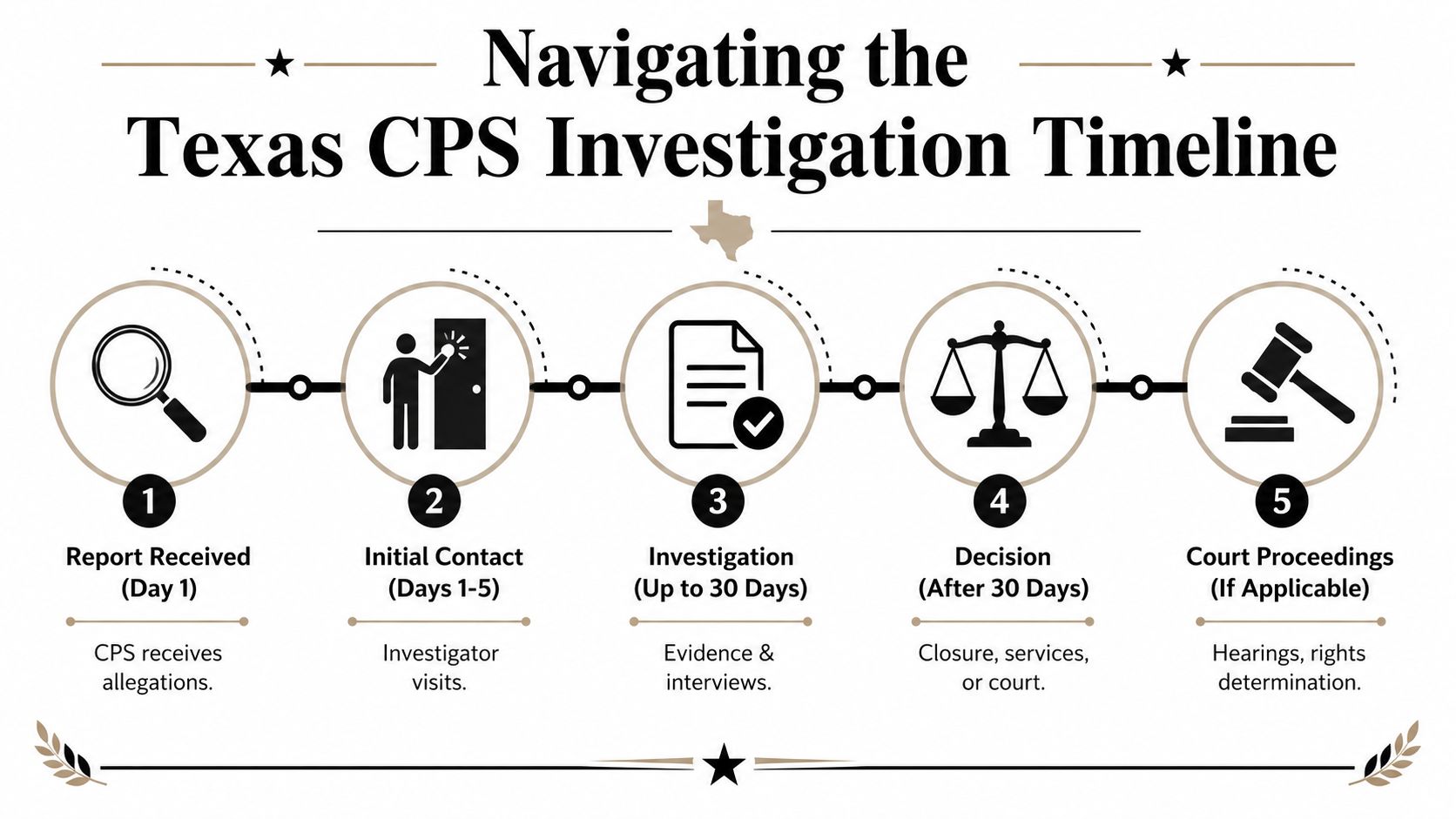
Texas Family Code Chapters 262, 263, and 161 usually frame the life of a serious CPS case. Chapter 262 deals with emergency action and removal. Chapter 263 covers the court's ongoing review of the case, including service plans and placement decisions. Chapter 161 addresses termination of parental rights.
Investigation stage
A case begins with a report, then an investigation. CPS may interview parents, children, relatives, teachers, doctors, or neighbors. The investigator may ask to see the home, review records, or have you sign releases.
This stage is where over-compliance causes real damage.
Parents often believe that saying yes to everything will make the case disappear. Sometimes it has the opposite effect. An offhand statement, a poorly worded text, or a signed release that gives CPS broad access to medical or mental health records can supply facts the agency later uses to support court action. Cooperation has to be measured, not automatic.
If CPS seeks emergency intervention or removal, Chapter 262 is the part of the Family Code that usually controls that process.
If you need a fuller explanation of the sequence, this guide to the Texas CPS timeline and what parents should expect at each stage helps place each deadline in context.
Early hearings and temporary orders
Once CPS files in court or removes a child, the case changes fast. Verbal pressure turns into written orders. Informal requests turn into deadlines. What a parent does in the first days after removal can shape the court's view for months.
A common progression looks like this:
| Stage | Why it matters |
|---|---|
| Initial investigation | CPS decides whether to close the case, seek services, or ask the court to step in |
| Emergency action under Chapter 262 | A judge reviews whether urgent intervention or removal was justified |
| Status and review hearings under Chapter 263 | The court tracks placement, service plan compliance, visitation, and case progress |
| Final resolution | The court decides whether the child returns home, remains in another placement, or the case moves toward permanent orders |
By the time a case reaches review hearings under Chapter 263, parents are often being judged on paper as much as in person. Missed visits, missed classes, disputed drug test results, and vague progress notes can all appear in reports filed with the court.
Service plans and the hidden risk
A service plan is not just a to-do list. It is often the framework CPS uses to argue that a parent is making progress, stalling, or refusing to address alleged risks.
That creates a real trade-off. Signing quickly may look cooperative, but it can also lock you into admissions, burdensome requirements, or services that do not match the actual allegation. Refusing everything without legal advice can also create avoidable problems in court. The right response depends on the facts, the evidence, and whether the request is tied to a legitimate safety concern.
I often tell parents to read a service plan like a document that may later be quoted back to them in court, because that is exactly what happens.
A rushed signature can do more damage than a difficult conversation with CPS.
Findings and the 45-day appeal window
Some cases end with an official CPS finding rather than immediate court litigation. If CPS sends a determination letter and you disagree with the result, the deadline to act is short. According to Gonzalez Law Group's discussion of CPS investigations, a parent has 45 days from the date of the letter to request an internal review of an abuse or neglect finding. The same source explains that if a court has already retained custody of the child, that appeal option is not available.
Many parents miss that deadline because they are focused on getting through the week. That is understandable. It is also costly.
The most serious stage
Chapter 161 governs termination of parental rights. At that point, the case is no longer about calming down an investigator or informally clearing up a misunderstanding. The record matters. Prior statements matter. Service plan history matters. Missed hearings matter.
Not every CPS investigation ends there. But parents protect themselves best when they treat the first stage like it can affect every later stage, because in many Houston cases, it does.
How a Houston CPS Lawyer Defends Your Parental Rights
A Houston CPS case is often won or lost long before trial. The lawyer's job is to slow the process down, force CPS to follow the law, and keep a frightened parent from handing the agency evidence it did not already have.

One of the first things counsel evaluates is whether CPS crossed legal lines at the start. Neal Davis's Houston CPS defense lawyer page describes several recurring problems in these cases: entry into a home without valid consent or legal authority, weak factual support for agency action, violations of a parent's rights, and a failure to test the evidence for gaps and inconsistencies. Those issues matter because parents are often told to "just cooperate" before anyone has checked whether CPS acted properly in the first place.
What that looks like in practice
Good defense work is specific.
A lawyer may challenge whether consent to enter the home was voluntary. A frightened parent standing in a doorway with a caseworker and possibly law enforcement nearby may say "okay" without understanding the consequences. That can become a major issue if the agency later claims the parent freely allowed a search.
A lawyer also presses CPS to show real evidence instead of suspicion, assumptions, or a one-sided report from an angry co-parent. In Houston cases tied to custody disputes, that distinction matters. Allegations made during family conflict are not automatically reliable, and they should be tested against medical records, school records, witness accounts, and the agency's own notes.
Another part of the defense is preventing over-compliance from turning into self-incrimination. Parents often sign safety plans, releases, or service agreements because they want to appear reasonable. Sometimes that helps. Sometimes it creates a written record suggesting the parent accepted concerns that were never proven. An experienced attorney explains that trade-off before any signature goes on paper.
Depending on the posture of the case, counsel may seek an emergency hearing after a removal, push back on a demand for unnecessary services, challenge unsupported restrictions on contact with a child, or work to close the case before it becomes a larger court proceeding.
A familiar Houston scenario
A father is in the middle of a custody fight. His child shows up with a bruise after a weekend of normal play. The other parent calls CPS. By the time the investigator arrives, the father is already trying to prove he has nothing to hide.
He agrees to a home inspection on the spot. He signs broad releases. He accepts classes no one has explained. He signs a safety plan because he thinks refusing will make him look guilty.
That approach can damage the case.
A stronger response starts with different questions. Was there a lawful basis for each request? Was the injury consistent with ordinary childhood activity? Did the report surface during active custody litigation? Did CPS document facts, or just repeat an accusation? Did any "voluntary" document create admissions that can be used later?
Those are legal questions, not just cooperation questions.
The video below gives more context on how these cases can unfold in practice.
What tends to help
Parents usually do better when they get counsel involved early, build a defense around the actual allegation, and treat every interview, release, and written agreement as part of the record. False or exaggerated claims in custody disputes can often be exposed, but only if someone gathers the right documents and frames the facts correctly.
What usually fails is trying to talk your way out of the case by being agreeable to everything. CPS cases turn on evidence, procedure, and the paper trail. A parent who understands that early is in a better position to protect both the case and the family.
If you are comparing counsel, this guide on how to choose the right CPS defense attorney in Texas can help you ask better questions. Law Office of Bryan Fagan PLLC is one Texas firm that handles CPS-related matters and related family law issues.
Choosing the Right CPS Attorney in Houston
Not every family lawyer is the right fit for a CPS case. CPS work moves fast, involves agency procedure, and often intersects with custody, emergency hearings, and long-term parental rights. You need someone who understands those pressure points and can act quickly.
The first question many parents ask is whether they can get a free court-appointed lawyer. Sometimes yes, but not at the beginning of every case.
Under Texas law, parents are not entitled to a court-appointed lawyer during a CPS investigation unless they meet all three requirements described by Texas Law Help's article on the right to a lawyer in CPS cases: indigency, active opposition to a CPS lawsuit filed in court, and a formal response in opposition to that petition. If any part is missing, the court doesn't have to appoint counsel at that stage.
Questions worth asking in a consultation
A strong consultation should leave you with clearer next steps, not more confusion. Ask direct questions such as:
How do you handle the first investigator contact?
You want a lawyer who gives concrete direction, not vague reassurance.What's your approach to safety plans and voluntary agreements?
This tells you whether the attorney understands the danger of unnecessary admissions.Do you handle court hearings if CPS files under Chapter 262 or later proceedings under Chapter 263 or 161?
Some lawyers advise early on but don't carry the matter through litigation.How do you communicate with clients during urgent deadlines?
CPS matters rarely wait for a convenient callback.What information do you need from me today?
An experienced attorney usually wants documents, names, timeline details, and copies of any letters or forms.
Fee structure matters
Parents should also ask how the lawyer charges. CPS cases may involve a retainer, an hourly arrangement, or sometimes a flat-fee structure for limited tasks. The point isn't to find the cheapest option. The point is to understand what work is covered.
A low initial fee can become expensive if it doesn't include hearings, document review, or emergency motions. Ask what happens if the case escalates from investigation to court.
A clear fee conversation is part of good legal service. If you don't understand what you're paying for, ask until you do.
What to look for beyond price
Use judgment about how the lawyer talks to you. Do they explain your rights in plain English? Do they understand Harris County practice? Do they talk realistically about trade-offs, or do they promise easy outcomes?
For a practical checklist, review how to choose the right CPS defense attorney in Texas.
Your Path Forward with Support and Resources
When CPS enters your life, it can feel like your family has lost control overnight. You haven't. But you do need to act carefully. The strongest first move is often not broad cooperation. It's informed cooperation after legal review.
Texas also places reporting duties on many professionals. Healthcare workers, teachers, attorneys, and clergy are legally required to report suspected abuse or neglect within 48 hours, and parents under investigation have the right to consult an attorney at any point, according to Whittemore Law Firm's discussion of CPS defense in Texas. That helps explain why some investigations begin suddenly and with very little warning.
Practical support you can gather now
Even before your next CPS contact, start building order around the situation:
Create a case folder
Keep every letter, business card, text message, email, medical record, and school communication in one place.List potential witnesses
Think of relatives, teachers, doctors, counselors, neighbors, or childcare providers who know your parenting and your child's condition.Preserve routine records
Attendance logs, appointment history, prescription records, and photographs may help explain what happened.Use local court information
If your case has entered court, monitor hearing details through the appropriate Harris County court channels and confirm dates with your lawyer's office.
Resources can help, but they don't replace strategy
Community support, counseling, and family help matter. So does practical legal information. If you're comparing lawyers more broadly, Finding a CPS Defense Lawyer Near You in Texas offers a useful starting point for evaluating options.
But information alone isn't enough when an investigator is asking for signatures, interviews, releases, or a home inspection. That is where legal strategy protects your family.
You don't need to have every answer today. You do need to avoid the mistake of giving away rights before you understand the consequences.
A CPS case can involve fear, anger, and deep embarrassment. Those feelings are common. They don't define the outcome. Careful decisions, honest preparation, and timely legal help often matter much more than the panic of the first day.
If CPS has contacted you, don't wait for the situation to get worse before you ask questions. The Law Office of Bryan Fagan PLLC offers a free consultation for Texas families dealing with CPS investigations, removals, and related court proceedings. A confidential conversation can help you understand your rights, avoid self-incriminating mistakes, and take the next step to protect your relationship with your child.