Skip to content
A CPS investigator at your door can make an ordinary day feel dangerous in seconds. You may be thinking about your children, your job, your home, and whether one wrong sentence could be used against you. If there's also a recent arrest, a DWI, or an assault allegation in the background, the fear gets sharper because now two legal systems may be moving at once.
Parents in San Antonio often make the same understandable mistake. They try to be polite, cooperative, and calm, and they assume that if they explain everything clearly, the problem will go away. Sometimes that instinct helps. Sometimes it gives CPS statements, documents, and admissions that become the foundation of a case against the family.
A CPS attorney in San Antonio helps slow the process down, protect your rights, and keep temporary panic from turning into permanent damage. Texas law gives parents important protections, but those protections work best when you use them early. That matters even more when CPS issues overlap with criminal allegations, because what you say in one case can affect the other.
Your World Turned Upside Down A CPS Call in San Antonio
Maria had just gotten home from work when someone knocked on her apartment door. The woman outside identified herself as a CPS investigator. Maria's heart dropped. She hadn't been to court. She hadn't been arrested. She didn't even know a report had been made.
What followed felt like a blur. The investigator asked to come inside, look around, and speak with the children. Maria wanted to seem respectful. She also wanted to protect her family. Those two instincts can clash fast when you don't know where your rights begin and end.
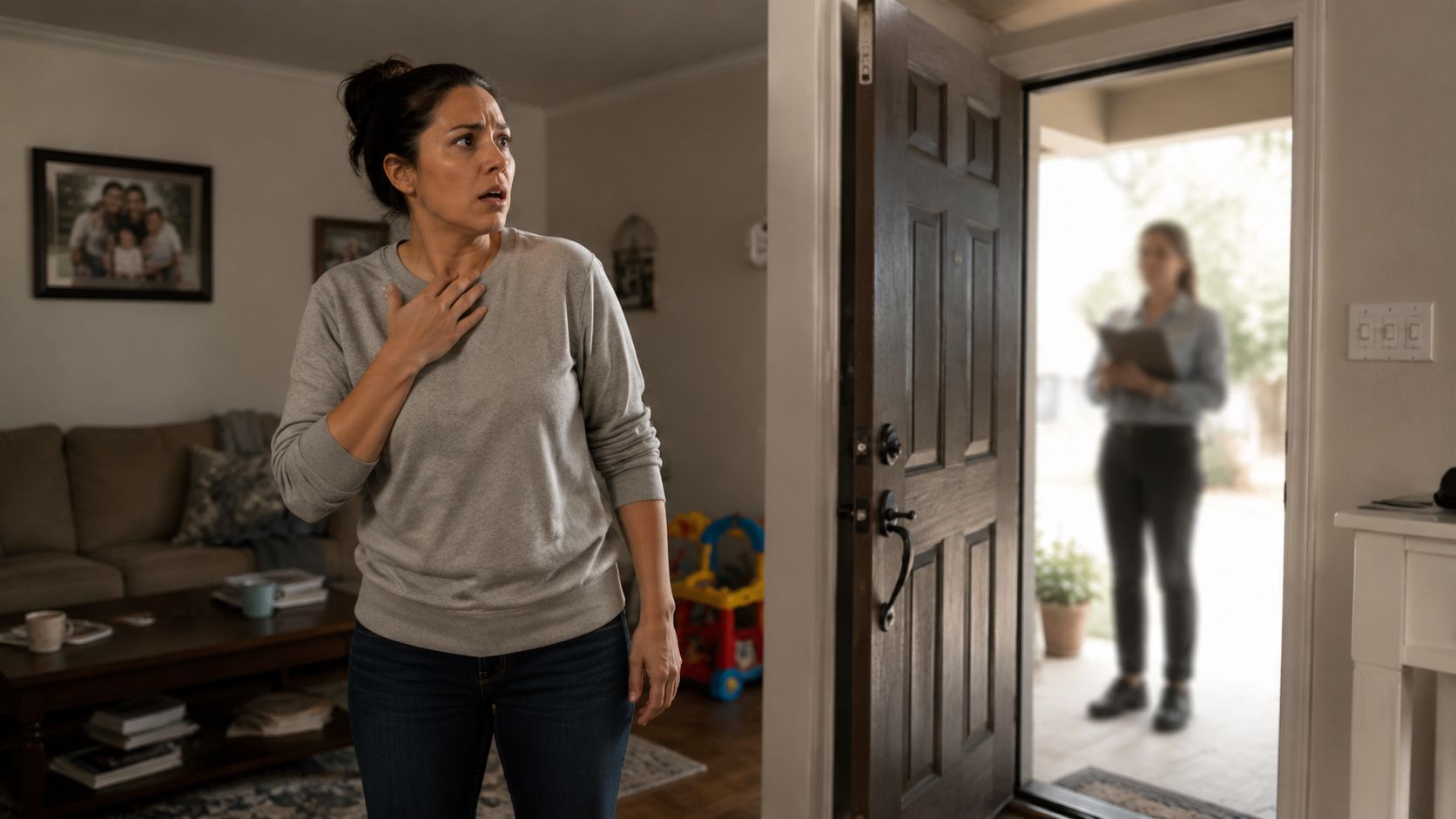
That kind of moment changes how a parent hears every word. A simple request can sound like an order. A casual question can feel like a trap. If you're in that position right now, your fear makes sense. CPS investigations are serious because they can affect where your child lives, what the court believes about your parenting, and whether the state asks a judge to step in.
Why this feels so disorienting
Texas CPS investigations are conducted by the Texas Department of Family and Protective Services, or DFPS, to respond to reports of suspected abuse or neglect and assess whether children are in immediate danger, as explained by this overview of CPS investigations in Texas. That sounds clinical on paper. In real life, it means a stranger may suddenly ask very personal questions about your children, your home, your relationship, your mental health, or a recent police report.
You don't have to choose between panic and surrender. You can pause, stay respectful, and get legal guidance before making major decisions.
What parents often need to hear first
Many parents assume asking for a lawyer will make them look guilty. It won't. In a CPS matter, especially one tied to a criminal case, legal advice is often the difference between a manageable problem and a much bigger one.
A seasoned CPS attorney in San Antonio doesn't just prepare for court. That lawyer helps you understand what CPS can ask for, what you may decline, and what needs a careful response instead of a rushed one. That early guidance can bring order to a moment that feels chaotic.
The First 48 Hours What Happens When CPS Investigates
At 7:30 p.m., a CPS investigator calls about an incident that already has police involved. Maybe it was a DWI arrest, a family violence call, or a loud argument that brought officers to your home. The investigator sounds calm and says they just want to “get your side” and “work with you.” For a parent in San Antonio, that can feel like a lifeline.
It can also be a trap if you speak before you understand which case is really being built.
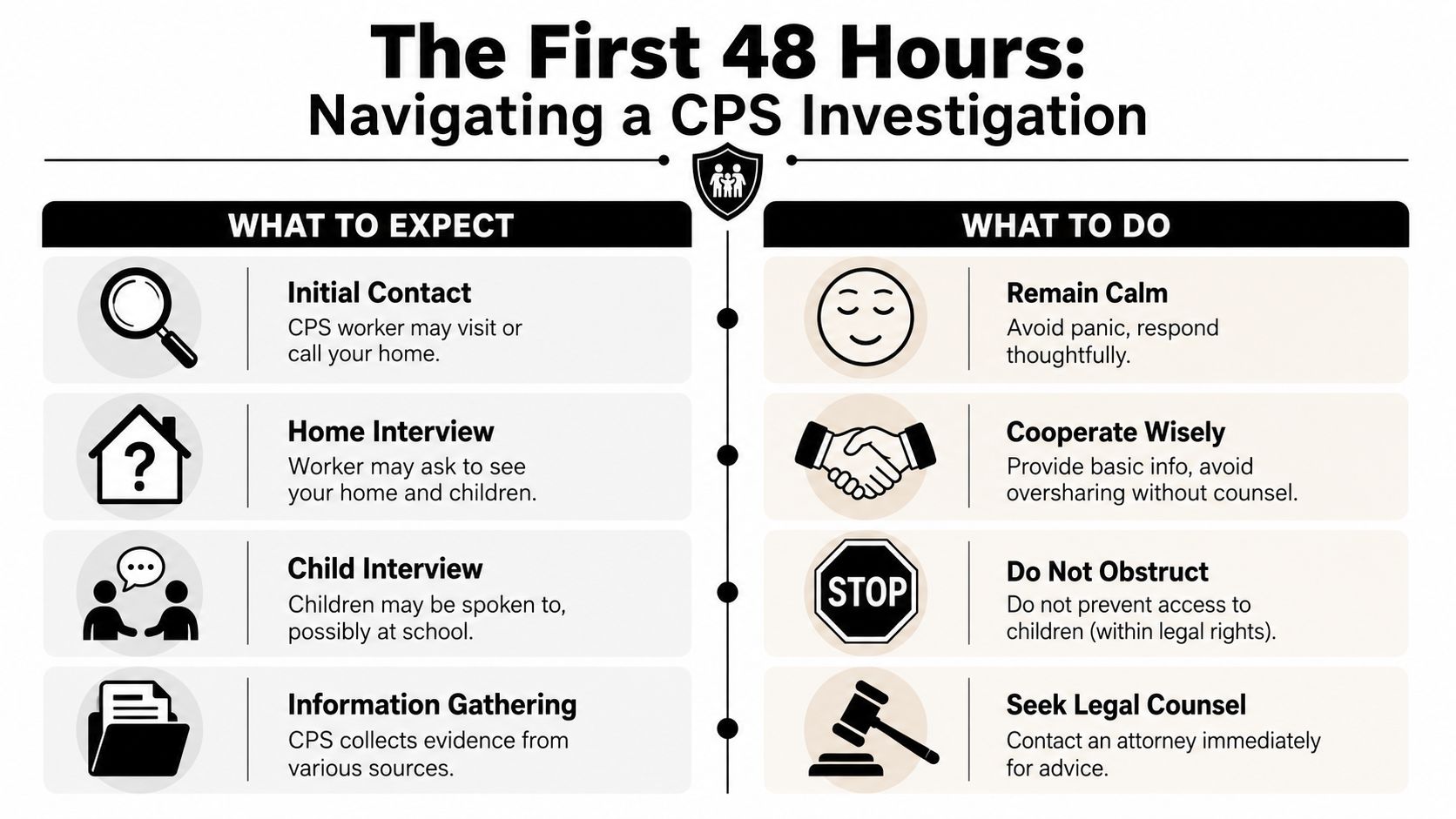
In the first 48 hours, CPS is often doing two things at once. The agency is checking whether your child is safe, and it may also be collecting statements that fit neatly into a criminal case. Parents often do not realize those tracks can run side by side. What sounds like cooperation in a CPS interview can look like an admission in court later.
What CPS may do right away
A caseworker may call, come to your home, ask to see your children, or contact other people around your family. That can include teachers, relatives, neighbors, doctors, therapists, or daycare staff. The pace feels fast because it is fast.
CPS often works like someone taking snapshots before the scene changes. They want to see the home as it is. They want to hear each person before stories harden. They want records before they disappear into a phone upgrade, a deleted text thread, or a missed appointment.
Texas law gives you an important boundary. CPS cannot enter your home without your consent, a court order, or law enforcement acting with legal authority to enter, as explained in this discussion of CPS entry into a parent's home.
That does not mean refusing everything is wise. It means you should know the difference between a request and a legal requirement.
Why "voluntary" can be dangerous
Parents hear “voluntary safety plan,” “voluntary interview,” or “voluntary drug test” and assume saying yes will make them look cooperative and calm things down. Sometimes it does. Sometimes it gives CPS a written record the agency can use to argue you admitted poor judgment, unsafe supervision, substance abuse, or domestic instability.
The danger gets sharper when a criminal allegation is already in the background.
A parent arrested for DWI may tell CPS, “I only had a couple drinks, and my child was asleep in the back seat.” A parent after a domestic dispute may say, “We were both yelling, but nobody was really hurt.” Those words may feel explanatory. To CPS, they may sound like admissions about alcohol use around a child, impaired caregiving, or violence in the home. To a prosecutor, they may sound useful too.
That is why early legal advice matters so much in San Antonio cases involving both CPS and police. One conversation can affect two different systems.
Practical rule: Give basic identifying information, stay respectful, and do not give a detailed statement about the incident until you have spoken with counsel.
Parents who want a clearer picture of the early timeline can review what to expect during a Texas CPS investigation.
What to do in the first night
- Write down every contact: Save the investigator's name, phone number, office, and the time and content of each call, text, or visit.
- Build a simple timeline: Note when the police arrived, who was present, where your children were, and what happened before and after the incident.
- Preserve records: Keep medical paperwork, school records, discharge papers, photos, text messages, and voicemails.
- Do not sign in a rush: If CPS asks you to sign a release, safety plan, or statement, ask for time to review it with an attorney.
- Stay off social media: A post meant to defend yourself can become evidence.
- Treat criminal facts carefully: If the investigation started after an arrest, alleged assault, drug accusation, or family violence report, answer routine identification questions and get legal advice before explaining the event.
The first 48 hours often feel like a blur. Try to treat them like the opening moves in a chess game, not a chance to talk your way out of danger. A calm, careful response protects you better than a long, emotional explanation.
Understanding the CPS Legal Process in Bexar County
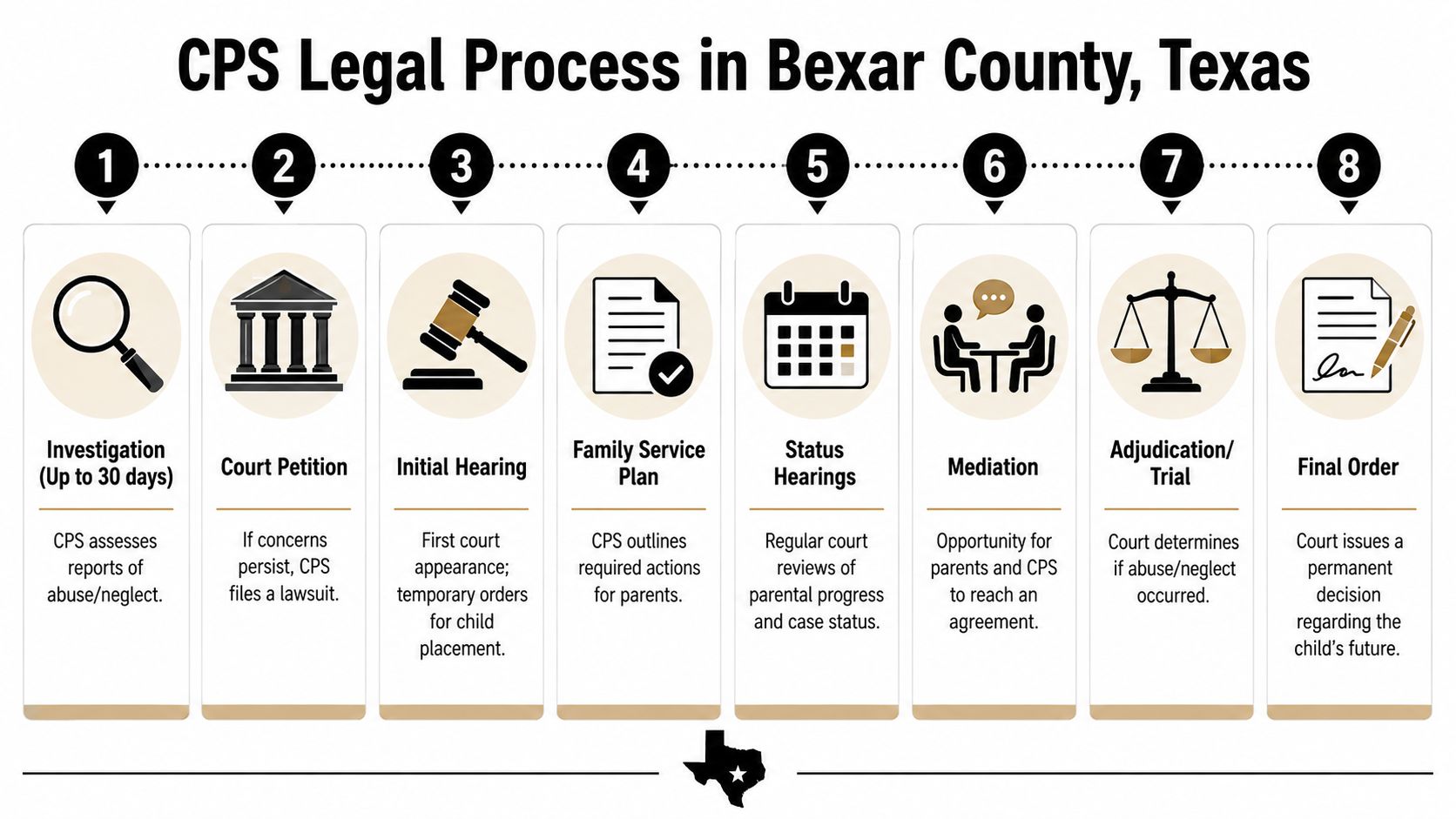
CPS cases feel unpredictable when you're inside them, but the process does follow a legal path. Texas Family Code Chapters 262, 263, and 161 shape much of that path. In plain language, Chapter 262 deals with emergency protection and removal, Chapter 263 addresses review hearings and case progress, and Chapter 161 covers termination of parental rights.
The timeline starts early. In Texas, CPS investigations must begin within 24 hours of receiving a report of abuse, neglect, or exploitation, and the agency must complete a full investigation within 45 days unless exceptional circumstances justify an extension, according to Texas Law Help's CPS overview.
The road from report to court
A lot can happen inside that investigation window. Sometimes CPS closes the case after gathering information. Other times, the agency asks for ongoing services, seeks court orders, or removes a child and starts a formal case.
This short video gives helpful context on how these cases move through court:
Here's a simple way to think about the process in Bexar County:
| Stage | What it usually means for a parent |
|---|---|
| Investigation | CPS gathers statements, records, and observations |
| Safety concerns raised | CPS may suggest a safety plan or services |
| Court filing | The state asks a judge for authority to act |
| Temporary orders | The judge sets rules about placement, contact, and services |
| Review period | The court checks progress under Chapter 263 |
| Final outcome | The case may end with reunification, conservatorship changes, or litigation under Chapter 161 |
Where parents get confused
Parents often think the case is only about whether something happened on one day. That's part of it, but the court also looks at stability, follow-through, housing, sobriety, supervision, and whether the parent takes concerns seriously.
A "service plan" can become central quickly. It may include counseling, classes, substance treatment, evaluations, or other tasks. Some requirements are sensible. Some may be broader than necessary. A CPS attorney in San Antonio can review what's being demanded and push back when CPS asks for more than the facts justify.
The process is legal, but it's also practical. Judges often watch whether a parent is organized, responsive, and willing to address concerns without making avoidable admissions.
Why the timeline matters
That 45-day benchmark is not just a date on a calendar. It creates pressure on CPS to gather facts lawfully and move the case properly. When the agency cuts corners, acts too fast, or builds recommendations on weak investigation work, a lawyer can challenge that.
Parents don't need to memorize the Family Code. They do need to understand this much. Early decisions shape everything that follows.
The Critical 14-Day Hearing and Your Legal Rights
If CPS removes your child or asks the court to approve removal, one deadline rises above almost everything else. The first hearing must occur within 14 days, and if you don't have a lawyer by that hearing, you must immediately ask the court to appoint one, as explained in Texas Law Help's guidance on your right to a lawyer in CPS cases.
That hearing carries real weight. The judge reviews whether CPS had a sufficient basis to act and whether the child should remain out of the home while the case continues. If you arrive unprepared, angry, or ready to "just explain everything," you can lose ground that is hard to recover.
What the judge is looking at
The court isn't only listening for your side of the story in a broad emotional sense. The judge is evaluating immediate safety, legal procedure, and what temporary orders should govern the case going forward.
A parent who has records, witnesses, a plan for the child, and counsel who knows how to challenge weak evidence walks into that hearing very differently from a parent who is reacting in real time.
What to bring into that hearing mindset
- Documents that support stability: housing records, school information, medical records, treatment records, or clean drug test results if relevant.
- A witness list: people with firsthand knowledge who can speak to your parenting and the child's safety.
- A careful approach to testimony: some facts may overlap with a pending criminal matter, so strategy matters.
- A direct request for counsel if needed: if you qualify and don't yet have a lawyer, ask the court immediately.
Parents who want a clearer picture of this stage can review what an adversary hearing means in a Texas CPS case.
The 14-day hearing is often the first moment when a parent can push back in a structured way. Waiting until after that hearing can cost you options.
When Criminal Charges and CPS Collide in San Antonio
You get a late-night call from the jail after a DWI arrest or an assault charge. By morning, CPS wants to talk about your children. For many San Antonio parents, that is the moment the fear doubles, because one event can trigger two separate cases that move on different timelines and follow different rules.
That overlap confuses people. It also creates risk.
A criminal case asks whether the state can prove a crime. A CPS case asks whether your child is safe now and whether the court should restrict your rights while the case is pending. Those questions sound related because they are. What you say in one setting can travel into the other.
One incident, two legal systems
Start with a common example. A parent is stopped for DWI with a child in the car. The criminal court may focus on intoxication, blood test results, and the traffic stop. CPS may look at neglectful supervision, alcohol use, who cares for the child, and whether the home is stable.
The same thing happens after a family violence arrest. Even if the criminal charge is later reduced, dismissed, or still being investigated, CPS may treat the incident as evidence of danger in the home. A parent who says, "We were both yelling, but nobody got hurt," may believe that sounds calming. A prosecutor may hear an admission of a violent argument. CPS may hear exposure to domestic conflict.
That is why parents get into trouble by trying to be "fully cooperative" without a plan.
"Voluntary" does not always mean safe
CPS often asks for interviews, written statements, drug tests, home visits, and safety plans. Some of those requests may feel informal. They are not casual.
A good way to understand it is this: the criminal case is one chessboard, and the CPS case is another. The same move can affect both boards at once. A statement meant to show honesty can become an admission. A rushed agreement can later be described as proof that CPS had serious concerns from the start.
Parents are often told that cooperating will make things easier. Sometimes respectful cooperation helps. Unplanned cooperation can also hand the state evidence it did not yet have.
Where parents make avoidable mistakes
These cases become more dangerous when the criminal lawyer and the CPS lawyer are not coordinating. One attorney may be trying to limit statements and protect the defense in the criminal case. Meanwhile, a parent may be speaking freely to CPS, signing releases, or agreeing to services that shape the family court record for months.
Common pressure points include:
- Police reports that reach CPS quickly: allegations in an arrest report may be treated as true before anyone tests them
- Plea decisions: a plea that seems practical in criminal court may later be used to argue poor judgment, instability, or danger to the child
- Protective orders or bond conditions: these can affect possession of the child, contact with the other parent, and access to the home
- Drug or alcohol allegations: what helps one side evaluate treatment can also create evidence for the other side
Careful timing matters. Sometimes the best answer is not silence forever. It is measured, strategic communication through counsel, with a clear understanding of what each system is trying to prove.
Serious injury or death cases carry another layer
The stakes rise even higher when a child has a suspicious injury or dies unexpectedly. Police may open a criminal investigation. CPS may investigate the safety of surviving children in the home. Medical findings can become the center of both cases.
In those situations, some families seek independent forensic review to understand whether the state's medical theory is complete or accurate. Resources such as Bexar County private autopsy services may help answer medical questions when the facts are disputed and the consequences are life-changing.
If criminal charges and CPS are both in play, every conversation, document, and agreement should be treated as part of one connected strategy.
How a San Antonio CPS Attorney Defends Your Family
At this stage, many parents feel trapped. CPS wants interviews, records, classes, home visits, and signatures. If a DWI, assault allegation, or other criminal charge is also hanging over the family, one careless statement can travel from one case file into the other.
A CPS attorney in San Antonio protects you by slowing the process down enough for clear decisions. The lawyer reviews what CPS is asking for, what you are legally required to do, and what could expose you in a related criminal case. That kind of guidance matters because "cooperating" can sound harmless even as it creates evidence.

What defense looks like in real life
A strong defense often starts with rebuilding the story from the ground up. CPS may be working from a hotline report, a brief interview, and records taken out of context. Your lawyer gathers the missing pieces. That can include school records that show routine attendance, medical records that explain an injury, text messages that correct a false timeline, or relatives who can speak to your parenting day after day.
The attorney also acts like a filter. Without one, parents often answer every question put in front of them because they are afraid that saying less will look guilty. In reality, some questions are broad, confusing, or aimed at getting admissions that hurt both the CPS case and any criminal case. A lawyer helps you answer carefully, produce the right documents, and avoid handing over information the state did not have a right to demand.
Where a lawyer protects your family most
- During interviews with CPS: your attorney prepares you for the topics that matter, the questions that are dangerous, and the difference between required cooperation and unnecessary self-incrimination.
- When CPS proposes a service plan: your lawyer checks whether the services match the allegations. Parents are often given a list that reads like a standard template, not a plan fitting the actual facts.
- In court: counsel objects to weak evidence, challenges unsupported safety claims, and gives the judge a fuller picture of your home, your history, and your progress.
- In dual-track cases: your attorney coordinates strategy so a statement, evaluation, or plea decision in one matter does not create avoidable damage in the other.
Service plans deserve special attention. They may look like paperwork, but they often function like a roadmap CPS later uses to judge your fitness as a parent. If a requirement is vague, unrealistic, unrelated to the accusation, or inconsistent with your criminal defense strategy, it should be questioned early, not after months have passed.
Some parents also need a lawyer who understands both systems under one roof. The Law Office of Bryan Fagan PLLC handles criminal matters and cases that intersect with family law and CPS. That overlap can help when the same allegation is shaping decisions in criminal court and child protection court at the same time.
If you are comparing counsel, this guide on how to choose the right CPS defense attorney in Texas explains what to ask before hiring anyone.
Important distinction: A lawyer cannot change the underlying facts. A lawyer can stop confusion, exaggeration, and rushed decisions from becoming the official version of your family's story.
Choosing the Right CPS Lawyer in Bexar County
Not every family law attorney handles CPS cases regularly, and not every criminal defense lawyer understands how CPS uses criminal allegations inside child welfare proceedings. In Bexar County, local court experience and cross-system awareness matter.
Questions worth asking in a consultation
Start with direct questions. Ask whether the lawyer has handled CPS matters in Bexar County, whether the office deals with cases that overlap with assault or DWI allegations, and who will appear in court with you.
Then listen for clarity. A good answer should be understandable. If the attorney buries you in jargon or gives broad reassurances without talking about deadlines, hearings, evidence, and service plans, keep looking.
Here's a short checklist:
- Local court familiarity: Does the lawyer know how CPS cases move through Bexar County courts?
- Dual-case judgment: Can the lawyer explain how a criminal case may affect your CPS strategy?
- Communication style: Will the lawyer tell you what to say, what not to sign, and what to gather now?
- Approach to urgency: Does the lawyer talk concretely about early hearings, records, and witness preparation?
Parents comparing options may find this guide useful: how to choose the right CPS defense attorney in Texas.
The right fit should leave you better informed, not more intimidated.
Your Questions Answered and Your Next Step
Parents usually still have a few urgent questions after they've learned the basics. Here are some of the most common.
Can I refuse to talk to CPS without a lawyer
You can be respectful and still insist on legal guidance before answering detailed questions. That is especially important if there is any related criminal allegation, police report, or pending charge.
Is a safety plan really voluntary
Sometimes a "voluntary" safety plan doesn't feel voluntary at all. Before signing anything that changes where your child stays, who can supervise contact, or what conditions you must meet, read it carefully and get legal advice if possible.
What if the report against me is false
A false or exaggerated report doesn't automatically disappear because it's untrue. CPS may still investigate, interview witnesses, and review records. That's why calm documentation matters. Save messages, identify witnesses, and avoid emotional reactions that create new concerns.
What should I do first if my child was removed
Focus on the next legally important step, not on arguing with the investigator by phone. Gather records, write down what happened, identify supportive witnesses, and prepare for court quickly. If you don't have counsel, ask for one at the first hearing if you qualify.
If you're reading this while your phone keeps buzzing, your family is under stress, and you're afraid one mistake could change everything, you're not overreacting. CPS cases are serious. Cases that involve both CPS and criminal charges are even more dangerous because each system can strengthen the other.
If your family is dealing with CPS in San Antonio, especially after a DWI, assault allegation, or other arrest, contact Law Office of Bryan Fagan PLLC for a free consultation. A confidential conversation can help you understand your rights, your deadlines, and the safest next step for protecting your relationship with your child.