Skip to content
When a CPS court notice lands in your hands, most parents feel the same jolt. Your mind races to the biggest fear first. Are my children coming home? Am I about to lose them? Is the next court date the day everything is decided?
That fear is real. So is the confusion. Texas CPS cases move through a system that feels cold and technical when you're living through one of the hardest seasons of your life. But the process is not random. Courts follow a set path, and once we translate that path into plain language, the timeline starts to make more sense.
A CPS case usually doesn't go to trial the way people imagine a criminal trial suddenly appearing on the calendar. In Texas, trial is usually the result of a case moving through a structured series of hearings until the judge has to make a final decision because the family and CPS haven't reached a workable resolution. That means the most important question often isn't just, "When does a CPS case go to trial in Texas?" It's also, "What is happening in the months before trial, and what can I do now to protect my family?"
The Moment a Court Notice Arrives
For many parents, the shift from investigation to court is the moment everything becomes real. Maybe a caseworker had already visited your home. Maybe you had signed paperwork you barely understood. Then a formal notice arrives, and suddenly the language changes. You're no longer just dealing with CPS. You're dealing with a judge, deadlines, hearings, and orders that can affect where your child lives.
A common scenario looks like this. A mother opens a packet from the court after her child has been placed outside the home. She sees words like "temporary orders," "conservatorship," and "hearing date." She assumes the next court appearance must be the final showdown. Many parents think that. In most cases, it isn't.
What matters right away is understanding that the court process has stages. Early hearings deal with immediate safety and temporary decisions. Later hearings track progress. A final trial happens only if the case still isn't resolved when the court reaches the point where it must enter final orders.
The court notice is frightening, but it also gives you something valuable. A legal timeline has started, and that means the case now has rules, deadlines, and opportunities for you to be heard.
That change in perspective matters. A CPS case can feel like something being done to you. In reality, each hearing creates a chance to show the court who you are, what you've done, and what your child needs. If you're organized early, you put yourself in a stronger position later.
What to do first
When that notice arrives, focus on a few practical steps:
- Read every page carefully. Look for hearing dates, court location, and any language about temporary orders or service requirements.
- Save every document in one place. Keep court notices, service plans, drug test results, certificates, and texts or emails with the caseworker.
- Write down your timeline. Note when CPS first contacted you, when your child was removed if that happened, and every hearing date since then.
- Talk with a lawyer quickly. The earlier you get advice, the more useful that advice usually is.
Parents often feel pressured to think only about the next court date. We encourage clients to think one step bigger. The next date matters, but so does the pattern the judge sees over time. Courts watch consistency.
Your First Court Dates Are Not the Final Trial
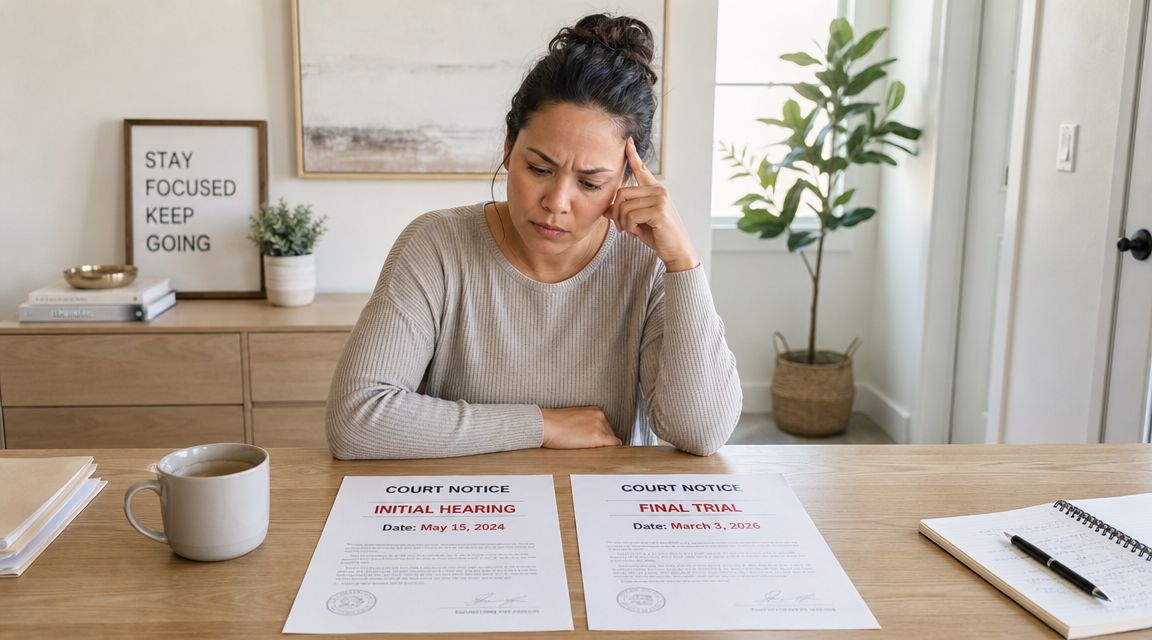
One of the biggest misunderstandings in CPS cases is thinking every hearing could permanently end the case. That's usually not how it works. Early court dates are urgent, but they serve a different purpose from a final contested trial.
A helpful comparison is this. The first hearings are like an emergency room visit. Doctors are trying to stabilize the situation, make immediate decisions, and prevent harm. A final trial is more like a scheduled major procedure. It happens later, after the court has reviewed the case over time and needs to make a lasting decision.
The emergency hearing
If a child is removed from your home without a court order, Texas law requires an emergency Show Cause hearing on the first working day after removal, and no later than 3 days after removal, according to DFPS guidance on investigations and emergency hearings. That hearing is not about deciding every long-term issue in your case. Its purpose is much narrower. The judge is deciding whether there was an urgent reason for the removal.
That early hearing sets the tone for the rest of the case. The court begins asking basic questions: Was the child in immediate danger? Where will the child stay for now? What needs to happen next?
Why these hearings matter so much
Even though these aren't the final trial, they still matter a great deal. Judges start forming impressions early. They notice whether a parent appears in court, listens carefully, follows instructions, and starts addressing concerns.
Here are the practical differences between early hearings and trial:
- Temporary focus early on. The court is dealing with immediate placement, safety concerns, and initial orders.
- Long-term decisions later. A final trial decides the child's permanent legal future if the parties can't agree.
- Services come in between. Parents are often asked to complete services, maintain contact, test when ordered, and show stability before the final stage.
If you're trying to understand what happens at that first appearance, our guide on your first CPS court hearing in Texas can help you prepare.
Parents also benefit from learning about their own role in the process. Early hearings are where your rights and responsibilities start to take practical shape. The court isn't just looking backward at the allegation. It's looking forward at whether progress is possible.
A short explanation from a lawyer can make these early court dates far less mysterious.
The trap parents should avoid
The biggest mistake we see is treating early hearings like routine check-ins. They aren't. They are the beginning of the record the judge will rely on later.
Practical rule: Show up early, dress respectfully, bring your paperwork, and take every temporary order seriously. Temporary decisions often shape the road to reunification.
If the court orders services, visitation rules, classes, counseling, or testing, don't assume you can sort it out later. A parent who starts strong usually has more options than a parent who waits until trial is close.
The Official Texas CPS Court Timeline
Texas CPS cases move under court-controlled deadlines. That matters because families often fear the case will drag on forever. In reality, Texas law pushes these cases toward a decision.
Under the Texas Family Code, a court must render a final order or dismiss a CPS case within 12 months of the child's removal, and the court may extend the case by up to 180 days in extraordinary circumstances, according to Texas Law Help's CPS timeline. That Day 360 deadline is the main reason unresolved cases head toward a trial setting around the one-year mark.
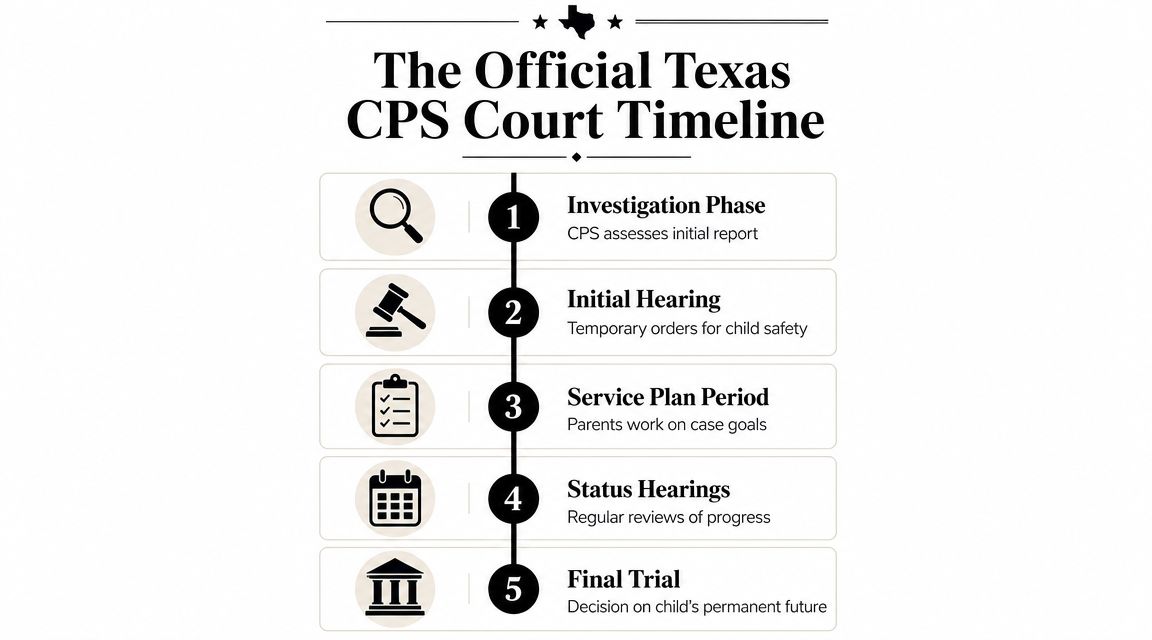
The timeline in plain English
After removal, the case doesn't jump straight from emergency hearing to trial. The court checks progress along the way.
A useful summary looks like this:
| Stage | What it usually means for a parent |
|---|---|
| Investigation | CPS is deciding whether there is enough concern to take legal action |
| Early court hearings | The judge addresses immediate safety and temporary placement |
| Status hearing | The court reviews the service plan and whether the parent understands what is required |
| Permanency hearings | The court checks progress, placement, and whether reunification still looks possible |
| Final setting | If the case isn't resolved, the court must move toward final orders |
Texas sources also explain that the first status hearing must occur within 60 days after the state gets temporary managing conservatorship, and permanency hearings follow every 120 days, as summarized in this discussion of the status hearing timeline in Texas CPS cases.
Why the court uses deadlines
The deadlines exist because children need stability and parents need a clear path. Courts don't want families stuck in limbo with no end point. That doesn't make the process easy, but it does make it more predictable.
Many parents seek clarification on the timing of a CPS case going to trial in Texas. Usually, trial becomes a realistic possibility when the case approaches the Day 360 deadline and the major issues still aren't resolved.
The dates that often matter most
These are the milestones many parents hear lawyers mention:
- Day 360. The court must enter final orders, dismiss the case, or extend it in extraordinary circumstances under the Texas Law Help CPS timeline.
- Day 540. If the case was extended, another major deadline arrives at about 18 months, when dismissal is generally required unless a final order has already been entered or the child is being monitored in a relative or parent placement.
- Day 720. An outer limit appears at about 24 months, by which the case must be dismissed or the court must enter a final conservatorship order.
Those dates can sound mechanical. For a parent, they usually feel very personal. By the middle months of a case, you may be juggling work, visitation, classes, counseling, and pressure from every direction. The legal calendar keeps moving anyway. That is why strategy matters long before a final hearing is set.
A trial usually isn't a surprise event. It's the point the court reaches when time has run forward and the adults in the case still disagree about safety, reunification, or conservatorship.
What Triggers a Contested Final Trial
A contested final trial usually happens because the core dispute in the case did not get solved during the review process. The court has heard updates, watched compliance, and given the family time. If the disagreement remains, the judge has to decide it.
The practical trigger is often an unresolved safety concern at the permanency stage. DFPS guidance explains that if an investigator concludes a child is unsafe, DFPS may file a court action, and if those safety concerns persist despite services, the case moves from supervised reunification efforts into a trial on final orders or termination, as described in the DFPS CPS handbook guidance.
What disagreement usually sends a case to trial
Sometimes the conflict is direct. A parent says, "I've done what you asked, and my child should come home." CPS says the risk remains too high. At that point, someone has to decide which view is supported by the evidence.
In other cases, the disagreement is about the long-term plan. CPS may ask for termination of parental rights. A parent may refuse to agree. Or everyone may agree the child can't immediately return home, but disagree sharply about whether a relative, another conservatorship arrangement, or more time is appropriate.
A common real-world example looks like this. A father completes classes, attends visits, and improves housing. But CPS still believes his judgment around unsafe relationships or substance use hasn't changed enough. He believes the agency is ignoring his progress. Trial becomes the place where both sides present witnesses, documents, and testimony so the judge can decide.
Trial is what happens when negotiation ends
Many CPS cases resolve before a contested final hearing. Some end in reunification. Others end in agreed orders. But when agreement fails, trial is the legal system's method for reaching a binding result.
You can think of the lead-up this way:
- Services were offered, but concerns remain
- Progress was made, but not accepted by everyone
- A permanent decision is due, and the parties can't agree
If you're trying to understand whether your final hearing would be decided by a judge or a jury, this overview of jury trial versus bench trial in Texas cases can help clarify the difference.
Sometimes trial doesn't mean a parent ignored the case. It means the parent and CPS reached different conclusions about what the evidence proves.
That distinction matters. Parents often carry shame into court, even when they have been working hard. A contested trial is not proof that you failed. It often means the dispute is serious enough that only a judge or jury can resolve it.
Your Rights and What to Expect at a CPS Trial
By the time trial arrives, many parents are emotionally exhausted. They know the courtroom. They know the caseworker. But trial still feels different because it is the day the court moves from review to decision.
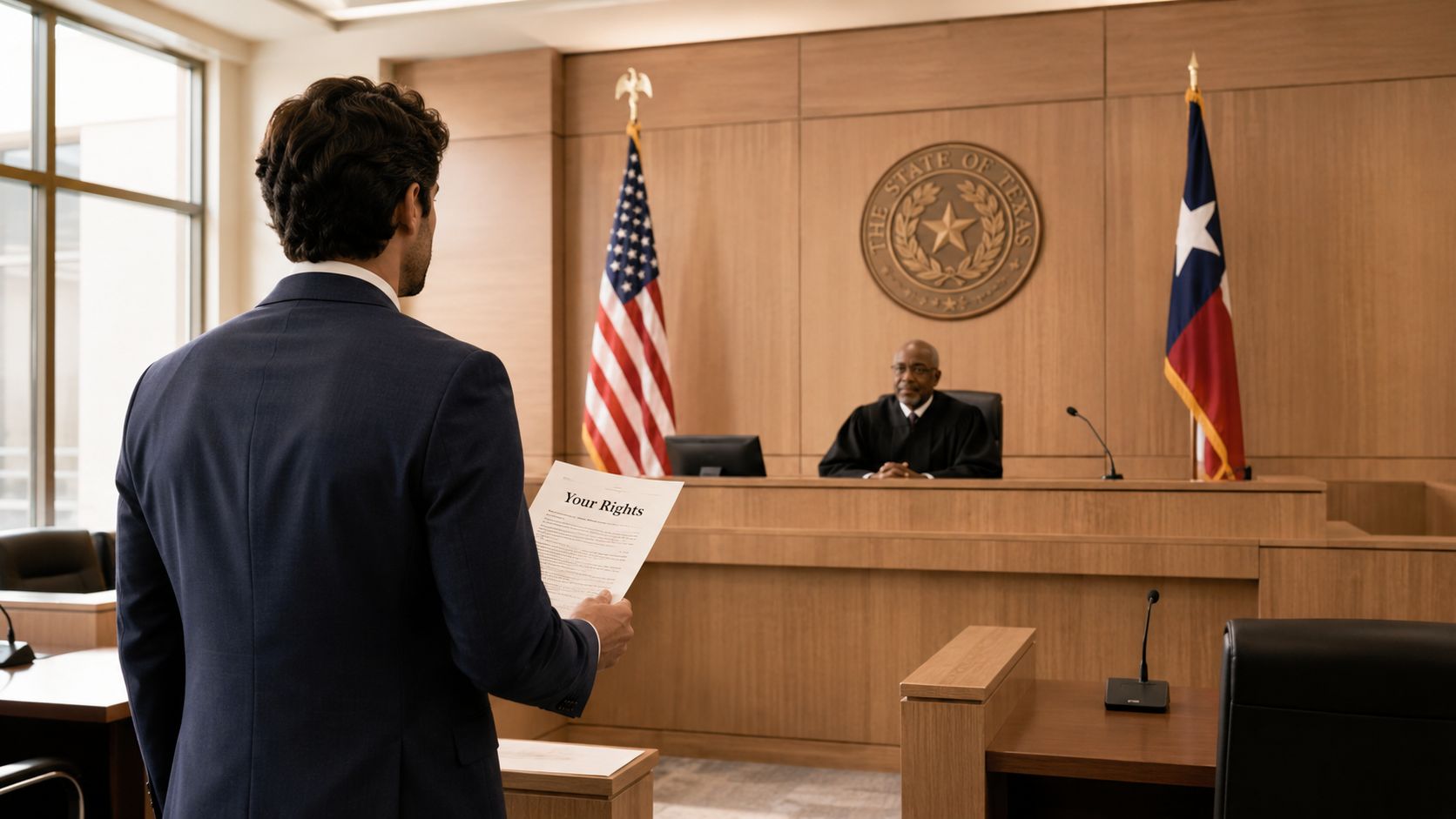
Who is usually in the courtroom
A CPS trial often includes the judge, attorneys, the CPS caseworker, the child's attorney or guardian ad litem, witnesses, and the parents. Sometimes relatives, counselors, service providers, or supervisors may testify.
That doesn't mean everyone will speak for the same amount of time. The court generally hears evidence in an organized way. Witnesses testify. Lawyers ask questions. Documents may be offered into evidence. The judge rules on what is admitted and what legal standard applies to the decision being made.
Rights that matter on trial day
Parents often feel like trial is something they endure. It isn't. You have rights, and those rights are the foundation of a fair hearing.
Those rights commonly include:
- Representation by counsel. You should not face a CPS final trial without legal guidance if you can avoid it.
- Access to the evidence. Your lawyer can review the material CPS plans to rely on.
- The right to testify or remain strategic about testimony. That decision should be made carefully with counsel.
- The right to call witnesses. Friends, family members, counselors, sponsors, or service providers may help tell the fuller story.
- The right to challenge CPS witnesses. Cross-examination matters because it tests assumptions, memory, and conclusions.
For families dealing with broader caregiving questions, especially when another adult may step in to help with decision-making, resources like Family Caregiving Kit's guardianship guide can help explain how courts think about long-term care roles in other contexts.
What the day often feels like
A final trial is usually less dramatic than television and more detailed than most parents expect. The judge may hear about your service plan, visitation history, housing, sobriety, counseling, support system, and your child's current needs. The small details matter because CPS cases are built from patterns.
You may be asked questions about:
| Topic | Why the court cares |
|---|---|
| Housing | Whether the home is stable and safe |
| Services | Whether you completed them and benefited from them |
| Visits | Whether your contact with the child has been consistent and appropriate |
| Support network | Whether safe adults can help you and the child |
| Judgment | Whether the concerns that brought CPS into the case have truly changed |
The courtroom can feel intimidating, but a trial is also your chance to put your evidence, your witnesses, and your progress into the record.
If you're preparing for trial, spend time with your lawyer reviewing the likely testimony, documents, and weak points in the case. Parents who walk into trial knowing the flow of the day usually feel more grounded than parents who show up hoping to "just tell the judge what happened."
Common Defenses and Strategic Considerations
A strong CPS defense is rarely built on one dramatic moment. It is usually built on proof. Proof that you followed orders. Proof that your home is safer. Proof that your child can return to a stable environment. Proof that CPS left out important context.

Build your case like the judge will read every page
That mindset helps parents focus on what persuades a court.
Useful evidence often includes:
- Clean testing records. If testing is part of your case, keep every result and organize them by date.
- Certificates and attendance records. Parenting classes, counseling, treatment, and other services should be documented.
- Visitation logs. Keep notes showing you attended visits, arrived on time, and interacted appropriately.
- Housing proof. Lease documents, utility bills, photographs, and testimony from people who have seen the home can matter.
- Supportive witnesses. A counselor, employer, pastor, sponsor, or family member may provide useful testimony if they have firsthand knowledge.
Don't confuse activity with progress
Parents sometimes complete services but fail to connect those services to the actual safety concerns in the case. Courts usually care less about checking boxes than about whether your behavior, decisions, and stability have changed in a meaningful way.
For example, if the original concern involved unsafe supervision, your defense should show more than class attendance. It should show what child care plan is now in place, who helps you, how emergencies will be handled, and why that plan is reliable.
A practical strategy discussion with your lawyer may include whether to challenge the investigation itself, whether to propose a relative placement, whether to seek a monitored return, or whether to prepare for a contested hearing on termination. The Law Office of Bryan Fagan PLLC offers information on Texas CPS hearings and case timelines that can help parents understand where their case stands.
Smart habits that help
Some of the most effective steps are simple:
- Keep one master folder. Paper or digital, but complete.
- Respond carefully. Be polite with caseworkers and providers, but don't guess or ramble.
- Prepare witnesses early. A good witness needs time to gather records and remember dates.
- Follow court orders exactly. Partial compliance often creates avoidable arguments.
- Tell your lawyer bad facts early. Surprises hurt more at trial than in preparation.
"I did what they asked" is a start. "Here is the record showing what I did, when I did it, and how it made my home safer" is much stronger.
After the Verdict Your Next Steps
When the judge signs a final order, the trial phase ends, but your next move depends on what the court decided. Some families reunify right away. Some move into a monitored return or another conservatorship arrangement. Some cases result in placement with a relative. In the most serious situations, the court may terminate parental rights.
What you should do next depends on the order itself. Read it carefully with your lawyer. Make sure you understand who has rights, who has duties, what visitation looks like, and whether there are any ongoing requirements.
If the result is unfavorable, ask immediately about appeal options. An appeal is not a new trial, and it is not available just because you disagree with the outcome. It is a legal process focused on whether the court made a significant error. But timing matters, so don't wait to get advice.
Parents often feel numb after the final hearing, even when the result is positive. That is normal. CPS cases are emotionally draining. Give yourself room to process what happened, then focus on the practical next step your family needs most.
If you're facing a Texas CPS case and need clear answers about deadlines, hearings, trial strategy, or your rights as a parent, contact Law Office of Bryan Fagan PLLC for a free consultation. We know how frightening this process feels. We also know that informed parents make better decisions. Our team can help you understand where your case stands, what the court is likely to expect next, and how to prepare for the strongest path forward for your family.