Skip to content
You finished the classes. You took the drug tests. You showed up for counseling, cleaned the house, fixed the safety issues, and made every visit count. Now you’re waiting for the part that matters most. A judge to say your Texas CPS case is over.
That waiting period can feel brutal. Many parents assume that once the service plan is complete, dismissal happens automatically and immediately. In real life, there’s usually still paperwork, hearings, recommendations, and court review between “I did everything” and “your case is dismissed.”
A lot of worried parents sit in that gap. They’ve worked hard, but they still feel like one misunderstanding, one delayed report, or one caseworker change could undo months of effort. That fear is understandable.
Dismissal after service plan completion Texas CPS cases is often the outcome parents are working toward. But the end of the case has rules, deadlines, and proof requirements that aren’t always explained clearly. Just as important, even a dismissed CPS case may leave a record behind. For many families, that post-dismissal issue is the part no one warned them about.
You've Completed Your CPS Service Plan What Happens Now
Consider a parent like Elena. She completed parenting classes, followed every counseling recommendation, maintained steady contact with her child, and made the repairs CPS wanted to see in the home. Her caseworker told her she was “doing well,” but nobody gave her a straight answer about when the case would end.
That’s one of the hardest parts of a CPS case. Progress doesn’t always feel final until the court signs off.
When parents complete the service plan and correct the safety concerns that brought CPS into the case, dismissal often becomes the logical next step. Texas courts look at whether the reasons for state oversight have been resolved. If they have, the court can close the case because ongoing intervention is no longer necessary.
Still, parents often get confused about three separate ideas:
- Finishing services means you’ve done the tasks.
- Demonstrating compliance means the court has reliable proof you did them.
- Getting dismissed means the judge formally closes the case.
Those aren’t the same thing.
When CPS has been part of your life for months, even good news can feel uncertain until it’s on paper in a court order.
If you’re in this stage, your work matters. Completing your plan is not just a personal milestone. It’s the foundation for asking the court to end the case. Judges want to see that the child can be safe without continued DFPS supervision, and your completed services help build that picture.
The remaining questions are practical ones. Has your progress been documented? Has your attorney pushed for the right hearing? Is everyone working from the same file? Has the court been given what it needs to dismiss instead of extend the case?
Those are the questions that move a case from “almost done” to “done.”
The Role of the Family Service Plan in a Texas CPS Case
The Family Service Plan is the center of most Texas CPS cases. It’s the written roadmap for what CPS says must happen before the child can safely return home or before the court can close the case.

A lot of parents experience the plan as a punishment. That reaction is understandable, especially when the requirements feel invasive or overwhelming. But legally, the plan is supposed to address the specific safety concerns that led to CPS involvement and create a path toward reunification or closure.
What the service plan is meant to do
A service plan usually tells the court and the parents what changes need to happen. That might include counseling, parenting education, substance abuse treatment, home conditions, stable housing, safe caregivers, or regular visitation. The exact terms depend on the concerns in the case.
Under Chapter 263 practice, the plan becomes a key measuring tool. At later hearings, the judge isn’t guessing whether things are better. The judge is often comparing your progress to what the plan required.
The simplest way to understand is this:
| Part of the plan | Why it matters |
|---|---|
| Services like classes or therapy | Shows willingness to address CPS concerns |
| Home and caregiver changes | Helps prove the child can return safely |
| Visitation and communication | Shows commitment and parenting involvement |
| Documentation of completion | Gives the court something concrete to rely on |
Why this document carries so much weight
In Texas, CPS handles a large number of cases, and families often feel lost in the system. High caseloads and caseworker turnover can complicate how cases are managed. One overview notes that turnover was around 25% annually in 2015, and that severe neglect drove 79% of removals in 2013, which helps explain why service plans become the main tool for correcting risks and building a safer return home through Texas Law Help’s discussion of CPS dismissal and monitored return.
That reality matters for parents. If a caseworker changes, your completed service plan may become the most stable piece of evidence in the file.
Practical rule: Don’t treat the service plan like a checklist only. Treat it like the court’s script for deciding whether your family still needs CPS oversight.
Parents also benefit from reading outside material that helps them understand what healthy parenting evidence looks like in everyday life. A practical resource on how to be a better parent can help some families connect service plan goals with daily routines, communication, and structure in the home.
What parents should do with the plan
Read every line. If something is unclear, ask for clarification early. If a service is unavailable, too far away, or scheduled in a way you can’t realistically complete, raise that issue immediately through your attorney.
Keep a copy of the plan and compare it against your progress every week. If you want a fuller breakdown of how these plans function in real Texas cases, review this guide to the CPS family service plan in Texas.
A completed plan doesn’t guarantee dismissal by itself. But without a clear plan, it’s much harder to prove you solved the problems that brought CPS into your life.
The Legal Path to Dismissal Key Timelines and Court Dates
Texas CPS cases don’t stay open forever. The law builds in a finish line, and that deadline is one of the most important protections parents have.
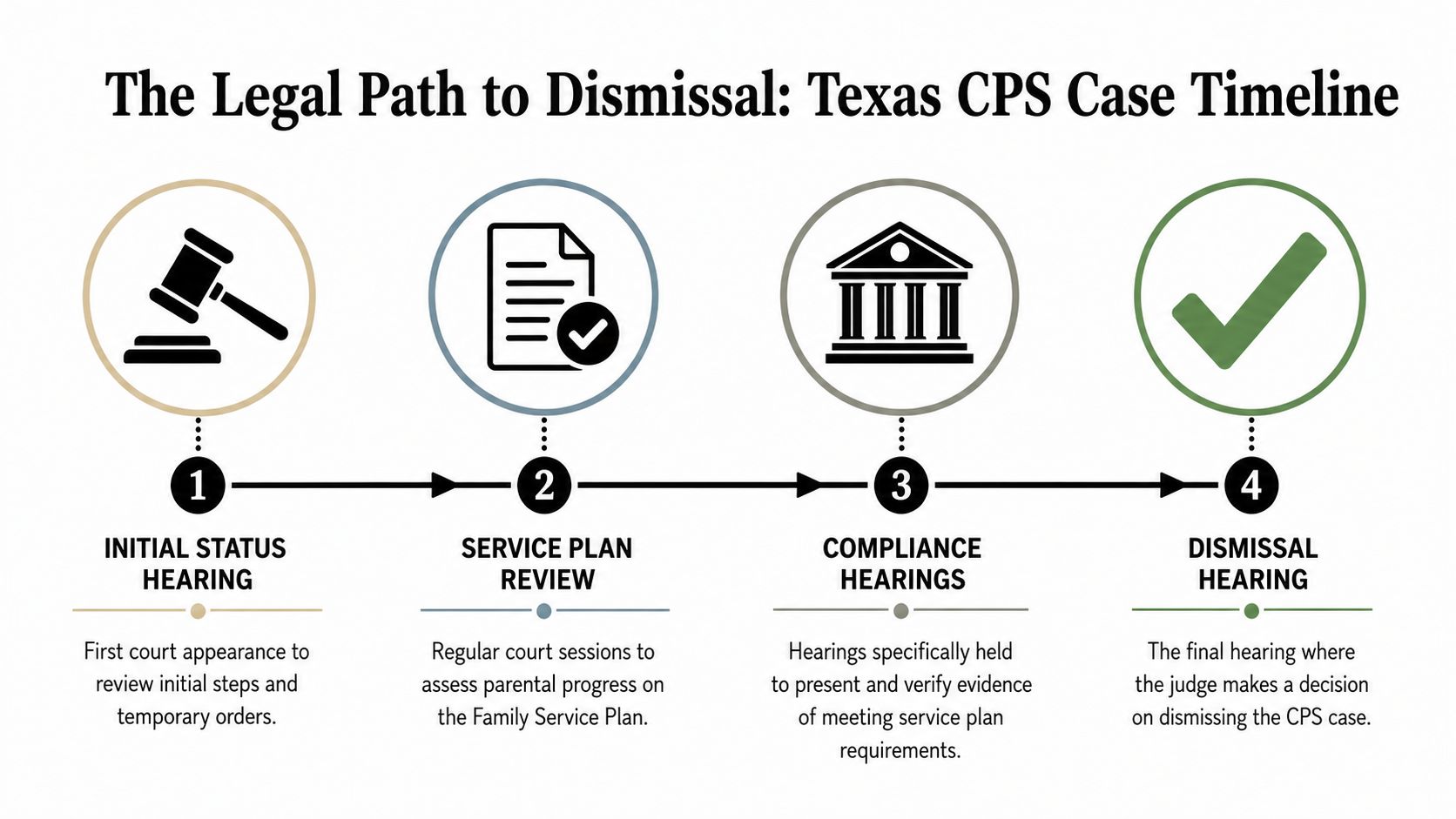
If you’re trying to understand dismissal after service plan completion Texas CPS proceedings, you need to know how the hearings build toward the final decision. Even when your child has returned home or your services are complete, the case usually remains open until the court holds the right hearing and enters the right order.
The one year dismissal deadline
Under Texas Family Code Section 263.401(a), a CPS case must be dismissed on the first Monday after the one-year anniversary of DFPS being appointed temporary managing conservator, unless trial has started or the court grants a single 180-day extension for extraordinary circumstances. The court must also provide notice 60 days prior to that dismissal date, as explained in the Texas Children’s Commission bench book on dismissal deadlines.
That deadline matters because it prevents cases from drifting without resolution.
In plain terms, the court usually has three basic options by that point:
- Dismiss the case if the safety concerns have been resolved
- Move forward to final orders on conservatorship or termination if the case is not ready for dismissal
- Grant one 180-day extension if extraordinary circumstances justify more time
How the hearings usually build toward dismissal
Most parents experience the process as a series of checkpoints. Each hearing asks a slightly different question.
Status hearing
This is often one of the earlier hearings after the case begins. The court reviews initial orders, makes sure parties understand the service plan, and sets expectations.
If you’re confused about what CPS wants from you, this is one of the first moments to raise that issue through counsel.
Permanency hearings
These hearings focus on progress. The judge looks at whether services have started, whether visits are happening, whether the child is safe in the current placement, and whether the parents are moving toward reunification.
Incomplete records can hurt a parent, even when the parent is working hard. If providers haven’t sent reports or if CPS hasn’t updated the court, the hearing may not reflect your real progress.
Final hearing
This is the end-game hearing. The court decides whether to dismiss, extend, return the child under monitored conditions, or enter other final orders.
If your service plan is complete and the safety concerns have been addressed, your attorney should now be framing the case for closure.
A simple timeline view
| Court stage | Main focus |
|---|---|
| Early case hearings | Temporary orders and service plan expectations |
| Review hearings | Whether you started and continued services |
| Permanency hearings | Whether return or dismissal is becoming realistic |
| Final hearing | Dismissal, extension, monitored return, or final orders |
A finished service plan is strongest when it reaches the judge before the deadline with organized proof, not last-minute verbal promises.
Why deadlines still cause confusion
Parents often assume the case ends the day they finish their last class or counseling session. It usually doesn’t. A provider may need time to issue discharge paperwork. The caseworker may need to update the court report. The attorney may need to file something or set the matter for hearing.
The dismissal deadline also doesn’t mean a parent should wait passively. If the one-year mark is approaching, your legal team should know exactly where the case stands.
Here are the questions worth asking well before the final date:
- What is the exact dismissal date in my case
- Has the court received proof of my completed services
- Is CPS recommending dismissal, monitored return, or extension
- Are there any missing reports or provider letters
- Has a final hearing been set
A parent who knows the timeline can prepare for it. A parent who doesn’t may get blindsided by delay, confusion, or an extension request that could have been challenged earlier.
The court is looking for more than task completion
The court wants to know whether the original dangers have been removed. That means your timeline and your evidence need to tell a story. Not just “I attended services,” but “I attended services, I applied what I learned, my home is safe, and my child does not need ongoing state supervision.”
That is what turns compliance into dismissal.
How to Prove Compliance and Push for Your Case Dismissal
Doing the work matters. Proving you did the work matters just as much.
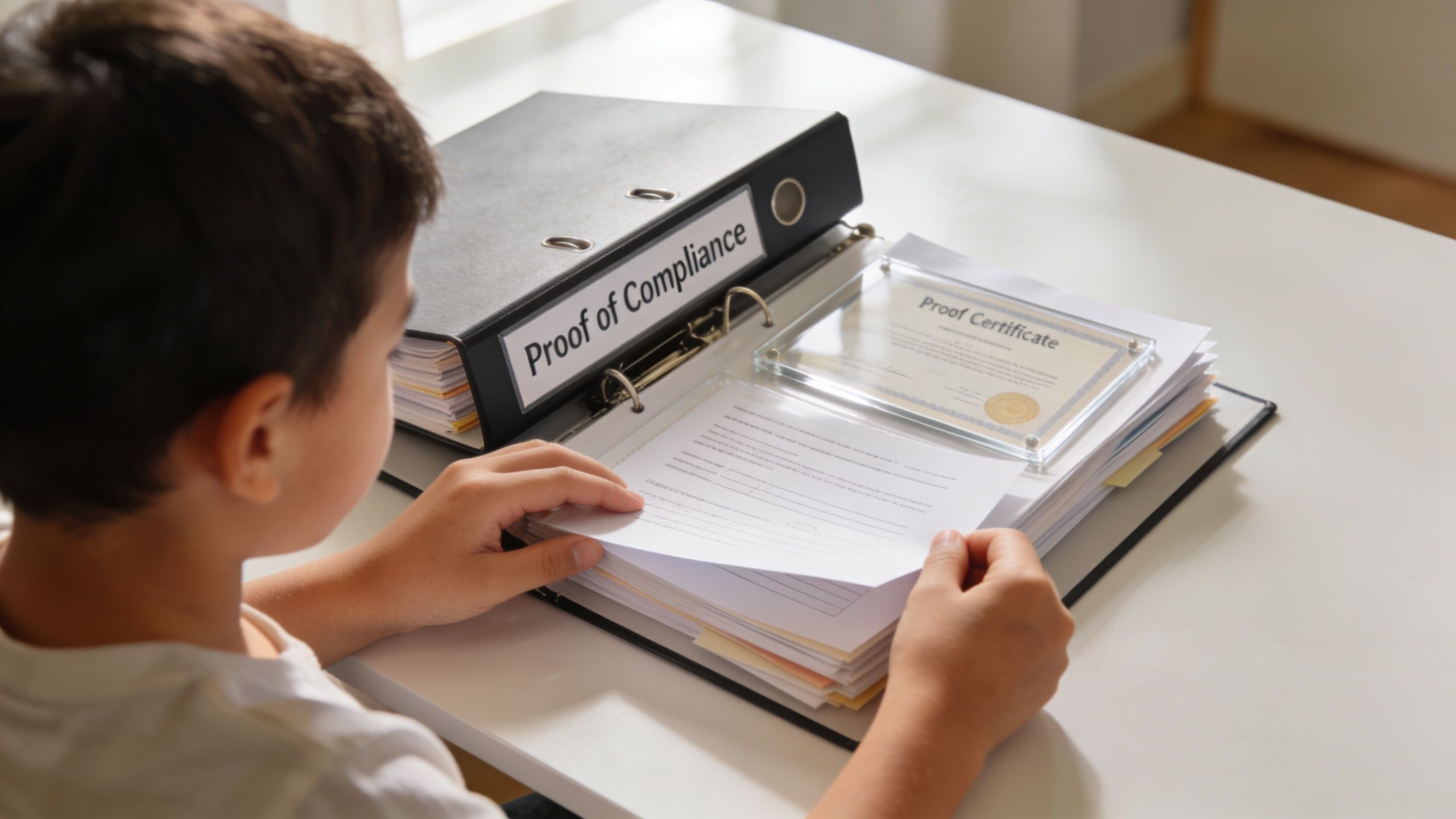
A parent can complete almost every requirement and still face delay if the paperwork is incomplete, the caseworker changes, or the court file doesn’t clearly show progress. That’s why I often tell parents to build a compliance portfolio long before the final hearing.
Maria is a good example. Her first caseworker left midway through the case. Because Maria kept a binder with certificates, attendance logs, drug test results, housing records, and provider contact information, her attorney was able to rebuild the missing parts of the record quickly. Without that binder, her progress could have looked much thinner than it really was.
What to collect and organize
Your compliance file should be simple, clear, and easy to hand to your attorney.
Include items like these:
- Completion certificates for parenting classes, counseling, substance abuse treatment, or anger management
- Attendance records from therapists, social workers, or group programs
- Drug test results if testing was part of your plan
- Housing proof such as a lease, utility bill, or photos showing safe living conditions
- Employment records if stable income was part of the concern
- Provider letters explaining participation, progress, and discharge
- Visitation notes showing regular and positive contact with your child
Don’t assume CPS already has everything. Providers delay. Offices close. Emails get missed. People leave jobs.
Keep your proof in one place
A paper binder works. A digital folder works too. The important part is consistency.
Use sections. Label each document. Put the most recent items on top. If you text or email your caseworker updates, save those messages.
Parents often lose ground not because they failed services, but because nobody put their proof in a form the court could easily trust.
If you believe the case should be ending and want to understand the procedural side, this resource on a motion to dismiss a CPS case in Texas helps explain how dismissal requests can be framed.
How to communicate with your caseworker and lawyer
Polite persistence helps. You don’t need to be confrontational to be effective.
Try these habits:
- Send documents promptly. When you finish a class, send the certificate that day.
- Confirm receipt. Ask whether the caseworker or attorney received it.
- Request specifics. If someone says you still need “more progress,” ask what exactly is missing.
- Follow up in writing. Emails create a clean record.
- Bring copies to court. Never assume the courthouse file is complete.
This short video gives a useful overview of how dismissal issues can arise in CPS cases:
Show change, not just attendance
A certificate says you showed up. The judge also wants signs that life is safer now.
That can include:
| Evidence | What it helps prove |
|---|---|
| Clean, stable home | Safety concerns were corrected |
| Consistent visitation | Parent-child bond remained active |
| Counseling discharge summary | You addressed the underlying issue |
| Support from employer or family | Daily stability has improved |
If your case involved supervision concerns, you may also need to show who helps with childcare, how your routines changed, and what you’ll do if stress rises again. Think in practical terms. The court is asking whether your child can stay safe on ordinary weekdays, not only on your best day in court.
A well-prepared parent doesn’t just hope the judge sees the effort. A well-prepared parent makes the proof impossible to ignore.
When Your CPS Case Stays Open Past the Deadline
Most parents hear about the one-year deadline and assume that if the case isn’t dismissed by then, something has gone terribly wrong. That’s not always true.
Sometimes the case stays open because the court finds extraordinary circumstances. One common example is a parent who has made real progress, completed much of the plan, and is close to reunification, but needs a little more time to finish the last pieces properly. In that situation, the law allows one extension of up to 180 days when the court believes extra time is in the child’s best interest and supports a return home rather than rushing toward a harsher outcome, as discussed in this overview of an extension of a CPS case beyond one year in Texas.
What an extension usually means
An extension is not automatically bad news. In some cases, it means the court sees enough progress to keep reunification alive.
That said, an extension should never be treated casually. The judge should have a concrete reason. The record should show why more time is needed and what is expected during that extra period.
A useful question for parents is this: What specific issue is preventing dismissal today?
If no one can answer that clearly, the extension may need closer scrutiny.
Monitored return can be part of the answer
A monitored return is often confusing to parents because it feels like the child is home, but the case is still open. In that arrangement, the child returns home while DFPS keeps temporary custody for a limited period so the agency can monitor safety while the parent completes remaining requirements.
This can be a strong sign that the case is moving in the right direction. It also means parents need to stay disciplined. Once the child comes home, some parents relax too early, miss appointments, or stop documenting progress. That can create new problems at the very stage when dismissal should be getting closer.
If your child is home under monitored return, act like the case is still under a microscope, because it is.
When the case shifts toward termination risk
Parents also deserve honesty. Not every open case after the deadline is headed toward dismissal. Some move toward termination proceedings under Chapter 161 when CPS believes the parent did not correct the dangers that led to removal.
Usually, that doesn’t happen out of nowhere. There are warning signs:
- Repeated missed services
- Ongoing unsafe housing or unsafe caregivers
- Continued positive drug tests or refusal to test
- Lack of contact with the child
- Failure to show improvement despite repeated court reviews
If your case is at or near the deadline and dismissal is not being discussed, ask direct questions. Is CPS asking for an extension? Is a monitored return on the table? Is the agency seeking final orders that could restrict or end parental rights? Those are very different paths, and you need to know which one your case is on.
Clarity is power in a CPS courtroom.
Life After Dismissal Understanding Your CPS Record
For many parents, dismissal feels like the end of the story. Legally, it may only be the end of the court case.

One of the most overlooked parts of dismissal after service plan completion Texas CPS cases is what happens to the record after the judge closes the case. Many parents assume a dismissal wipes everything away. It usually doesn’t.
A dismissed case does not mean an erased file
Even after a successful dismissal, DFPS may keep records for several years, and sometimes indefinitely, and those records do not automatically disappear. They may have less impact than confirmed abuse findings, but parents often still need to take proactive legal steps, including possible expunction, especially where the CPS matter overlaps with criminal issues like DWIs or protective orders, as explained in this discussion of why CPS cases get dismissed and what happens afterward.
That surprises many families. They hear “dismissed” and understandably think “gone.”
It’s better to think of dismissal this way: the court case is closed, but the paper trail may still exist.
Why the record can matter later
A lingering CPS record may affect future interactions with DFPS if another report is made. It can also create headaches when a family has related legal matters involving criminal allegations, protective orders, or record-clearing efforts.
Here are common areas where parents should ask questions after dismissal:
| Post-dismissal issue | Why it matters |
|---|---|
| Future CPS reports | Prior history may shape how new allegations are reviewed |
| Criminal record strategy | A CPS file can complicate related legal cleanup |
| Employment or licensing concerns | Some parents need to know what information may still exist |
| Family court disputes | Prior CPS involvement may surface later |
The emotional side of post-dismissal recovery
A closed case doesn’t instantly remove the stress the family has been carrying. Parents may still feel watched, ashamed, or afraid that one new accusation could reopen old wounds.
That’s one reason emotional recovery matters alongside legal cleanup. For families coping with the lingering anxiety that often follows a CPS case, outside support like effective mental health support can help parents rebuild stability in daily life while legal questions are being addressed.
Dismissal gives you breathing room. It doesn’t always give you peace of mind until you know what records remain and what can be done about them.
Ask the questions most parents never ask
After dismissal, many parents should be asking:
- What records does DFPS still keep
- Do I qualify to petition for expunction
- Does my CPS history affect any related criminal or protective-order matter
- What should I do if a future report is made
That post-dismissal review can be as important as the dismissal itself. If you stop at “case closed,” you may miss the final step that protects your family’s future.
When to Hire an Attorney for Your CPS Case
Some parents wait to hire counsel because they think asking for a lawyer makes them look guilty. It doesn’t. It shows you understand what’s at stake.
A CPS case involves deadlines, court orders, service plans, evidence, and long-term consequences for your family. Even when you’re doing well, the system can still produce mistakes. Reports may be incomplete. Deadlines may be misunderstood. A provider may not submit the right paperwork. An attorney’s job is to protect your rights while those things are happening.
What a lawyer adds to the process
A parent-focused attorney can do several things that matter at the dismissal stage:
- challenge vague or unreasonable service plan demands
- track statutory deadlines and court settings
- organize proof of compliance into a persuasive record
- respond when CPS asks for an extension
- argue for dismissal instead of continued oversight
- advise on post-dismissal record issues, including possible expunction
Parents also get confused about who represents whom in court. The child may have an attorney ad litem or guardian ad litem. That person is not your lawyer. CPS has its own lawyers too. If you want someone focused on your rights, your compliance record, and your path to dismissal, you need your own legal advocate.
The right time is often earlier than parents think
If the service plan contains unrealistic requirements, if the one-year date is getting close, if your child is on monitored return, or if nobody will clearly explain why the case hasn’t been dismissed, those are strong reasons to talk with counsel.
A lawyer is especially valuable after dismissal if you need guidance on whether the CPS record remains, what can be challenged, and whether additional action is needed to protect your future. That part often gets ignored until a parent applies for a job, faces a related legal issue, or gets reported again.
Legal help isn’t just for trial. In many CPS cases, it matters most in the final stretch and in the cleanup that follows.
Taking the Final Step to Close Your CPS Chapter for Good
Completing your CPS service plan is a major achievement. It means you kept going through one of the most stressful experiences a parent can face. In many Texas cases, that work creates the path to dismissal and reunification.
Still, the final step matters. The court has to see clear proof of compliance, the statutory deadlines have to be respected, and the right orders have to be entered. Even after dismissal, many parents still need answers about what records remain and whether more legal action is needed.
That’s why the ultimate goal isn’t just finishing services. It’s finishing the case well.
If you’re close to the end of your case, don’t assume everyone else is keeping track of what you’ve accomplished. Keep your records organized. Ask direct questions about the dismissal date. Make sure the court has what it needs to close the case. And if the case has already been dismissed, find out whether your CPS record still needs attention.
Families can move forward after CPS involvement. They just need clear information, careful timing, and the right legal steps at the right moment.
If you need guidance on dismissal after service plan completion texas cps issues, record concerns after dismissal, or the next move in your case, contact Law Office of Bryan Fagan PLLC for a free, confidential consultation. An experienced Texas attorney can help you understand where your case stands, what deadlines apply, and what it will take to close this chapter as completely as possible.