Skip to content
A knock at the door. A packet of papers. A caseworker's name on one page and a court caption on the next.
For many parents, that's the moment fear turns into panic. Until then, CPS may have felt like an investigation you could explain away with a few phone calls, a clean drug test, or a better conversation. Once a petition is filed, it becomes a court case. A judge is now involved, deadlines matter, and decisions about your child can happen fast.
If you're reading this right now, you may be asking one question over and over: What happens after CPS files a petition in Texas? The short answer is that the process moves from agency review into a formal legal track, and your choices in the early days can shape everything that follows.
A parent in this position often looks calm on the outside and terrified underneath. You may still have to go to work, answer family questions, coordinate school pickups, and act like life is normal while your family feels anything but normal. That's why legal jargon doesn't help much. You need plain English, practical steps, and a realistic sense of what works.
The good news is that panic is not a strategy, but preparation is. If you understand what the court is deciding, what CPS is trying to prove, and how to document your own progress, you can start to regain control.
The Moment Your World Changes The CPS Petition
A CPS petition is not just another letter from the state. It is the document that asks a Texas court to step in and make decisions about your child, your home, and in some cases your parental rights.
That shift matters. Before the petition, you may have been dealing mainly with a caseworker. After the petition, you're dealing with a judge, courtroom rules, attorneys, and written orders that can affect where your child lives and what you must do next.
What the petition usually means in real life
For a parent, the petition often lands in the middle of an already chaotic week. One child has practice. Another needs medicine. You're trying not to miss work. Then someone hands you legal papers with words like “conservatorship,” “temporary orders,” or “removal.”
Those words can feel cold. What they usually mean is much more personal:
- Your family is now under court supervision
- Your next court date may be very soon
- The judge can make temporary decisions before the case is over
- You need to treat every communication and every deadline seriously
In Texas, these cases often involve parts of the Family Code that deal with emergency protection, court review, permanency planning, and in the most serious cases, termination. You don't need to memorize chapter numbers tonight. You do need to understand that the case has entered a stage where delay hurts.
You are not powerless just because CPS filed first. But once the case is in court, waiting to “see how it goes” is one of the most common mistakes parents make.
A familiar scenario
A mother is served after work. She assumes the first hearing is just a formality, so she decides she'll explain everything directly to the judge when she gets there. She doesn't gather text messages, doesn't organize medical records, and doesn't line up a relative who could help with placement.
By the time she realizes the hearing has real consequences, temporary decisions have already been made.
That's the part many parents don't see coming. The early hearings aren't the end of the case, but they often set the tone for visitation, services, placement, and the court's first impression of whether you're prepared to protect your child.
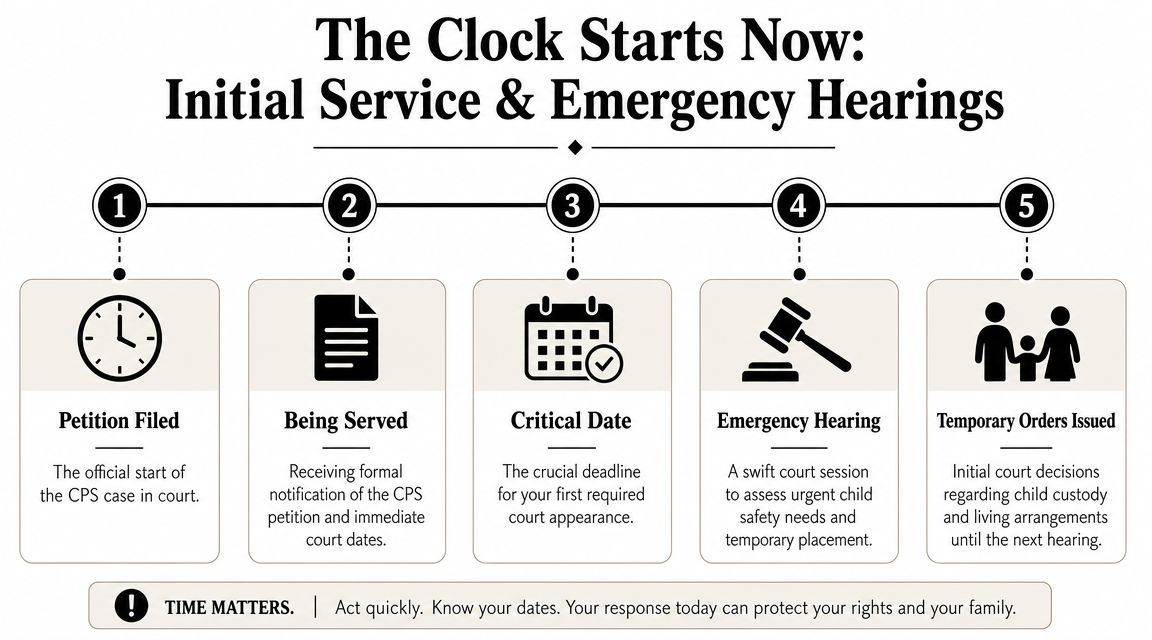
The Clock Starts Now Initial Service and Emergency Hearings
Once CPS files the petition, the case runs on the court's calendar, not yours. That can feel unfair, especially when you're trying to absorb what happened. But the date on the paperwork matters because it tells you the case has started formally.
If your child was removed, Texas law requires an emergency hearing within 1 business day after removal, and a full adversary hearing must follow within 14 days. If DFPS is appointed temporary conservator, the first permanency hearing must be held no later than 180 days after that appointment, and the case generally must reach final resolution within 1 year under the timeline described in this overview of key CPS litigation events in Texas.
What being served actually means
Being served means you've been formally given notice of the lawsuit. It is not a casual warning. It is legal notice that the state has asked the court to act.
What parents should do immediately:
Read the caption and hearing information carefully
Look for the court, cause number, and scheduled dates.Save every page
Don't leave papers in the car or hand them to a relative and forget about them.Start a case folder tonight
Put all texts, emails, school records, drug test results, counseling records, and names of witnesses in one place.Call a lawyer before calling everyone else
Friends can comfort you. Counsel can protect you.
Emergency removal versus a standard filing
Some cases begin after an emergency removal. Others begin with a petition requesting court orders while the child remains at home or with a relative. That distinction changes the pace, but either way, the petition moves the matter into court.
A useful way to think about it is this: an investigation is like being questioned on the roadside. A petition is like being ordered into the courthouse. The stakes are no longer hypothetical.
Practical rule: If your child has been removed, assume every hour matters. If your child has not been removed, assume the next hearing could affect whether that changes.
What works in the first few days
A parent who does well early usually does simple things consistently:
They stay reachable
Missed calls and unanswered messages make you look disengaged.They gather names fast
Safe relatives, teachers, counselors, doctors, pastors, and daycare providers can all matter.They stop arguing facts by text
Angry messages rarely help and often become exhibits.They fix obvious problems immediately
If the concern is housing, clean and document the home. If the concern is supervision, identify a safe support plan.
What doesn't work is hoping the court will slow down because you're overwhelmed. It won't.
Your First Day in Court The Adversary Hearing Explained
The adversary hearing is one of the most important early court dates in a Texas CPS case. It is not the final trial. Think of it as a mini-trial focused on one urgent question: should the child remain out of the home while the case continues?
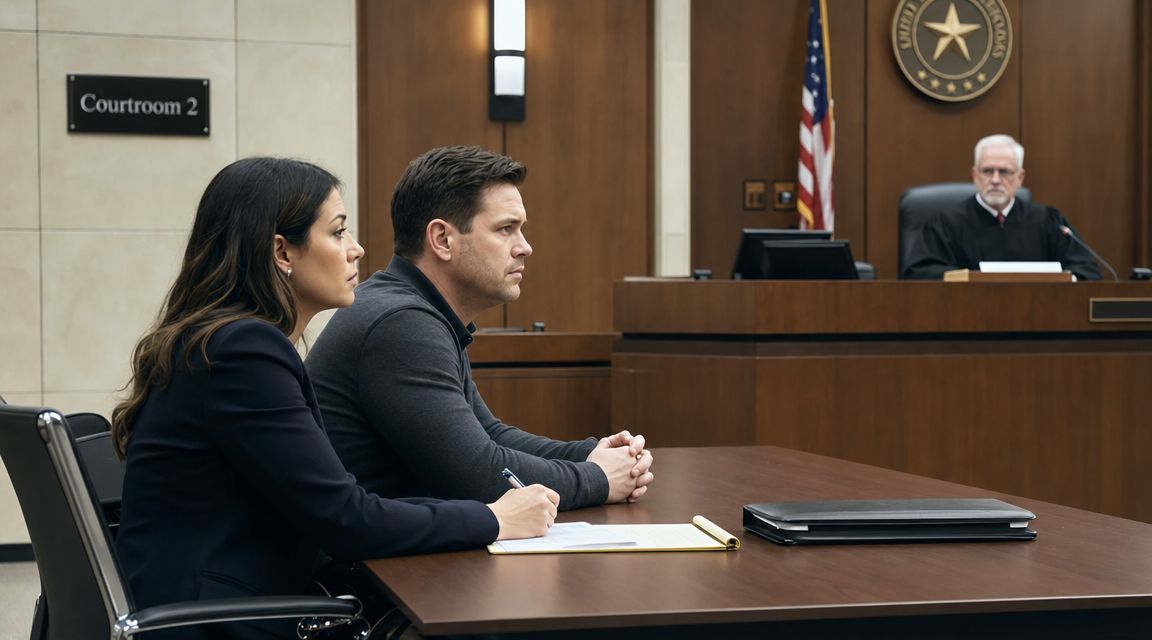
Texas requires the court to hold a hearing no later than 14 days after a CPS petition is filed. In emergency removals without a prior court order, the agency must appear by the next business day and show evidence of continuing danger. DFPS outlines that process in its CPS court procedures handbook.
Who is usually in the courtroom
You'll usually see some combination of these people:
- The judge who decides temporary issues
- The CPS attorney
- The caseworker
- Your attorney, including court-appointed counsel if you qualify
- The child's attorney or guardian ad litem
- You, and sometimes the other parent
- Possible witnesses, depending on the case
If you want a fuller picture of how this hearing works, this guide to the adversary hearing in a Texas CPS case is a useful companion.
What the judge is looking at
The court is not deciding every issue in your life that day. The judge is deciding whether CPS has shown enough to justify temporary intervention.
That often includes evidence about:
| Issue | What it can mean |
|---|---|
| Home safety concerns | Whether the child can safely return now |
| Alleged drug use | Whether testing, treatment, or supervision is needed |
| Domestic conflict | Whether protective steps are in place |
| Medical or school concerns | Whether neglect allegations have support |
| Available relatives | Whether a family placement is safer than foster care |
A common misunderstanding is that the parent's goal is to “tell their whole story.” The better goal is to address the court's immediate safety concerns with proof, not just emotion.
After you understand the setting, this short video can help make the hearing feel less mysterious.
What helps and what hurts
Helpful conduct in court is often plain and disciplined:
- Arrive early and look organized
- Bring documents your lawyer requested
- Speak respectfully, even if you feel attacked
- Answer the question asked, not three more
What hurts is talking over the judge, arguing with the caseworker in the hallway, or assuming your sincerity alone will carry the day.
The courtroom rewards proof and preparation. It does not reward the parent who is most upset, even when that parent has every reason to be upset.
Navigating Temporary Orders and Your Service Plan
After the first hearings, many parents discover that the hardest part of the case isn't the courtroom. It's the daily grind that follows. Temporary orders can shape where your child stays, how visits happen, who can supervise contact, and what steps you must complete before reunification is even considered.
If CPS is named temporary managing conservator, you may be given a service plan. That plan is the court case translated into a to-do list. It often becomes the measuring stick the court uses to evaluate whether your home will be safe going forward.
What life under temporary orders can look like
A father might leave work early for a drug test, rush to a supervised visit, miss a parenting class because traffic was bad, and then get blamed for “noncompliance” when the class provider marks him absent. That kind of thing happens all the time.
The problem isn't only whether you're trying. The problem is whether you can prove you're doing what the court ordered.

For a deeper explanation of how these requirements work, review this resource on the Texas CPS family service plan.
What a service plan usually demands from you
Service plans vary, but the pattern is familiar. You may be expected to address the issues CPS says created risk.
Common categories include:
Housing stability
Keep the home safe, clean, and suitable for children.Counseling or assessment
Attend therapy, substance abuse assessment, psychological evaluation, or similar services if ordered.Drug testing
Test when asked, on time, and through the approved provider.Parenting education
Complete classes and keep your certificate.Visitation compliance
Show up for visits, engage appropriately, and avoid conduct that creates new concerns.
How to treat the service plan strategically
Don't treat the plan like a homework packet you can finish at the end. Treat it like a job with a paper trail.
Use a simple system:
- Keep a binder or digital folder for every referral, sign-in sheet, certificate, and receipt.
- Confirm appointments in writing so missed scheduling doesn't get pinned on you.
- Take lawful photos of home conditions after repairs, cleaning, or safety improvements.
- Track visits in a calendar with times, observations, and any problems.
- Tell your lawyer early if a service is impossible because of work schedule, transportation, or cost.
A service plan is not only about completion. It is also about credibility. The parent who documents effort usually presents far better in court than the parent who says, “I did it, but I don't have the paperwork.”
The trade-off parents need to understand
Some parents resent the plan so much that they half-comply. They attend some services, skip others, and explain the rest away as unfair. That reaction is understandable. It is also dangerous.
Judges often look for one simple theme: are you moving toward safety, insight, and stability, or are you fighting every step? You can challenge unreasonable demands through counsel. But ignoring the plan usually gives CPS a cleaner story than they started with.
Building Your Defense Evidence and Discovery in a CPS Case
By the time a petition is filed, CPS already has a head start. The agency's evidence often begins in the investigation phase, long before your first court appearance. DFPS states that investigations normally must be completed within 45 days of intake, with one 45-day extension for good cause, and caseworkers must attempt to interview alleged victims within 72 hours and document interviews and observations within 24 hours of contact, as described on the DFPS investigations page.
That matters because the court file often grows from those early interviews, notes, photos, safety assessments, and risk conclusions.
What discovery means in plain English
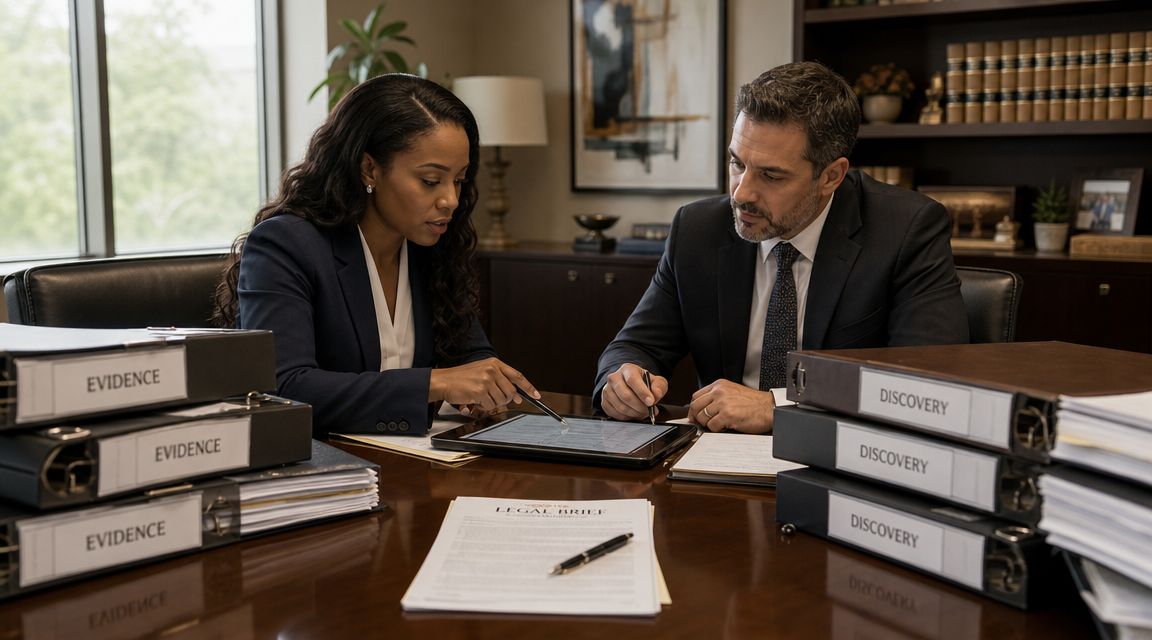
Discovery is the formal process of getting information and evidence. Your lawyer is not limited to reacting to whatever CPS says in court. Counsel can seek records, review reports, compare statements, and test whether allegations are consistent.
This often includes looking at:
- Caseworker notes
- Drug test records
- Police materials
- Medical records
- Photographs
- Prior statements from witnesses
- Service provider records
If you want to understand how parents push back against weak or misleading proof, this article on challenging CPS evidence in a Texas case is worth reading.
The evidence you should be building yourself
Parents sometimes make the mistake of thinking only CPS gets to gather evidence. That's not true. You should be building your own file from day one.
Strong defense material can include:
| Evidence you gather | Why it matters |
|---|---|
| Counseling attendance records | Shows engagement with treatment |
| Clean test results | Counters ongoing substance concerns |
| Lease, utility bill, repair receipts | Supports housing stability |
| Work schedule and pay records | Shows routine and support capacity |
| Certificates from classes | Confirms progress on services |
| Messages with relatives willing to help | Helps with safe placement options |
What works versus what doesn't
What works is organized, boring, verifiable information. Judges and attorneys rely on documents far more than dramatic speeches.
What doesn't work:
- Screenshots without context
- A stack of papers with no dates
- Character letters from people who don't know the facts
- Social media arguments about the case
- Waiting until the last hearing to collect records
Build your file as if someone else will have to understand your life from paper alone. Because in court, that's often exactly what happens.
The Road to Resolution Permanency Hearings and Final Outcomes
Early hearings deal with immediate safety. Later hearings ask a harder question: where is this case going, and what permanent arrangement serves the child?
That is where permanency hearings come in. These hearings review placement, services, visitation, progress, and whether the current plan still makes sense. The court is not supposed to let these cases drift forever. Texas law sets a hard deadline. The court must enter a final order or dismiss the suit no later than one year after DFPS is named conservator, with a possible extension of up to 180 days only for extraordinary circumstances, as explained in the TDCAA discussion of CPS litigation deadlines.
Why the middle of the case often decides the end
Many parents focus on the first hearing and the final trial. The middle gets less attention, but that stretch often shapes the result.
The court watches patterns:
- Are you visiting consistently?
- Are you finishing services instead of starting and stopping?
- Are housing and employment becoming more stable?
- Are the same safety issues still showing up?
- Is there a relative placement that makes more sense than foster care?
Permanency hearings are where these patterns become the court's working narrative of your case.
The main outcomes parents need to understand
A Texas CPS case usually moves toward one of several broad endings. The labels are legal. The consequences are personal.
Reunification
Your child returns home, sometimes with conditions or continuing oversight for a period. This is usually the outcome parents want, and it usually depends on showing the court that the original safety concerns have been addressed in a concrete way.
Permanent conservatorship
A relative, another caregiver, or in some cases the state may receive permanent decision-making authority. This can happen when the court decides the child should not return home, but termination is not the chosen outcome.
Termination of parental rights
This is the most serious result. It ends the legal parent-child relationship. In Chapter 161 cases, the stakes are permanent, which is why service plan performance, evidence, and litigation strategy matter so much long before the final hearing.
A practical way to think about permanency
Parents often ask whether one mistake ruins everything. Usually, one mistake is not the issue. A repeated pattern is.
If you miss one class but promptly reschedule, document it, and keep moving, that can often be managed. If you miss visits, delay testing, ignore referrals, change phones repeatedly, and show up unprepared at review hearings, the court starts to see instability as the story of the case.
The court's final decision often feels sudden to parents. From the court's perspective, it usually reflects months of accumulated impressions.
How an Experienced Attorney Can Defend Your Family
A CPS case can leave a parent feeling watched, judged, and exhausted. That feeling is real. But it should not push you into silence or surrender.
You have important rights in this process. You can have an attorney. If you qualify as indigent in the right type of case, the court may appoint one. You can review the allegations, challenge evidence, present your own witnesses, and ask the court to consider safer alternatives than the one CPS is proposing. You are not required to walk into these hearings alone and hope for mercy.
What a lawyer actually does in these cases
A good CPS lawyer does more than stand next to you in court. Counsel can:
- Test the evidence instead of accepting the agency's version at face value
- Push for relative placements when that option protects the child better
- Address service plan problems early before missed referrals become “noncompliance”
- Prepare you for testimony so you don't damage your case by overexplaining
- File motions and make objections when procedure matters
If you're trying to stay organized between hearings, support staff can matter too. Families and legal teams sometimes rely on resources such as Paralegal Assistants to help keep records, deadlines, and case materials organized, though legal advice itself must come from your attorney.
The Law Office of Bryan Fagan PLLC handles Texas CPS and related family law matters, including court appearances, temporary orders, and trial preparation. Whether you work with that firm or another qualified lawyer, the point is the same. Get someone involved who understands how Texas CPS cases move through court.
Waiting until the case feels “serious enough” is usually waiting too long. A CPS petition means it is already serious.
You don't have to know every statute tonight. You do need a plan, a file, and an advocate who can help you make smart decisions while there is still time to affect the outcome.
If CPS has filed a petition against you, talk with Law Office of Bryan Fagan PLLC about your situation in a free consultation. You can get clear answers about the next hearing, your rights, your service plan, and the steps that may help protect your relationship with your child. When your family is on the line, informed action matters.