Skip to content
If CPS has contacted you, your mind is probably racing. You may be wondering whether your child will be removed, whether you said the wrong thing, or whether one bad moment is about to define your entire future as a parent.
That fear is real. So is the confusion. Texas CPS cases move fast, and the language in court papers can feel cold and unforgiving. But parents are not powerless in this process. In a CPS termination of parental rights Texas case, the outcome often turns on what you do early, how consistently you respond, and whether you understand the rules that govern Chapters 262, 263, and 161 of the Texas Family Code.
A parent who knows the process is in a better position to protect the parent-child relationship. That means knowing what CPS is investigating, what the court expects after removal, what grounds the state may claim under Section 161.001, and how to push back when the evidence is weak or the procedure is unfair.
A common example looks like this. A mother leaves her child with a relative during a housing crisis. CPS gets a report, opens an investigation, and quickly starts asking about drug testing, supervision, school attendance, and home safety. She feels judged and overwhelmed, misses one meeting, then falls behind on services. What hurts her case isn't just the allegation that started the file. It's the appearance, over time, that she isn't engaged. That's often where termination cases become more dangerous.
Knowledge changes that. So does a plan.
The Moment Your World Changes The CPS Investigation
The first contact from CPS usually comes without warning. It may be a phone call during work, or a caseworker at your door asking to talk about your child. In that moment, most parents feel panic first and clarity second.
That reaction is normal. It also makes the opening hours of a case especially important. What you say, what records you can gather, and how quickly you get legal advice can shape everything that follows under Texas Family Code Chapter 262, which governs emergency protection and removal issues.
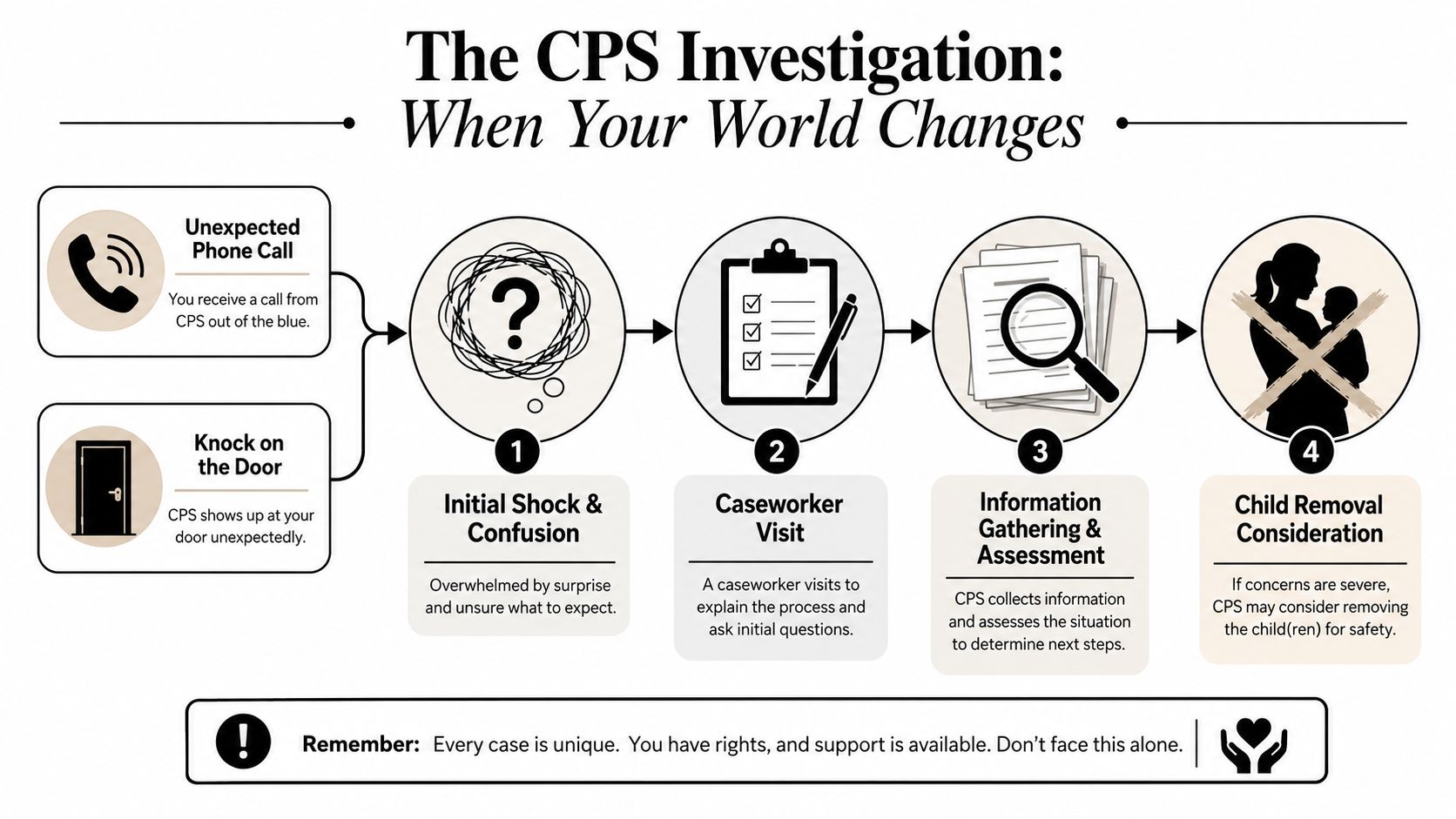
How a case usually begins
A CPS case starts with a report. From there, CPS decides how urgently to respond and whether the report describes immediate danger, neglectful supervision, abuse, drug exposure, unsafe living conditions, or some other concern. Parents often focus on whether the accusation is fair. CPS focuses on whether it believes a child may be unsafe right now.
The practical question is not just, “Did this happen?” It is also, “What can CPS document, and how quickly can the parent show stability?”
For many families, that means the first days should include:
- Saving records early: Keep texts, school records, medical paperwork, lease documents, and proof of treatment or counseling.
- Identifying safe relatives: If CPS is worried about immediate safety, a relative placement is often better than allowing the agency to control every placement decision.
- Getting legal advice fast: A parent who understands the process usually avoids preventable mistakes during interviews and safety plan discussions.
Parents who want a more detailed walk-through of first contact and early case stages can review what to expect during a Texas CPS investigation.
What caseworkers are looking for
Caseworkers usually try to answer a short list of practical questions. Is the home safe? Is there sober and reliable supervision? Has the child been harmed, or placed at risk of harm? Is there a caregiver who can protect the child while the investigation continues?
Practical rule: Cooperate carefully, not casually. You don't help your case by arguing with a caseworker, but you also shouldn't guess, speculate, or agree with facts that aren't true.
One helpful resource on this stage is The Texas CPS Investigation Process Explained, which gives a step-by-step breakdown of how a Texas CPS investigation unfolds and a parent's rights at each stage.
The situation holds significant gravity. According to federal data reported by The Imprint, since 2006, Texas has terminated parental rights for 91,589 children. That number matters because it shows that termination is not a remote possibility reserved for a tiny set of cases. It is a real risk in this state.
When investigation turns into removal
Removal doesn't happen just because CPS opens a file. But if CPS believes there is immediate danger and no workable safety alternative, it may seek emergency intervention through the court. That is the point where fear often spikes, because the case stops being only an investigation and becomes active litigation.
What works for parents at this stage is urgency, organization, and follow-through. What usually doesn't work is denial without proof, hostility toward everyone involved, or assuming the case will fade on its own.
The Legal Grounds for Termination in Texas
A judge can't terminate your parental rights because CPS thinks you are imperfect, struggling, or hard to work with. Texas law requires more than concern and more than suspicion. Under Texas Family Code Section 161.001, CPS must allege and prove a recognized legal ground for termination, then separately prove that termination is in the child's best interest.
That distinction matters. Many parents hear broad accusations such as “neglect” or “endangerment” and assume the case is already lost. It isn't. The state still has to fit the facts into the statute.
Why the legal grounds matter so much
The risk is not theoretical. As of the end of Fiscal Year 2019, there were 51,417 children in the custody of the Texas Department of Family and Protective Services, and only 33% of children who enter foster care in Texas ever return home to their families, according to the Texas Public Policy Foundation's review of CPS litigation and custody data. Once a case moves deep into substitute care, parents need to understand exactly what ground CPS is relying on.
Some grounds focus on conduct. Others focus on failures over time. Others arise from criminal convictions, abandonment-type allegations, or noncompliance with court-ordered services.
Statutory grounds parents commonly see
Below is a plain-English guide to the kinds of grounds that frequently appear in CPS termination litigation under Section 161.001.
| Statutory Grounds for Involuntary Termination in Texas (Texas Family Code §161.001) | Brief Explanation |
|---|---|
| Endangerment allegations | CPS may claim a parent placed the child in dangerous conditions or engaged in conduct that put the child's physical or emotional well-being at risk. |
| Constructive abandonment | This ground can apply when a child has remained in DFPS custody for the required period and CPS argues the parent has not maintained meaningful contact or shown an ability to provide a safe environment. |
| Failure to support | Texas law allows termination claims based on failure to support a child for the statutory period when the parent had the ability to do so. |
| Failure to comply with a court-ordered service plan | CPS often relies on missed services, incomplete treatment, failed drug testing, or poor follow-through after removal. |
| Abandonment-type conduct | These allegations usually focus on leaving a child without support, without contact, or without a clear plan for care. |
| Serious criminal conduct | Certain violent crimes, including crimes involving severe harm, can become a direct statutory basis for termination. |
| Chronic substance abuse tied to danger | Substance use alone is not the entire analysis. The legal question is whether the conduct endangered the child and remained unresolved. |
What parents should read in their petition
When you receive a petition or court order, look for the exact statutory language. Don't stop at labels. Read what conduct CPS says supports the ground. Then compare that allegation to your records, your witnesses, your treatment history, your visitation history, and your housing situation.
The best defense often begins with a simple question: “What specific act, failure, or pattern is CPS saying justifies termination?”
A vague response from the state can be challenged. A detailed response from the parent can be powerful.
Navigating the Texas Family Court Timeline
Once a child is removed, the case starts moving on a schedule that can feel relentless. Parents often assume they will have plenty of time to “get things together.” In reality, Chapter 263 pushes the case forward through a series of hearings designed to evaluate safety, services, permanency, and whether the parent is moving toward reunification quickly enough.
This early visual helps show how fast the court process unfolds after removal.
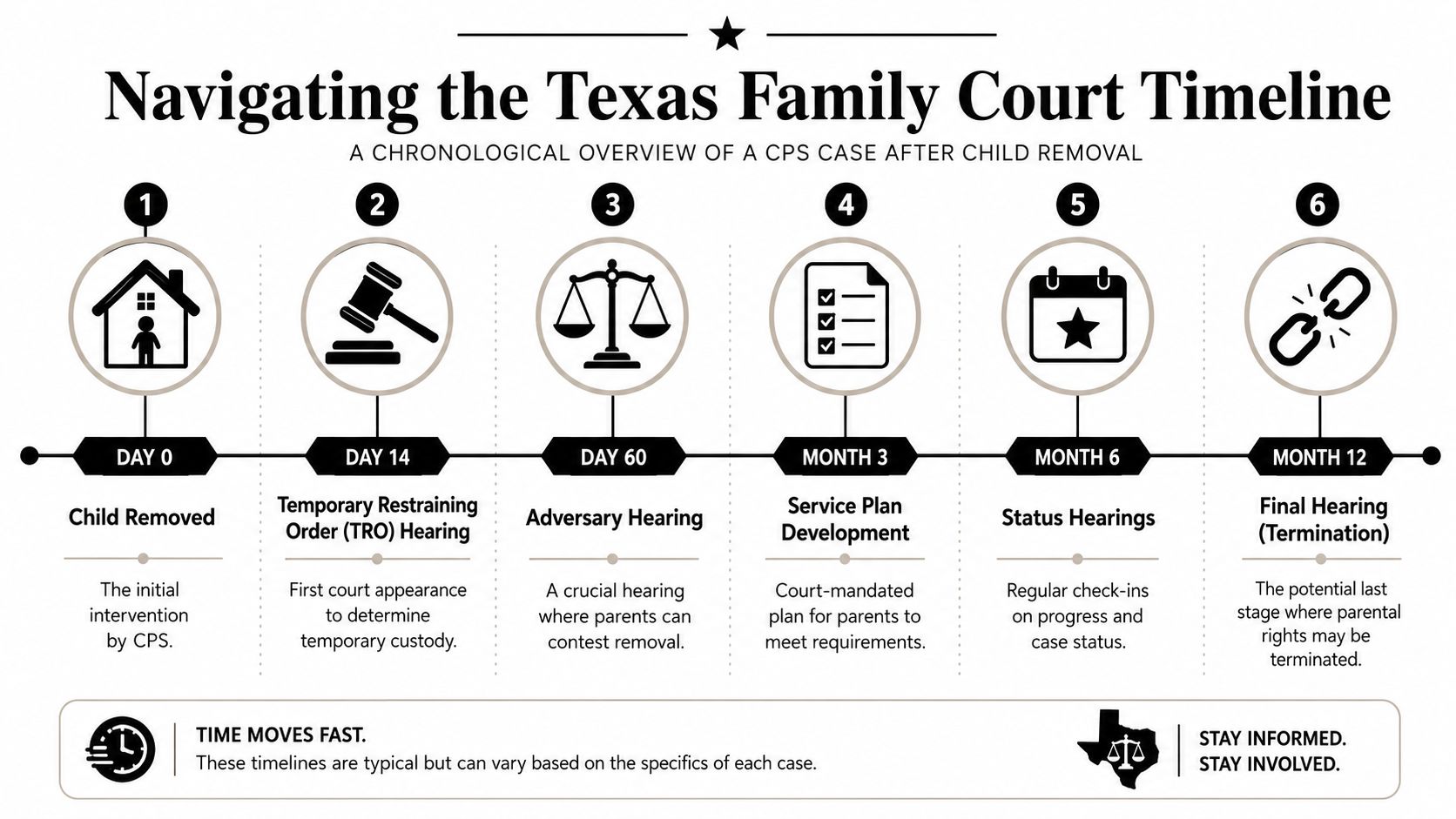
A typical case can feel like this from the parent's side. The child is removed. A flood of paperwork arrives. Then the parent appears in court and realizes every hearing has a different purpose, a different legal standard, and a different opportunity to help or hurt the case.
The early hearings
The first major hearing after emergency action is often the adversary hearing, during which the court looks closely at whether the child should remain out of the home while the case continues. Parents need to arrive prepared, because waiting for “the next hearing” is a mistake that can set the tone for everything after.
Then comes the service plan stage. The court expects the parent to begin specific tasks such as counseling, classes, treatment, drug testing, housing stabilization, psychological evaluation, or regular visitation. These services are not busywork. In practice, they become the paper trail the judge will later review when deciding whether reunification is realistic.
A short explanation in video form can help if court procedure still feels abstract:
The middle of the case
Status and permanency hearings are where parents often lose ground without realizing it. The court isn't only checking whether you started services. It is looking at consistency, insight, sobriety if relevant, attendance, housing, employment, and whether visits with the child show progress.
A parent may feel, “I'm trying.” A judge may be asking, “Is there measurable, documented movement toward safe reunification?”
That difference matters.
Here is how those hearings usually function in real life:
- Adversary hearing: The court decides whether continued removal is justified.
- Status hearing: The court reviews the service plan and whether the parent understands what must be done.
- Permanency hearings: The judge checks whether progress is real, timely, and sufficient to support reunification.
- Final hearing: The court decides whether to return the child, extend the case if legally appropriate, appoint another permanent arrangement, or terminate parental rights.
A parent's timeline is not the same as a parent's intentions
One father I often think about in cases like these had stable employment but delayed his drug assessment because he believed his clean tests would speak for themselves. He visited regularly and loved his child tremendously. But the file reflected delay, not effort. By the time he corrected course, CPS argued he had not demonstrated timely compliance.
Parents are judged on documented action, not private intention.
What works is treating every hearing like a checkpoint. Bring certificates. Confirm attendance. Fix transportation issues early. Ask for referrals in writing. If a service provider waitlist is slowing you down, make sure the court sees that the delay isn't your fault.
The Two Hurdles CPS Must Clear in Court
A termination trial is not supposed to be a rubber stamp. CPS has to clear two separate hurdles before a court can sever the legal relationship between parent and child. If either one is missing, termination should fail.
The first hurdle is proof of a statutory ground under Section 161.001. The second is proof that termination is in the child's best interest. These are related issues, but they are not the same issue.
Clear and convincing is a real burden
Texas doesn't let CPS win a termination case on a minimal showing. Under DFPS guidance on Texas Family Code Section 161.001, CPS must prove its case by clear and convincing evidence, which is a higher standard than a preponderance of evidence but lower than beyond reasonable doubt. In plain language, the evidence must be strong enough to produce a firm belief or conviction.
That affects how a judge should evaluate old allegations, weak hearsay, incomplete records, and assumptions about a parent's future.
Parents often benefit from understanding the burden of proof in a Texas CPS case, because the standard sounds abstract until you see how it applies to witness testimony, testing records, service completion, and credibility disputes.
Best interest is broader than blame
Even if CPS proves a legal ground, it still must prove that termination is in the child's best interest. Courts often consider the child's needs, safety, emotional bond, the parent's abilities, the stability of the proposed home, and whether the problems that led to removal can realistically be corrected.
A parent can lose on this issue by underestimating it. Some parents defend only against the accusation and ignore the forward-looking question. Judges do not.
A strong defense addresses both the past and the future. It challenges what CPS says happened, and it shows what safe parenting looks like now.
What this means in practice
At trial, judges are often comparing two stories. CPS presents a pattern of danger or instability. The parent presents a pattern of correction, commitment, and capacity. The side with the cleaner, better-documented, more credible story usually has the advantage.
That is why good defense work is rarely theatrical. It is detailed. It is organized. And it is tied to proof.
How to Defend Your Parental Rights
You get out of court with a stack of papers, a service plan full of deadlines, and no clear sense of what matters most. Parents in that moment often want to fight every accusation at once. In a termination case, the better approach is narrower and more practical. Build proof, fix what can be fixed, and show the court that your child can be safe in your care now and in the near future.
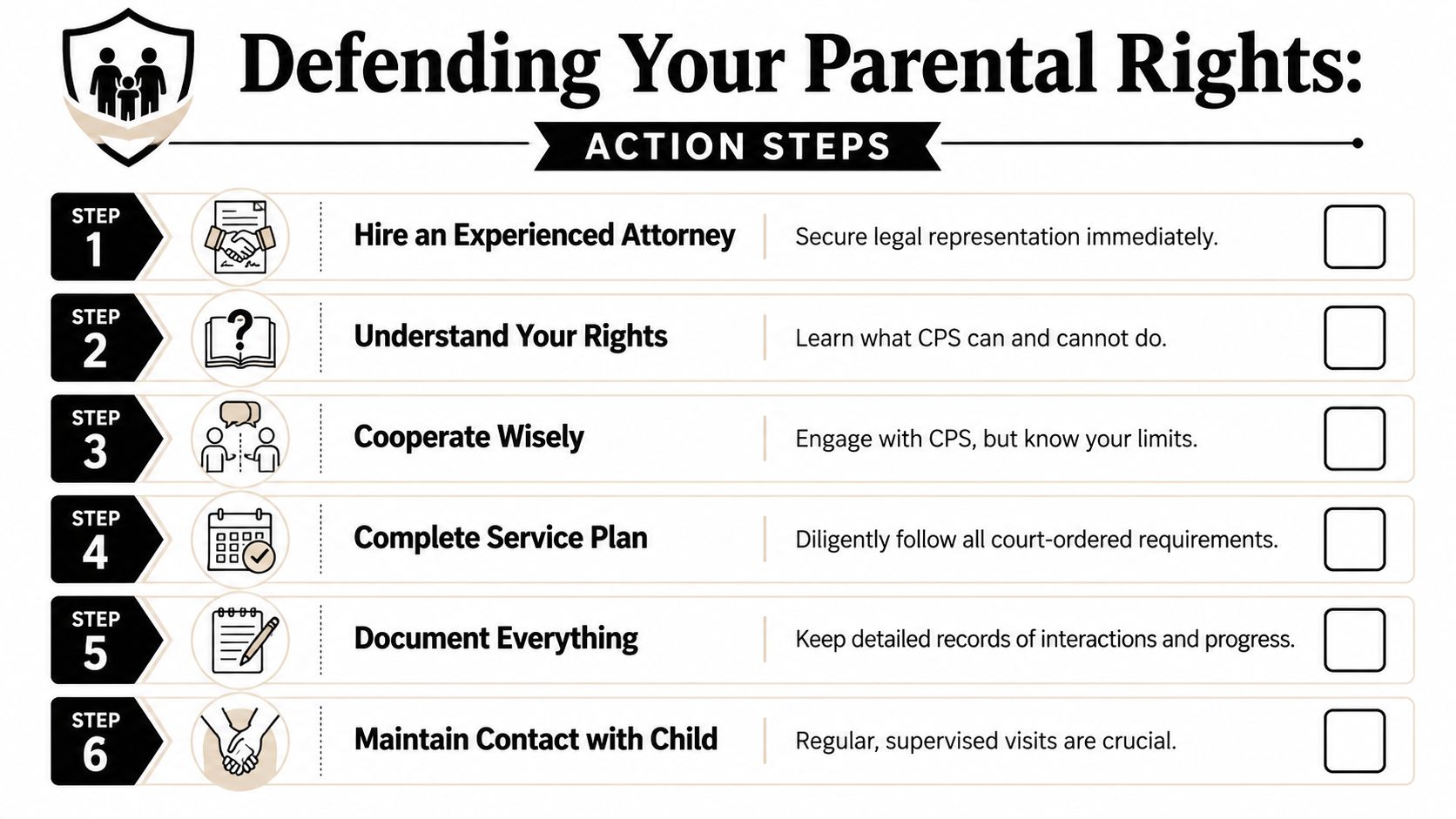
Judges usually look for patterns. So do I when I prepare a parent's case. One clean month helps. Six documented months help more. The parents who put themselves in the strongest position are usually the ones who stop arguing with the paperwork and start creating a better record than CPS has.
What usually strengthens a parent's defense
Start with the court-ordered service plan. If it requires classes, counseling, treatment, testing, evaluations, or stable housing, treat each item like a piece of trial evidence. Save certificates, attendance logs, discharge summaries, provider letters, pay stubs, lease documents, and test results. If you finish a service, get written proof before the provider forgets or closes your file.
Keep your own case file.
A binder or organized digital folder should include court dates, visit notes, names and phone numbers for every provider, screenshots of messages about scheduling, school or medical records, and copies of anything you gave CPS. That file does two jobs. It helps your lawyer prepare, and it protects you when a report leaves out context or gets a date wrong.
Witnesses can help, but only if they know something firsthand. A therapist who can describe attendance and progress may matter. A relative who only believes you love your child usually adds less than parents expect. Pick witnesses who can speak to sobriety, parenting, housing, mental health treatment, employment, or the quality of your visits.
Speed matters when a problem is real. If housing fell apart, get into stable housing and document it. If transportation keeps you from services, ask for help in writing and keep the response. If a provider has a waitlist, get on it immediately and save proof of the intake date. Judges can tell the difference between avoidance and a genuine obstacle that a parent worked to overcome.
Stay consistent with your child. Missed visits hurt cases, especially when the missed contact is not well explained. If a visit is canceled, ask for a make-up visit in writing. If the visit went well, write down what happened while it is still fresh. Those small records often become important later.
A defense usually rises or falls on documentation
I have seen parents make real progress and still struggle in court because they could not prove it. I have also seen imperfect parents keep a case from turning into termination because they documented each step, each class, each clean test, each request for help, and each visit.
That is often the trade-off. Anger may feel justified, but organization is more persuasive.
A practical example
A parent facing termination after allegations involving substance use and poor supervision improved her position by doing repetitive, ordinary work well. She entered treatment, kept attendance records, appeared for visits, requested make-up time when scheduling problems came up, and brought housing and employment documents to every hearing. She did not rely on promises about what she planned to do. She showed what she had already done.
That kind of record does not guarantee reunification. It does give the judge something concrete to trust.
Due process issues can change a case
Some parents are in a weaker position than they should be because they were not given a fair chance to participate. That issue comes up often for incarcerated parents, parents who moved, or parents who were hard to locate. Texas law requires service of citation in termination suits, and the Family Code also addresses appointment of an attorney ad litem for an indigent parent who responds in opposition to termination. See Tex. Fam. Code Sections 102.009, 107.013, and 161.211.
If you were in jail or prison while the case was pending, do not assume the court had all the right contact information or that proper notice reached you. Ask for the full court file, the return of service, the docket sheet, and any order appointing counsel. Review whether you were named, served, transported, allowed to appear remotely, or otherwise given a meaningful chance to participate. In the right case, those failures can matter on appeal or in a post-judgment challenge.
Protect the reliability of your records
Parents lose credibility when their proof is scattered, incomplete, or hard to trace. If you plan to rely on screenshots, videos, text messages, drug test results, or provider records, organize them in a way that shows when they were created, who sent them, and whether they were changed. A practical reference on how to document evidence integrity can help you set that up.
Some parents also ask whether rights can ever be restored after termination. That is rare and fact-specific, but you can review how reinstatement of parental rights in Texas works if your case reaches that stage. Parents who need direct representation sometimes also consult firms that handle CPS-related litigation, including the Law Office of Bryan Fagan PLLC, depending on the county and posture of the case.
After the Verdict Appeals and Unanswered Questions
A termination order feels final because it is severe. But it may not always be the end of the legal road. If the trial court terminates parental rights, parents need to talk with appellate counsel immediately. Delay can cost you the chance to challenge legal error, evidentiary weakness, or serious procedural defects.
When an appeal may matter
Appeals are not retrials. An appellate court usually reviews whether the trial court applied the law correctly and whether the evidence was legally and factually sufficient under the standard used in termination cases. That means trial records matter. Objections matter. Exhibits matter. Whether an issue was preserved can matter.
If you are considering an appeal, gather these items right away:
- The final order: You need the signed termination order and the date it was entered.
- The clerk's record and reporter's record: Appellate review depends on what is in the record.
- Your timeline notes: Write down missed notice, excluded evidence, service plan barriers, and anything unusual that happened in court.
- Appellate consultation: A lawyer can evaluate whether the issue is evidentiary, procedural, constitutional, or all three.
Does child support always end
Many parents assume termination automatically ends every financial obligation. Usually, future child support obligations do end after termination. But that is not absolute in every case.
According to Texas Law Help's discussion of termination and support exceptions, parental rights termination typically ends child support obligations in Texas, but courts may keep support active in limited cases, such as when a parent is financially able or was convicted of certain crimes. That is an area where parents need case-specific advice, not assumptions.
Some of the hardest post-trial mistakes happen because a parent thinks the order answered questions it did not actually answer.
Can parental rights ever come back
Reinstatement is not a routine remedy. It is limited, fact-specific, and unavailable in many situations. Still, some parents want to understand whether any future legal avenue exists after termination, especially if the child is not adopted and circumstances later change. For a focused discussion of that issue, review reinstatement of parental rights in Texas.
Parents also need to think practically after the verdict. Keep copies of all orders. Follow any remaining court directives. Don't rely on verbal explanations from non-lawyers about what the order means. Read the actual language.
You Are Not Alone Take the Next Step to Protect Your Family
A CPS case can make a parent feel judged before being heard. It can turn ordinary struggles like housing problems, relapse, family conflict, or missed appointments into a legal narrative that sounds much harsher on paper than it feels in real life. That is one reason these cases are so emotionally difficult. The law is moving at the same time your family is trying to stay steady.
But there is a way through this. Parents do better when they understand where the case sits under Chapters 262, 263, and 161, when they respond early instead of waiting, and when they build a record that shows safety, stability, and commitment. In a CPS termination of parental rights Texas case, silence usually hurts. Delay usually hurts. Disorganization usually hurts.
The opposite also tends to be true.
What parents can do today
If CPS has already contacted you, focus on the next concrete steps:
- Read every court paper closely: Look for hearing dates, service plan requirements, and the exact legal grounds being alleged.
- Start documenting immediately: Keep a calendar, save messages, and gather records that show housing, treatment, employment, parenting effort, and visitation.
- Ask questions in writing when possible: Written requests create a clearer record than verbal conversations alone.
- Show up consistently: Court attendance, provider attendance, and visit attendance all matter.
- Get legal advice before the case outruns you: Early strategy is often more effective than late damage control.
Why legal help changes the picture
A good lawyer doesn't erase facts. A good lawyer identifies weak spots in the state's case, protects your procedural rights, pushes back on overreach, and helps present your progress in a way the court can use. That may include challenging removal, contesting statutory grounds, addressing service plan barriers, preserving error for appeal, or exposing notice failures that undermined due process.
Some parents need advice for the investigation stage. Others need trial defense. Others need help after a judgment has already been signed. The right legal help depends on the stage of the case, but waiting rarely improves your position.
If you want more information about this area of law and the legal issues surrounding termination litigation, the firm's core resource on termination and CPS matters can help you evaluate the road ahead.
If your family is facing CPS involvement, you don't have to sort through it alone. Law Office of Bryan Fagan PLLC offers free consultations for Texas parents who need guidance on investigations, removals, hearings, and termination cases. A calm, informed legal strategy can make a real difference. Reach out today to talk about your situation, your rights, and the next step to protect your family.