Skip to content
When a CPS worker says the state may try to end your rights as a parent, you often don't hear the next sentence. Your mind jumps to the worst possibilities. Will I lose my child forever? Did one mistake ruin everything? Is there anything I can still do?
That fear is real. So is the confusion. Texas termination cases move through a legal system that uses words like “endangerment,” “best interest,” and “clear and convincing evidence,” even though the parent sitting in court is usually thinking about something much simpler: how to get back to their child and keep their family together.
Understanding parental rights termination in Texas requires more than a list of statutes. You need a plain-English explanation of what the court is looking at, what CPS must prove, and what steps can still protect you.
The Moment Your World Stops Hearing About Termination
A mother comes home from a hearing and tells her sister, “They kept saying the word termination, but I couldn't process anything after that.” That reaction is common. People freeze. Some start talking too much because they're scared. Others shut down and miss deadlines, meetings, and service-plan tasks because the case feels bigger than they can handle.

If that's where you are right now, take a breath. A termination case is serious, but serious is not the same thing as hopeless. You can still make smart decisions, protect your words, organize your records, and start responding in a way that helps instead of hurts.
One reason this subject feels isolating is that parents often think they're the only family facing it. They aren't. According to a 2016 national estimate on termination of parental rights, 1 in 100 U.S. children, representing a cumulative prevalence of 0.9%, will experience the termination of parental rights by age 18, a figure that has roughly doubled since 2000 when the rate was 0.7%.
What parents usually feel first
- Shock: You may hear legal terms but not understand what they mean for your daily life.
- Shame: Many parents feel judged before they've had a real chance to explain.
- Panic: Some want to fix everything in one day and make rushed choices.
- Helplessness: Court dates and CPS meetings can make it seem like everyone else has the power.
Practical rule: Don't let panic make your decisions for you. In CPS cases, calm, documented action matters more than emotional promises.
The parents who put themselves in the best position usually do three things early. They get legal advice fast. They stop guessing about what the court expects. They start treating every meeting, drug test, class, visit, and text message as something a judge may eventually examine.
Voluntary vs Involuntary Termination in Texas
Not every termination case starts the same way. Some parents are considering a planned legal relinquishment. Others are being sued by the state or by another party and do not want their rights terminated at all. Those are very different situations.
A voluntary case might come up in a stepparent adoption. For example, a child has lived for years with one parent and a stepparent who has taken on the day-to-day parenting role. In that setting, one biological parent may choose to sign papers relinquishing rights. Even then, the court still has to approve the result.
An involuntary case is different. That's the form commonly referred to when discussing parental rights termination in Texas during a CPS case. CPS or another petitioner asks the court to end the parent-child relationship over the parent's objection.
Voluntary vs. Involuntary Termination at a Glance
| Aspect | Voluntary Termination (Relinquishment) | Involuntary Termination (by Court Order) |
|---|---|---|
| Who starts it | Usually the parent, often within a larger family-law or adoption matter | CPS, another parent, or another authorized party asks the court to terminate |
| Parent's consent | The parent agrees to relinquish rights | The parent contests it, or the case proceeds without consent |
| Common setting | Stepparent adoption or a planned transfer of legal parenthood | CPS litigation involving allegations of danger, abandonment, or serious parental misconduct |
| Court's main concern | Whether the termination and any follow-up plan serve the child | Whether legal grounds exist and whether termination is in the child's best interest |
Why this difference matters
If you're in a CPS case, don't assume the court sees your situation as a paperwork issue. In an involuntary case, the state is trying to prove legal grounds and best interest. That means every allegation, service-plan task, visit record, and safety concern may become evidence.
Parents sometimes confuse “signing something” with “making the case go away.” It doesn't work that way. A court order is what changes legal status. Before you agree to anything, understand whether you're discussing a true relinquishment, a temporary placement, or a litigation strategy.
If you need background on how relinquishment works in CPS cases, this guide on voluntary relinquishment in Texas CPS matters is a useful starting point. Some parents also look at Termination of Parental Rights in CPS Cases for a factual overview of when CPS seeks to permanently terminate parental rights and how to contest it.
Voluntary termination is a choice a parent makes. Involuntary termination is a case someone else brings against the parent.
That distinction changes everything from the evidence you need to the urgency of getting a lawyer.
What Gives Texas the Right to Terminate Parental Rights
Texas doesn't get to terminate rights just because a parent is imperfect, struggling, or unpopular with a caseworker. The court must work within the statute. In these cases, the legal framework comes from Chapter 161 of the Texas Family Code, and the allegations must fit recognized grounds.
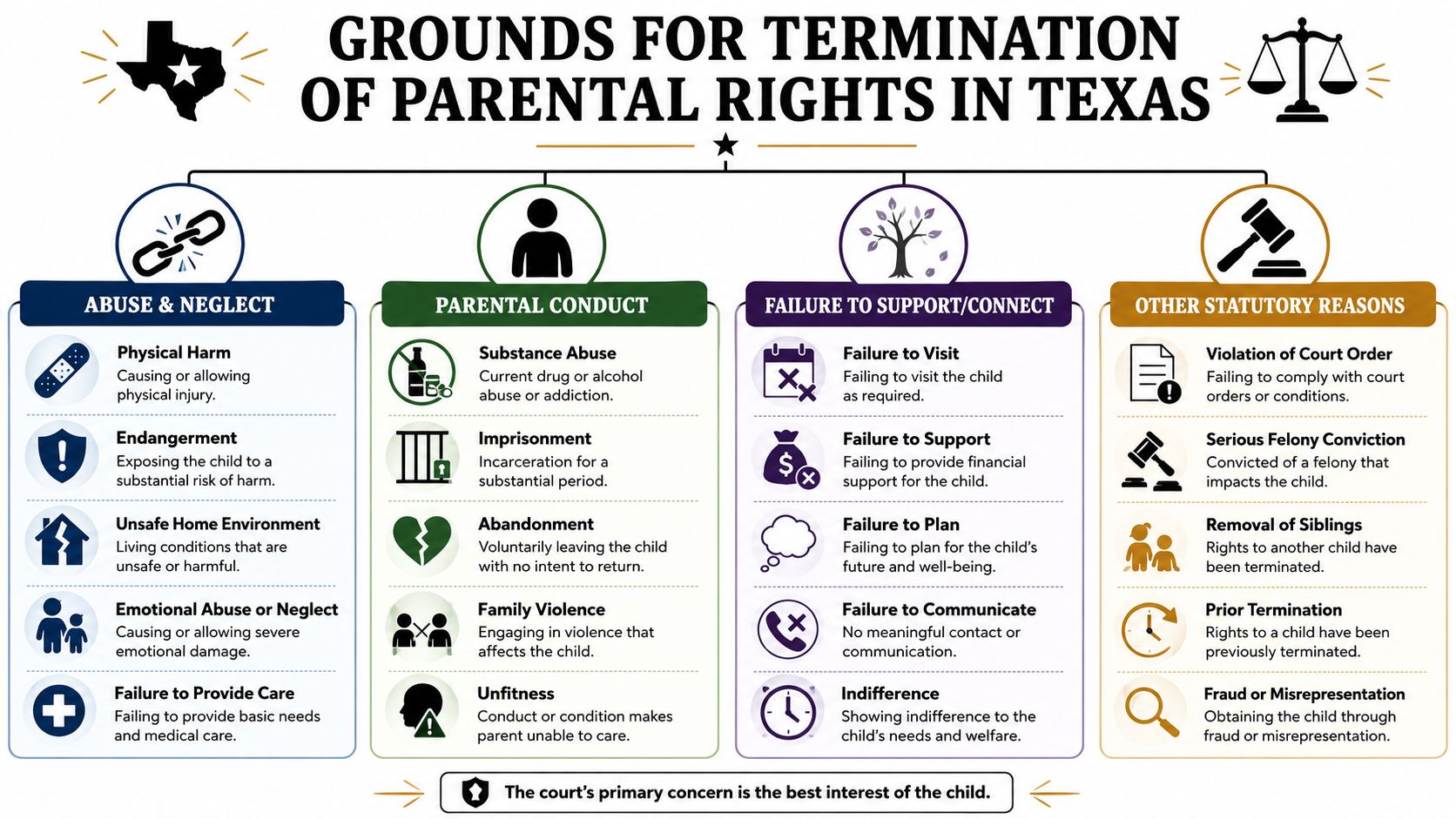
A helpful way to understand the law is to group the grounds into themes instead of reading them as one long legal list. Texas law includes many specific grounds. According to a Texas termination grounds overview, involuntary termination requires clear and convincing evidence that specific statutory grounds exist under Chapter 161 of the Texas Family Code, such as abandonment for six months, failure to support for one year, or incarceration rendering the parent unable to care for the child for two years. The statutory grounds include twenty-five specific conditions, including knowingly placing a child in harmful environments, conviction for crimes against children, substance abuse endangering the child, and constructive abandonment.
Four categories parents can understand
Abuse and neglect concerns
These cases focus on danger. The court may look at whether a parent caused harm, allowed harm, or left a child in an unsafe environment.
A real-world example is a parent who knows a violent partner is using drugs in the home and still leaves the child there repeatedly. The issue isn't just bad judgment in the abstract. The issue is whether the child was knowingly exposed to danger.
Parental conduct
Some grounds focus on what the parent has done, including criminal conduct, substance abuse tied to child safety, or conduct that shows serious inability to provide safe care.
A parent can feel frustrated here because the law isn't asking whether they love the child. Many parents do. The court is asking whether their conduct puts the child's physical or emotional well-being at risk.
Failure to support or maintain the relationship
Other grounds look at long periods of absence, failure to support, lack of visits, or constructive abandonment while the department has custody.
This is one area where parents often get tripped up by silence. They think, “I stayed back because I didn't want conflict,” or “I missed visits because transportation was a mess.” The court may instead see a record showing little contact and little follow-through.
Other statutory reasons
Texas law also includes grounds tied to prior terminations, serious crimes against children, and incarceration under specific conditions.
One practical lesson is simple. Don't assume CPS has to prove every possible allegation. It only needs to prove the grounds it pleaded and the court finds supported.
What clear and convincing evidence really means
This phrase worries parents because it sounds technical. In plain language, clear and convincing evidence means the judge must be firmly convinced the allegation is highly likely true. It is a higher standard than “maybe” and stronger than a bare tip or suspicion.
Think of it this way. A judge doesn't terminate parental rights because the caseworker thinks something could have happened. The judge must reach a much firmer level of confidence based on testimony, records, documents, and the full pattern of facts.
The higher burden matters because termination is permanent. Texas law does not treat it like an ordinary disagreement about parenting style.
That doesn't mean parents should feel safe if the evidence is building against them. It means your defense should focus on facts, timelines, witnesses, clean tests when available, treatment records, housing proof, employment records, and documentation that directly answers the allegations.
If you're trying to understand your options for legal help, Finding a CPS Defense Lawyer Near You in Texas explains how Texas parents can find and evaluate a qualified CPS defense attorney.
Navigating the CPS Court Timeline Step by Step
Parents often tell me the hardest part is not knowing what happens next. Court dates come fast. Different people speak at each hearing. You leave with papers, tasks, and another setting on the calendar. Once you understand the sequence, the process becomes easier to manage.
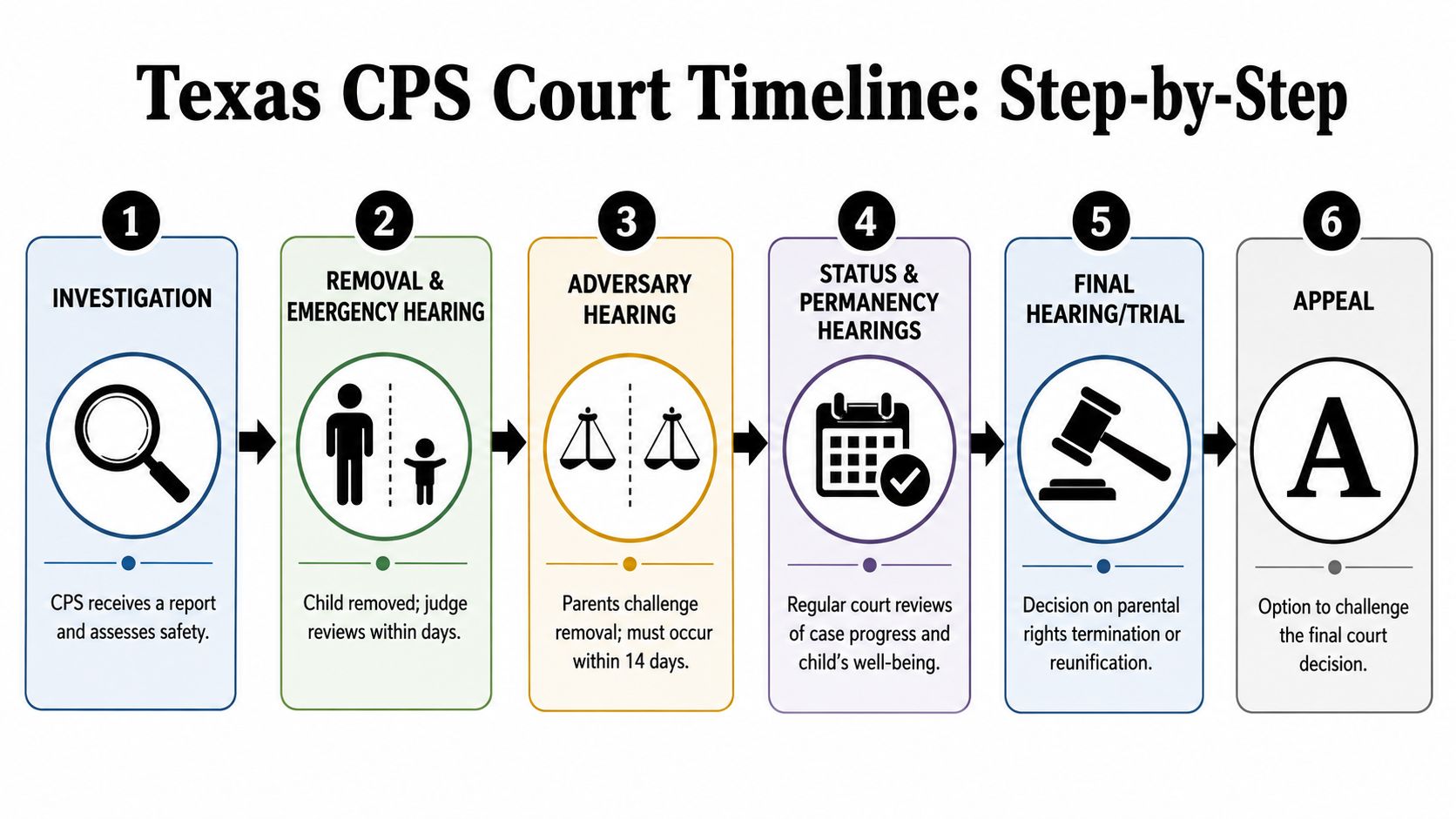
This visual gives a basic roadmap of how many Texas CPS cases move through court.
The early stage under Chapter 262
A case often starts with an investigation. CPS receives a report, interviews people, and decides whether it believes the child is safe in the home. If CPS removes the child, the court reviews that removal quickly.
One hearing parents hear about early is the adversary hearing, often called the show cause hearing. In Texas practice, that hearing must occur within 14 days of removal. During this hearing, the court examines whether the emergency removal should continue while the case moves forward.
The judge may hear from the caseworker, the parents, and lawyers. This is not the final trial, but it matters. Early impressions can shape how the court views urgency, safety, and credibility.
The middle stage under Chapter 263
After the initial fight over removal, the case shifts into review mode. The court looks at the family service plan, visits, testing, treatment, placement stability, and whether reunification is realistic.
Parents usually hear about the status hearing and later permanency hearings. A status hearing is commonly discussed around the 60-day mark. By then, the court expects clearer direction on what services are required and what each side is doing.
To make the timeline easier to follow, watch this short overview.
Courtroom reality: Every hearing builds the record. A missed visit in one month can become part of a larger story CPS tells at trial.
The final deadline and who is in the room
Texas CPS cases also operate under a major final deadline. Courts often work toward a final ruling within about one year, unless the law allows more time. That deadline matters because cases don't stay open forever while everyone waits to see what happens.
You'll also see several different legal players:
- The judge: Decides what evidence is credible and whether legal standards are met.
- The CPS caseworker: Presents the department's concerns, progress notes, and recommendations.
- The child's attorney ad litem: Represents the child's legal interests in the case.
- Your attorney: Challenges allegations, protects your rights, and helps present your evidence clearly.
A parent without counsel may still speak, but that doesn't mean they're protected. CPS cases are document-heavy and procedure-driven. A parent can be sincere and still lose because key evidence never got organized or introduced correctly.
For a fuller walkthrough of hearings and expectations, review this guide to the Texas CPS timeline for parents.
How to Build Your Defense and Understand New 2026 Laws
A strong defense in a CPS termination case usually looks less dramatic than people expect. It's built from steady, documented conduct. Showing up. Testing when ordered. completing treatment. Keeping records. Maintaining safe housing. Visiting consistently. Telling the truth carefully and with legal guidance.
That may sound basic, but judges often decide these cases by looking at patterns. A parent who says “I'm trying” is in a weaker position than a parent who can hand over certificates, negative test results, counseling attendance logs, rent receipts, text records about visits, and proof of work or support.
Defensive steps that help in real cases
- Get your paperwork under control: Keep every court order, service plan, drug test result, certificate, and email in one place.
- Read the service plan line by line: If something is unclear, ask your lawyer what it requires and how to document completion.
- Fix the risk that brought CPS in: If the issue is drug use, address sobriety. If it's unsafe housing, fix housing. If it's a violent relationship, create separation and document it.
- Protect your statements: Don't guess, exaggerate, or try to explain away serious allegations without legal advice.
- Show consistency during visits: Your behavior before, during, and after parent-child contact can become part of the record.
The part of the new law many parents misunderstand
Some recent Texas changes have created false hope. The safer way to say it is this: a parent should never assume that old conduct has stopped mattering just because the law changed how courts analyze certain grounds.
According to reporting on new Texas laws affecting parents previously deemed unfit, effective September 1, 2025, Texas removed “past mistakes” as a standalone ground for involuntary termination, but that does not protect parents who have current endangerment, substance abuse, or willful abandonment. That point matters even more for parents trying to make sense of the law going into 2026.
Texas also changed how courts approach some Family Service Plan issues. As of September 1, 2025, Texas repealed the prior ground based solely on failure to comply with a Family Service Plan or court order after nine months of removal under Chapter 262. Courts must now find clear and convincing evidence that the plan itself was specific, capable of compliance, and not fulfilled before ordering termination under that path.
A legal reform is not a free pass. If current conditions still endanger the child, the case can still move toward termination.
That's why legal advice matters. The guide to building a strong defense against CPS allegations can help you think through the practical side of preparing your case. In some cases, parents also consult the Law Office of Bryan Fagan PLLC for representation in CPS-related litigation and defense strategy.
The Lifelong Impact After a Termination Order
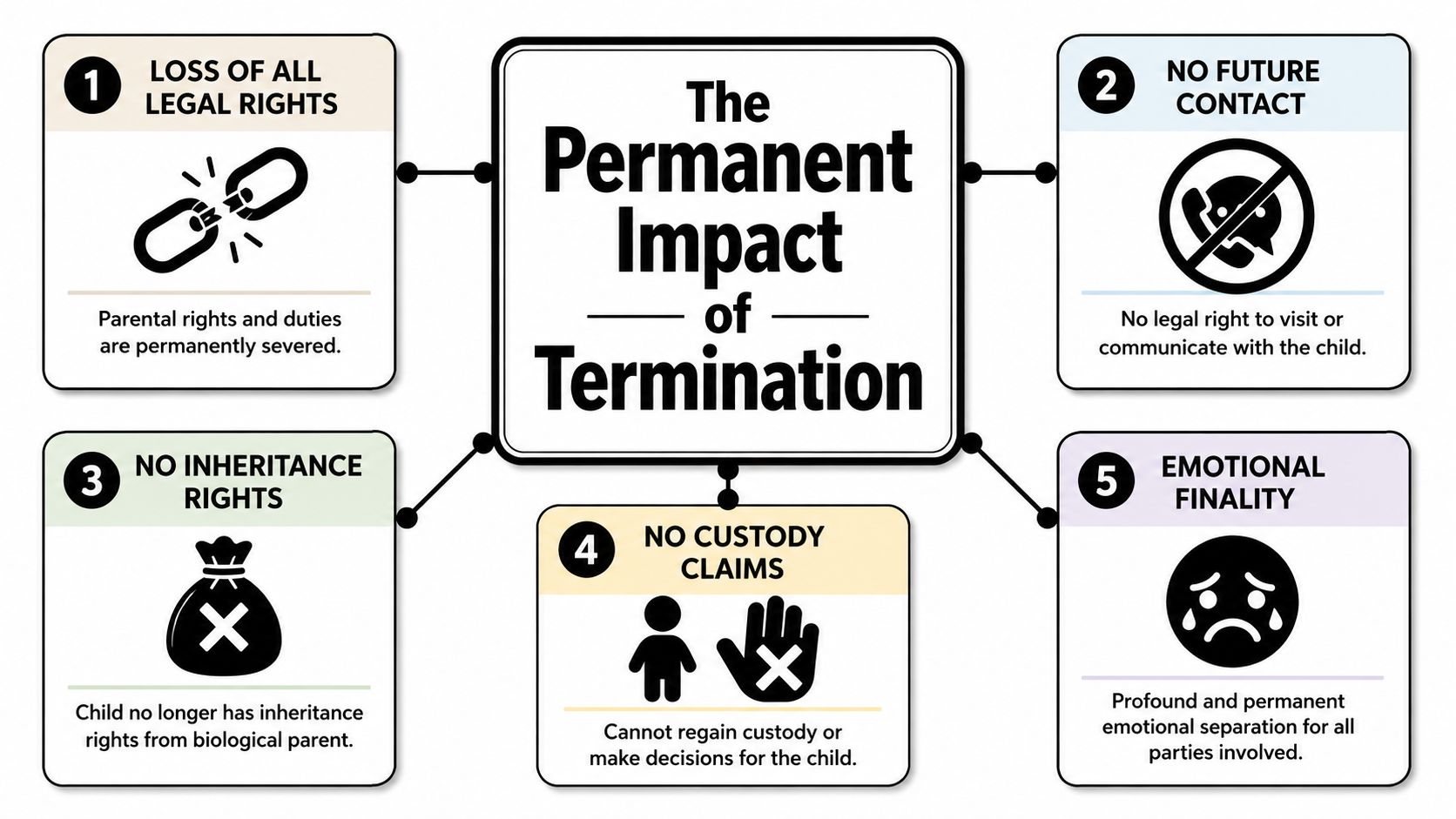
A termination order doesn't just change who has possession of the child this month. It permanently severs the legal relationship between parent and child. After that order, the parent loses the right to make decisions, seek custody, or claim the legal status of parent in the ordinary sense.
That finality can be emotionally devastating. It can also affect the child's future placement, including adoption by another family. For many people, this is the moment when the legal language stops feeling abstract.
What people often miss about child support
Many parents assume termination always wipes out future support. Usually, support ends, but not always. According to TexasLawHelp's explanation of termination of parental rights, Texas Family Code confirms that child support typically ends upon termination, with two exceptions where courts can keep support active: when a financially able parent's child is in substitute care of the department, and when the parent engaged in specific criminal acts against the child.
That means a parent can lose rights and still face ongoing financial obligations in certain cases. For planning purposes, that's important. You don't want to make legal decisions based on an assumption that every duty disappears automatically.
The human consequences after court
- No legal right to contact: A parent generally loses the right to visitation or communication.
- No decision-making power: Medical, educational, and placement decisions move to others.
- Adoption may follow: The child may become legally available for adoption.
- Emotional loss continues: Court signs an order in one day. Families live with it much longer.
Parents and relatives often need help understanding the emotional toll of separation, not just the legal one. For that perspective, this clinical guide for family separation offers useful context on how separation can affect children and families.
The legal case may end with a signed order. The emotional consequences usually don't.
Take Action Now to Protect Your Family
If CPS is talking about termination, treat the case like an emergency that requires organized action, not panic. The most useful first step is getting clear on what allegations are in the case. The second is building proof that addresses those allegations directly. The third is making sure your words, behavior, and paperwork all support the same story.
Start here:
- Stop speaking casually about the case. Anything you say to CPS, family members, or in text messages can become important later.
- Collect your documents today. Put court papers, service-plan records, testing results, certificates, and housing proof in one file.
- Follow orders carefully. If something is impossible, raise that issue through counsel instead of ignoring it.
- Keep visiting and participating. Consistency matters.
- Get legal help quickly. Delay gives CPS more time to build its version of events without a focused response from you.
If you're facing parental rights termination in Texas, you don't need to figure this out alone. The law is technical, the stakes are permanent, and early mistakes can be hard to undo. Fast, informed action gives you the best chance to protect your relationship with your child.
If you're worried CPS may seek to terminate your parental rights, contact Law Office of Bryan Fagan PLLC for a free consultation. A confidential conversation can help you understand the allegations, your options, and the next steps to protect your family.