Skip to content
When CPS contacts you, most parents feel the same two things at once. Panic, and the urge to fix everything immediately. That reaction is normal. It's also where many parents make choices that slow their case down instead of helping it.
If you want to know how to regain custody faster in a CPS case, the answer usually isn't one dramatic courtroom moment. In Texas, faster reunification usually comes from understanding the legal deadlines early, doing the right work in the right order, and proving your progress in a way the judge and CPS can effectively use.
I've seen parents waste valuable time arguing about whether the case is fair. Fairness matters, but the court is also watching what happens next. Did you show up? Did you start services? Did you fix the safety issue? Can you prove it? Those questions often move a case faster than emotional explanations ever will.
A Texas CPS case runs on deadlines under the Texas Family Code, especially Chapters 262, 263, and 161. That's why speed matters. The parent who treats the case like a time-sensitive legal process usually has more options than the parent who waits for CPS to “see they're a good parent.”
The First 48 Hours After a CPS Call
When a CPS investigator knocks on your door, your first job is to stay steady. Your second job is to realize that the legal clock may already be running.
One independent review found that 70% to 95% of children entering foster care do so through an emergency removal before parents have a hearing, and if CPS removes a child in an emergency, the agency must file a petition within two court days, with the court holding a hearing by the end of the next business day, as explained in this review of emergency foster care removals. In practical terms, that means waiting to “see what happens” can cost you ground almost immediately.

What to do at the door
You don't need to be rude, and you don't need to talk yourself into trouble.
- Confirm who you're speaking with: Ask for the investigator's name, agency, business card, and contact information.
- Stay respectful: Angry confrontations often get written into the file and can shape how the investigator views risk.
- Don't guess or ramble: If you don't know an answer, say so. If an allegation is false, say it clearly and briefly.
- Start documenting immediately: Write down the date, time, who was present, what was asked, and what you said.
Parents often think cooperation means agreeing to everything on the spot. It doesn't. Strategic cooperation means you stay calm, avoid unnecessary admissions, and get legal advice quickly.
Practical rule: In the first hours of a CPS case, your tone matters, your paperwork matters, and your timing matters more than your outrage.
Your rights and your urgency
Texas cases often begin under emergency circumstances, and Chapter 262 issues can move fast. If CPS has already removed your child, the first hearing can shape placement, visitation, and the court's early view of your credibility. Judges want to know whether there's an immediate safety path that could support return, not whether a parent can give a long emotional speech.
A common early mistake looks like this. A parent spends two days calling relatives, venting online, and arguing with the investigator, but doesn't contact a lawyer, gather prescriptions, collect school records, or line up sober testing or housing proof. By the time the hearing arrives, the parent is upset but unprepared.
A better approach is much more focused:
- Call a CPS lawyer immediately
- Gather proof of housing, employment, medications, and childcare
- Identify family members who may qualify for placement
- Avoid social media posts about the case
- Show up organized and calm
If you're dealing with that first knock right now, this guide on how to respond when CPS shows up at your door in Texas is a good place to start.
What the court is looking for early
In the opening phase of a case, the court is usually focused on safety, not perfection.
A judge may respond better to a parent who says, “I've already enrolled, I have a clean place to stay, and I brought proof,” than to a parent who keeps insisting CPS is lying but brings nothing concrete. That doesn't mean false allegations don't matter. They do. It means that early hearings often turn on present risk and immediate corrective action.
If you need speed, think in terms of evidence from day one.
Understanding Your Texas CPS Service Plan
Once the initial shock settles, most Texas CPS cases start revolving around one document. The Family Service Plan.
Many parents read that plan as a punishment list. That mindset slows cases down. A service plan is usually better understood as a roadmap the court expects you to follow if you want your child back.

Why the service plan matters
The court doesn't just want promises. It wants visible change tied to the concerns that brought CPS into your life.
Independent legal guidance emphasizes that a faster reunification strategy is built around measurable compliance, and that caseworkers and courts are most influenced by visible proof of completing safety-plan conditions, showing stable housing and income, and demonstrating parenting capacity, not just verbal assurances, as discussed in this overview of getting a CPS case closed.
That is why two parents can both say, “I'm doing everything you asked,” but only one moves faster. The parent who can show attendance records, clean test results, lease paperwork, and completed classes gives the court something it can act on.
Here's a helpful video that walks through the process from a parent's perspective:
How to read your plan strategically
A typical Texas plan may include parenting classes, counseling, drug or alcohol assessment, random testing, psychological evaluation, stable housing, employment, and visitation requirements. Don't treat those items as isolated chores. Each one usually connects to a safety concern CPS says must be addressed.
Consider a parent named Maria. She receives a service plan that requires counseling, parenting education, and stable housing. Her first reaction is anger because she believes the allegations were exaggerated. But once she steps back, the strategy becomes clearer. Counseling addresses emotional regulation concerns. Parenting classes address supervision concerns. Housing documentation addresses stability concerns.
That shift matters. When you understand what each task is meant to prove, you can complete it in a way that helps your case instead of just checking a box.
What works and what doesn't
| Approach | What usually happens |
|---|---|
| Starting services immediately | Builds momentum and gives the court early proof of effort |
| Waiting for CPS reminders | Creates avoidable delays and makes you look passive |
| Asking questions about vague terms | Helps prevent technical noncompliance |
| Skipping services because you disagree with the case | Often gets framed as resistance |
| Keeping your own records from day one | Makes hearings easier and cleaner |
The service plan is not a test of whether you feel accused unfairly. It's a test of whether you can respond in a way the court can verify.
If a requirement seems unclear, overbroad, or impossible because of transportation, work, or cost, raise that issue early through counsel. Don't fall behind without addressing it. Parents who handle their plan strategically often save time by preventing avoidable violations and misunderstandings. This resource on how to work your CPS service plan strategically can help you think through that process.
Proving Your Progress to the Court and CPS
Two parents complete the same parenting course. Both attend visits. Both tell the caseworker they're doing better. One gets credit for the progress. The other doesn't.
The difference is usually documentation.
The parent who “did it” versus the parent who proved it
Parent A finishes counseling but never asks for attendance logs. She takes drug tests but doesn't keep copies of results. She changes apartments but doesn't save the lease. At court, she says she's completed a lot. The caseworker's report is incomplete, and the judge has little hard proof in the file.
Parent B creates a folder from the first week. Every class certificate goes in it. Every negative test result gets saved. Every pay stub, lease document, counselor letter, and visitation note is dated and organized. At hearing, the lawyer can hand the court a clean record of progress.
That second parent usually presents a much stronger reunification case, even if both parents worked equally hard.
What to collect
You need to think like someone building evidence, not just surviving appointments.
- Service records: Certificates of completion, intake forms, attendance sheets, discharge summaries
- Testing records: Clean drug or alcohol test results and the dates tied to them
- Stability records: Lease, utility bill, employer letter, pay stubs, work schedule
- Parenting records: Visitation logs, positive visit feedback, school or medical participation when allowed
- Communication records: Emails and texts with providers, caseworkers, and placement contacts
If paperwork tends to get lost in the stress of daily life, use a simple system to organize family documents so you can pull what you need quickly before every hearing.
Build a hearing-ready file
Create one binder or digital folder with sections. Label everything by date. Bring copies, not just originals. If a provider promises to send something to CPS, still get your own copy.
Bring proof as if no one else will. Sometimes records don't make it into the file on time. Sometimes they get summarized badly. Your copy protects you.
This also changes how your lawyer can present your case. Instead of making broad arguments about effort, counsel can point to completed steps, consistent testing, and stable living conditions. That makes it easier to argue for expanded visitation, trial return, or dismissal when appropriate.
If you're close to finishing services, this discussion of dismissal after service plan completion in Texas CPS cases can help you understand what the court may still want to see.
Key Court Hearings and the Texas CPS Timeline
Texas CPS cases move through a structured court schedule. If you know what each hearing is for, you can prepare for the judge's actual concerns instead of walking in blind.
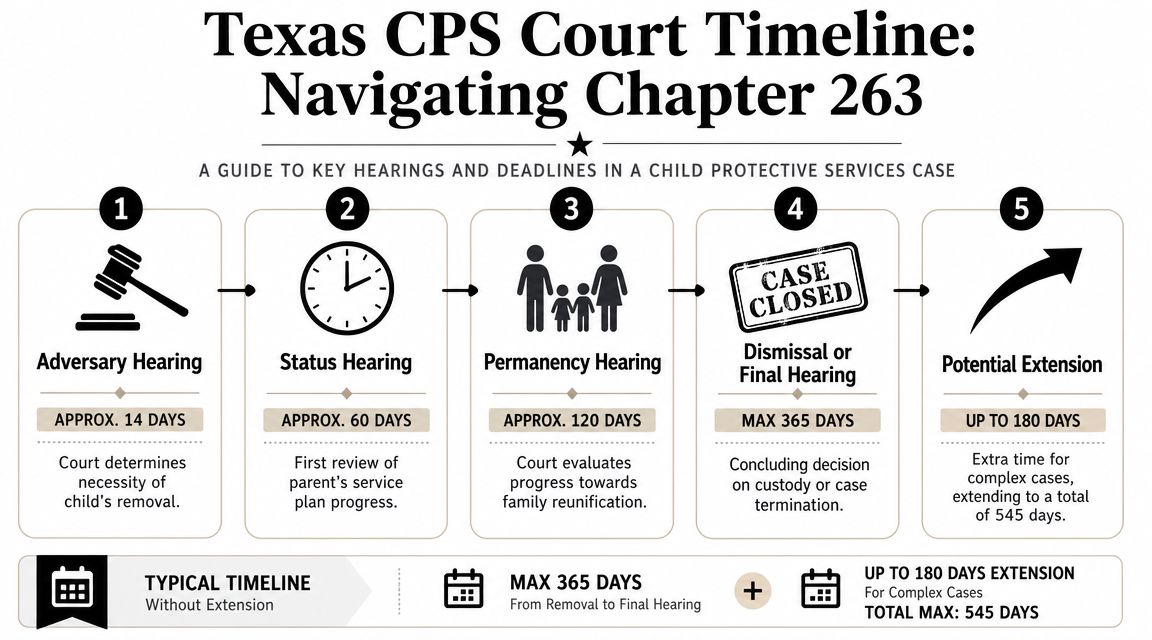
Benchmark timelines in Texas show that CPS cases are commonly resolved within about 12 months, with a possible 6-month extension, creating a broader 6-to-18-month reunification window tied to how quickly a parent completes services and resolves safety concerns, as outlined in this Texas-focused guide on navigating getting your kids back from CPS.
The hearings that shape your case
Under Chapter 262 and Chapter 263 practice, these hearings matter for different reasons.
| Hearing | What the court is usually focused on | What helps you most |
|---|---|---|
| Adversary hearing | Whether removal should continue | Early evidence, calm testimony, practical safety plan |
| Status hearing | Whether the case is on track and the plan is understood | Starting services fast and raising obstacles early |
| Permanency hearings | Whether reunification progress is real and sustained | Documented compliance and strong visitation history |
| Final hearing | Whether the child can return, the case can close, or rights may be affected | A complete record, stable conditions, no loose ends |
Why timing changes outcomes
Parents often ask why a late start matters so much if they eventually complete everything. The reason is simple. The court doesn't evaluate your case in one final snapshot. It evaluates progress across multiple checkpoints.
If you wait months to begin counseling, testing, or housing repairs, later hearings may show a long period of noncompliance followed by a rush of activity. Judges notice that pattern. So do caseworkers and attorneys ad litem.
By contrast, a parent who starts immediately gives the court a cleaner story. At each hearing, there is something positive to report. That can help with visitation, placement discussions, and trust.
How to prepare for each appearance
Don't treat every hearing the same. Tailor your preparation to the purpose.
- Before early hearings: Gather immediate safety evidence. Think housing, relatives, medical records, and communication history.
- Before status review: Bring proof that services have begun, even if nothing is finished yet.
- Before permanency hearings: Show consistency, not just completion. Regular visits and steady testing matter.
- Before final resolution: Eliminate loose ends. Judges are less comfortable returning children when a parent is “almost done.”
Courts move faster for parents who make the judge's decision easier. Clear records and consistent conduct do that.
Texas Family Code Chapters 263 and 161 come into sharp focus. Chapter 263 drives the review timeline. Chapter 161 becomes critical if the case moves away from reunification and toward termination issues. The faster path is to build a record early enough that the case doesn't drift in that direction.
Common Pitfalls and How an Attorney Can Help
A CPS case often slows down for a reason that does not feel important in the moment. A parent misses one visit because work ran late. A counselor cancels and nobody follows up. A frustrated text gets sent at midnight. In court, those scattered moments can be framed as a pattern, and patterns affect how quickly a judge is willing to expand visits, approve placement, or return a child.
That is why small mistakes matter in Texas CPS cases. The legal timeline keeps moving under Chapter 263, whether your paperwork is organized or not. If the record shows delay, confusion, or inconsistent follow-through, the case can drift toward more restrictions and more skepticism. If the record shows prompt action and clean proof, reunification becomes easier to defend at each setting.
Mistakes that slow cases down
Some problems hurt because they suggest risk. Others hurt because they waste time that cannot be recovered before the next hearing.
Common examples include:
- Missing visits or arriving late: Courts look closely at contact with your child. Missed visits can be used to argue that the bond is weak or that reunification should wait.
- Starting services late: A parent who waits to enroll gives CPS less progress to report before the next review date.
- Failing to document obstacles: If a provider never called back, classes were full, or transportation fell through, prove it. Without documentation, the file may only say you did not comply.
- Sending emotional or careless messages: Angry texts, social media posts, and offhand remarks often show up later in reports or testimony.
- Agreeing too quickly: Safety plans, home searches, releases, and placement decisions can have lasting effects. Parents should understand what they are agreeing to before they say yes.
One missed task rarely decides a case by itself. Repeated gaps do.
Rights matter, and strategy matters too
Parents have rights during a CPS investigation, and those rights still matter when pressure is high. As noted in this child welfare investigations and parental rights overview, parents are not required to treat every request as automatic. The Texas question is usually not whether to cooperate at all. A key question is how to cooperate in a way that protects your position and keeps the case moving toward return.
For example, a parent may want to appear cooperative by answering every question on the spot, signing every form, or accepting every accusation without clarification. That approach can create new problems. A better approach is informed cooperation. Provide what is required, correct mistakes early, and get advice before making decisions that affect placement, testing, or admissions.
How an attorney helps speed up the case
A lawyer can do more than appear at hearings. Good counsel helps shape the record between hearings, which is often where time is won or lost.
That may include reviewing the service plan line by line, pressing CPS to make referrals promptly, documenting failed provider communication, preparing you for testimony, objecting when requests go too far, and organizing proof in a form the court can use. If a problem is slowing your case, the right response is usually not just "work harder." It is to identify what the judge and CPS need to see next, then build that proof on purpose.
I often tell parents this: the system moves faster when your file is easy to understand. Judges do not have time to guess whether you are making progress. They look for records, dates, certificates, test results, visit logs, housing proof, and credible explanations for any gap.
One available option for Texas parents is the Law Office of Bryan Fagan PLLC, which handles CPS and related family law matters.
Legal help cannot erase every delay. It can prevent avoidable ones, protect your rights, and keep temporary setbacks from becoming the story of the case.
Frequently Asked Questions in Texas CPS Cases
Can I refuse a drug test from CPS
That depends on the stage of the case and whether a court order is involved. Refusing may be legally possible in some situations, but it can still create serious practical consequences in your CPS case. Before you refuse, get legal advice about how that choice is likely to be framed by CPS and the court.
What if the allegations are false
False allegations do happen. But in a CPS case, saying “that's a lie” is only the starting point. You still need evidence that supports your position. Gather messages, medical records, school records, witness names, and anything else that helps your lawyer challenge the claim with specifics rather than general denials.
If an allegation is false, respond with records, witnesses, and consistency. Outrage alone rarely changes the court file.
Will my child have to testify
Not always. Many CPS cases are built through reports, provider testimony, caseworker testimony, records, and statements introduced through the legal process. Whether a child will testify depends on the facts, the child's age, the court's rulings, and how the attorneys approach the evidence.
What if I have a criminal record
A prior record doesn't automatically end your case. The court usually cares most about whether the past issue connects to current safety concerns and whether your present circumstances show stability. Old conduct and current risk are not the same thing. Your lawyer's job is to keep that distinction clear.
Can I get my child back before every service is complete
Sometimes, yes. In some cases, the court may consider increased visitation, monitored return, or a trial placement before every line item is fully closed out. That usually depends on whether the core safety concerns have been addressed in a credible, documented way.
What should I bring to court
Bring identification, copies of service records, clean test results, proof of housing and employment, a notebook, and a written timeline of your compliance. Dress neatly, arrive early, and be ready to answer short questions directly. Judges often notice preparation long before anyone speaks.
What is the fastest mindset to have in a CPS case
Treat the case like a deadline-driven legal process, not a misunderstanding that will sort itself out. Parents who move fastest usually do three things well. They start early, stay organized, and make it easy for the court to see progress.
If your family is in the middle of a CPS case, you don't have to guess your way through it. A focused legal strategy can help you avoid delays, protect your rights, and show the court the progress that matters most. Contact Law Office of Bryan Fagan PLLC for a free consultation and talk through the facts of your case, the deadlines you're facing, and the clearest path toward getting your child back.